Sulphur in the air as Rabaul
pp. 21-22 · Read in the full issue
waits for the big blow
The acid, acrid smell of sulphur is strong over Rabaul these days as the city of 20,000 souls waits, tensely, for a volcanic eruption scientists say is imminent and which could be at least as bad as the 1937 explosions which killed more than 500.
Aircraft leaving the town are now full, and arrivals are dwindling. It is becom ing more difficult to find a place on one of the coastal barges by which local peo ple get around the region.
People are heeding the warning of the Chief Gov ernment Vulcanologist, Dr Peter Lowenstein, and are either moving out, or pre paring to do so.
Rabaul, crouched in the grip of five volcanoes for ming Simpson and Matupi Harbors on the island of New Britain, in Papua New Guinea is now on Stage Two alert, which means the eruption is expected within months to weeks. Soon, however, if the scientists now constantly and anx iously monitoring the im mense natural bombs now ticking away around Rabaul are correct, they will call Stage Three and expect the big bang within weeks or perhaps days.
Stage Four will mean com pulsory, and prompt, evacuation ... if, by then, there is time, and means.
Experts from Australia were sent up to Rabaul within days of Dr Lowen stein’s report being made public to help plan for an evacuation should it be ordered.
There is no panic in Rabaul. The place is accus tomed to earthquakes and they come so frequently locals no longer notice them. But apprehension is in the air, and a bit of bravado with it as men hang on, having sent their women and children out to safety.
Rabaul has always been a dangerous place to live.
Almost everyone wonders why it was built there, sit ting, literally, on top of a
seething caldera, sur rounded by its necklace of volcanoes, any of which is capable of catastrophic eruption.
The tallest of the volca noes, believed to be ex tinct, is the “Mother”. On her left flank stands Raba lankaia, a relatively small crater, still very much alive and regarded as a prime suspect in the cur rent emergency.
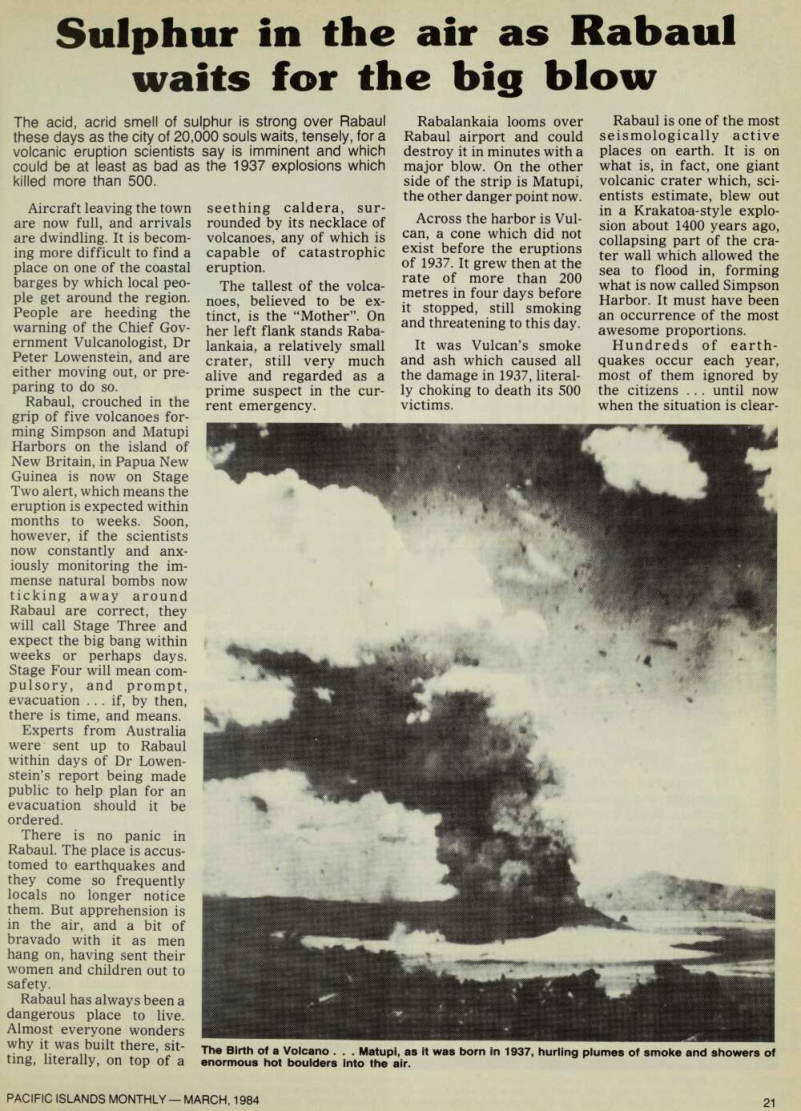
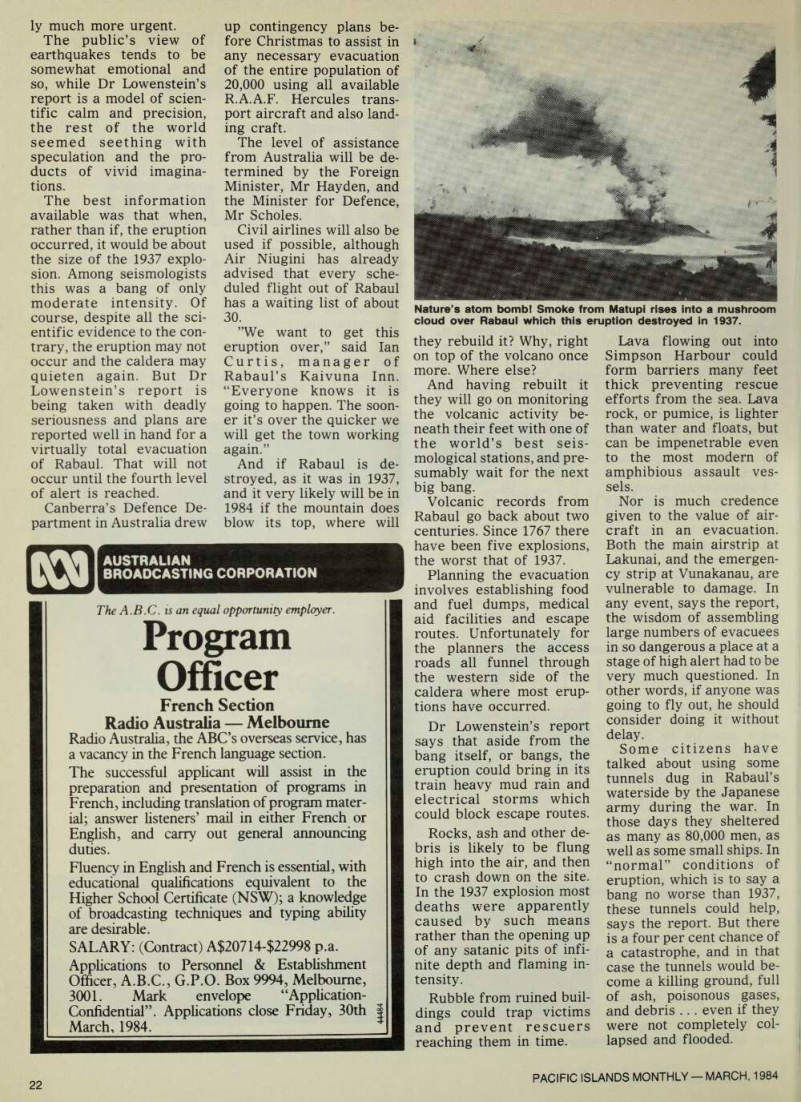
Rabalankaia looms over Rabaul airport and could destroy it in minutes with a major blow. On the other side of the strip is Matupi, the other danger point now.
Across the harbor is Vul can, a cone which did not exist before the eruptions of 1937. It grew then at the rate of more than 200 metres in four days before it stopped, still smoking and threatening to this day.
It was Vulcan’s smoke and ash which caused all the damage in 1937, literal ly choking to death its 500 victims.
Rabaul is one of the most seismologically active places on earth. It is on what is, in fact, one giant volcanic crater which, sci entists estimate, blew out in a Krakatoa-style explo sion about 1400 years ago, collapsing part of the cra ter wall which allowed the sea to flood in, forming what is now called Simpson Harbor. It must have been an occurrence of the most awesome proportions.
Hundreds of earth quakes occur each year, most of them ignored by the citizens ... until now when the situation is clear-
The Birth of a Volcano . . . Matupi, as it was born in 1937, hurling plumes of smoke and showers of enormous hot boulders into the air.
ly much more urgent.
The public’s view of earthquakes tends to be somewhat emotional and so, while Dr Lowenstein’s report is a model of scien tific calm and precision, the rest of the world seemed seething with speculation and the pro ducts of vivid imagina tions.
The best information available was that when, rather than if, the eruption occurred, it would be about the size of the 1937 explo sion. Among seismologists this was a bang of only moderate intensity. Of course, despite all the sci entific evidence to the con trary, the eruption may not occur and the caldera may quieten again. But Dr Lowenstein’s report is being taken with deadly seriousness and plans are reported well in hand for a virtually total evacuation of Rabaul. That will not occur until the fourth level of alert is reached.
Canberra’s Defence De partment in Australia drew
up contingency plans be fore Christmas to assist in any necessary evacuation of the entire population of 20,000 using all available R.A.A.F. Hercules trans port aircraft and also land ing craft.
The level of assistance from Australia will be de termined by the Foreign Minister, Mr Hayden, and the Minister for Defence, Mr Scholes.
Civil airlines will also be used if possible, although Air Niugini has already advised that every sche duled flight out of Rabaul has a waiting list of about 30. ”We want to get this eruption over,” said lan Curtis, manager of Rabaul’s Kaivuna Inn.
“Everyone knows it is going to happen. The soon er it’s over the quicker we will get the town working again.”
And if Rabaul is de stroyed, as it was in 1937, and it very likely will be in 1984 if the mountain does blow its top, where will
they rebuild it? Why, right on top of the volcano once more. Where else?
And having rebuilt it they will go on monitoring the volcanic activity be neath their feet with one of the world’s best seis mological stations, and pre sumably wait for the next big bang.
Volcanic records from Rabaul go back about two centuries. Since 1767 there have been five explosions, the worst that of 1937.
Planning the evacuation involves establishing food and fuel dumps, medical aid facilities and escape routes. Unfortunately for the planners the access roads all funnel through the western side of the caldera where most erup tions have occurred.
Dr Lowenstein’s report says that aside from the bang itself, or bangs, the eruption could bring in its train heavy mud rain and electrical storms which could block escape routes.
Rocks, ash and other de bris is likely to be flung high into the air, and then to crash down on the site.
In the 1937 explosion most deaths were apparently caused by such means rather than the opening up of any satanic pits of infi nite depth and flaming in tensity.
Rubble from ruined buil dings could trap victims and prevent rescuers reaching them in time.
Lava flowing out into Simpson Harbour could form barriers many feet thick preventing rescue efforts from the sea. Lava rock, or pumice, is lighter than water and floats, but can be impenetrable even to the most modern of amphibious assault ves sels.
Nor is much credence given to the value of air craft in an evacuation.
Both the main airstrip at Lakunai, and the emergen cy strip at Vunakanau, are vulnerable to damage. In any event, says the report, the wisdom of assembling large numbers of evacuees in so dangerous a place at a stage of high alert had to be very much questioned. In other words, if anyone was going to fly out, he should consider doing it without delay.
Some citizens have talked about using some tunnels dug in Rabaul’s waterside by the Japanese army during the war. In those days they sheltered as many as 80,000 men, as well as some small ships. In “normal” conditions of eruption, which is to say a bang no worse than 1937, these tunnels could help, says the report. But there is a four per cent chance of a catastrophe, and in that case the tunnels would be come a killing ground, full of ash, poisonous gases, and debris ... even if they were not completely col lapsed and flooded.
Nature’s atom bomb! Smoke from Matupi rises into a mushroom cloud over Rabaul which this eruption destroyed in 1937.