People
p. 19 · Read in the full issue
The question has probably niggl
ed at the edges of the mind of plenty of PIM readers, when they’ve seen the name of the
magazine’s Pago-based con
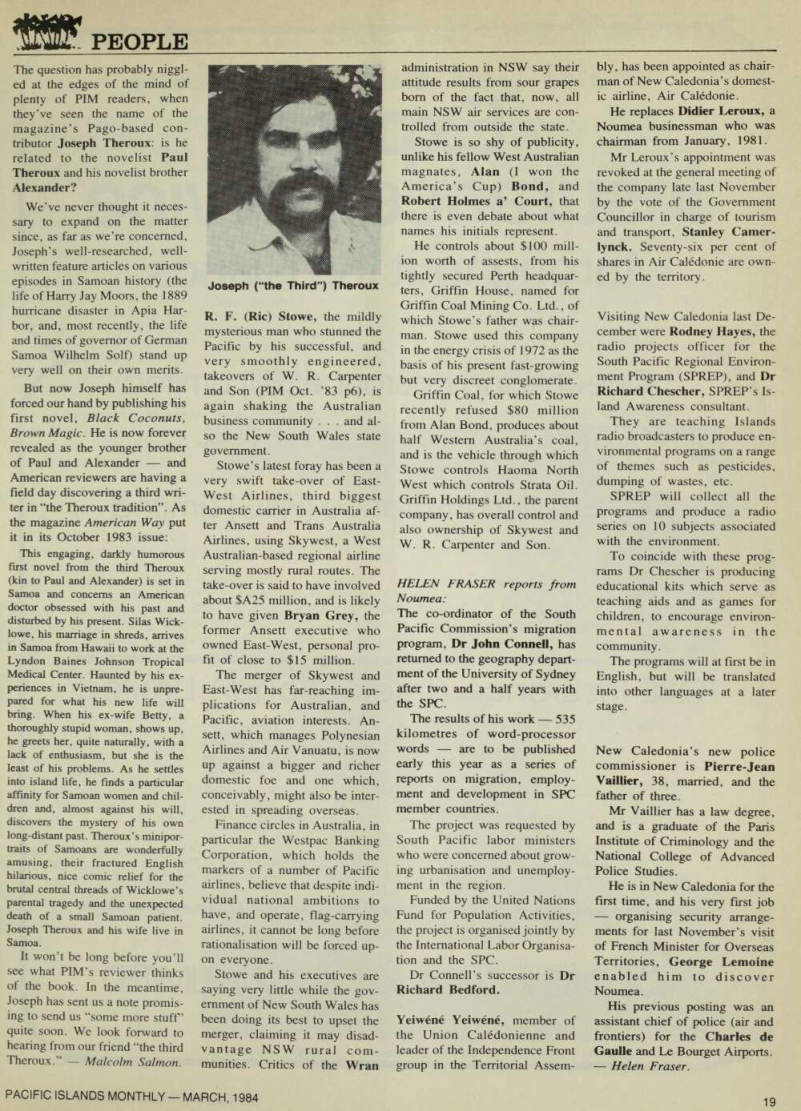
tributor Joseph Theroux; is he related to the novelist Paul Theroux and his novelist brother Alexander?
We’ve never thought it neces sary to expand on the matter since, as far as we’re concerned, Joseph’s well-researched, well written feature articles on various episodes in Samoan history (the life of Harry Jay Moors, the 1889 hurricane disaster in Apia Har bor, and, most recently, the life and times of governor of German Samoa Wilhelm Solf) stand up very well on their own merits.
But now Joseph himself has forced our hand by publishing his first novel, Black Coconuts, Brown Magic. He is now forever revealed as the younger brother of Paul and Alexander and American reviewers are having a field day discovering a third wri ter in “the Theroux tradition”. As the magazine American Way put it in its October 1983 issue; This engaging, darkly humorous first novel from the third Theroux (kin to Paul and Alexander) is set in Samoa and concerns an American doctor obsessed with his past and disturbed by his present. Silas Wick lowe, his marriage in shreds, arrives in Samoa from Hawaii to work at the Lyndon Baines Johnson Tropical Medical Center. Haunted by his ex periences in Vietnam, he is unpre pared for what his new life will bring. When his ex-wife Betty, a thoroughly stupid woman, shows up, he greets her, quite naturally, with a lack of enthusiasm, but she is the least of his problems. As he settles into island life, he finds a particular affinity for Samoan women and chil dren and, almost against his will, discovers the mystery of his own long-distant past. Theroux’s minipor traits of Samoans are wonderfully amusing, their fractured English hilarious, nice comic relief for the brutal central threads of Wicklowe’s parental tragedy and the unexpected death of a small Samoan patient.
Joseph Theroux and his wife live in Samoa.
It won’t be long before you’ll see what PlM’s reviewer thinks of the book. In the meantime, Joseph has sent us a note promis ing to send us “some more stuff’ quite soon. We look forward to hearing from our friend “the third
Theroux.”
Malcolm Salmon.
R. F. (Ric) Stowe, the mildly mysterious man who stunned the Pacific by his successful, and very smoothly engineered, takeovers of W. R. Carpenter and Son (PIM Oct. ’B3 p 6), is again shaking the Australian business community . . . and al so the New South Wales state government.
Stowe’s latest foray has been a very swift take-over of East- West Airlines, third biggest domestic carrier in Australia af ter Ansett and Trans Australia Airlines, using Skywest, a West Australian-based regional airline serving mostly rural routes. The take-over is said to have involved about SA2S million, and is likely to have given Bryan Grey, the former Ansett executive who owned East-West, personal pro fit of close to $l5 million.
The merger of Skywest and East-West has far-reaching im plications for Australian, and Pacific, aviation interests. An sett, which manages Polynesian Airlines and Air Vanuatu, is now up against a bigger and richer domestic foe and one which, conceivably, might also be inter ested in spreading overseas.
Finance circles in Australia, in particular the Westpac Banking Corporation, which holds the markers of a number of Pacific airlines, believe that despite indi vidual national ambitions to have, and operate, flag-carrying airlines, it cannot be long before rationalisation will be forced up on everyone.
Stowe and his executives are saying very little while the gov ernment of New South Wales has been doing its best to upset the merger, claiming it may disad vantage NSW rural com munities. Critics of the Wran
administration in NSW say their attitude results from sour grapes bom of the fact that, now, all main NSW air services are con trolled from outside the state.
Stowe is so shy of publicity, unlike his fellow West Australian magnates, Alan (I won the America’s Cup) Bond, and Robert Holmes a’ Court, that there is even debate about what names his initials represent.
He controls about $lOO mill ion worth of assests, from his tightly secured Perth headquar ters, Griffin House, named for Griffin Coal Mining Co. Ltd., of which Stowe’s father was chair man. Stowe used this company in the energy crisis of 1972 as the basis of his present fast-growing but very discreet conglomerate.
Griffin Coal, for which Stowe recently refused $BO million from Alan Bond, produces about half Western Australia’s coal, and is the vehicle through which Stowe controls Haoma North West which controls Strata Oil.
Griffin Holdings Ltd., the parent company, has overall control and also ownership of Skywest and W. R. Carpenter and Son.
HELEN FRASER reports from Noumea: The co-ordinator of the South Pacific Commission’s migration program. Dr John Connell, has returned to the geography depart ment of the University of Sydney after two and a half years with the SPC.
The results of his work 535 kilometres of word-processor words are to be published early this year as a series of reports on migration, employ ment and development in SPC member countries.
The project was requested by South Pacific labor ministers who were concerned about grow ing urbanisation and unemploy ment in the region.
Funded by the United Nations Fund for Population Activities, the project is organised jointly by the International Labor Organisa tion and the SPC.
Dr Connell’s successor is Dr Richard Bedford.
Yeiwene Yeiwene, member of the Union Caledonienne and leader of the Independence Front group in the Territorial Assem
bly, has been appointed as chair man of New Caledonia’s domest ic airline. Air Caledonie.
He replaces Didier Leroux, a Noumea businessman who was chairman from January, 1981.
Mr Leroux’s appointment was revoked at the general meeting of the company late last November by the vote of the Government Councillor in charge of tourism and transport, Stanley Camer lynck. Seventy-six per cent of shares in Air Caledonie are own
ed by the territory.
Visiting New Caledonia last De cember were Rodney Hayes, the radio projects officer for the South Pacific Regional Environ ment Program (SPREP), and Dr Richard Chescher, SPREP’s Is land Awareness consultant.
They are teaching Islands
radio broadcasters to produce en vironmental programs on a range of themes such as pesticides, dumping of wastes, etc.
SPREP will collect all the programs and produce a radio series on 10 subjects associated with the environment.
To coincide with these prog rams Dr Chescher is producing educational kits which serve as teaching aids and as games for children, to encourage environ mental awareness in the
community.
The programs will at first be in English, but will be translated into other languages at a later stage.
New Caledonia’s new police commissioner is Pierre-Jean Vaillier, 38, married, and the father of three.
Mr Vaillier has a law degree, and is a graduate of the Paris Institute of Criminology and the National College of Advanced Police Studies.
He is in New Caledonia for the first time, and his very first job
organising security arrange
ments for last November’s visit of French Minister for Overseas Territories, George Lemoine enabled him to discover Noumea.
His previous posting was an assistant chief of police (air and frontiers) for the Charles de Gaulle and Le Bourget Airports.
Helen Fraser.
Joseph (“the Third”) Theroux