Grasping the
p. 18 · Read in the full issue
Letters
Grasping the significance of Samoa
The letter (PIM Jan p 9) by Grant McCall, who is an associate pro fessor in the school of sociology of the University of New South Wales, is an outlandish product.
Dedicated to the great philosopher of science Sir Karl Popper, my book Margaret Mead and Samoa: The Making and Unmaking of an An
thropological Myth is an applica
tion to Mead’s romantic writings on Samoa of Popper’s fundamen tal principle that science progres ses by the elimination of error from its formulations. The need for this elimination of error in the case of Samoan studies is strik ingly demonstrated in Falani Pe ters’ poignant letter (PIM Jan p 9) in which she recounts the deplor able treatment meted out to her by her woefully ignorant social psychology lecturer in an Ameri
can university.
It is only by securing exact
knowledge about the problems that face human beings that we have any prospect of genuine solutions, and to suppose, as does Associate Professor McCall, that the recognition of an undesirable state of affairs is in any sense to condone this state is a quite elementary logical error.
The information in my book about unlawful behavior in Samoa is, for the most part, drawn from court records, and is, therefore public knowledge. As I emphasise in my book, the Sa moans are, first and foremost, a Christian people, and, this being so, the great majority of them have the capacity to face the facts about such unlawful behaviour as exists in Samoa without anger or fear, and with a determination to see that it is lessened as far as
may be humanly possible.
Moreover, it is in the open sided council houses of Samoa that this capacity is most con
spicuously displayed. There is,
of course, no “genetic message” written on the “open walls” of these houses as McCall suggests in his egregious letter. Rather
they are symbols of the “shining
virtues” of the Samoans to
which I refer on p 278 and elsewhere in my book. Samoa is no paradise, but it is, very defi nitely, a place of immense hu man worth.
Indeed, it is my hope, as the academic pro-chancellor of the University of Samoa, that as authentic Samoan studies develop it will be possible to communicate to the outside world, many of the humanly valuable aspects of Samoan cul ture. As, for example, the dig nified politeness, or amio fa’aaloalo of Samoa; the practice of tapua'i, or the formal offering of sympathy to those in misfor tune or distress; the enlightened way in which Samoa deals with convicted criminals; and, perhaps most importantly of all, the techniques in which the Sa moans are expert for achieving when necessary, a fa’aleleiga, or reconciliation between warring social factions.
It is thus very much my view that although Samoa is a small country it has great significance for the world at large, and that Samoan studies as they develop, will contribute importantly to hu man studies in general, and to our understanding of what it means to be human.
Derek Freeman
Australian National University Canberra. A.C.T.
Australia.
All Called
Together
In his column, “A View from Honolulu” in your December, 1983 issue, Robert C. Kiste repeats a “Washington Pacific Report” story that Senate Energy and Natural Re sources Committee Chairman James McClure has requested a comprehen sive General Accounting Office study of federal policy toward United States territories.
While that is true, I must point out for the record that the request was conceived of and developed by both Senator McClure’s committee and the House Committee on Interior and Insular Affairs and a companion re quest for the study was made by House Committee Chairman Morris Udall.
Antonio Won Pat
Washington, D.C. USA Congressman Won Pat, of Guam, is chairman of the Subcommittee on Insular Affairs at the U.S. House of Representatives.
Remembering
Rennell
I greatly enjoyed the fine article on Rennell Island in the October issue of PIM. It gave me an excellent picture of life on this unique Polynesian outer island of the Solomons, as it is today and perhaps forever was and will be.
During the Guadalcanal phase
of World War II in 1942, Rennell figured in our fantasies if not in our combat operations. It seems that a Navy PBY Catalina flying
boat landed on Rennell’s Lake Tegano to fix some minor engine
problem. The reception by the
Polynesians was warm and the young ladies were so friendly that it took three days to repair the PBY’s engine.
Word got around, of course, and one day while our Army B -17 Flying Fortress was on a routine search mission west out of Espiritu Santo, we detoured over to Rennell for a good look.
There on Lake Tegano was yet another PBY, no doubt with another engine problem! Our B -17 crew vowed that if we ever got in trouble in that part of the Coral Sea, somehow we’d man age to ditch your plane on Lake
Tegano!
I certainly enjoy your fine
magazine.
808 Berger
Harbor Springs, Michigan, 49740,
Usa.
South Pacific Island Airways (SPIA) has appointed Charles E.
Phelan area manager for the Samoas.
Mr Phelan will be responsible for all of SPIA’s activities within the Samoan region, including operations to the outer islands of Tau and Ofu and the main island of Tutuila in American Samoa, as well as Apia and Faleolo airport in Western Samoa.
SPIA operates trans-Pacific jet ser vices as well as original inter-island flights from their Pago Pago hub.
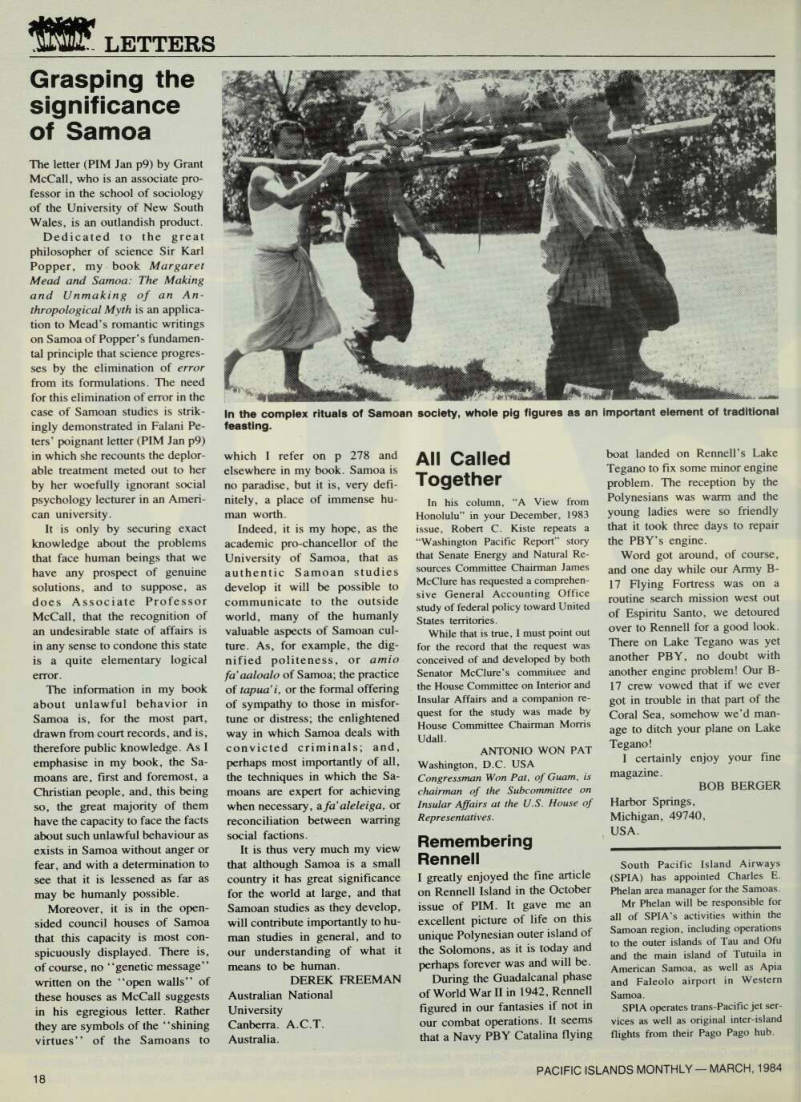
In the complex rituals of Samoan society, whole pig figures as an important element of traditional feasting.