Queen Emma
pp. 51-54 · Read in the full issue
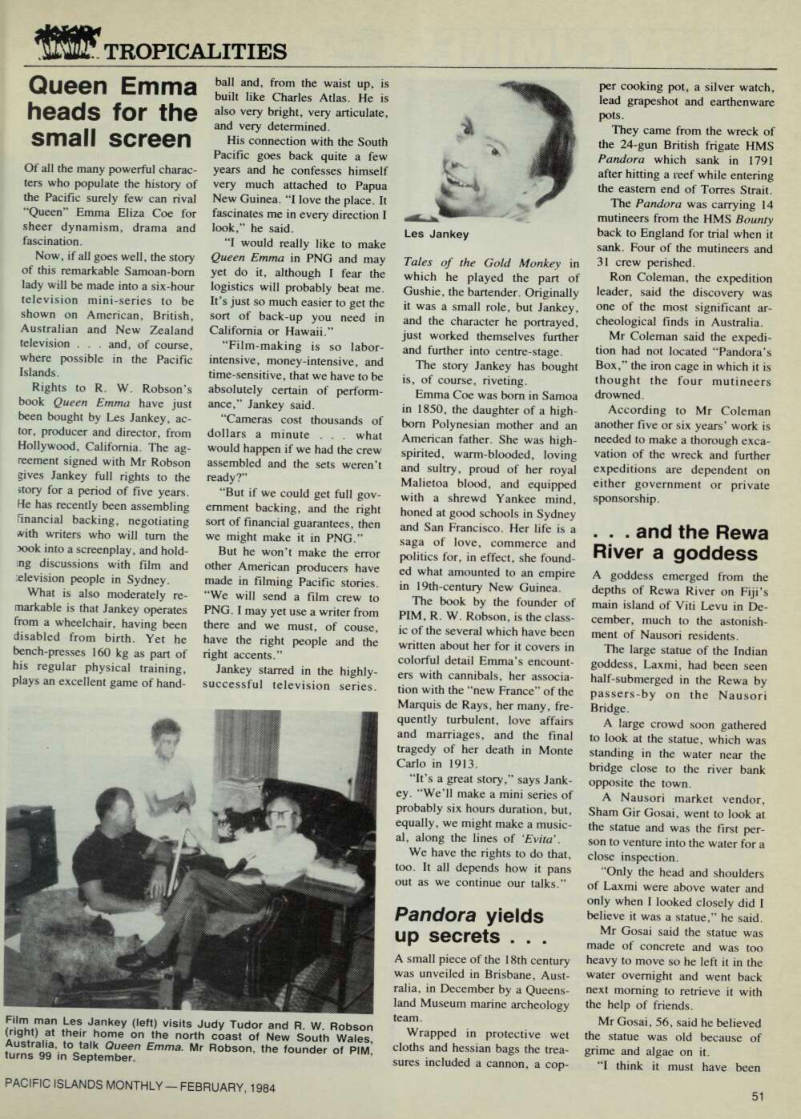
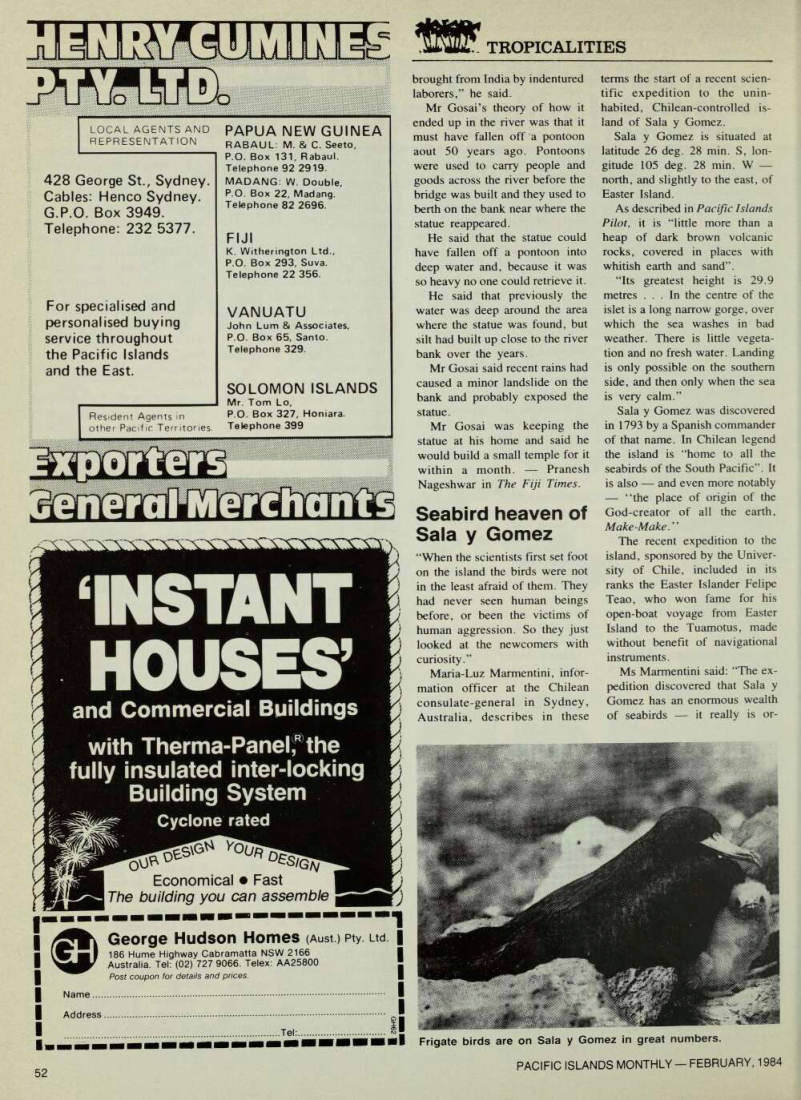
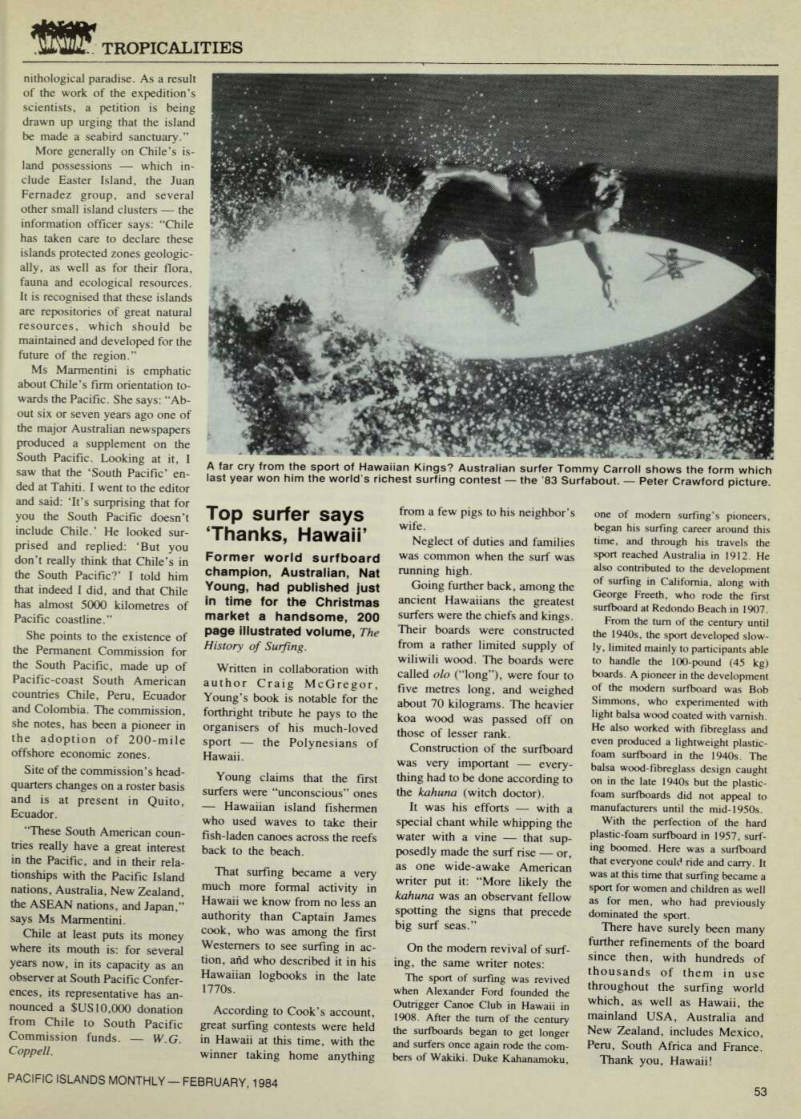
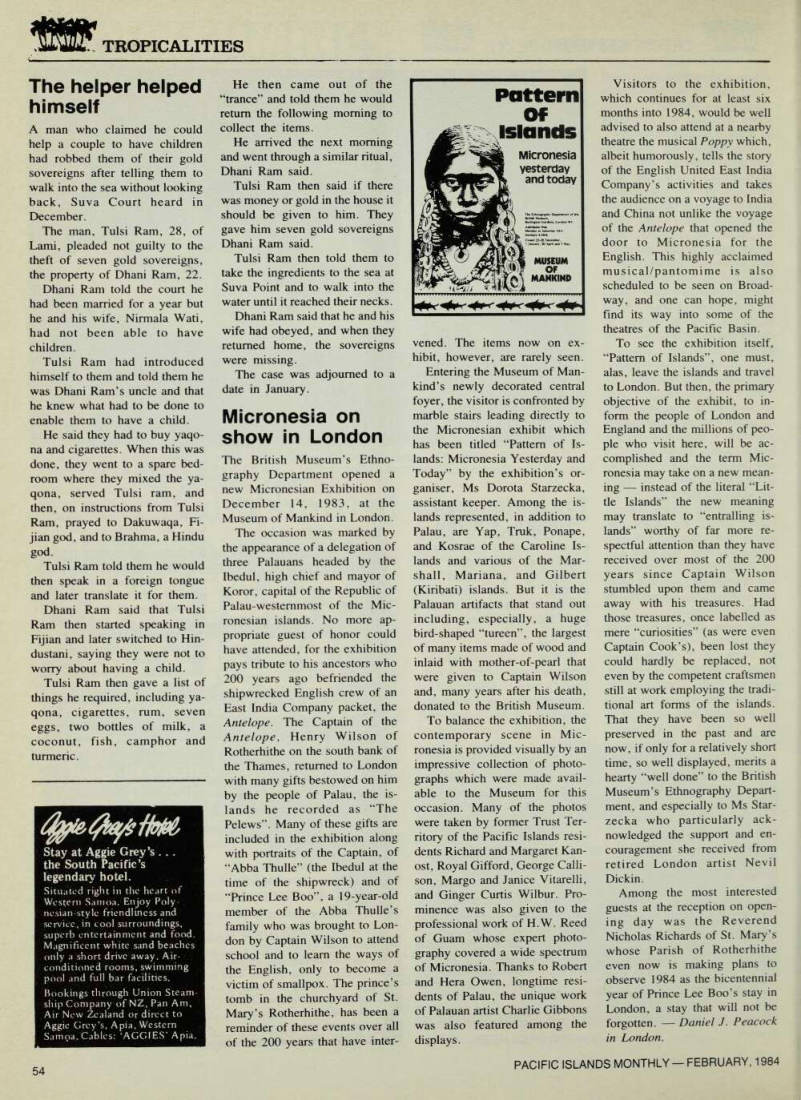
Tropicalities
Queen Emma heads for the small screen
Of all the many powerful charac ters who populate the history of the Pacific surely few can rival “Queen” Emma Eliza Coe for sheer dynamism, drama and fascination.
Now, if all goes well, the story of this remarkable Samoan-bom lady will be made into a six-hour television mini-series to be shown on American, British, Australian and New Zealand television . . . and, of course, where possible in the Pacific Islands.
Rights to R. W. Robson’s book Queen Emma have just been bought by Les Jankey, ac tor, producer and director, from Hollywood, California. The ag reement signed with Mr Robson gives Jankey full rights to the story for a period of five years.
He has recently been assembling financial backing, negotiating with writers who will turn the x>ok into a screenplay, and hold ing discussions with film and ;elevision people in Sydney.
What is also moderately re markable is that Jankey operates from a wheelchair, having been disabled from birth. Yet he bench-presses 160 kg as part of his regular physical training, plays an excellent game of hand
ball and, from the waist up, is built like Charles Atlas. He is also very bright, very articulate, and very determined.
His connection with the South Pacific goes back quite a few years and he confesses himself very much attached to Papua New Guinea. “I love the place. It fascinates me in every direction I look,” he said.
“I would really like to make Queen Emma in PNG and may yet do it, although I fear the logistics will probably beat me.
It’s just so much easier to get the sort of back-up you need in California or Hawaii.”
“Film-making is so labor intensive, money-intensive, and time-sensitive, that we have to be absolutely certain of perform ance,” Jankey said.
“Cameras cost thousands of dollars a minute . . . what would happen if we had the crew assembled and the sets weren’t ready?”
“But if we could get full gov ernment backing, and the right sort of financial guarantees, then we might make it in PNG.”
But he won’t make the error other American producers have made in filming Pacific stories.
“We will send a film crew to PNG. I may yet use a writer from there and we must, of couse, have the right people and the right accents.”
Jankey starred in the highly successful television series.
Tales of the Gold Monkey in which he played the part of Gushie, the bartender. Originally it was a small role, but Jankey, and the character he portrayed, just worked themselves further and further into centre-stage.
The story Jankey has bought is, of course, riveting.
Emma Coe was bom in Samoa in 1850, the daughter of a high born Polynesian mother and an American father. She was high spirited, warm-blooded, loving and sultry, proud of her royal Malietoa blood, and equipped with a shrewd Yankee mind, honed at good schools in Sydney and San Francisco. Her life is a saga of love, commerce and politics for, in effect, she found ed what amounted to an empire in 19th-century New Guinea.
The book by the founder of PIM, R. W. Robson, is the class ic of the several which have been written about her for it covers in colorful detail Emma’s encount ers with cannibals, her associa tion with the “new France” of the Marquis de Rays, her many, fre quently turbulent, love affairs and marriages, and the final tragedy of her death in Monte Carlo in 1913.
“It’s a great story,” says Jank ey. “We’ll make a mini series of probably six hours duration, but, equally, we might make a music al, along the lines of ‘Evita’.
We have the rights to do that, too. It all depends how it pans out as we continue our talks.”
Pandora yields
up secrets . . .
A small piece of the 18th century was unveiled in Brisbane, Aust ralia, in December by a Queens land Museum marine archeology team.
Wrapped in protective wet cloths and hessian bags the trea sures included a cannon, a cop
per cooking pot, a silver watch, lead grapeshot and earthenware pots.
They came from the wreck of the 24-gun British frigate HMS Pandora which sank in 1791 after hitting a reef while entering the eastern end of Torres Strait.
The Pandora was carrying 14 mutineers from the HMS Bounty back to England for trial when it sank. Four of the mutineers and 31 crew perished.
Ron Coleman, the expedition leader, said the discovery was one of the most significant ar cheological finds in Australia.
Mr Coleman said the expedi tion had not located “Pandora’s Box,” the iron cage in which it is thought the four mutineers drowned.
According to Mr Coleman another five or six years’ work is needed to make a thorough exca vation of the wreck and further
expeditions are dependent on
either government or private
sponsorship.
. . . and the Rewa
River a goddess
A goddess emerged from the depths of Rewa River on Fiji’s main island of Viti Levu in De cember, much to the astonish ment of Nausori residents.
The large statue of the Indian goddess, Laxmi, had been seen half-submerged in the Rewa by passers-by on the Nausori
Bridge.
A large crowd soon gathered to look at the statue, which was standing in the water near the bridge close to the river bank opposite the town.
A Nausori market vendor, Sham Gir Gosai, went to look at the statue and was the first per son to venture into the water for a
close inspection.
“Only the head and shoulders of Laxmi were above water and only when I looked closely did I believe it was a statue,” he said.
Mr Gosai said the statue was made of concrete and was too heavy to move so he left it in the water overnight and went back next morning to retrieve it with the help of friends.
Mr Gosai, 56, said he believed the statue was old because of grime and algae on it.
“I think it must have been
Film man Les Jankey (left) Visits Judy Tudor and R. W. Robson (right) at their home on the north coast of New South Wales, Australia, to talk Queen Emma. Mr Robson, the founder of PIM, turns 99 in September.
Les Jankey
brought from India by indentured laborers,” he said.
Mr Gosai’s theory of how it ended up in the river was that it must have fallen off a pontoon aout 50 years ago. Pontoons were used to carry people and goods across the river before the bridge was built and they used to berth on the bank near where the
statue reappeared.
He said that the statue could have fallen off a pontoon into deep water and, because it was so heavy no one could retrieve it.
He said that previously the water was deep around the area where the statue was found, but silt had built up close to the river bank over the years.
Mr Gosai said recent rains had caused a minor landslide on the bank and probably exposed the statue.
Mr Gosai was keeping the statue at his home and said he would build a small temple for it within a month. Pranesh Nageshwar in The Fiji Times.
Seabird heaven of
Sala y Gomez
“When the scientists first set foot on the island the birds were not in the least afraid of them. They had never seen human beings before, or been the victims of
human aggression. So they just
looked at the newcomers with
curiosity.”
Maria-Luz Marmentini, infor mation officer at the Chilean
consulate-general in Sydney,
Australia, describes in these
terms the start of a recent scien tific expedition to the unin habited, Chilean-controlled is land of Sala y Gomez.
Sala y Gomez is situated at latitude 26 deg. 28 min. S, lon gitude 105 deg. 28 min. W north, and slightly to the east, of Easter Island.
As described in Pacific Islands Pilot, it is “little more than a heap of dark brown volcanic rocks, covered in places with whitish earth and sand”.
“Its greatest height is 29.9 metres ... In the centre of the islet is a long narrow gorge, over which the sea washes in bad weather. There is little vegeta tion and no fresh water. Landing is only possible on the southern side, and then only when the sea is very calm.”
Sala y Gomez was discovered in 1793 by a Spanish commander of that name. In Chilean legend the island is “home to all the seabirds of the South Pacific”. It is also and even more notably “the place of origin of the God-creator of all the earth.
Make-Make .”
The recent expedition to the island, sponsored by the Univer sity of Chile, included in its ranks the Easter Islander Felipe Teao, who won fame for his open-boat voyage from Easter Island to the Tuamotus, made without benefit of navigational instruments.
Ms Marmentini said: “The ex pedition discovered that Sala y Gomez has an enormous wealth of seabirds it really is or-
Frigate birds are on Sala y Gomez in great numbers.
nithological paradise. As a result of the work of the expedition’s scientists, a petition is being drawn up urging that the island be made a seabird sanctuary.”
More generally on Chile’s is land possessions which in clude Easter Island, the Juan Fernadez group, and several other small island clusters the information officer says: “Chile has taken care to declare these islands protected zones geologic ally, as well as for their flora, fauna and ecological resources.
It is recognised that these islands are repositories of great natural resources, which should be maintained and developed for the future of the region.”
Ms Marmentini is emphatic about Chile’s firm orientation to wards the Pacific. She says: “Ab out six or seven years ago one of the major Australian newspapers produced a supplement on the South Pacific. Looking at it, I saw that the ‘South Pacific’ en ded at Tahiti. I went to the editor and said: ‘lt’s surprising that for you the South Pacific doesn’t include Chile.’ He looked sur prised and replied: ‘But you don’t really think that Chile’s in the South Pacific?’ I told him that indeed I did, and that Chile has almost 5000 kilometres of Pacific coastline.”
She points to the existence of the Permanent Commission for the South Pacific, made up of Pacific-coast South American countries Chile, Peru, Ecuador and Colombia. The commission, she notes, has been a pioneer in the adoption of 200-mile offshore economic zones.
Site of the commission’s head quarters changes on a roster basis and is at present in Quito, Ecuador.
“These South American coun tries really have a great interest in the Pacific, and in their rela tionships with the Pacific Island nations, Australia, New Zealand, the ASEAN nations, and Japan,” says Ms Marmentini.
Chile at least puts its money where its mouth is: for several years now, in its capacity as an observer at South Pacific Confer ences, its representative has an nounced a SUS 10,000 donation from Chile to South Pacific Commission funds. W.G.
Coppell.
Top surfer says
‘Thanks, Hawaii’
Former world surfboard champion, Australian, Nat Young, had published just in time for the Christmas market a handsome, 200 page illustrated volume, The History of Surfing.
Written in collaboration with author Craig McGregor, Young’s book is notable for the forthright tribute he pays to the organisers of his much-loved sport the Polynesians of Hawaii.
Young claims that the first surfers were “unconscious” ones Hawaiian island fishermen who used waves to take their fish-laden canoes across the reefs back to the beach.
That surfing became a very much more formal activity in Hawaii we know from no less an authority than Captain James cook, who was among the first Westerners to see surfing in ac tion, and who described it in his Hawaiian logbooks in the late 17705.
According to Cook’s account, great surfing contests were held in Hawaii at this time, with the winner taking home anything
from a few pigs to his neighbor’s wife.
Neglect of duties and families was common when the surf was running high.
Going further back, among the ancient Hawaiians the greatest surfers were the chiefs and kings.
Their boards were constructed from a rather limited supply of wiliwili wood. The boards were called 010 (“long”), were four to five metres long, and weighed about 70 kilograms. The heavier koa wood was passed off on those of lesser rank.
Construction of the surfboard was very important every thing had to be done according to the kahuna (witch doctor).
It was his efforts with a special chant while whipping the water with a vine that sup posedly made the surf rise or, as one wide-awake American writer put it: “More likely the kahuna was an observant fellow spotting the signs that precede big surf seas.”
On the modem revival of surf ing, the same writer notes: The sport of surfing was revived when Alexander Ford founded the Outrigger Canoe Club in Hawaii in 1908. After the turn of the century the surfboards began to get longer and surfers once again rode the com bers of Wakiki. Duke Kahanamoku,
one of modem surfing’s pioneers, began his surfing career around this time, and through his travels the sport reached Australia in 1912. He also contributed to the development of surfing in California, along with George Freeth, who rode the first surfboard at Redondo Beach in 1907.
From the turn of the century until the 19405, the sport developed slow ly, limited mainly to participants able to handle the 100-pound (45 kg) boards. A pioneer in the development of the modem surfboard was Bob Simmons, who experimented with light balsa wood coated with varnish.
He also worked with fibreglass and even produced a lightweight plastic foam surfboard in the 19405. The
balsa wood-fibreglass design caught
on in the late 1940 s but the plastic foam surfboards did not appeal to manufacturers until the mid-19505.
With the perfection of the hard plastic-foam surfboard in 1957, surf ing boomed. Here was a surfboard that everyone could ride and carry. It was at this time that surfing became a sport for women and children as well as for men, who had previously dominated the sport.
There have surely been many further refinements of the board since then, with hundreds of thousands of them in use
throughout the surfing world
which, as well as Hawaii, the mainland USA, Australia and New Zealand, includes Mexico, Peru, South Africa and France.
Thank you, Hawaii!
A far cry from the sport of Hawaiian Kings? Australian surfer Tommy Carroll shows the form which last year won him the world’s richest surfing contest - the ’83 Surfabout. - Peter Crawford picture.
The helper helped
himself
A man who claimed he could help a couple to have children had robbed them of their gold sovereigns after telling them to walk into the sea without looking back, Suva Court heard in December.
The man, Tulsi Ram, 28, of Lami, pleaded not guilty to the theft of seven gold sovereigns, the property of Dhani Ram, 22.
Dhani Ram told the court he had been married for a year but he and his wife, Nirmala Wati, had not been able to have children.
Tulsi Ram had introduced himself to them and told them he was Dhani Ram’s uncle and that he knew what had to be done to enable them to have a child.
He said they had to buy yaqo na and cigarettes. When this was done, they went to a spare bed room where they mixed the ya qona, served Tulsi ram, and then, on instructions from Tulsi Ram, prayed to Dakuwaqa, Fi jian god, and to Brahma, a Hindu
god.
Tulsi Ram told them he would then speak in a foreign tongue and later translate it for them.
Dhani Ram said that Tulsi Ram then started speaking in Fijian and later switched to Hin dustani, saying they were not to worry about having a child.
Tulsi Ram then gave a list of
things he required, including ya
qona, cigarettes, rum, seven eggs, two bottles of milk, a coconut, fish, camphor and turmeric.
He then came out of the “trance” and told them he would return the following morning to collect the items.
He arrived the next morning and went through a similar ritual, Dhani Ram said.
Tulsi Ram then said if there was money or gold in the house it should be given to him. They gave him seven gold sovereigns Dhani Ram said.
Tulsi Ram then told them to take the ingredients to the sea at Suva Point and to walk into the water until it reached their necks.
Dhani Ram said that he and his wife had obeyed, and when they returned home, the sovereigns
were missing.
The case was adjourned to a date in January.
Micronesia on
show in London
The British Museum’s Ethno
graphy Department opened a
new Micronesian Exhibition on December 14, 1983, at the Museum of Mankind in London.
The occasion was marked by the appearance of a delegation of three Palauans headed by the Ibedul, high chief and mayor of Koror, capital of the Republic of Palau-westemmost of the Mic ronesian islands. No more ap propriate guest of honor could have attended, for the exhibition pays tribute to his ancestors who 200 years ago befriended the shipwrecked English crew of an East India Company packet, the Antelope. The Captain of the
Antelope, Henry Wilson of
Rotherhithe on the south bank of the Thames, returned to London with many gifts bestowed on him by the people of Palau, the is lands he recorded as “The Pelews”. Many of these gifts are included in the exhibition along with portraits of the Captain, of “Abba Thulle” (the Ibedul at the time of the shipwreck) and of “Prince Lee Boo”, a 19-year-old member of the Abba Thulle’s family who was brought to Lon don by Captain Wilson to attend school and to learn the ways of the English, only to become a victim of smallpox. The prince’s tomb in the churchyard of St.
Mary’s Rotherhithe, has been a reminder of these events over all of the 200 years that have inter-
vened. The items now on ex hibit, however, are rarely seen.
Entering the Museum of Man kind’s newly decorated central foyer, the visitor is confronted by marble stairs leading directly to the Micronesian exhibit which has been titled “Pattern of Is lands: Micronesia Yesterday and Today” by the exhibition’s or ganiser, Ms Dorota Starzecka, assistant keeper. Among the is lands represented, in addition to Palau, are Yap, Truk, Ponape, and Kosrae of the Caroline Is lands and various of the Mar shall, Mariana, and Gilbert (Kiribati) islands. But it is the Palauan artifacts that stand out
including, especially, a huge
bird-shaped “tureen”, the largest
of many items made of wood and inlaid with mother-of-pearl that were given to Captain Wilson and, many years after his death, donated to the British Museum.
To balance the exhibition, the contemporary scene in Mic
ronesia is provided visually by an
impressive collection of photo
graphs which were made avail able to the Museum for this occasion. Many of the photos were taken by former Trust Ter ritory of the Pacific Islands resi dents Richard and Margaret Kan ost, Royal Gifford, George Calli son, Margo and Janice Vitarelli, and Ginger Curtis Wilbur. Pro minence was also given to the professional work of H.W. Reed of Guam whose expert photo graphy covered a wide spectrum of Micronesia. Thanks to Robert and Hera Owen, longtime resi dents of Palau, the unique work of Palauan artist Charlie Gibbons was also featured among the
displays.
Visitors to the exhibition, which continues for at least six months into 1984, would be well advised to also attend at a nearby theatre the musical Poppy which, albeit humorously, tells the story of the English United East India Company’s activities and takes the audience on a voyage to India and China not unlike the voyage of the Antelope that opened the door to Micronesia for the
English. This highly acclaimed
musical/pantomime is also scheduled to be seen on Broad way, and one can hope, might find its way into some of the theatres of the Pacific Basin.
To see the exhibition itself, “Pattern of Islands”, one must, alas, leave the islands and travel to London. But then, the primary objective of the exhibit, to in form the people of London and England and the millions of peo ple who visit here, will be ac complished and the term Mic ronesia may take on a new mean ing — instead of the literal “Lit tle Islands” the new meaning may translate to “entralling is lands” worthy of far more re spectful attention than they have received over most of the 200 years since Captain Wilson stumbled upon them and came away with his treasures. Had those treasures, once labelled as mere “curiosities” (as were even Captain Cook’s), been lost they could hardly be replaced, not even by the competent craftsmen still at work employing the tradi tional art forms of the islands.
That they have been so well preserved in the past and are now, if only for a relatively short time, so well displayed, merits a hearty “well done” to the British
Museum’s Ethnography Depart
ment, and especially to Ms Star zecka who particularly ack nowledged the support and en couragement she received from retired London artist Nevil Dickin.
Among the most interested guests at the reception on open ing day was the Reverend Nicholas Richards of St. Mary’s whose Parish of Rotherhithe even now is making plans to observe 1984 as the bicentennial year of Prince Lee Boo’s stay in London, a stay that will not be
forgotten.
Daniel J. Peacock
in London.