Unchanged change
p. 49 · Read in the full issue
in Nauru
Nowhere can politics be more downright practical than on Nauru where, after the general election of December 3 no less than three erstwhile opponents of long-time presi dent Hammer Deßoburt have been appointed to the new Cabinet. One of them, in deed, is a former president.
Kenas Aroi, Laurence Stephen and Bernard Dowiy ogo, members of the group which temporarily ousted De- Roburt in 1976-78 were sworn into the portfolios of Finance, Health and Educa tion, and Justice, Respectively.
Deßoburt’s long-serving
lieutenant, Buraro Detudamo, stays with the Department of Works and Community Ser vices and remains as Minister Assisting the President.
Deßoburt himself, in addi tion to the Presidency, carries the portfolios of External and Internal Affairs, Public Ser vice, and Island Development and Industry.
Apart from that brief inter lude of 1976-78 Deßoburt and Detudamo have held elected office since the first elections in 1966 for a Nauru Legislative Council. That body preceded the present Parliament which came into being upon Nauru’s Inde pendence from Australia in 1968.
Dowiyogo’s success in 1976 not only stunned tiny Nauru but was regarded as significant enough to win a page in TIME magazine’s ed ition of January 17, 1977.
The newly-formed Nauru Party, of which he had been the leader for only a few days was not expected to unseat Deßoburt . . . some say that even the most optimistic Nauru party member was quite unprepared for the suc cess for Deßoburt, even then, was the phosphate island’s undisputed and universally
acknowledged leader.
All the Nauru Party had sought to do was convince Deßoburt he should open his administration to younger members. In particular they wished to see replaced two older ministers, whom they regarded as ineffective, and obstructive.
Most of them, at least ini tially, did not wish to sup plant Deßoburt, who had led the campaign for independ ence and who had ruled the microscopic, but immensely rich republic ever since.
Deßoburt refused to dis cuss the retirement of the two old ministers, holding that it was entirely the President’s prerogative to decide who would make up his Cabinet; he would not be dictated to by some bunch of young up starts, or anyone else.
The row boiled along, and the 1976 elections were held, spelling near disaster for the fledgling Nauru Party when
its leader, Lagumot Harris, lost his seat at the hustings.
Hastily the party appointed Dowiyogo in Harris’s place and, with Deßoburt maintain ing his stance as Presidential prerogatives, Dowiyogo led a push at the first parliamentary session after the election to unseat Deßoburt.
Dowiyogo, a shopkeeper, then only 29, overnight found himself with the keys to the Presidential palace, and a place in Pacific history which he, least of all, had hardly expected.
For 18 months he clung uncomfortably to the office while the formidable De- Roburt kept up the pressure until a re-elected Harris came into the post. Ignominiously he lasted but one week before Deßoburt resumed that which he, and most Nauruans really, regarded as his own. He has been there ever since, is as secure, or even more secure, than ever, and was re appointed yet again by Parlia ment on December 5.
Deßoburt had long since come to political terms with Aroi and Stephen, who have been ministers for some
years, but the inclusion of former Geelong law-student Dowiyogo as Justice Minister may be seen as a mark of further evolution in Nauru politics.
The five-man Cabinet now contains only two of the old guard, both undoubtedly the most senior and powerful political figures on the island.
But Deßoburt, in his far seeing manner, which some times has him making moves for objectives ten or even 20 years ahead, has gone a long was towards countering criti cisms that he runs a one-man band.
Today there are in the Cabinet men who, only a few years ago, Deßoburt prob ably regarded as hot-headed irresponsibles. They, and Nauru, and its position in the world, have changed and, perhaps, so has Deßoburt’s outlook. Without question Deßoburt remains undisputed leader of Nauru, and his word is law. But the inevitability of Nauru’s future is fast approaching and Deßoburt is a skilled and practical politi cian who seeks the survival of his people.
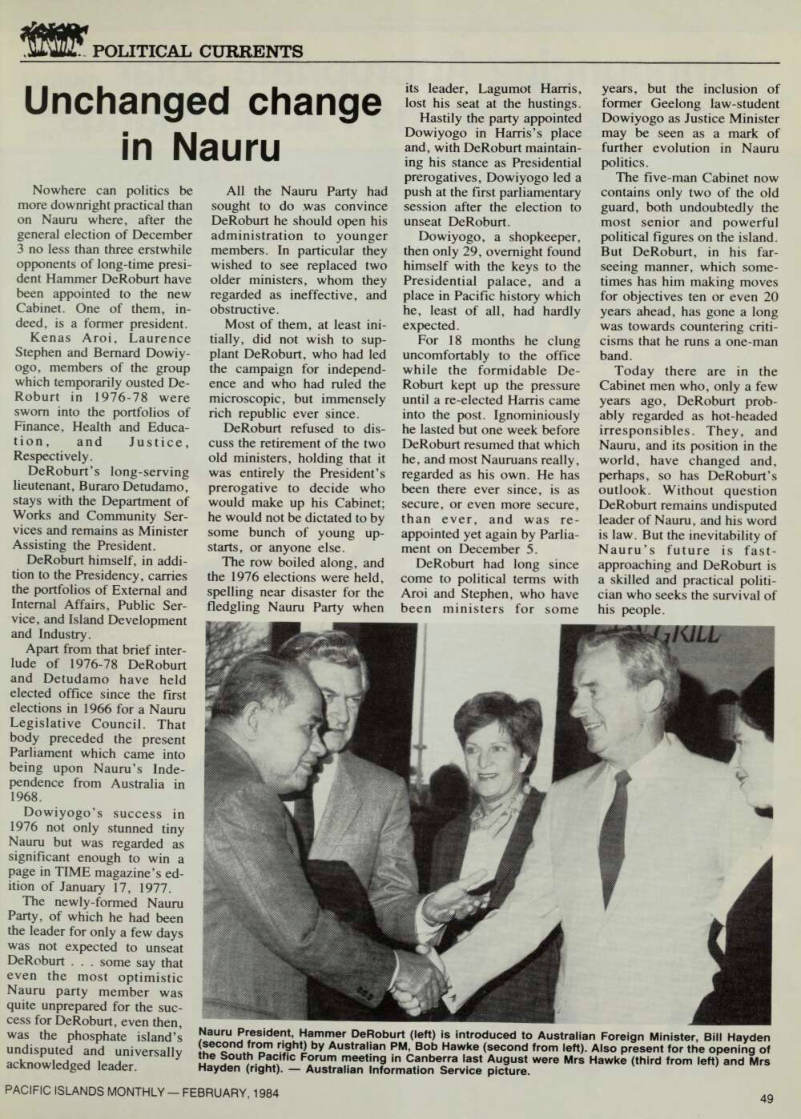
Nauru President, Hammer DeRoburt (left) is Introduced to Australian Foreign Minister, Bill Hayden (second from right) by Australian PM, Bob Hawke (second from left). Also present for the opening of the South Pacific Forum meeting in Canberra last August were Mrs Hawke (third from left) and Mrs Hayden (right). - Australian Information Service picture.