“Little short
pp. 43-47 · Read in the full issue

Tropicalities
“Little short of a tragedy..."
The Solomon Islands National Archives - SINA - stands in a grove of trees about 150 metres from Mendaña Avenue, in the heart of Honiara.
SINA is a quietly imposing, two-storey, white concrete build ing with a floor area of almost 600 square metres, a structure intended as a worthy successor to the Western Pacific Archives (WPA) in Suva.
For eight years (1970-78) the WPA - an unassuming, wooden structure of wartime provenance in the Government House grounds - housed what one archivist called ”... one of the
largest organised assemblages of
original source materials in exist ence relating . . .” to British colonial policy in the South Pacific, and to Pacific Islands history in general. The last per manent director of the WPA, Bruce Bume, was a meticulous and dedicated official who work ed tirelessly to develop the arc hive’s holdings and to assist re searchers working in Pacific studies.
Realising the physical and en vironmental limitations of the WPA, its acute vulnerability to fire, and the anomaly involved in housing the files of tropical de
pendencies in an independent
dominion, Bume worked hard to promote the establishment of SI NA. However, before SINA was completed, Bume’s period in of fice came to an end, and the WPA was disbanded. I can well remember standing in the hall way of the WPA in August, 1978, watching in a state of growing dismay while the files of the Western Pacific High Com mission (WPHC), relating primarily to the Solomons, Kiribati, Tuvalu, Vanuatu, Ton ga, and the Samoas, for the period 1874-1941 - were packed into crates destined for
England.
For more than five years now those files have been lost to the world, lying on shelves in a Public Record Office repository in Hayes, Middlesex. So far as I can determine the Foreign and
Commonwealth Office lacks the staff and the resolve to deal with the WPHC materials, and until this is done the files - and/or microfilms of same - will not be deposited in the National Arc hives in Honiara.
The transfer of the WPHC files not only flew in the face of accepted archival convention that, whenever possible, files
Dr JIM BOUTILIER tells the story of SINA, the Solomon Islands National Archives, and of how it came about that what should be the core of its holdings is lying virtually forgotten in an official records repository in the United Kingdom.
should be housed in the area to which they relate - but robbed SINA of 80 per cent of its intend ed collection.
What is more, SINA lacks another key element in its archiv al collection, microfilm of the WHPC files. Before the closure of the WPA, Bume’s staff under took the massive project - with Australian and Islands - aid of microfilming all the WHPC files down to 1927.
They did so not only as a
hedge against the possible loss of
the originals, but as a way of providing universities in the reg ion, interested in Pacific studies, with an invaluable news resource.
Unfortunately, SINA does not have a copy of those microfilms, and the master negative mic rofilm copy of WPHC records, comprising 315 reels, was re mitted to the United Kingdom
without the consent of the par
ticipants in the project.
Nevertheless, SINA did re ceive several cartons of mic rofilm - principally Pacific Islands Monthly and assorted mis sionary papers (microfilm relat ing to the Battle for Guadalcanal was presented to SINA at a later date by the United States Marine Corps) - from the WPA, as well
as all of the archive’s microfilm ing and processing equipment.
However, the microfilm auto processor has never worked, and Benjamin Piri, the senior techn ical officer and cameraman, with 17 years of experience behind him in Lands and Surveys, has been able to undertake only the smallest assignments, painstak ingly developing them by hand.
A new processor is on order, but until it arrives some time this year SINA is not equipped to
begin large-scale microfilming
projects of its own, or to meet readers’ requests for microfilm.
The first SINA archivist was R. G. Chesterman who had serv ed previously (among other ap pointments) in the India Office Archives in London. He took up his appointment in June, 1979, and the following year engaged as his assistant a serious, articu late, young graduate from the
University of the South Pacific, Joseph Wale. While at USP Wale had volunteered for two weeks “in-service” training at the WPA, and, encouraged by Bruce Bume, went on to do a two month archival course, funded by British Commonwealth tech nical aid, at the Malaysian Na tional Archives in Petaling Chaya, Selangor. Two years la ter he completed a nine-month course in archives administration at University College, London, and in 1983 was confirmed in his post as Solomon Islands Govern ment Archivist.
Wale is at present wrestling with a number of problems, and doing so with good-natured pro fessionalism. Hitherto, there has been no national policy with re spect to the deposition of public documents in SINA. Wale and his staff have been obliged to tour the islands recovering files from the Auki, Gizo,and Makira provincial headquarters, and with a National Archives Bill now before the legal draftsmen he faces the prospect of a vast number of government files be ing transferred to his charge.
Interestingly enough, some of the files relating to the Solomons were, in fact, sent to Honiara in 1978. Those British Solomon Is-
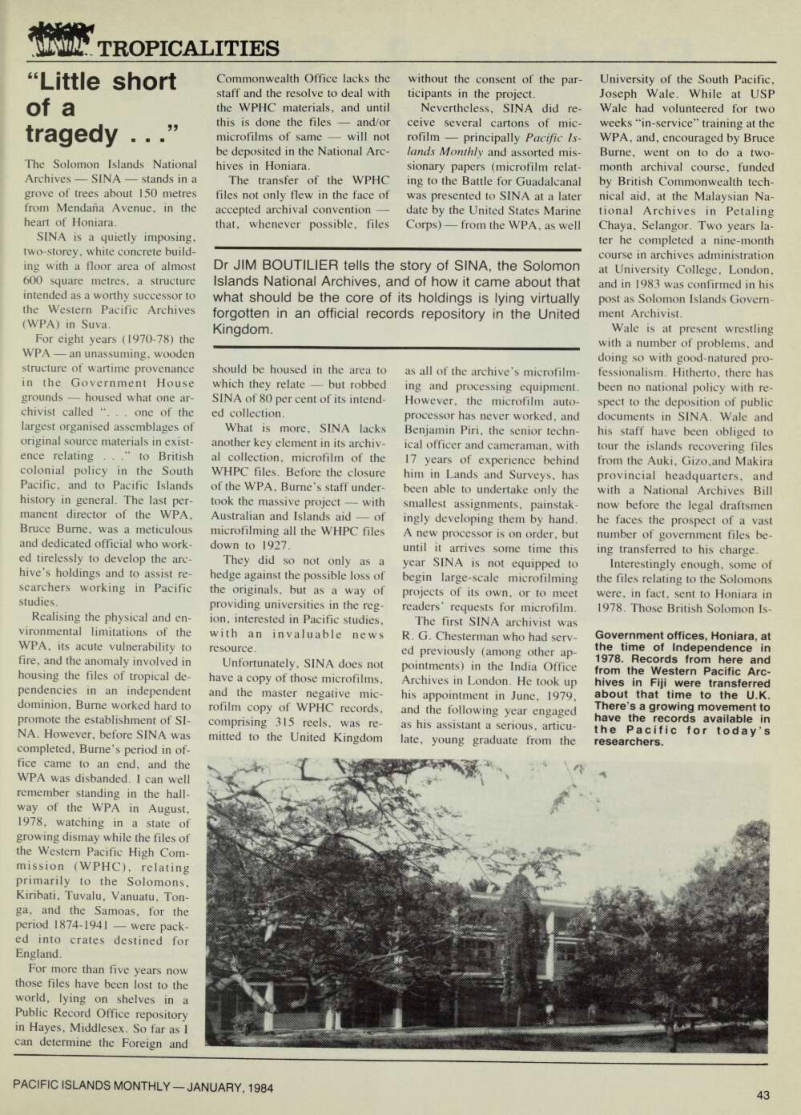
Government offices, Honiara, at the time of Independence in 1978. Records from here and from the Western Pacific Arc hives in Fiji were transferred about that time to the U.K.
There’s a growing movement to have the records available in the Pacific for today’s researchers.
lands Protectorate (BSIP) papers consisted of some resident com missioners’ files (until the termi nation of that office in 1952), some district records, which, apart from those for Malaita, were fragmentary, and an assort ment of miscellaneous files.
As a consquence of wartime destruction, the BSIP materials are incomplete, and Wale has discovered that the files, which fill four bays of metal shelving, have not been weeded properly.
When I asked him what his big gest task was he replied with a smile, “Over there,” gesturing towards the boxes that needed to be gone through.
In addition, there are the inter connected and perennial prob lems of staffing and finance.
Wale’s staff consists of a cameraman, messenger, two ar chival assistants, a search room supervisor, a typist, and a con servator. He is understandably anxious to ensure that each of them has an opportunity to up grade his or her qualifications.
He needs new equipment for
binding documents, and conser vation measures are a constant necessity, particularly in a trop ical setting, where cockroaches, silverfish, rodents, and damp menace his collection.
But overshadowing all of these concerns is the one basic and
increasingly forgotten problem,
that SINA is an archives almost bereft of records. Years ago Bruce Bume observed that it would be “. . . little short of a tragedy” if the WPA holdings were broken up and dispersed.
Sadly, that is exactly what hap pened, and now, more than half a decade later, bureaucratic indif ference and dithering have de nied SINA and the people of the Pacific islands the records which SINA was originally built to house.
It is a tragic state of affairs that as Solomon Islanders convene workshops at the USP Centre in Honiara to prepare a history of their nation, many of the records they require lie virtually forgot ten on the other side of the globe.
Jim Boutilier.
Big blast opens
Aitutaki lagoon
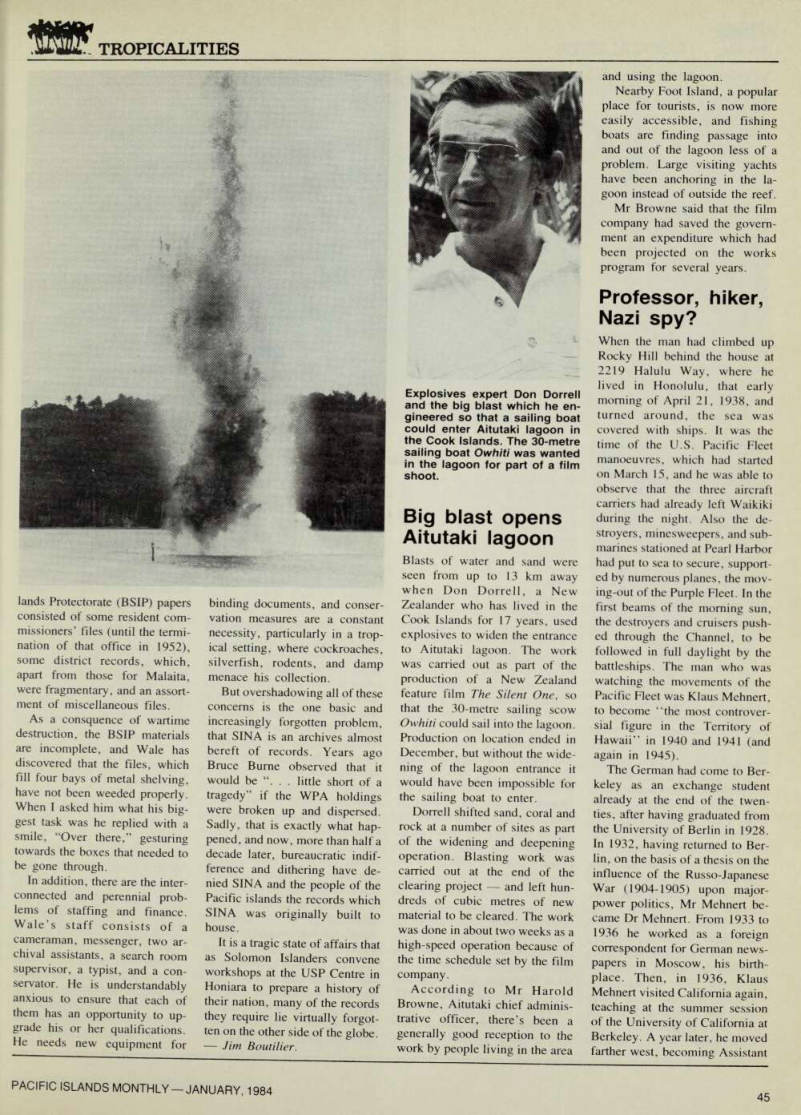
Blasts of water and sand were seen from up to 13 km away when Don Dorrell, a New Zealander who has lived in the Cook Islands for 17 years, used explosives to widen the entrance to Aitutaki lagoon. The work was carried out as part of the production of a New Zealand feature film The Silent One, so that the 30-metre sailing scow Owhiti could sail into the lagoon.
Production on location ended in December, but without the wide ning of the lagoon entrance it would have been impossible for the sailing boat to enter.
Dorrell shifted sand, coral and rock at a number of sites as part of the widening and deepening operation. Blasting work was carried out at the end of the clearing project and left hun dreds of cubic metres of new material to be cleared. The work was done in about two weeks as a high-speed operation because of the time schedule set by the film company.
According to Mr Harold Browne, Aitutaki chief adminis trative officer, there’s been a generally good reception to the work by people living in the area
and using the lagoon.
Nearby Foot Island, a popular place for tourists, is now more easily accessible, and fishing boats are finding passage into and out of the lagoon less of a problem. Large visiting yachts have been anchoring in the la goon instead of outside the reef.
Mr Browne said that the film company had saved the govern ment an expenditure which had been projected on the works program for several years.
Professor, hiker,
Nazi spy?
When the man had climbed up Rocky Hill behind the house at 2219 Halulu Way, where he lived in Honolulu, that early morning of April 21, 1938, and turned around, the sea was covered with ships. It was the time of the U.S. Pacific Fleet manoeuvres, which had started on March 15, and he was able to observe that the three aircraft carriers had already left Waikiki during the night. Also the de stroyers, minesweepers, and sub marines stationed at Pearl Harbor had put to sea to secure, support ed by numerous planes, the mov ing-out of the Purple Fleet. In the first beams of the morning sun, the destroyers and cruisers push ed through the Channel, to be followed in full daylight by the battleships. The man who was watching the movements of the Pacific Fleet was Klaus Mehnert, to become “the most controver sial figure in the Territory of Hawaii” in 1940 and 1941 (and again in 1945).
The German had come to Ber keley as an exchange student already at the end of the twen ties, after having graduated from the University of Berlin in 1928.
In 1932, having returned to Ber lin, on the basis of a thesis on the influence of the Russo-Japanese War (1904-1905) upon major power politics, Mr Mehnert be came Dr Mehnert. From 1933 to 1936 he worked as a foreign correspondent for German news papers in Moscow, his birth place. Then, in 1936, Klaus Mehnert visited California again, teaching at the summer session of the University of California at Berkeley. A year later, he moved farther west, becoming Assistant
Explosives expert Don Dorrell and the big blast which he en gineered so that a sailing boat could enter Aitutaki lagoon in the Cook Islands. The 30-metre sailing boat Owhiti was wanted in the lagoon for part of a film shoot.
Professor (of History) at the Un iversity of Hawaii. In 1936, while on his way from Russia to California. Mehnert had touched at Honolulu, also having a short meeting with Dean William H.
George, College of Arts and Sci ences, and it was the Dean who the same year had taken the initiative to make the German historian to the University of Hawaii.
For about three years things in Honolulu appear to have gone on
quite normally, though, as Dean
George noted. Mehnert had a few months after his arrival in
1937 already sought “permission
to deliver four lectures on world affairs, with emphasis on current events, before a downtown group
which is being organised by
Charles Loomis and others ...”
“When Mehnert arrived I
warned him against propaganda
of any kind, and suggested that he refrain from public lecturing.
But I think the time has come to turn him loose. I do not mean that he should overdo this lectur ing business, but a series such as the one proposed would not be out of the place.” (The “down town group” referred to was to become the local chapter to the Institute of Pacific Relations, with Charles F. Loomis as their secretary and David L. Craw ford, President of the University of Hawaii at the time, as one of their later activists).
Suddenly, in the middle of July 1940, Klaus Mehnert re ceived a letter from the editors of The New Republic, of New York, asking him whether he was a regular correspondent to the German ‘ ‘Arbeits
gemeinschaft fur Geopolitik’’,
also informing President Craw ford. About a month later, the snowball had turned into an av alanche, as the whole American public could read that “A Ger man professor of history at the University of Hawaii has con tributed articles on the U.S.
Navy to the Nazi magazine
‘ ‘Zeitschrift fur Geopolitik’ ’.
Mehnert’s scientific activity in Honolulu so far had resulted in his study “The Russians in Hawaii, 1804-1819’’; in addi tion, “partly because I like to write, and partly because this is for me the easiest way to remind
my friends in Germany of my existence,” he had accumulated information about the military significance and the armaments of the Hawaiin Islands sent to and published by Professor Karl Haushofer in Munich, a retired
major-general and a personal
friend of Adolf Hitler who had founded a “Study Group for Geopolitics” which had co workers in all important countries.
Defended by his American wife, Mehnert, on returning to Honolulu from his Californian vacation, denied that he was the
“Study Group’s’’ man in
Hawaii, or a Nazi at all. As to the article on the 1938 manoeuvres, “There was nothing secretive ab out it. I sent copies of the manu script to the intelligence officers of the army and navy before it was printed. Neither voiced any objection.” No wonder that Mehnert openly confessed in the
German journal that, compared
with most other countries, the United States were much more generous with regard to their military “secrets”. Thus, in his report on Fleet Problem XIX, after having listed the ships in detail, he computed the number
of participating ships, airplanes
and men as follows: “Together with the seven submarines which had left California but never call ed at Hawaii, and the three air craft carriers off Waikiki, 145 warships. There were 700 war planes on Oahu and about 75,000 men in the army and navy.”
President Crawford and the University in general had no ob jections to such writing. And though the accusation “fifth col umnist” had been brought into the discussion, it was not
Mehnert’s hiking, photographing
or his contacts with high-ranking officers but the question of whether a “nazi” could be a professor which concerned peo ple. However, when Reverend
Hollis H. Corey, Epiphany
Church Vicarage, complained
that his son’s lecturer was a “Nazi in sympathy”, President Crawford could reassure him; ”... and even if he were a Nazi sympathiser, which he is not, there would be no occasion for current ideologies such as Nazi ism to come into classroom discussions.”
Suddenly, in his letter of De cember 20, 1940, Mehnert sub mitted his resignation from his
University position “because
. . . my being on the faculty might cause serious embarrass ment to the University”; he al
ready regretted his decision,
however, at the beginning of the following May: “When in De
cember 1940 I wrote my letter of resignation, I was influenced by recent attacks against me and impressed with the rapid deterio ration of US-German relations.
Since then half a year has passed.
I have not heard of any new attacks, the Legislature to my
knowledge said nothing against
me and I am less convinced of the inevitability of an imminent American-German war than I was some months ago. As I had then no other reason for asking for my resignation than this fear of causing the University trou ble. I am now beginning to won der whether a compromise solu tion such as leave might not be feasible”.
About a fortnight later, all this was forgotten again as Mehnert had in the meantime received a telegram offering him work in Shanghai as the “editor of an
academic periodical” (carrying a
good salary). President Crawford
accepted his resignation, so that on June 2, 1941, Mehnert gave his Aloha talk at the University denying once more that he was a Nazi but stressing at the same time his loyalty to Ger
many. Apparently quickly re
covered from a tonsil operation, which had forced him to cancel his last talk at the Friday Lunc heon Group of the IPR, Klaus Mehnert left Hawaii on the even ing of June 10 and not, as announced at the beginning of June, “late this month” —join
ing a shipload of Japanese and
Germans on the Tatsuta Maru. (“I saw with a sad heart Kaena Point disappear on the hori zon”). Via Yokohama (a voyage of about a week) he came to Tokyo by June 20, where he stayed for 10 days; from Kobe he sailed to Shanghai. (Thus it hap pened that Mehnert was in Japan at the outbreak of the Soviet German war on June 22.) Mrs Mehnert joined her husband later by crossing the ocean from Mex ico as the United States govern ment had prohibited their citizens from going to the far East at that time.
Therefore, when “it” hap pened that sunny, early Sunday morning of December 7, 1941, Klaus Mehnert was no longer on location, and probably did es cape the fate his countryman
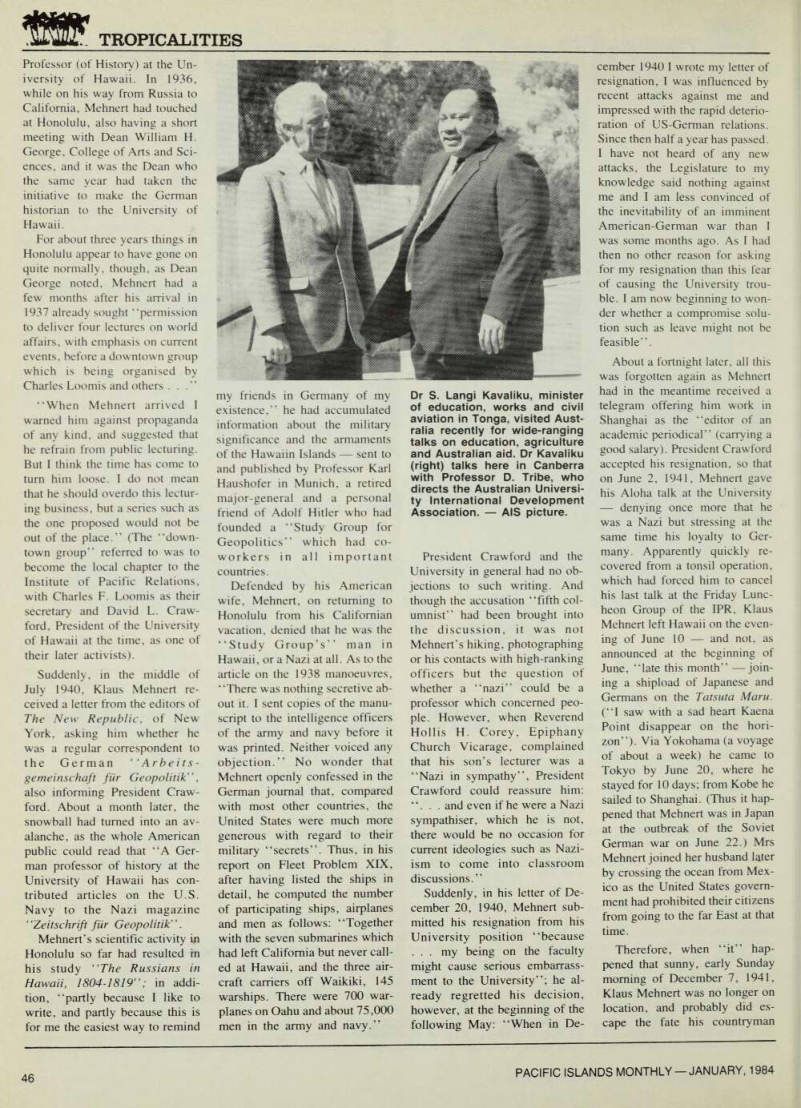
Dr S. Langi Kavaliku, minister of education, works and civil aviation in Tonga, visited Aust ralia recently for wide-ranging talks on education, agriculture and Australian aid. Dr Kavaliku (right) talks here in Canberra with Professor D. Tribe, who directs the Australian Universi ty International Development
Association. - AIS picture.
Bernard Julius Otto (“Friedel”) Kuhn had to suffer: being con victed of espionage in Hawaii during the war. People in Hawaii had not, however, forgotten Klaus Mehnert, maybe “Pearl Harbor’’ had sharpened their memory. After World War 11, when his arrest in Shanghai be came known, the Mehnert Case was raised again, and this time it was his possible part in the plan ning of the Japanese attack on the U.S. Pacific Fleet which was under debate. Fulton Lewis, Jr., in a broadcast, pointed to the “Pearl Harbor’’ connection re ferring to Mehnert’s hiking, photographing, interest in maps, getting together with military people, etc. Again it was the President of the University of Hawaii who followed the princi ple giving Mehnert the benefit of the doubt. Though calling Mehnert “the most controversial figure in the Territory of Hawaii’’ and feeling “that the Nazi knew he was the ideal per son to have in a place like Hon olulu’’, President Gregg M.
Sinclair, when asked for his tes timony, referred to the words of a retired general; “If Mehnert was a spy, he fooled the best people in Honolulu. But I don’t think he was a spy”.
In June 1946, Klaus Mehnert returned to Germany from China in the first possible war transport of Germans from east Asia: “He was screened for possible Nazi activism and shortly thereafter released from the repatriation centre at Ludwigsburg” in the American Zone; in 1948, he worked as a Russian expert in the “German peace office” at Stutt gart. Klaus Mehnert became editor and co-publisher of the conservative weekly “Christ und Welt”, and in 1961 he entered the (West) German academic scene again, being appointed professor of political science at the Aachen Institute of Technol ogy. It was not until March 1965 that Klaus Mehnert, a holder of the West German Grand Disting uished Service Cross and a mem ber of the national PEN centre, reappeared in the headlines of the Honolulu newspapers because of his calling again at the place where he had once been under fire. A widower since 1955, and
professor emeritus since 1973, the early 1980 s saw him if not hiking the world living in the Black Forest, West Germany climbing the mountains behind his residence at Blumenhof?
W. Wilfried Schuhmacher. Re printed with permission from the collection ' ‘Essays in Honour of Aarne A. Koskinen”, published by the Finnish Anthropological Society.
Solomons art on
show in Honolulu
Solomon Islands art by Kuai Maueha (1933-1981) (PIM Aug. ’B3 p 37) was on display in November-December at Hon olulu’s East-West Center Bums Hall foyer. The exhibit was free and open to the public.
The expressive and imagina tive style of the late Solomon Islander was demonstrated through his detailed work in wood sculpture and copper bas relief. Twenty-six wood carvings and two works in copper were presented, along with about 20 photographs of the artist’s work.
Kuai was from Bellona, a Polynesian outlier in the Sol omons. Although he did not be come a serious artist until 1969, his talent was soon recognised.
He was twice an artist in resi dence at the University of the South Pacific, first at the Laucala campus in Fiji and again at USP’s Solomon Islands Center in
Honiara. He died in May 1981 after a fall from a tree.
The exhibit was presented at the E-WC by the Culture Learn ing Institute. It was organised in Honiara by Anna Craven Tuhanuku and Ann Stevenson, with support from the Australian South Pacific Cultures Fund and Air Pacific.
After the display at the E-WC, the exhibit was to travel to Fiji, Australia and Papua New Guinea before returning to the Solomons.
An exhibition of contemporary prints by Papua New Guinean artist David Lasisi was also on display at the E-WC during the same period.
Marginal Farm
in the mainstream
The play The Marginal Farm (PIM Nov ’B3 p3l) opened at the Russell Street Theatre, Mel bourne, on November 2, and not one critic protested that “kava” should be pronounced “yanngo na” (written “yaqona”).
The cast of Australian dramat ist Alexander Buzo’s play were immensely cheered by this, as they were by the announcement that the play’s season was to be extended to December 17.
The Melbourne Theatre Com pany, which presented the play, were pleased to hear that Neil Jillett of The Age thought The
Marginal Farm “a warm-hearted comedy that is always ati'active and entertaining”. Another critic, Anee Crawford, saw it in a more sombre light, however. “Don’t expect a play full of happy na tives,” she warned.
Geoffrey Hutton in The Aust ralian had a rare complaint.
Diane Craig, who plays the lead ing role, is “almost too attrac tive”, he protested. Of all the blunders . . .
Members of the Samoan com munity in Brisbane, capital of the Australian state of Queens land, have opened their own church. It is the Bardon church of the Congregational Christian Church of Samoa. Its minister, the Rev Urika Saifoloi (lower picture) has served in parishes in Western Samoa, PNG and Fiji. He conducts services in the
Samoan language. - Greg Nos
worthy picture.