Honiara-Taipei-Peking:
pp. 41-42 · Read in the full issue
What the devil’s going on?
By a Special Correspondent
Could there just possibly after all be something more than wishful thinking to the proclaimed ambi tion of Solomon Islands to be come the first state in the world to have diplomatic-level relations both with the People’s Republic of China (PRC) and Taiwan (the Republic of China, or ROC)?
It has been reported that early last year the Honiara government approached diplomatic au thorities in both Washington and Canberra for their views on the idea. They were told, according to the reports, that it was just not on.
In terms of past Chinese prac tice, the advice was certainly sound. If there is one issue on which China has been rockfirm since the communist take-over in 1949 it is this one. “There is no other (Chinese) God but me,” has been Peking’s unchanging standpoint. Anyone who dreamed “impossible dreams” about pulling off any kind of two-card trick in the matter of diplomatic relations with China was simply sent packing.
But the difference facing the
world of 1984 is simply this; there is nothing rockfirm about any aspect of Chinese policy any more.
Powerful new factors are now in play which make it possible to question the permanence of even so sacred a cow as the “one- China policy”.
They are the negotiations with Britain over the future of Hong Kong after the expiry in 1997 of the leases on the New Territories negotiations which have taken on a quite unparalleled urgency as the crunch time looms just 13 years off and the new, super charged, diplomatic offensive by Peking to shift the logjam in relations with Taiwan itself.
In both cases Peking is making offers of a future autonomous status, and of non-interference with internal economic and so cial systems, which are quite extroardinary by all previous standards.
If so much has changed in Peking’s proposed future rela tions with two Chinese entities of vital concern to it, why should there not equally be movement in the “one-China” position in rela tions with foreign countries? And
why not test the water in the case of ties with a relatively insignif icant mini-state of the southwest Pacific, which is nevertheless in a region which China shows clear signs of consciously target ing as one in which it wishes to extend its influence?
So far these are only questions and there are no grounds for treating them as any more than that. What is extraordinary is that for the first time they appear to be questions worth asking.
Peking has links with five Pacific Island states Fiji, Kiribati, Papua New Guinea,
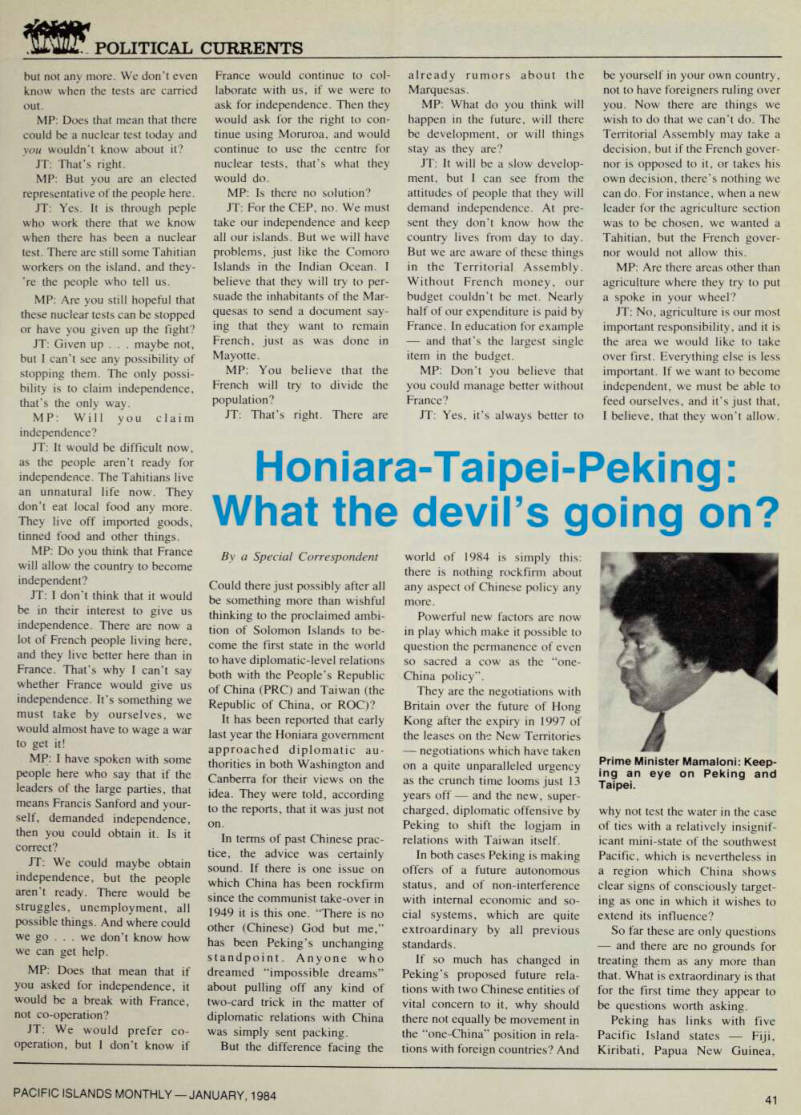
Prime Minister Mamaloni: Keep ing an eye on Peking and Taipei.
Western Samoa and Vanuatu, and Mr Zhu Xue-fan, a vice chairman of the National Peo ple’s Congress (parliament), said in a recent statement that China wanted to extend this South Pacific network.
Mr Zhu last September met a delegation visiting China from the Solomons parliament led by Speaker Lloyd Gina.
This would have been unre markable enough if it were not for the fact that seven months earlier, in February, Solomon Islands had established consular level diplomatic relations with Taiwan. At the very least, in the past, this would have earned the Solomons representatives a stem lecture on the “one-China” poli cy. But as things turned out, Mr Zhu merely voiced hopes for diplomatic relations between the PRC and the Solomons.
Other Chinese officials have come out in favor of trade and economic ties. Indeed, such no tions appear to have moved bey ond the mere expression of hopes: in June a newspaper in China’s Guangdong province re ported that the provincial govern ment was planning a joint ven ture with the Solomons, with 20,000 hectares of forest land being made available to supply Guangdong with more than 3000 cubic metres of timber annually for 13 years.
In its fight against what it calls “the strategy of the ‘southward drive’ pursued by Moscow,” which is “casting a shadow” over the South Pacific, Peking has one undeniable advantage over the Russians; in almost all urban settlements in the South Pacific there are long-established, some times very powerful, Chinese communities. The Chinese are “known”, if they are not always loved, throughout the region.
The existence of this long standing Chinese presence no doubt has something to do with the fact that whereas China has a physical diplomatic presence in a spread of countries across the region, Moscow’s diplomats are accredited to only three - Fiji, Tonga, and Western Samoa and are resident in none.
Of course, the presence of
Chinese communities can be a two-edged sword.
Thus, late last year, we had Solomons Prime Minister Sol omon Mamaloni referring ex plicitly to “about 12 local Chin ese businessmen”, and threaten ing them with deportation if they did not stay within the Sol omon’s foreign investment laws.
He accused those concerned of “deviously” seeking help from other ministers, and highly placed government officials. One or two of them had been “marked down” for deportation, he said.
Whatever the episode had to do if it had anything to do with the complex, three-way dip
lomatic Honiara-Taipei-Peking
relationship, there is no doubt that more will be heard of this trio as 1984 goes on.
Fiji’s Finance
Minister
Walker resigns
Fiji’s Finance Minister Charles Walker resigned on December 7 in protest against a Cabinet deci sion to grant a $F300 annual pay increase to public servants.
Expressing “shock” at the re signation in a statement next day, Prime Minister Ratu Sir Kamis ese Mara nevertheless defended the cabinet decision, saying that the country could not afford a public service strike, and that government would have been go ing back on its word in failing to grant the increase, which it had promised several years ago.
Mr Walker is believed to have told Cabinet that the country could not afford the measure.
Borrowing funds from abroad to meet the cost (an estimated $3.5 million a year) would simply be mortgaging Fiji’s independence to the International Monetary Fund.
Earlier on December 7, the parliament in Suva, after two weeks of debate, had passed the budget, which provides for major tax increases (PIM Dec. p 5).
Mr Walker, 55, had been minister of finance since 1979.
Foreign Affairs Minister Mosese Qionibaravi was appointed act ing finance minister following the resignation.