endless quest
pp. 27-29 · Read in the full issue

Tropicalities
Floreana to Tuin: An endless quest
‘Excuse me darling, could I have our teeth for a moment?’
Two ill-starred attempts by Caucasian couples to live the “natural life” on deserted Pacific Islands are related in recently published books. Separated in time by more than 50 years, and in space by the distance between the Galapagos Islands and Torres Strait, they still have much in common. In their differences, they offer interesting insights in to changes in social mores, espe cially in relations between the sexes, over the past half-century.
First of the books to appear was The Galapagos Affair , by Cambridge University zoologist John Treheme, who came across the story by accident during re search trips to the Galapagos Archipelago where he studied the islands’ world-famous fauna.
The other book, Castaway, describes a recent adventure on a Torres Strait island between Australia and the New Guinea land mass.
The Galapagos Affair began in 1929 when Friedrich Ritter, an eccentric German doctor, and his lover, Dore Strauch, forsook spouses and homes in Berlin and set out for the Galapagos to seek the doctor’s vision of a wil derness paradise where he could
achieve his “great ideal of solitude”.
Dore Strauch’s love for Ritter was obsessive. She saw him as a “Superman” figure, and revelled in their “great mutual quests”.
As for Ritter, they had not been long on the small island of Floreana before he made it plain that he really had no time for his besotted soulmate, and began to treat her with the utmost cruelty.
Still, Dore clung on. Before long, stories began to appear in the German and foreign press about the pair, projecting them as a modem Adam and Eve who practised nudism and more extraordinarily still shared the same set of stainless steel dentures.
The stories soon drew other would-be settlers to Floreana, including notably a weird nym phomaniac styling herself Eloise Baroness Wagner de Bosquet, who turned up on the island in October, 1932, accompanied by a brace of lovers, and an Indian
helper.
The “baroness” disappeared with one of her lovers in 1934, and no trace of them was ever found. A little later, the body of her other lover was discovered, dead from starvation and thirst on another island, near that of a male sailing companion.
Dore was not long afterwards indirectly responsible for the death of her beloved Friedrich Ritter she inadvertently serv
ed the (supposedly vegetarian) doctor poisoned chicken.
Despairing, Dore returned to the Germany of the Nazis, where she received wide publicity. An article in The New York Times in December, 1934, spoke of her as “the lonely survivor of this inter nationally famous nudist couple”.
Most durable of all the Florea na settlers were the least eccentr ic: the farming couple Heinz Wittmer and his wife Margret, who had arrived shortly before the “baroness”. They eked out a living on the island, and even raised children there. Although he tried hard in the early 1980 s, Treheme could not find the aged Margret on the island. But he believed she was then still living there.
The 1980 s story is told in a new book, Castaway, by 27year-old Englishwoman Lucy Ir vine. The book had its Australian launching in November.
Far from loving Gerald Kings land, her companion of a year living on uninhabited Tuin Island in Torres Strait, Lucy Irvine found him “a lazy, ignorant, bor ing old fool”.
But Lucy had joined him by choice. At 16, she had become the youngest member of British Mensa, the society for people with well-above-average IQs.
For the next nine years, she had tried an extraordinary array of jobs, but without finding one that fully satisfied her.
At 25, she replied to an adver tisement in an English magazine in which Kingsland, 52, an ex paratrooper and general knock about man, sought a “wife” to spend a year with him on a desert
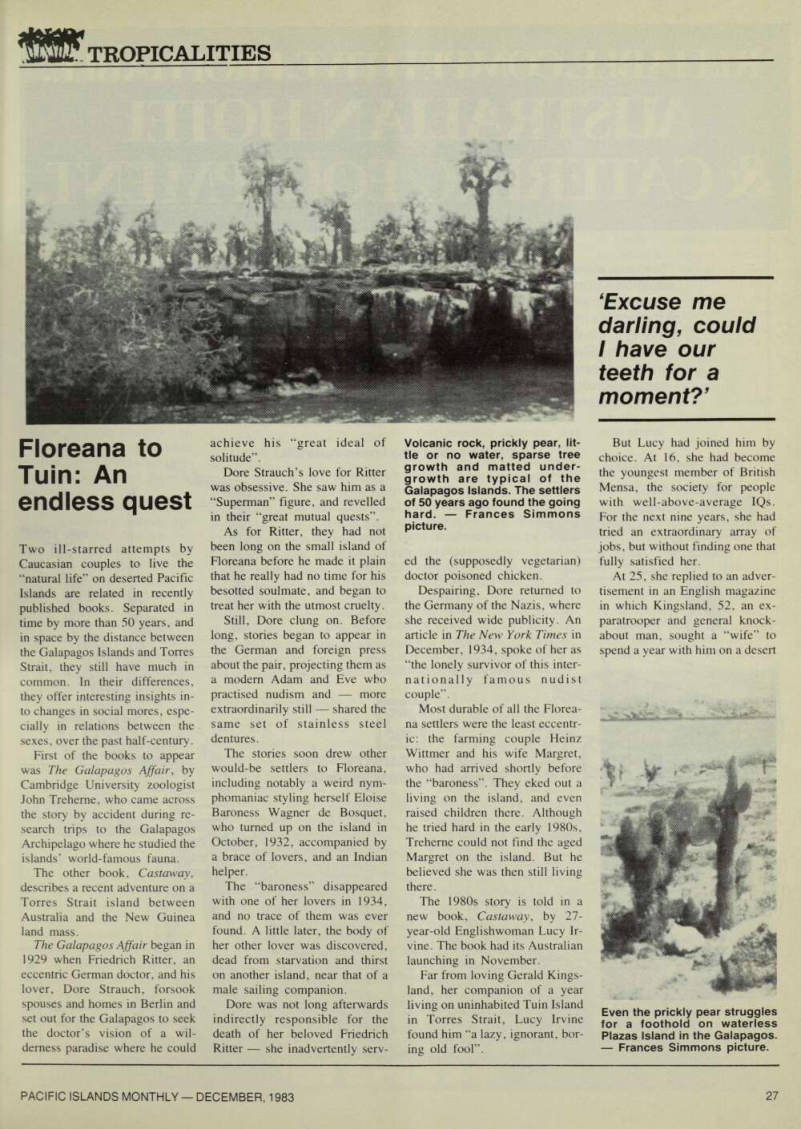
Volcanic rock, prickly pear, lit tle or no water, sparse tree growth and matted under growth are typical of the Galapagos Islands. The settlers of 50 years ago found the going hard. Frances Simmons picture.
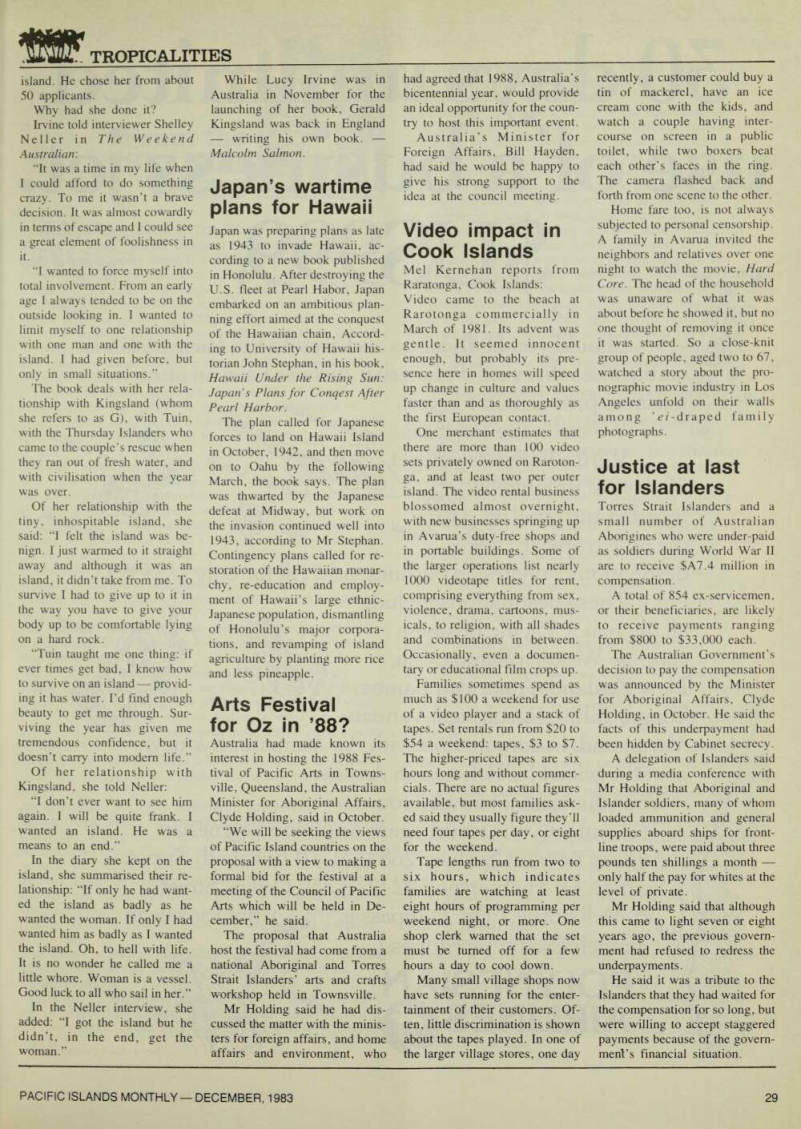
Even the prickly pear struggles for a foothold on waterless Plazas Island in the Galapagos. - Frances Simmons picture.
island. He chose her from about 50 applicants.
Why had she done it?
Irvine told interviewer Shelley Neller in The Weekend Australian ; “It was a time in my life when I could afford to do something crazy. To me it wasn’t a brave decision. It was almost cowardly in terms of escape and I could see a great element of foolishness in it.
“I wanted to force myself into total involvement. From an early age I always tended to be on the outside looking in. I wanted to limit myself to one relationship with one man and one with the island. I had given before, but only in small situations.”
The book deals with her rela tionship with Kingsland (whom she refers to as G), with Tuin, with the Thursday Islanders who came to the couple’s rescue when they ran out of fresh water, and with civilisation when the year was over.
Of her relationship with the tiny, inhospitable island, she said: “I felt the island was be nign. I just warmed to it straight away and although it was an island, it didn’t take from me. To survive I had to give up to it in the way you have to give your body up to be comfortable lying on a hard rock.
“Tuin taught me one thing: if ever times get bad, I know how to survive on an island provid ing it has water. I’d find enough beauty to get me through. Sur viving the year has given me tremendous confidence, but it doesn’t carry into modem life.”
Of her relationship with Kingsland, she told Neller: “I don’t ever want to see him again. I will be quite frank. I wanted an island. He was a means to an end.”
In the diary she kept on the island, she summarised their re lationship: “If only he had want ed the island as badly as he wanted the woman. If only I had wanted him as badly as I wanted the island. Oh, to hell with life.
It is no wonder he called me a little whore. Woman is a vessel.
Good luck to all who sail in her.”
In the Neller interview, she added: “I got the island but he didn’t, in the end, get the woman.”
While Lucy Irvine was in Australia in November for the launching of her book, Gerald Kingsland was back in England writing his own book.
Malcolm Salmon.
Japan’s wartime
plans for Hawaii
Japan was preparing plans as late as 1943 to invade Hawaii, ac cording to a new book published in Honolulu. After destroying the U.S. fleet at Pearl Habor, Japan embarked on an ambitious plan ning effort aimed at the conquest of the Hawaiian chain. Accord ing to University of Hawaii his torian John Stephan, in his book, Hawaii Under the Rising Sun: Japan’s Plans for Conqest After Pearl Harbor.
The plan called for Japanese forces to land on Hawaii Island in October, 1942, and then move on to Oahu by the following March, the book says. The plan was thwarted by the Japanese defeat at Midway, but work on the invasion continued well into 1943, according to Mr Stephan.
Contingency plans called for re storation of the Hawaiian monar chy, re-education and employ ment of Hawaii’s large ethnic- Japanese population, dismantling of Honolulu’s major corpora tions, and revamping of island agriculture by planting more rice and less pineapple.
Arts Festival
for Oz in ’88?
Australia had made known its interest in hosting the 1988 Fes tival of Pacific Arts in Towns ville, Queensland, the Australian Minister for Aboriginal Affairs, Clyde Holding, said in October.
“We will be seeking the views of Pacific Island countries on the proposal with a view to making a formal bid for the festival at a meeting of the Council of Pacific Arts which will be held in De cember,” he said.
The proposal that Australia host the festival had come from a national Aboriginal and Torres Strait Islanders’ arts and crafts workshop held in Townsville.
Mr Holding said he had dis cussed the matter with the minis ters for foreign affairs, and home affairs and environment, who
had agreed that 1988, Australia’s bicentennial year, would provide an ideal opportunity for the coun try to host this important event.
Australia’s Minister for Foreign Affairs, Bill Hayden, had said he would be happy to give his strong support to the idea at the council meeting.
Video impact in
Cook Islands
Mel Kernehan reports from Raratonga, Cook Islands: Video came to the beach at Rarotonga commercially in March of 1981. Its advent was gentle. It seemed innocent enough, but probably its pre sence here in homes will speed up change in culture and values faster than and as thoroughly as the first European contact.
One merchant estimates that there are more than 100 video sets privately owned on Raroton ga, and at least two per outer island. The video rental business blossomed almost overnight, with new businesses springing up in Avarua’s duty-free shops and in portable buildings. Some of the larger operations list nearly 1000 videotape titles for rent, comprising everything from sex, violence, drama, cartoons, mus icals, to religion, with all shades and combinations in between.
Occasionally, even a documen tary or educational film crops up.
Families sometimes spend as much as $lOO a weekend for use of a video player and a stack of tapes. Set rentals run from $2O to $54 a weekend: tapes, $3 to $7.
The higher-priced tapes are six hours long and without commer cials. There are no actual figures available, but most families ask ed said they usually figure they’ll need four tapes per day, or eight for the weekend.
Tape lengths run from two to six hours, which indicates families are watching at least eight hours of programming per weekend night, or more. One shop clerk warned that the set must be turned off for a few hours a day to cool down.
Many small village shops now have sets running for the enter tainment of their customers. Of ten, little discrimination is shown about the tapes played. In one of the larger village stores, one day
recently, a customer could buy a tin of mackerel, have an ice cream cone with the kids, and watch a couple having inter course on screen in a public toilet, while two boxers beat each other’s faces in the ring.
The camera flashed back and forth from one scene to the other.
Home fare too, is not always subjected to personal censorship.
A family in Avarua invited the neighbors and relatives over one night to watch the movie, Hard Core. The head of the household was unaware of what it was about before he showed it, but no one thought of removing it once it was started. So a close-knit group of people, aged two to 67, watched a story about the pro nographic movie industry in Los Angeles unfold on their walls among family photographs.
Justice at last
for Islanders
Torres Strait Islanders and a small number of Australian Aborigines who were under-paid as soldiers during World War II are to receive $A7.4 million in compensation.
A total of 854 ex-servicemen, or their beneficiaries, are likely to receive payments ranging from $BOO to $33,000 each.
The Australian Government’s decision to pay the compensation was announced by the Minister for Aboriginal Affairs, Clyde Holding, in October. He said the facts of this underpayment had been hidden by Cabinet secrecy.
A delegation of Islanders said during a media conference with Mr Holding that Aboriginal and Islander soldiers, many of whom loaded ammunition and general supplies aboard ships for front line troops, were paid about three pounds ten shillings a month only half the pay for whites at the level of private.
Mr Holding said that although this came to light seven or eight years ago, the previous govern ment had refused to redress the underpayments.
He said it was a tribute to the Islanders that they had waited for the compensation for so long, but were willing to accept staggered payments because of the govern ment’s financial situation.