faces, after poll
pp. 23-25 · Read in the full issue

New issues, new faces, after poll
Vanuatu’s November election, the first since independence in 1980, is over, though not without its hitches. The Vanuaaku Party (VP) is still in government. As I write, there is confusion over the Santo town election, where an error in the rolls deprived 150 registered voters of their vote.
This seems likely to bring about a by-election. As things stand, one of the two seats has gone to
the VP and one to the Union of Moderate Parties (UMP), with another VP candidate (and, inci dentally, the only woman candi date in the election, Celestine Tamata) lying third by a margin of only five votes. However, a change in the result there will not affect the result overall.
The VP campaigned on its record, after governing since 1979 by principles of custom
land ownership, steady small scale development, and active support for independence move ments in the Pacific neighbor hood, and it promised more of the same.
But it would not be true to say there will be no change in the political life of Vanuatu. There will be changes in the make-up of parliament, of course, but also in the major opposition party, the UMP, and, more generally, in the electorate’s awareness of the formidable and diverse forces in volved in the country’s politics.
The campaign brought home the uncomfortable reality that outside interests mainly
business interests who stand to gain financially from changes in policy are trying, and will continue to try, to influence the country’s political future.
Early in October, four opposi tion politicians travelled to West ern Samoa, and thence to Ameri can Samoa. This excursion, like earlier trips to New Caledonia and the USA, was not explained at all. However, soon after their return, money and rumors of money began to flow about Port Vila in about equal quantities.
Finally, Prime Minister Walter Lini made an announcement over Radio Vanuatu a paid an nouncement in the time reserved for “classified ads’’. He accused
Report from Vanuatu Julie-Ann Ellis
the four outright of receiving money for their campaign from Michael Oliver, the American businessman involved in the Phoenix Foundation, which has tried hard to set up its own libertarian state in the Pacific, initially on Tonga’s Minerva Reef, and, most recently, via the 1980 rebellion in Vanuatu. The four replied that this was “non sense and useless” and appealed to their supporters to “keep calm and have confidence”. They did not directly deny the charge until another week had elapsed; then they not only denied it, but an nounced they would begin legal proceedings against Lini and the Vanuaaku Party.
Lini, undeterred, went on to claim that the businessmen in volved, including deportees and prohibited immigrants connected with the 1980 rebellion, though primarily interested in changing Vanuatu’s policy of custom land ownership, are operating under a cloak of purely political (anti communist) interest, and are in tent on reviving the Jimmy Ste vens Royal Church movement to undermine custom land rights.
The opposition parties
primarily the UMP and the Vanuatu Independence Alliance Party (VIAP), who hoped to form a coalition government were indeed accusing the VP of communistic tendencies. The ac cusations were based on the es tablishment earlier this year, of diplomatic relations with Cuba, one of the first supporters of Vanuatu’s independence at the United Nations, and backed up by the showing of a McCarthy era film, which had possibly been brought into the country illegally. VP reaction was at first to question the origin of the film, and to threaten its seizure if it had been smuggled in. A more useful reply came on October 26, when VP Ministers Albert Sande and Sethy Regenvanu offered de finitions of communism, point ing out that their party does not endorse state control of land, atheism or a one-party system.
Shortly after this, Morrisson Tangarasi of the VIAP admitted receiving money from “some friends who are against commun ism, in order that we fight com munism in Vanuatu”, though he denied that the money had come from Oliver. Then, two nights before the election, Willie Jim my of the UMP confirmed that “some of (our leaders) met a group of American businessmen,
including Michael Oliver”, He denied that any money was re ceived from Oliver, rather disin genuously claiming that “he’s very poor now, he hasn’t got a penny”. As to the question of whether the Phoenix Foundation had been involved, he said, “I personally don’t understand the Phoenix Foundation or who are members of the Phoenix Foundation”.
It’s clear, then, that money was received from overseas in terests, if not directly from Oliv er. Charity can be discounted as a reason for the handouts; the businessmen were expecting some return. According to Willie Jimmy they asked when (given a VIAP/UMP win in the elections) Jimmy Stevens could be re leased. The reply, according to Jimmy, was that most of his sentence could be cancelled, but that the three years extra for attempted escape would have to be served.
This exchange gives some col or to Lini’s charge that these interests are hoping to use Ste vens, and his Royal Church, to undermine custom ownership of land.
In addition, it was generally those politicians most involved in the receipt of money who most emphasised the reintroduction of freehold titles as part of their campaigns.
Campaigning, even after Vanuatu’s independence, has been shown to be vulnerable to outside forces; the awareness of this vulnerability will affect Vanuatu’s internal politics for a long time to come.
A more concrete change is in the composition of the new Parli ament, which is greatly changed from the old, most markedly in the complete rout of the VIAP.
The VP, though still securely in government, has a narrower ma jority than its former two-thirds, while the UMP has gained noticeably. Some well-known fi gures have won seats one is Willie Jimmy who has been elected as a UMP member for Port-Vila. Some equally well known persons are out of parlia ment one is John Naupa, who left the VP to campaign as an Independent, and lost his seat.
Other absences were due to per sonal decision Fr Gerard Ley
maing was one who did not contest the election, under the edict of Pope John II that the role of priest does not encompass that of active politician. Ley maing, formerly leader of the opposi tion, took no part in the cam paign, being busy organising a campaign of a different sort, on the theme “Jesus is Alive.”
Another who did not contest the election signals the third change to come from the election and the campaign. Walter Tulan gi, formerly a UMP supporter, was an Independent candidate for the Port-Vila town electorate.
When he realised UMP’s policy of re-introducing freehold title, and its effects on his village of Ifira, he withdrew in favor of VP candidate Kalpokor Kalsakau.
His standing down is symp tomatic of a malaise afflicting the UMP dissatsifaction within the party with its policies and strategies. Very senior members are feeling the same. Maxime Carlot told a public meeting at Erakor village that the freehold title was Willie Jimmy’s idea, not his own; Vincent Boulekone expressed his grave reservations about the fund-raising overseas by refusing to campaign outside his own electorate, in effect withholding endorsement of that strategy. Further, the freehold title policy proved not popular with the electorate; there was a big vote for the VP in Port-Vila, formerly a UMP stronghold, with Willie Jimmy trailing a weak fourth to Albert Sande, Kalpokor Kalsakau (both VP), and Maxime Carlot.
With the loss of Fr Leymaing, and such divisions among other senior members of the party (Carlot was Speaker in the last parliament), the UMP is philosophically, if not electoral ly, in disarray. As its name sug gests, it was originally formed as a union of smaller parties, to counter the “extremist” VP. As an opposition, it often adopted a blankly obstructionist attitude, primarily because its chief moti vation was negative to defeat the VP. Now, following the elec tion, it is in urgent need of self examination, to discover a more positive driving force, and to overcome the divisions left by this campaign. Julie-Ann Ellis.
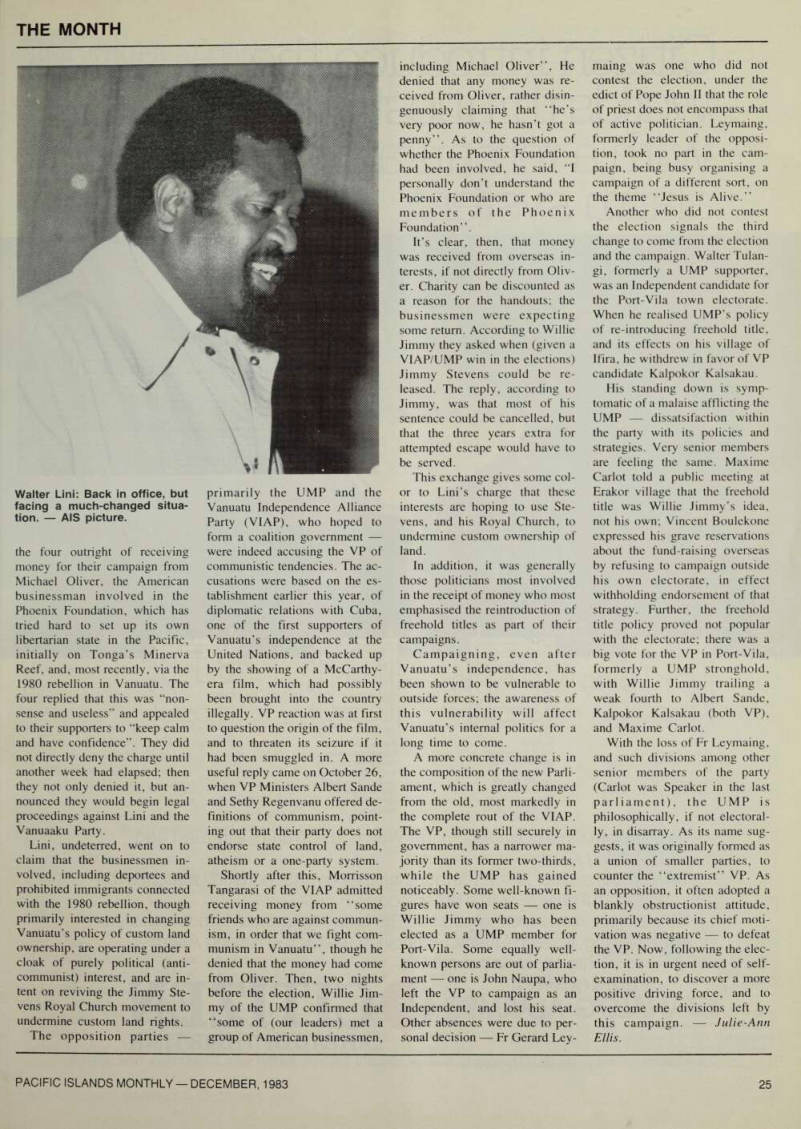
Walter Lini: Back in office, but facing a much-changed situa tion. AIS picture.