Discovering Malaita, and Kwai,
pp. 47-49 · Read in the full issue

Travel
Discovering Malaita, and Kwai, Ngongosila, and some more
Following their experiences on Rennell Island, Solomon Islands, related in RIM October, Dr STEPHEN WEINS TEIN and his wife ELISABETH spent a week’s “R&R” on Malaita. That they were far from idle is quite clear from this concluding part of a two-part series on their time in Solomon Islands.
Malaita is the second largest is land in the Solomons, after Guadalcanal, and has the largest population 60,000. We spent a week on the island as “rest and recuperation” after our soujoum on Rennell.
Solair flies there daily from Honiara ($2B one way), and there are twice-weekly boat ser vices taking about six hours from Honiara ($9.50 one way).
We took one of these. The ships are modem, though some what rusty. Halfway across Iron Bottom Sound one passes the Ngela group of islands, which are seen at night only as a navi gation beacon.
Our ship was met by dozens of children and adults in outrigger and dugout canoes as she passed the reef islets to reach the wharf at Auki, the capital. People in some of the canoes were fishing by forming their craft into a semi-circle with a net and scaring fish into it by splashing the wa ter, while others were ferrying schoolchildren and produce bet ween the thatched villages around Auki, and those on the little islets outside.
On the wharf, passengers be
gan carrying their baggage
ashore. This more often than not included bedding bundles, cook ing pots and purchases from Honiara, such as rice and kerosene. A fleet of small pickup trucks from all comers at least those reachable by road of Malaita was on hand to meet wantoks (people speaking the same language), and, after some shopping, the new arrivals fann ed out back to their villages.
Auki has one business street of mostly Chinese-owned trade stores, a pub, a petrol station, and police, post and other gov ernment offices. There is also an interesting market, a smaller ver sion of the one in Honiara, sel ling sweet potatoes, bananas, pineapples, occasional artefacts,
and that commodity vital to Melanesian living betel nut.
Fish is also brought in and sold when the catch has been good.
A small eating establishment at the market offers solid meals of fish or beef and curried rice for 80c each.
The market is also a communi cations centre. Since there is no public transport on Malaita, most villages own one or more trucks, and it is easy to get rides from the market to most points on the island. Fares vary from 40c to neighboring villages, to $5 for a journey that will take you right across the island. Of course, the wooden seats in the back of these
trucks do seem a bit hard on the long, bumpy dirt roads of the interior.
For accommodation on Malai ta, there is the Auki Lodge, the only hotel, which also serves meals in its restaurant. The alter native is the Provincial Rest House, which provides a bed in a dormitory, with cooking facilities, for about $5 a night.
We chose, however, to spend every night in a different village.
This is not only more interesting, but also quite easily done if you don’t mind a little discomfort and frequent drenching by rain.
We found the Malaitans, perhaps contrary to the reputa-
tion given them in some parts of the Solomons, to be open, friendly and generous. We were met with warmth and hospitality in nearly all villages, even when arriving unannounced and know ing no one, and we were happy to repay a bed or sleeping mat and evening meal of sweet potato and fish with a few dollars and some store-bought food.
Our first night was spent in Arabala village on the shores of
the Langa Langa Lagoon. This
lagoon has some artificial islets, an interesting feature found in many places around Malaita’s coasts. These were paintstaking ly built in pagan days by piling rock upon rock, until a platform large enough for a few houses rose above sea-level. Built chief ly to escape enemies both human and mosquito many are still inhabited today by the “salt water people’’. The latter were traditional enemies of the “bush people” who lived inland, and head-hunting raids were a frequent occurrence. Malaita warriors were also feared in other parts of the Solomons that were within range of their large, well decorated, war canoes.
A few kilometres down the road from Arabala is the village of Tanakali, centre of shell money “manufacture”. This traditional currency is still wide ly used by Malaitans living at home and in Honiara, and even as far away as Bougainville in Papua New Guinea. Its chief use is for customary transactions such as wife purchases. Our host in one particular village said he paid 100 one-fathom lengths of shell money to his father-in-law.
This is about $ 1000 at the present rate of exchange, or one fathom for $lO. He also had to add a bit
of “English money”, meaning
Solomon Islands dollars. The father-in-law then keeps the shell money for his sons when they need to purchase their wives.
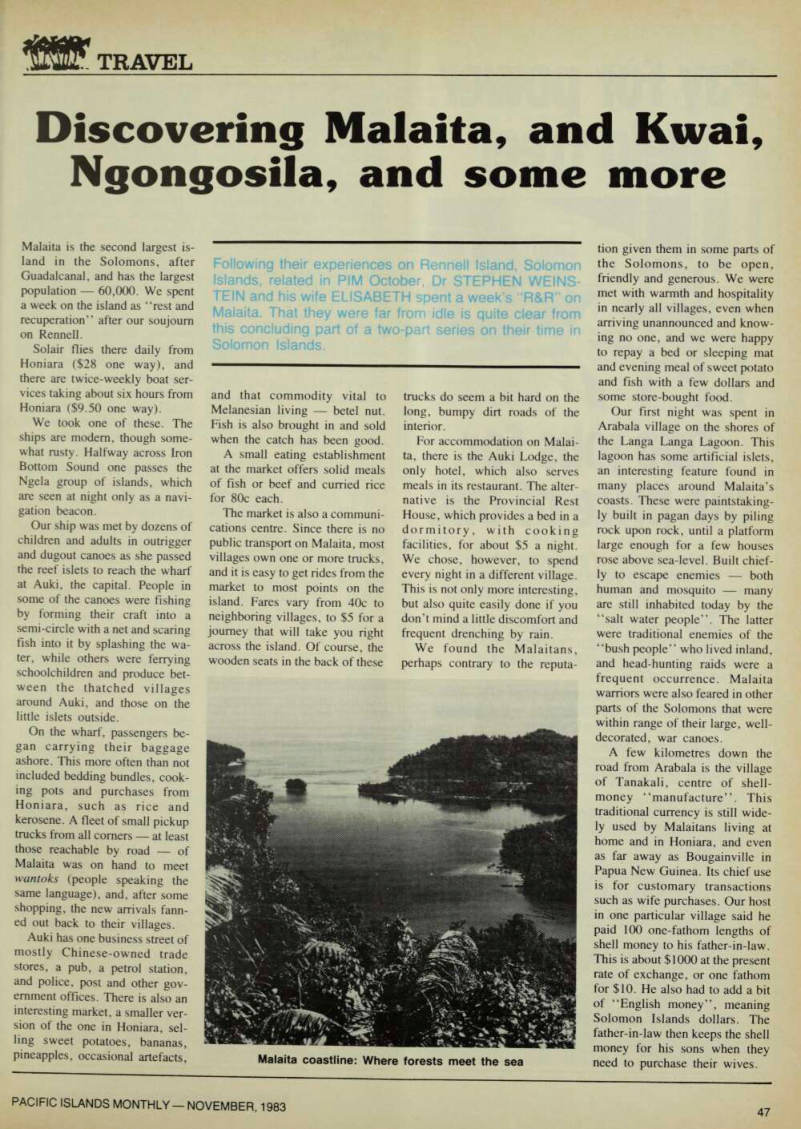
Malaita coastline: Where forests meet the sea
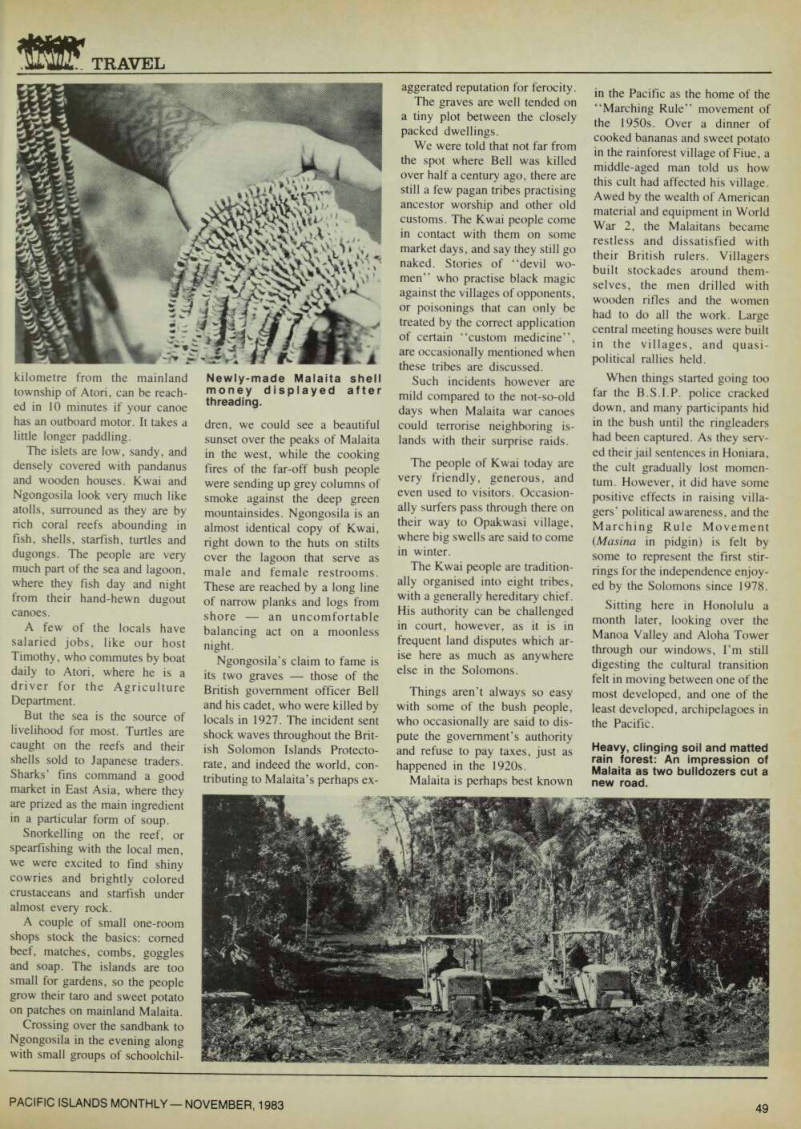
The shell-money is made by chipping certain shells and dril ling holes in them. These chips are then threaded into fathom strings and filed into smooth even discs by rubbing them on grooved stones. Ten fathoms are tied together to make an elabo rate belt worth $lOO. The value also depends on the colors, with red being the most prized since the shell is heat-treated to bring out the red color, hence more work is involved. Then come orange and white, with black the least appreciated.
Across the lagoon from Tanakali is the artificial island named Laulasi, the home of the shark-callers. This is one of the many villages on Malaita where the inhabitants still practise tradi tional ancestor worship, although some of them belong to the vari ous mission denominations.
Laulasi is one of the few partly commercialised attractions of Malaita, with tours going there from Auki Lodge. We visited the place by hiring a dugout canoe to take us across from Tanakali, but still had to pay a landing fee to go ashore at Laulasi. There my wife and I had to separate ac cording to the local custom, go ing to visit the male and female “custom houses” respectively, since these are taboo to the oppo site sexes. There were three male custom houses, each of which contained the skulls of the tribes’ founding chiefs or “big men”.
Those of lesser rank lay on the ground, while those of greater importance were wrapped in reed bundles and hung from the roof or placed on a shelf. The animist priest, or “custom man”, spoke to the skulls asking their permis sion for me to photograph them.
Outside the shrine lay more skulls from people whose identi ty was no longer known. When a chief of this particular village dies, even if in Honiara, his body is taken to decompose at a secret locality in the bush, and the skull later is brought back to its right ful resting place in the custom house.
The female part consisted of a small thatched house fenced in by a 60 cm stone wall. There were no windows, only a door way. Behind this structure
another thatched house, used during childbirth, once existed.
Now only a stone platform re mains to mark its location. It would appear that childbirth at least has become less taboo, and most women go to hospitals to have their babies.
However, as in many oceanic cultures, the monthlies are as sociated with their own set of restrictions. During menstruation the women stay in the thatched houses and are isolated from all contact with the rest of the vil lage. They must get their own food from the gardens on the mainland, and no one is allowed to give them anything or take anything from them. While I was there several women were oc cupying the house. In the dis tance I could see a boatshed with a large decorated war canoe, but I was not permitted to have a closer look or to take a picture.
Across the path from the cus tom houses (for living space is very cramped on an artificial island) are two stone enclosures where the sacrificial offerings for the sharks are kept prior to the ritual. These victims used to be human, but now pigs have taken their place. The ceremony is rarely performed and very com plicated, but we were shown the passage between the islets where the six-metre monsters swim in when summoned by the chants of the priest. A recent tour by film crews to film this ritual has in flated the price for staging the event to about $6OO.
Inland Malaita, the home of the “bush people”, is a land of rugged mountains, covered in dense rainforest, with tiny vil lages of thatched huts in small clearings. The gardens where the people grow sweet potato, the most important subsistence crop, are located on steep hillsides, often covered in fog or low cloud. It takes about three hours to cross Malaita from east to west, over cool mountain streams and sharp ridges. The bumpy ride was well worth it, because we were headed for the island of Kwai, one of the most idyllic places in the Solomons.
The twin islets of Kwai and Ngongosila are joined by a sand bank which is exposed at low tide. The islets, only about a
kilometre from the mainland township of Atori, can be reach ed in 10 minutes if your canoe has an outboard motor. It takes a
little longer paddling.
The islets are low, sandy, and densely covered with pandanus and wooden houses. Kwai and Ngongosila look very much like atolls, surrouned as they are by rich coral reefs abounding in fish, shells, starfish, turtles and dugongs. The people are very much part of the sea and lagoon, where they fish day and night from their hand-hewn dugout canoes.
A few of the locals have salaried jobs, like our host Timothy, who commutes by boat daily to Atori, where he is a driver for the Agriculture
Department.
But the sea is the source of livelihood for most. Turtles are caught on the reefs and their shells sold to Japanese traders.
Sharks’ fins command a good market in East Asia, where they are prized as the main ingredient in a particular form of soup.
Snorkelling on the reef, or spearfishing with the local men, we were excited to find shiny cowries and brightly colored crustaceans and starfish under almost every rock.
A couple of small one-room shops stock the basics: corned beef, matches, combs, goggles and soap. The islands are too small for gardens, so the people grow their taro and sweet potato on patches on mainland Malaita.
Crossing over the sandbank to
Ngongosila in the evening along
with small groups of schoolchil
aggerated reputation for ferocity.
The graves are well tended on a tiny plot between the closely packed dwellings.
We were told that not far from the spot where Bell was killed over half a century ago, there are still a few pagan tribes practising ancestor worship and other old customs. The Kwai people come in contact with them on some market days, and say they still go naked. Stories of “devil wo men’’ who practise black magic against the villages of opponents, or poisonings that can only be treated by the correct application of certain “custom medicine”, are occasionally mentioned when these tribes are discussed.
Such incidents however are mild compared to the not-so-old days when Malaita war canoes could terrorise neighboring is lands with their surprise raids.
The people of Kwai today are very friendly, generous, and even used to visitors. Occasion ally surfers pass through there on their way to Opakwasi village, where big swells are said to come in winter.
The Kwai people are tradition ally organised into eight tribes, with a generally hereditary chief.
His authority can be challenged in court, however, as it is in frequent land disputes which ar ise here as much as anywhere else in the Solomons.
Things aren’t always so easy with some of the bush people, who occasionally are said to dis pute the government’s authority and refuse to pay taxes, just as happened in the 19205.
Malaita is perhaps best known
dren, we could see a beautiful sunset over the peaks of Malaita in the west, while the cooking fires of the far-off bush people were sending up grey columns of smoke against the deep green mountainsides. Ngongosila is an almost identical copy of Kwai, right down to the huts on stilts over the lagoon that serve as male and female restrooms.
These are reached by a long line of narrow planks and logs from shore an uncomfortable balancing act on a moonless
night.
Ngongosila’s claim to fame is its two graves those of the British government officer Bell and his cadet, who were killed by locals in 1927. The incident sent shock waves throughout the Brit ish Solomon Islands Protecto rate, and indeed the world, con tributing to Malaita’s perhaps ex
in the Pacific as the home of the “Marching Rule” movement of the 19505. Over a dinner of cooked bananas and sweet potato in the rainforest village of Fine, a middle-aged man told us how this cult had affected his village.
Awed by the wealth of American material and equipment in World War 2, the Malaitans became restless and dissatisfied with their British rulers. Villagers built stockades around them selves, the men drilled with wooden rifles and the women had to do all the work. Large central meeting houses were built in the villages, and quasi political rallies held.
When things started going too far the 8.5.1. P. police cracked down, and many participants hid in the bush until the ringleaders had been captured. As they serv ed their jail sentences in Honiara, the cult gradually lost momen tum. However, it did have some positive effects in raising villa gers’ political awareness, and the Marching Rule Movement (Masina in pidgin) is felt by some to represent the first stir
rings for the independence enjoy
ed by the Solomons since 1978.
Sitting here in Honolulu a month later, looking over the Manoa Valley and Aloha Tower through our windows, I’m still digesting the cultural transition felt in moving between one of the most developed, and one of the
least developed, archipelagoes in
the Pacific.
Heavy, clinging soil and matted rain forest: An impression of Malaita as two bulldozers cut a new road.
Newly-made Malaita shell money displayed after threading.