pots of Papua New Guinea
p. 45 · Read in the full issue
Honor is done to the pots of Papua New Guinea
The Traditional Pottery of Papua New Guinea. By Patricia May and Margaret Tuckson.
Published 1982 by Bay Books Pty Ltd, 61-69 Anzac Parade, Kensington, NSW 2033, Aust ralia. ISBN 0 8 5835 5337. Price $A99.50.
The last decade has seen a flood of books about Papua New Guinea, from the popular ac count to the turgid academic treatise. Lacking among these have been works dealing in depth with traditional arts and crafts, with the notable exceptions of Crawford on the Gogodala and Kirk/Strathem on body decora tion. May and Tuckson offer here a detailed study based primarily on field observation of one of the most fascinating and distinctive Papua New Guinea crafts.
The book provides an historic al chapter reviewing the ar cheological evidences for the area, especially its pre-historic pottery, and then a general chap ter on potting clays and techni ques. This chapter makes heavy reading, but is essential for
understanding the nine chapters
that follow dealing with the specific pottery industries. These chapters cover 10 provinces and the western part of Solomon Is lands. Irian Jaya is not included.
There is a glossary of technical terms and comprehensive inde xes to the text and the many illustrations.
The emphasis of the book is on description, both verbal and visual, drawn from the authors’ personal experiences wherever possible. Over nearly a decade they travelled, sometimes to gether, to as many pottery making centres as they could.
Only the Watut Valley, Sinasina, Mailu, the northern Solomons and a few parts of the Sepik were not visited, and for these areas they have had to rely on informa tion drawn from other sources.
Such an energetic pursuit of their study allows them to write with authority, for they watched pot-
tery-making and firing in most of the villages visited. These first hand experiences also allow May and Tuckson to talk about the potters as individuals, adding a human touch which is often mis sing from books on non-Westem art and craft.
Patricia May lectures on fine art at the Australian National University, and Margaret Tuck
son is a well-known Sydney pot ter. This combination has proved a most valuable one, resulting in a book of excellent quality and coverage. As the authors re peatedly observe, in many parts of Papua New Guinea pottery vessels are being replaced by metal pots, and in some areas the replacement is complete. In this sense, the book has an archival
quality; it is an historical docu ment. May and Tuckson recog nise this when they express the hope that the book will “stimu late the interest and pride of both the established potter and the young people in whose hands lies the fate of the country’s ceramic traditions”.
Noble sentiments, indeed, but I can’t help feeling that they are somewhat misplaced. The price of the book alone will confine its circulation in Papua New Guinea to a privileged few. The fate of the pottery industries will be de termined as much by perceptions of relevance as by “interest” and “pride”. Many potters formerly worked to produce goods for trading, as part of traditional social and economic systems long since disrupted by Western influences. In the absence of these fundamental reasons for production, the pottery industries may have to be redirected, as has happened in Madang, to new markets with cash income as an objective. Unless there is im aginative marketing, I suspect that only a few industries will survive. Which ones these will be is likely to be determined by external forces. The book does not really come to terms with issues such as these.
The authors set out to produce a descriptive record of pottery manufacture and have produced a work which fully achieves this aim. They have been well served by their p produced a most attrac tive volume.
I believe some of the photo graphs suffer a little from poor quality control, but, since the majority are of excellent quality, this is a minor quibble. I recom mend the book to anyone with an interest in traditional crafts of the Pacific, and expect archeologists working with pottery to be using the book regularly as a source of basic information.
They will regret, I suspect, the lack of a comprehensive analysis of the various styles, and of the social context of potters and their wares. To have achieved that, however, would have doubled the production time, and size and cost of the book. As it stands, the book justifies its high cost and has a wide appeal. Jim Specht.
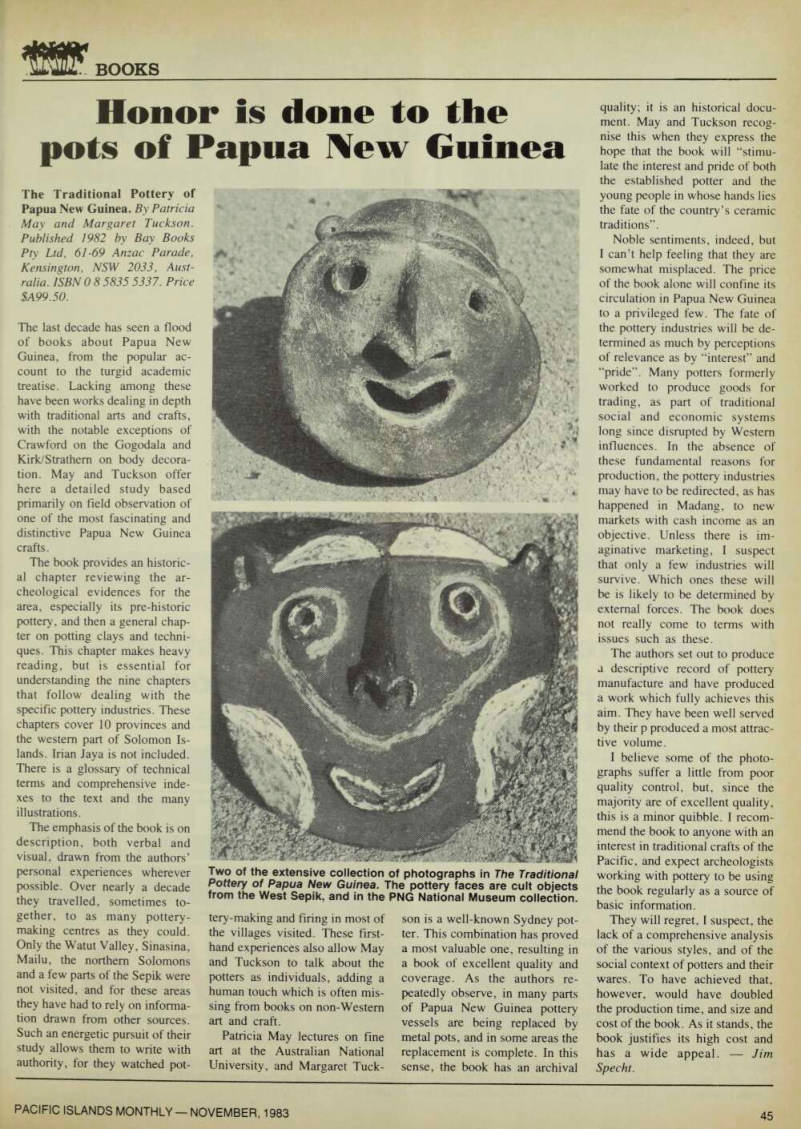
Two of the extensive collection of photographs in The Traditional Pottery of Papua New Guinea. The pottery faces are cult objects from the West Sepik, and in the PNG National Museum collection.