‘getting organised' in PNG
pp. 43-44 · Read in the full issue
Books
Economics and politics of ‘getting organised' in PNG
Micronationalist Movements in Papua New Guinea. Edited by R. J. May. Published by Aust ralian National University Press, Canberra, 1982. ISBN 0 908160 275. Price $A9.50.
This is a collection of 12 essays about 10 recent movements in Papua New Guinea. It is not clear whether every one of the nine authors sees the movements as an expression of nationalism, but Dr Ron May, editor and contributor of two essays, in troduction and conclusion, sees them thus.
Two of the movements are in the Bismarck Archipelago, three in coastal New Guinea, one in the Highlands, and four in Papua. The editor has grouped Peli Association and Pitenamu Society (PS) as “Marginal Cargo Cults”, Napidakoe Navitu, Mataungan Association, Nemea Landowners’ Association and Ahi Association as “Local Pro test Movements”; the two move ments in the Trobriand Islands and Damuni Association as
“Self-help Development Move
ments”; and Papua Besena and Highlands Liberation Front (HLF) as “Regional Separatist Movements”. After reading the 448 pages of text and 17 pages of references, it seems to me that there is so much overlap of the social environment and objec tives of the 10 movements that grouping them is futile. What R.
Adams observes of the Pitenamu Society can be taken as the basis for considering them all: ... a genuine grassroots movement which has developed at this period of the country’s development quite spontaneously without external sup port or guidance ... a broad move towards integration, a demand for recognition and autonomy and for social and economic advance based upon traditional collectivism and leadership patterns ... a movement that seeks, through a mixture of old and new, the combination of tradi tional magico-religious beliefs and modem economic processes, to re gain for people control over their own affairs. In these respects it may be seen as Utopian and futile, yet it
represents a clear desire for change, a demand for freedom and autonomy and a response to the colonial system and the processes of peasantisation induced by the intrusion of the capitalist market system.
Adams suggests that the gov ernment needs to have a “sym pathetic understanding” of the way in which these movements have come about and how they operate, so that it can then “pro mote new ideologies of change and development” which will help the people to make more effective use of their resources.
Now, every one of these move ments has frittered away re sources, to the detriment not only of its adherents but of the nation as well. Even if one sees Papua Besena and the HLF as primarily political movements, one must keep in mind that the over whelming majority of people in PNG and elsewhere take to polit ics to obtain a greater share of the “economic cake”, the available and potential resources. This makes particularly good sense in a new nation such as PNG, where colonialism did not offer the populace an opportunity to obtain material benefits equal to, let alone greater than, those
gained by the colonial rulers.
Right now, PNG’s national polit ics are 99 per cent about the economic cake, with Father John Momis, MP, and a few people outside parliament, such as Ber nard Narakobi, the ideologically concerned one per cent.
Cargo cults often have politic al undertones, the cargo being seen as a power symbol. As long ago as 1950, Hogbin observed that New Guineans had been plunged into a psychological morass by the introduction of a second (the European) set of moral standards, and that a strong, authoritarian leader of fered a way out by revealing a ready-made answer to all prob lems. Such leadership has been a feature of the movements de scribed in these essays. The young men who led the HLF, for instance, were men of two worlds (as were the middle-aged bikmen entrepreneurs who sup ported them), and the HLF is, therefore, a very different kind of movement from, say, the Peli Association with its charismatic but tradition-bound prophet, Matthias Yaliwan, who, unable to “handle” the modem power structure, resigned his seat in the House of Assembly.
On the surface, the Kabisawali Movement and its opponent, the Tonenei Kamokwita Movement, in the Trobriand Islands, seem to be organisations to give villagers
material benefits through modem business, while endeavoring to accord a respected place to tradi tional chiefly power. Some ob servers may wonder, though, whether the personal struggle between the leaders of the two movements, both of whom have much knowledge of the world outside PNG, has been the decid
ing factor.
The leadership question has been important, too, in Napidakoe Navitu, the move ment among villagers in the cop per mining area of Northern Sol omons Province which made the colonial government change the minerals policy, to the benefit of the local people and the country as a whole. And the Mataungan Association, the biggest and politically most influential of the 10 movements, too, would not have gained such prominence and achieved some of its aims had it not “thrown up” the re
quisite leadership.
Of the 12 essays, lan Grosart’s on the Mataungan Association, written after 10 visits to the Gazelle Peninsula over almost 20 years, is of particular interest.
For one thing, the Tolai people are among the wealthiest and most sophisticated in the coun try; for another, nationalism bey ond the micro-level has charac terised the association’s leader ship, for all its understandable emphasis on achieving that grea ter slice of the economic cake.
That as many as 10,000 people were mobilised for street de monstrations was, if Grosart is right, because of “the oldest grievances’’ concerning land and power, and the successful com ing together of the “Red” Tolai, the young, educated and sophis ticated, and the “Black” Tolai, the tradition-bound older people.
Even then, a catalyst seems to have been needed, and the colo nial power’s failure to meet the Reds’ job expectations and the Blacks’ demands for a return of alienated lands provided that catalyst. Of the 10 movements, Mataungan Association and, to a lesser degree, Papua Besena and HLF were without undertones of cargo cultism; but they, too, were a “demand for freedom and autonomy and a response to the colonial system and the proces ses of peasantisation induced by
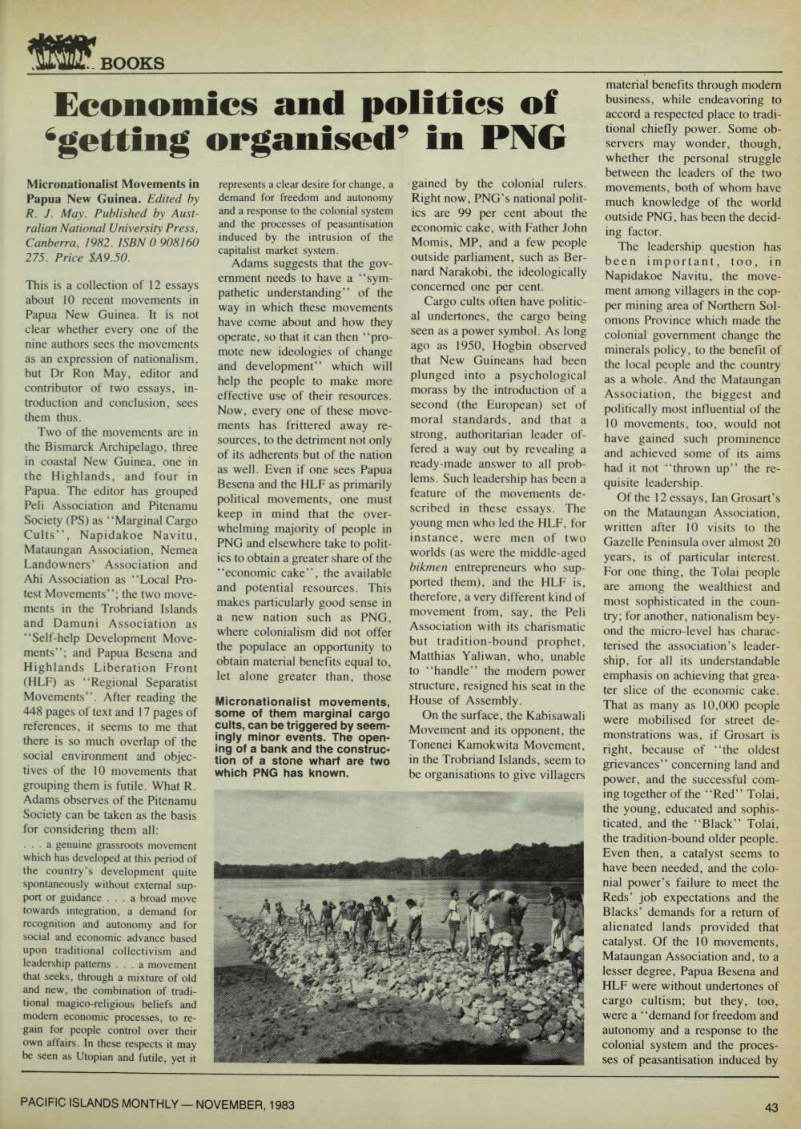
Micronationalist movements, some of them marginal cargo cults, can be triggered by seem ingly minor events. The open ing of a bank and the construc tion of a stone wharf are two which PNG has known.
the intrusion of the capitalist sys tem.” People want their bellies filled before they concern them selves with ideological politics.
Nationalism has, therefore, not been high on the villagers’ agenda.
Each essay is well worth read ing and deserves a mention here.
For brevity’s sake, this review must end with a comment on Adams’s essay on the Pitenamu Society because the PS is a very good example of the amalgam of cargo cult, consistent busines s/investment orientation, emerg ence of bikmen bilong bisnis and fringe politics which, I believe, is found in many development corporations, co-operatives and other business group ventures outside urban areas. The PS operated in the Pindiu area, Finschhafen district, Morobe province, between 1971 and 1974. From the 1950 s on, two enterprises with shareholders throughout the Finschhafen dis trict, namely Finschhafen Mar keting & Development Society, a co-operative under the aegis of the colonial government, and Native Marketing & Supply
Company, sponsored by the
Lutheran Mission, had marketed villagers’ primary produce and operated village stores and coas tal shipping. Their shareholders became dissatisfied with the re turns from their produce and the cost of goods; inland villagers, in
particular, were disappointed as
the logistics disadvantaged them.
The area had had cargo cults from as long ago as the 19305, and the failure of a company formed by a European entre preneur in the late 1960 s and financed by the villagers was the last straw.
In retrospect, it seems that the promoters of the PS could rightly and, no doubt, did point out to the people that every ven ture with European help had not met their expectations and that the cults had been abortive, too.
The promoters used the local cult technique, with its planting of tanket (a red-leafed shrub) and the thinking behind it, but they gave priority to economic objec tives in the modem sense and went about organising the PS in a businesslike manner. Dividing the area into spheres of influence led by a traditional bikman or, at
least, having him up front, and encompassing Pindiu people settled at Lae and elsewhere, the PS’s leaders succeeded in raising funds to operate passenger motor vehicles on the Lae-Wau road, and to conduct village stores.
There was, moreover, an attempt to link up with the emerging Pangu Pati, the political party which, in 1975, provided the nation’s frst prime minister.
That the PS went broke was not because of a lack of grassroots support or objectives but because of the inadequacy of managerial skill at all levels and the failure to understand modem business among all but a small number of the shareholders. That small number, one must assume, were the individuals who came out of the PS debacle as successful en trepreneurs on their own account.
Many of the wealthy local businessmen in PNG today have cut their business teeth as em ployees or directors of co operatives, development corpo rations or other group business ventures. If capitalism continues on its seemingly inexorable way, its ethic replacing traditional values, these businessmen and like-minded politicians and publ ic servants may deal with move ments like those described in these essays much more harshly than the colonial government dealt with them. In any case, continuing modernisation of al most every aspect of life is re moving the conditions for the emergence and survival of such movements.
As so often happens with the publication by academic presses of collections of essays, this col lection has been so long in the making that most of the essays do not deal with the current situation. Then, too, only one of the essays is by a Papua New Guinean. Even so, one would be hard put to find better value for $9.50 and, most important, it is precisely the kind of information offered by Dr Ron May and his collaborators which Papua New Guinea’s political decision makers need and must consider if national development is to be achieved at the least possible cost to the freedom and dignity of
every citizen.
Harry H.
Jackman.