People
pp. 37-41 · Read in the full issue


Harry Ewing, 57, has stepped down as managing director of the Papua New Guinea Banking Cor poration. He has been succeeded by Mekere Morauta, a former finance secretary who was ap pointed managing director designate last April.
“Wildcat” in the Sydney weekly magazine The Bulletin, wrote in tribute to Ewing: He earned a reputation as the straight player who got results.
Notable among them: A lift in the market share of commercial banking business to 52 per cent (it had 25 per cent in 1974, its foundation year) and a five per cent lift in net profit last year, a creditable record in PNG’s present economic straits.
Under Ewing, who left a 10-year stint in hotel finance with the Travelodge chain to take up the PNGBC job in 1978, the bank has led the way in staff training and develop ment, computerisation and in tak ing its business to the bush, where most of PNG’s people are.
Key elements in the latter project have been the bank’s motor boat Nambawan (Number One) and last year’s purchase of an executive air craft. Ewing ran into some flak on that one but, characteristically, he decried the criticism as “media over reaction”.
Of his plans for after he “goes finish”, Sydneysider Ewing says he’ll “take a breather for a while”.
His pursuits include squash, tennis and game fishing.
The United States Peace Corps in Fiji and Tuvalu has a new direc tor. He is John J. Finnegan, Jr., formerly deputy director of the Peace Corps in the Philip pines. He replaces Ms Sue Greene who has returned to the United States.
Dr Terry Crowley, who has been teaching linguistics at the University of Papua New Guinea for the past five years, has ar rived in Port-Vila to work as co ordinator of the newly establish ed Pacific Languages Unit of the University of the South Pacific.
The unit has been set up to promote and teach linguistic studies throughout that sizeable part of the Pacific region in which the USP operates. Port- Vila has been selected as the base for the new unit partly because of
Vanuatu’s linguistic diversity
(104 indigenous Austronesian
languages, plus Bislama, English
and French), and partly because of Vanuatu’s central location.
The unit will not only promote awareness and understanding within the linguistic field, but will make it possible for people throughout the region to study for formal qualifications in lan guage studies at certificate, de gree and diploma level. Included in the initial range of courses are
Basic Linguistics (currently be
ing taught in Port-Vila and by correspondence in the Solomons, Kiribati, Western Samoa and the Cook Islands), and Translation Techniques (to be taught over the Christmas period in Port-Vila and Tuvalu).
As a further part of the unit’s program, Professor John Lynch, head of the Language Department at UPNG, will be visiting Vanuatu later in the year to work with some local teachers from Tanna on preparation of materials that will help to make it possible for the Tanna languages to be used as the medium of instruction in the first years of primary schooling on that island.
Professor Lynch has published a dictionary and a grammar of Lenakel, one of the five lan guages indigenous to Tanna.
David Walsh.
Tongan boxer Sani Fine lost his bout with the Fiji Government in September when it was officially announced that he had not met all
requirements for continuing to
live in Fiji, and would have to quit the country. The announce ment gave no details.
As a member of the Fiji box ing team, Fine won a gold medal in the light-heavyweight division at the 1982 Commonwealth Games in Brisbane.
Under the headline “Bruta Hen ry: Sept. 6 could be start of reconciliation”, The Marshall Islands Journal, on the eve of the
republic’s September 7 plebis
cite, carried the following letter of farewell to Micronesia by
Brother Henry Schwalbenberg.
Brother Schwalbenberg, a Jesuit lay brother from the United States, has been advising the people of the Trust Territory on the intricacies of negotiations over their compacts of free as sociation with the U.S.
Dear Editor. For all practical purposes, my educational work and the educational work of ComPolEd is finished now that the political cam paigns for and against the Compact are fully underway during these last three weeks before the plebiscite.
I thought, however, that a letter to the editor at this time might be a good way to say thanks. I do not speak your language and I do not know many of your customs, but many of you have listened to me and trusted me to be fair and impartial. In return I am honored to have been your guest. I hope I have done a fair job in trying to educate the people. I have tried my best to be as fair as possible and just give basic information in a way that most people would under
stand. Forgive me if at times I was not very clear. And I hope I did not bore too many people.
Now that most of my education work for you is done I guess that maybe my real work for you is just beginning. As a Jesuit I believe I have a special obligation to pray for you. So each day when I attend Mass I will offer it to the Lord for you. I will be asking the Lord to heal the divisions among you and to guide you in making a wise decision on
September 7.
As some of you know on Septem ber 6, the day before the plebiscite, no campaigning will be allowed on the radio. I think that this day could be a very valuable time for people to relax, to cool off, to weigh quietly the pros and cons and come to a decision on whatever you feel is the best for everyone. Unfortunately,
during political campaigns it is very easy to get carried away and say things that hurt other people. So maybe September 6 could be a spe cial day for peace, prayer, and the beginning of reconciliation.
With respect and gratitude.
Bruta Henry.
Peter Mason, group accountant for the Papua New Guinea com pany Dobel Farming & Trading Pty. Ltd., has paid warm tribute to Papua New Guinean adminis trator and businessman, Paul Po ra, who was appointed earlier this year as chairman of the board of the Papua New Guinea Banking Corporation. Mr Pora is also chairman and managing di rector of the Dobel group.
In a speech to a luncheon in Mt Hagen marking his PNGBC appointment, Mr Mason traced Paul Pora’s career from child hood in Mt Hagen, and secon dary school studies at Sogeri
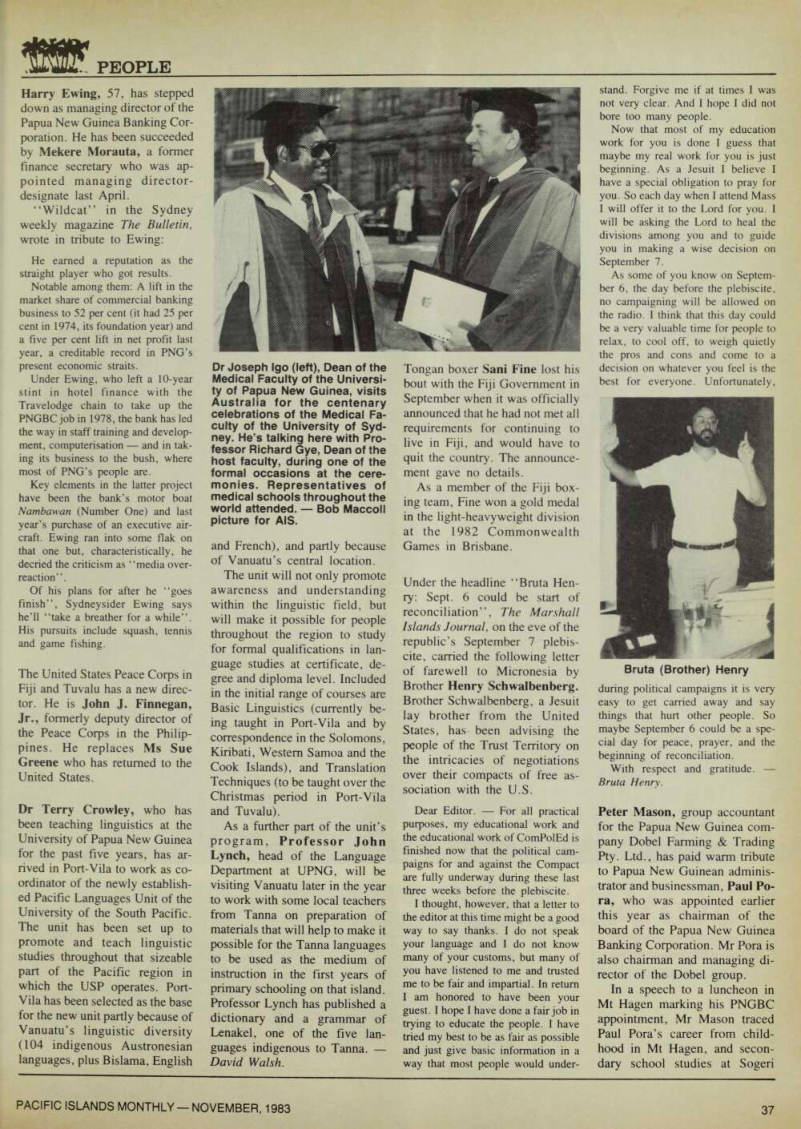
Dr Joseph Igo (left), Dean of the Medical Faculty of the Universi ty of Papua New Guinea, visits Australia for the centenary celebrations of the Medical Fa culty of the University of Syd ney. He’s talking here with Pro fessor Richard Gye, Dean of the host faculty, during one of the formal occasions at the cere monies. Representatives of medical schools throughout the world attended. - Bob Maccoll picture for AIS.
Bruta (Brother) Henry
High in Port Moresby. His first job after leaving school was with the Reserve Bank of PNG. While with the bank he attended the Business Administration Col lege, earning a certificate of public administration in 1966.
He was appointed as the bank’s registrar of loans and research officer. He continued his studies and in 1972 graduated Bachelor of Economics at the University of PNG.
In 1974 he was appointed town clerk of his home town, Mt Hagen. Said Mr Mason: “During his five years in office, Mt Ha gen changed for the better. Kerb ing and drainage were in troduced, and the beautiful trees which divide the main street
were planted. PNG’s Mt Hagen Market was built under council direction, and remains under council control.’’
While still serving as town clerk Mr Pora was appointed chairman of the board of Air Niugini, and his seven years in that post are still remembered as years of achievement for the air line, said Mr Mason.
Paul Pora was awarded the MBE in 1978 in recognition of his public service, and his business activities including the development of the Dobel coffee plantation, wholesale
trading, freight haulage, and
motor dealerships earned him the title of PNG’s Businessman of the Year in 1982.
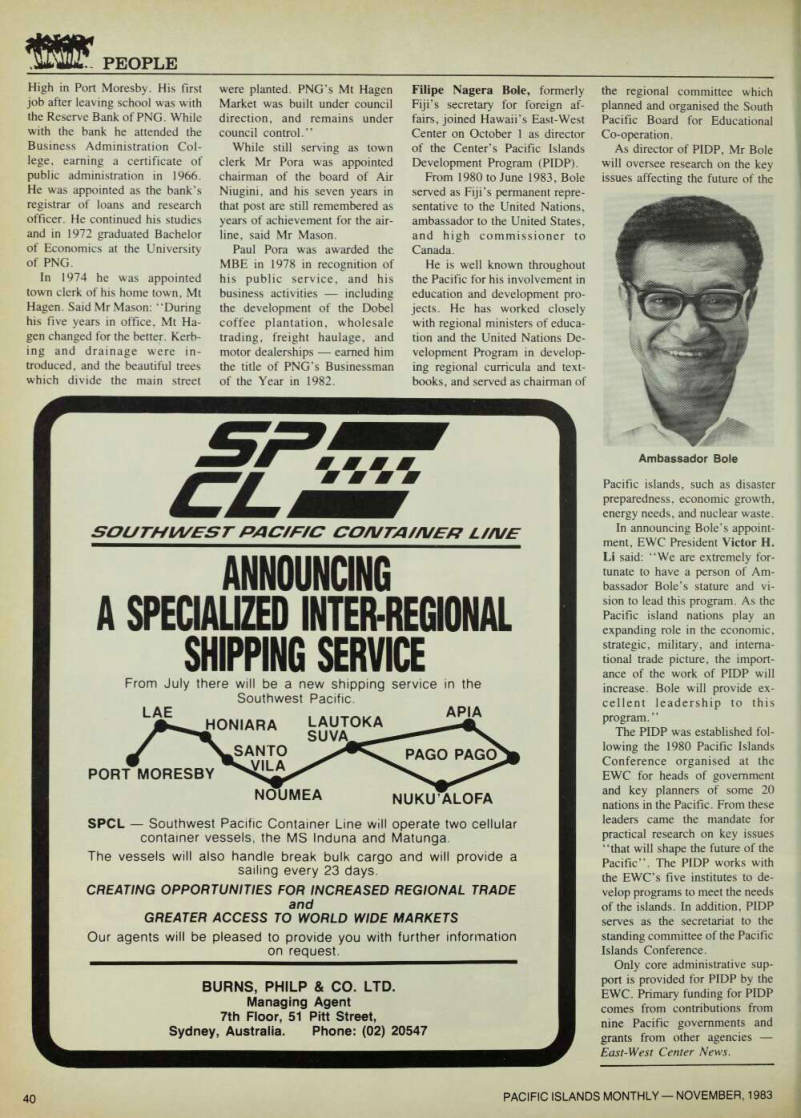
Filipe Nagera Bole, formerly Fiji’s secretary for foreign af fairs, joined Hawaii’s East-West Center on October 1 as director of the Center’s Pacific Islands Development Program (PIDP).
From 1980 to June 1983, Bole served as Fiji’s permanent repre sentative to the United Nations, ambassador to the United States, and high commissioner to Canada.
He is well known throughout the Pacific for his involvement in education and development pro jects. He has worked closely with regional ministers of educa tion and the United Nations De velopment Program in develop ing regional curricula and text books, and served as chairman of
the regional committee which planned and organised the South Pacific Board for Educational
Co-operation.
As director of PIDP, Mr Bole will oversee research on the key issues affecting the future of the
Pacific islands, such as disaster preparedness, economic growth, energy needs, and nuclear waste.
In announcing Bole’s appoint ment, EWC President Victor H.
Li said; “We are extremely for tunate to have a person of Am bassador Bole’s stature and vi sion to lead this program. As the Pacific island nations play an expanding role in the economic, strategic, military, and interna tional trade picture, the import ance of the work of PIDP will increase. Bole will provide ex cellent leadership to this
program.’’
The PIDP was established fol lowing the 1980 Pacific Islands Conference organised at the EWC for heads of government and key planners of some 20 nations in the Pacific. From these leaders came the mandate for practical research on key issues “that will shape the future of the Pacific’’. The PIDP works with the EWC’s five institutes to de velop programs to meet the needs of the islands. In addition, PIDP serves as the secretariat to the standing committee of the Pacific Islands Conference.
Only core administrative sup port is provided for PIDP by the EWC. Primary funding for PIDP comes from contributions from nine Pacific governments and grants from other agencies
East-West Center News.
Ambassador Bole
Tourist establishments set up outside Noumea in Melanesian areas of New Caledonia have had their share of problems, the latest and most dramatic being the de struction by fire of the resort hotel on the island of Ouvea in the Loyalty group (PIM Oct. p 5).
But one man who seems to have the answer to all the prob lems is Henry Fairbank, prop rietor of the Relais de Koulnoue, near Hienghene on the northeast coast of the big island.
When Kevin Voltz, travel editor of the Sydney Sunday pap er The Sun-Herald, visited Koul noue earlier this year he found that he couldn’t lock the door of
his Melanesian-style bungalow.
“No need to,” said Mr Fair bank. “We’ve never had any trouble with thieving here. The natives are good people.”
Voltz commented: “Certainly, easy smiling Melanesians in the area do seem a friendly lot, and there’s no sign of the spraycan political graffiti that decorate the walls and fences in Poindimie, the east coast administration headquarters 62 kilometres to the southeast.
“Maybe it’s because Koul noue is a very laid-back sort of place. Crops thrive in the local villages. Henry seems to have no shortage of lobsters, crabs and other seafood to serve, and there’s nothing much to do ex cept eat, drink and laze or play tennis ...”
Whatever the reasons, good luck to Henry Fairbank, and to the friendly locals of Koulnoue.
Papua New Guinea’s new am bassador to Indonesia is Brian Amini, who will quit the post of
high commissioner in New Zea land to go to Jakarta. Mr Amini succeeds Benson Gegeyo, whose term in the key Jakarta post ends in December.
New Zealand’s Maoris may not yet have won the right to take part in the South Pacific Games for which they are striving, but they certainly won some hearts with their September presenta tion of a fully equipped ambu lance to the organisers of the 7th South Pacific Games in Apia.
The vehicle, manned by two am bulance men from New Zealand whose services also came free, was used throughout the Games.
At the presentation ceremony in Apia were the chairman of the New Zealand Maori Sports Fed eration, Dr Heanare Brough ton, the executive director of the Games, Seiulu Paul Wallwork, chairman of the organising com mittee, Peter Paul, secretary John Macdonald, and treasurer Tilafono Joe Hunter.
A former captain of Western Samoa’s national team, the Rev.
Faitala Talapusi, conducted a brief dedication ceremony of the vehicle, which bore the words Te rau Aroha tuarua. According to The Samoa Times, they mean “The Leaf of Love Number Two’’ in memory of the famous second Maori Battalion of the New Zealand Army.
With Dr Broughton at the ceremony were vice-chairman of the New Zealand Maori Sports Federation Frankie Dennis, and secretary Joy Martin.
Mr Dennis would not reveal the cost of the vehicle. “There is no price, because it comes from here,’’ he said, placing his hand on his heart.
Pacific Islanders resident in Syd ney were well to the fore in the 1983 Spring Fair held by the city’s Wesley Central Mission.
Miss Pacific Islands Mar garet Auva’a from Western Samoa came third in the fund raising contest staged to help the mission. Her tally was $A 14,000. (Miss International, representing Asian countries such as China and Indonesia, came first with $lB,OOO, and Miss Class of Senior Citizens elderly Australians second with $16,000). Total sum raised by all participants was a record $128,000.
The Spring Fair is one of many projects supported every year by Fijians, Rotumans, Samoans, Tongans and Australians through the Sydney-based Pacific Islan ders’ Council.
Chairman of the council is Margaret Auva’s’s father, the Rev. Fa’atoese Auva’a, who is associate minister at Wesley Central Mission with special re sponsibility for 12 Pacific Islands congregations around Sydney.
Members of the Pacific Islands Council, in association with the municipal councils of the Sydney suburbs of Ryde and Leichhardt, offered entertainments and Poly nesian-style feasts as part of Gar ni vale ’B3, a multi-cultural fes tival sponsored in September each year by the government of New South Wales.
The Organising Committee of the 7th South Pacific Games has presented a Games gold medal to Western Samoa’s Head of State Malietoa Tanumafili 11.
A spokesman for the commit tee said the presentation was to show the committee’s apprecia tion to the Western Samoan lead er for his contribution to the success of the event, especially for his opening and closing of the Games.
Henry Fairbank and one of the huts at the Relais de Koulnouè: “You don’t need locks here.”
Right: Margaret Auva’a wears her Miss Pacific islands sash.