the ‘marginal
pp. 31-35 · Read in the full issue

Tropicalites
Prominent Australian playwright Alexander Buzo has writ ten a play set in Fiji. Called The Marginal Farm, it opened at the Melbourne Theatre Company on November 1. Here he describes how he came to write it.
Drama set in
the ‘marginal
lands’ of
Fiji
I was fated to go to Fiji but I didn’t know it at the time. My father had been in Suva in 1939.
My aunt had been a governess to some children on a pineapple plantation in Ovalu in 1949. In 1968 I became a professional playwright. Then in 1978 I got an idea for a play set in Fiji.
At first it was to be called Godfrey Pollock, and was to be about an anguished adolescent from Melbourne sent out to the Pacific to find his feet working for CSR in the ’sos. (In those days that was what they did with anguished adolescents now they make television documen taries about them). Then Godfrey got the bullet when I decided the other characters were more im portant. I still liked the title, but eventually dropped it on the grounds that the audiences would expect to find a character called Godfrey Pollock in a play titled Godfrey Pollock. The new ver sion was and is called The Mar ginal Farm. It is still about someone trying to find their di rection in the Pacific.
The new central character is a teacher, Elspeth “Toby” Parks, who goes to Fiji in the 1950 s to teach the children of a CSR field officer and a field superintendent in the sugar cane country outside Lautoka. The nickname came ab out when her father thought she looked as ugly as a toby jug when she was bom, but she has since blossomed into a beauty who is now a bit over the hill in her late and widowed 30s. Un like my aunt, she votes Labor
and plays golf.
For my dramatic purposes it would have been ideal if World War II had ended in 1950 and Fiji had achieved independence in 1965. Then I could have had
Toby sliding off postwar Aust
ralia into newly emerging Fiji.
But with a little poetic licence I have set the play in the “1950 s and 19605” and it is about grow ing up and colonialism, about love and change, about Toby and an Indian called Illy and their battle to build a life in the mar ginal lands, that shady area that is neither the plains nor the mountains. As Toby helps her students towards adulthood, so the country is changing too.
My first research trip took me to Suva and Pacific Harbour in 1981, where I learned exactly nothing. I hadn’t formulated my plans for the play beyond know ing who the leading characters were, and that the theme would be about growing up and col onialism. I had been hoping that
something would happen to bring the play more acutely into focus, but nothing did. We swam, we played tennis, my three-year-old daughter was lionised, and we had a great Japanese meal cooked by Indians as we watched a group of Rarotongan entertain ers. We learned about the uses of pandanus leaves and not to put too much slice on a backhand volley, but that was about it. Of the real Fiji there was no sign.
I decided that another trip to Fiji was needed and that this time I would crack the shell. Before I left Australia I unknowingly took the decisive step in this cam paign: I went to a party at Len Evans’s wine cellars. There I met Nancy Keesing, who introduced me to her husband from CSR, who put me in touch with the CSR librarian, who introduced me to Joe Daniels, a former cane breeder in Fiji and someone who was highly, almost religiously, thought of by his colleagues in the islands. Joe gave me a letter of reference to Abdul Jusef, the head of the Fiji Sugar Corpora tion, and he rang Joe Osborne, an FSC field superintendent who introduced me to Aliki Nakaitini, and with Aliki I finally struck gold. He took me around the cane farms, and I met the people.
went into their homes, and left my tourist mentality behind.
Aliki was the field officer at Navo, outside Nadi, and his house was cheerfully invaded at all hours by cane farmers with problems and cane farmers with out problems. I learned to drink kava and not to ask Indians if they had ever thought of going “back to India” (they come from Fiji), ate seaweed and discovered that the FSC does not provide floodgates, etc.
The big break came one still afternoon at the homestead of an Indian cane-farming family. We sat outside and sipped tea and I was reminded of my early child hood in Brisbane, that feeling just past mid-aftemoon when the heat falters and then relaxes its grip, and you wonder what the fuss was about the whole of life is laid out at your feet.
On this afternoon a light breeze played about in victory as an old Indian cane farmer spoke of his early days in Fiji. He preferred the white overseers of the CSR days to the current crop of local office-holders. I asked Aliki what he thought of that comment. “Not too much,” he said, and we both laughed. La ter, I said we’re always being told in Australia that things go better with overseas controllers.
We laughed again at the liberat ing absurdity of this. I learned to laugh in Fiji, that deep laugh that comes when you realise if only momentarily that the whole of life is laid out at your feet.
Having cracked the shell of Fiji, I next had some slogging practical work to do. The title The Marginal Farm came from the areas designated as “margin al lands”. At first cane farms were only established on the flat lands, but in the 19505, the time in which most of the play is set, breeders discovered new kinds of cane that would grow in the foothills. These marginal lands were taken over for cultivation by Indian farmers who could at last own their land after years of being a dispossessed race.
Until recently Indians could not own land in Fiji because of the Native Lands Act. Illy, the Indian m the play, carries with him the feeling of being trans planted, one of the dispossessed
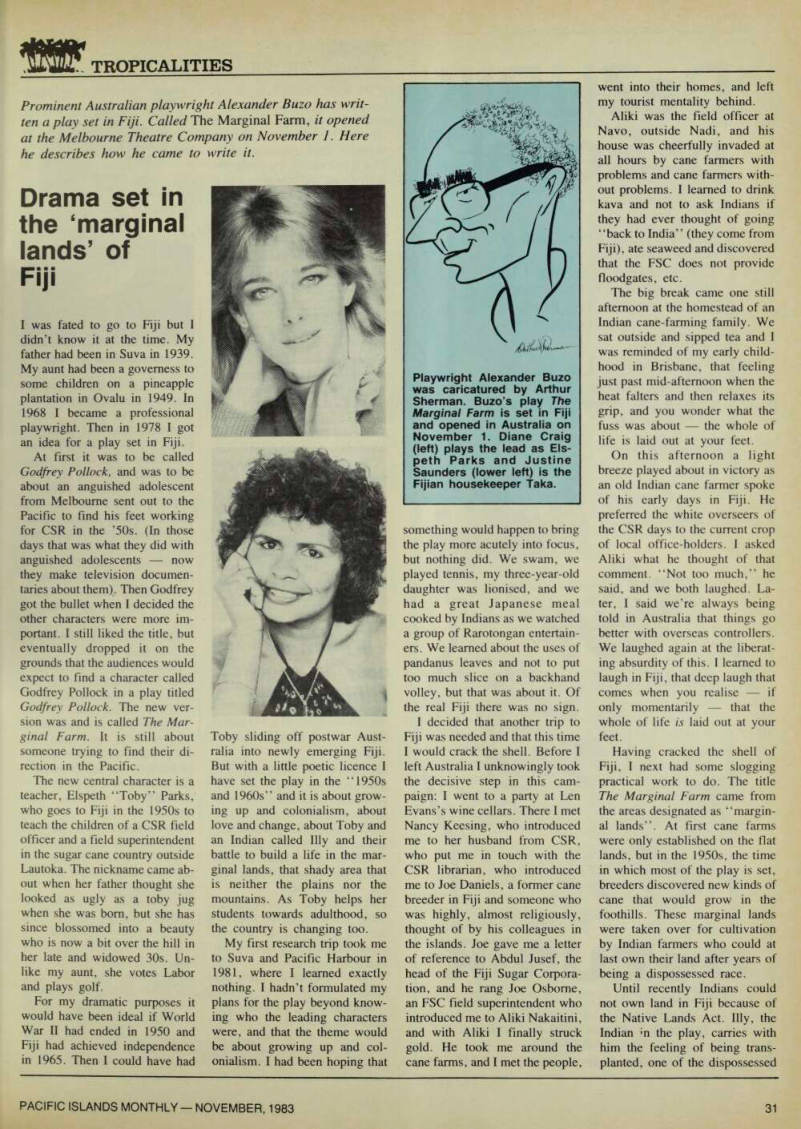
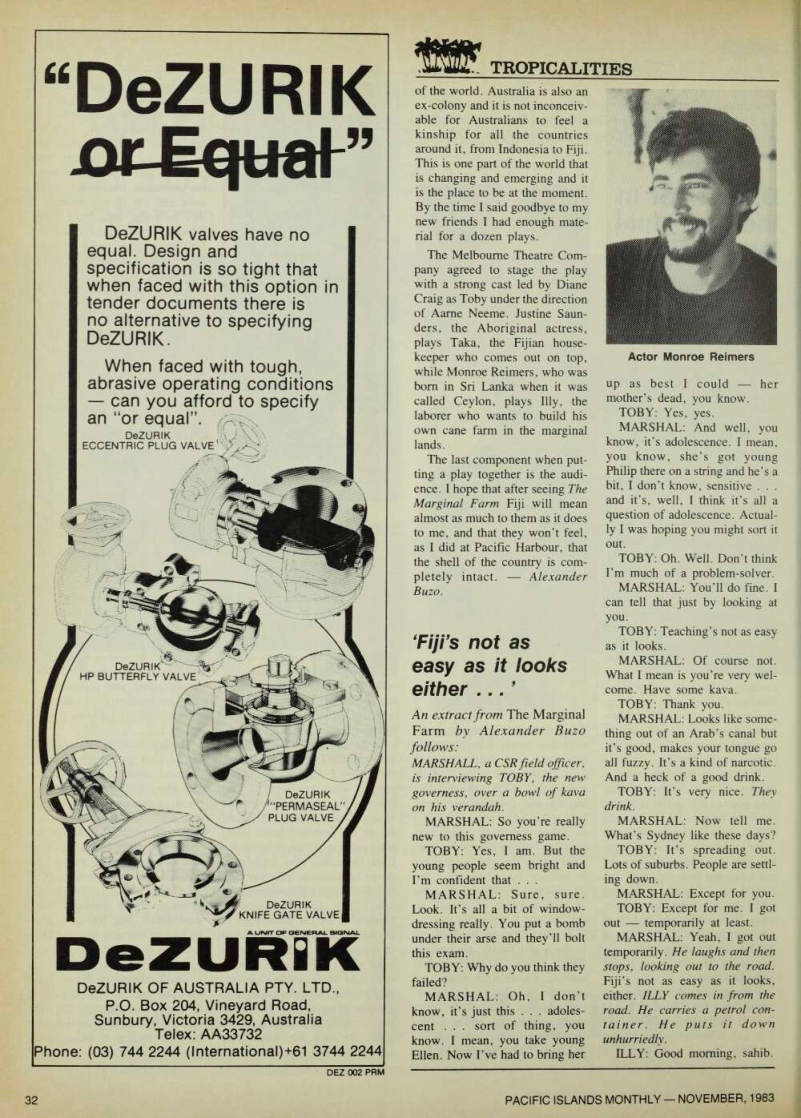
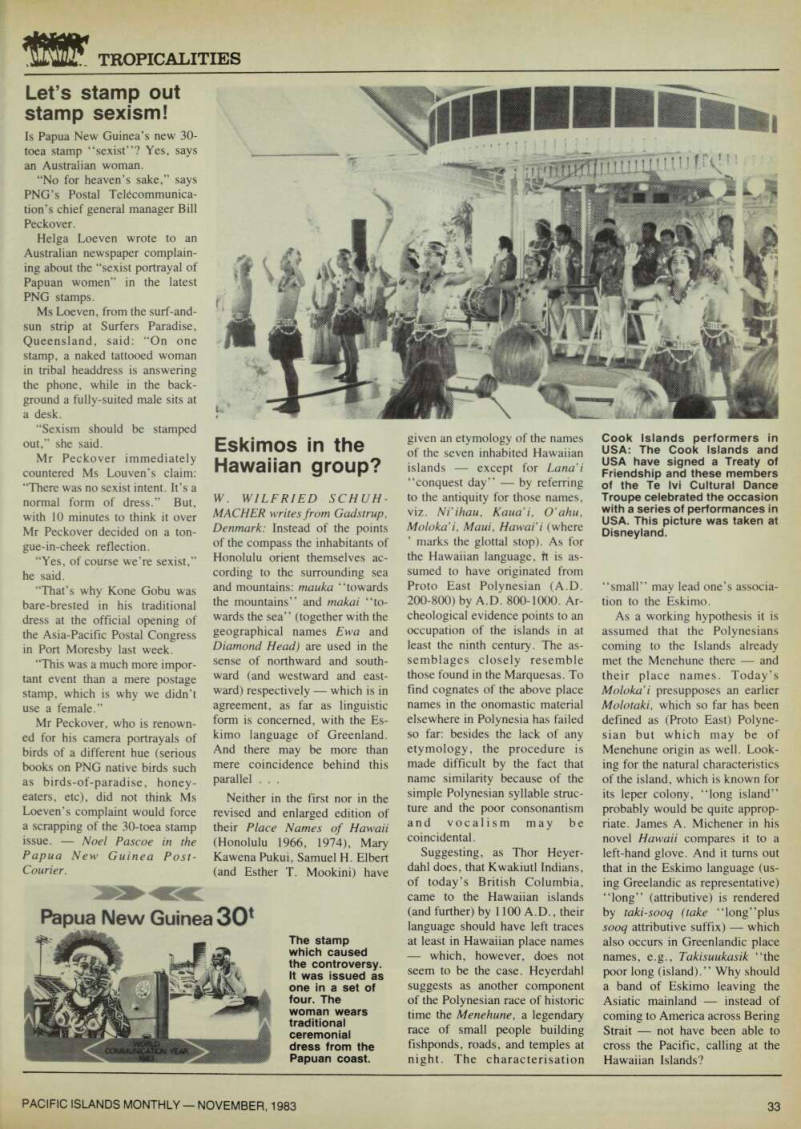
Playwright Alexander Buzo was caricatured by Arthur Sherman. Buzo’s play The Marginal Farm is set in Fiji and opened in Australia on November 1. Diane Craig (left) plays the lead as Els peth Parks and Justine Saunders (lower left) is the Fijian housekeeper Taka.
of the world. Australia is also an ex-colony and it is not inconceiv able for Australians to feel a kinship for all the countries around it, from Indonesia to Fiji.
This is one part of the world that is changing and emerging and it is the place to be at the moment.
By the time I said goodbye to my new friends I had enough mate rial for a dozen plays.
The Melbourne Theatre Com pany agreed to stage the play with a strong cast led by Diane Craig as Toby under the direction of Aame Neeme. Justine Saun ders, the Aboriginal actress, plays Taka, the Fijian house keeper who comes out on top, while Monroe Reimers, who was bom in Sri Lanka when it was called Ceylon, plays Illy, the laborer who wants to build his own cane farm in the marginal lands.
The last component when put ting a play together is the audi ence. I hope that after seeing The Marginal Farm Fiji will mean almost as much to them as it does to me, and that they won’t feel, as I did at Pacific Harbour, that the shell of the country is com-
pletely intact.
Alexander
Buzo.
‘Fiji’s not as
easy as it looks
either ... ’
An extract from The Marginal Farm by Alexander Buzo
follows:
MARSHALL, a CSR field officer, is interviewing TOBY, the new governess, over a bowl of kava on his verandah.
MARSHAL: So you’re really new to this governess game.
TOBY: Yes, I am. But the young people seem bright and I’m confident that . . .
MARSHAL: Sure, sure.
Look. It’s all a bit of window dressing really. You put a bomb under their arse and they’ll bolt this exam.
TOBY: Why do you think they failed?
MARSHAL: Oh, I don’t know, it’s just this . . . adoles cent . . . sort of thing, you know. I mean, you take young Ellen. Now I’ve had to bring her
up as best I could her mother’s dead, you know.
TOBY: Yes, yes.
MARSHAL: And well, you know, it’s adolescence. I mean, you know, she’s got young Philip there on a string and he’s a bit, I don’t know, sensitive . . . and it’s, well, I think it’s all a question of adolescence. Actual ly I was hoping you might sort it out.
TOBY: Oh. Well. Don’t think I’m much of a problem-solver.
MARSHAL: You’ll do fine. I can tell that just by looking at you.
TOBY; Teaching’s not as easy as it looks.
MARSHAL; Of course not.
What I mean is you’re very wel come. Have some kava.
TOBY; Thank you.
MARSHAL: Looks like some thing out of an Arab’s canal but it’s good, makes your tongue go all fuzzy. It’s a kind of narcotic.
And a heck of a good drink.
TOBY: It’s very nice. They drink.
MARSHAL: Now tell me.
What’s Sydney like these days?
TOBY: It’s spreading out.
Lots of suburbs. People are settl
ing down.
MARSHAL: Except for you.
TOBY: Except for me. I got out temporarily at least.
MARSHAL; Yeah, I got out temporarily. He laughs and then stops, looking out to the road.
Fiji’s not as easy as it looks, either. ILLY comes in from the road. He carries a petrol con tainer. He puts it down unhurriedly.
ILLY: Good morning, sahib.
Actor Monroe Reimers
Let’s stamp out
stamp sexism!
Is Papua New Guinea’s new 30toea stamp “sexist”? Yes, says an Australian woman.
“No for heaven’s sake,” says PNG’s Postal Telecommunica tion’s chief general manager Bill Peckover.
Helga Loeven wrote to an Australian newspaper complain ing about the “sexist portrayal of Papuan women” in the latest PNG stamps.
Ms Loeven, from the surf-and sun strip at Surfers Paradise, Queensland, said: “On one stamp, a naked tattooed woman in tribal headdress is answering the phone, while in the back ground a fully-suited male sits at a desk.
“Sexism should be stamped out,” she said.
Mr Peckover immediately countered Ms Louven’s claim: “There was no sexist intent. It’s a normal form of dress.” But, with 10 minutes to think it over Mr Peckover decided on a ton gue-in-cheek reflection.
“Yes, of course we’re sexist,” he said.
“That’s why Kone Gobu was bare-brested in his traditional dress at the official opening of the Asia-Pacific Postal Congress in Port Moresby last week.
“This was a much more impor tant event than a mere postage stamp, which is why we didn’t use a female.”
Mr Peckover, who is renown ed for his camera portrayals of birds of a different hue (serious books on PNG native birds such
as birds-of-paradise, honey
eaters, etc), did not think Ms Loeven’s complaint would force a scrapping of the 30-toea stamp issue. Noel Pascoe in the Papua New Guinea Post- Courier.
Eskimos in the
Hawaiian group?
W. Wilf Rl Edschuh
MACHER writes from Gadstrup,
Denmark: Instead of the points of the compass the inhabitants of Honolulu orient themselves ac cording to the surrounding sea and mountains: mauka “towards the mountains” and makai “to wards the sea” (together with the geographical names Ewa and Diamond Head) are used in the sense of northward and south ward (and westward and east ward) respectively which is in agreement, as far as linguistic form is concerned, with the Es kimo language of Greenland.
And there may be more than mere coincidence behind this parallel . . .
Neither in the first nor in the revised and enlarged edition of their Place Names of Hawaii (Honolulu 1966, 1974), Mary Kawena Pukui, Samuel H. Elbert (and Esther T. Mookini) have
given an etymology of the names of the seven inhabited Hawaiian islands except for Lana’i
“conquest day” by referring
to the antiquity for those names, viz. Ni’ihau, Kaua’i, O’ahu, Moloka’i, Maui, Hawaii (where ’ marks the glottal stop). As for the Hawaiian language, it is as sumed to have originated from Proto East Polynesian (A.D. 200-800) by A.D. 800-1000. Ar cheological evidence points to an occupation of the islands in at least the ninth century. The as
semblages closely resemble
those found in the Marquesas. To find cognates of the above place names in the onomastic material elsewhere in Polynesia has failed so far: besides the lack of any etymology, the procedure is made difficult by the fact that name similarity because of the simple Polynesian syllable struc ture and the poor consonantism and vocalism may be coincidental.
Suggesting, as Thor Heyer dahl does, that Kwakiutl Indians, of today’s British Columbia, came to the Hawaiian islands (and further) by 1100 A.D., their language should have left traces at least in Hawaiian place names which, however, does not seem to be the case. Heyerdahl suggests as another component of the Polynesian race of historic time the Menehune, a legendary race of small people building fishponds, roads, and temples at night. The characterisation
“small” may lead one’s associa tion to the Eskimo.
As a working hypothesis it is assumed that the Polynesians coming to the Islands already met the Menehune there and their place names. Today’s Molokai presupposes an earlier Molotaki, which so far has been defined as (Proto East) Polyne sian but which may be of Menehune origin as well. Look ing for the natural characteristics of the island, which is known for
its leper colony, “long island”
probably would be quite approp riate. James A. Michener in his novel Hawaii compares it to a left-hand glove. And it turns out that in the Eskimo language (us ing Greelandic as representative) “long” (attributive) is rendered by taki-sooq (take “long’’plus sooq attributive suffix) which also occurs in Greenlandic place names, e.g., Takisuukasik “the poor long (island).” Why should a band of Eskimo leaving the Asiatic mainland instead of coming to America across Bering Strait not have been able to cross the Pacific, calling at the Hawaiian Islands?
The stamp which caused the controversy.
It was issued as one in a set of four. The woman wears traditional ceremonial dress from the Papuan coast.
Cook Islands performers in USA: The Cook Islands and USA have signed a Treaty of Friendship and these members of the Te Ivi Cultural Dance Troupe celebrated the occasion with a series of performances in USA. This picture was taken at
Disneyland.
Great new PNG
film find
An early Australian silent film which has been described as “probably the most valuable pic torial icord of New Guinea” has been found in a warehouse in Melbourne.
The National Film Archive said the finding of In New
Guinea Wilds provided potential
for much research into what life was like in the area.
The two-hour documentary of life in the coastal regions and offshore islands of what was the Australian mandated territory was filmed by William Jackson in 1926.
It shows an active volcano, giant starfish, the graves of World War I servicemen at Samarai, structures near Rabaul believed to have been built dur ing the German annexation of New Guinea, missionary estab lishments, Rabaul’s Chinatown and many aspects of sea and
village life.
The film was never screened publicly because Mr Jackson was unable to find a distributor.
When it passed into the hands of one of his creditors, Mr Jackson became a photographer on the staff of a Sydney daily newspaper.
Members of the creditor’s family recently found the 61 cans of film in four crates in a family warehouse in Melbourne and gave them to the Museum of Victoria.
The museum passed the film to the National Library in Can berra to have it copied on to a safety-based film for preserva tion in both the museum and the library’s National Film Archive.
Australian Information Service. 0 Peter Kili, writing in the Un iversity of Papua New Guinea’s student paper, Uni Tavur, reports: The UPNG library is planning to get a copy of an old film about Papua New Guinea, recently dis covered in Melbourne, Australia.
The university librarian, Alan Butler, said he was interested in buying a copy of the film so that the people of PNG can see it. He said, however, it would cost a lot
of money to reprocess the old film and make copies.
MP for North Fly, Warren Dutton, has urged Finance Minister Philip Bouraga to sign a cheque to buy the film from Australia and “save it for Papua New Guinea”.
The film. In New Guinea Wilds, was made by Australian film maker, William Jackson in the coastal and offshore island regions in 1926.
Mr Butler said if the govern ment buys the film “it would be nice, but better still if we let the Australians reprocess it and then either the PNG National Library or the UPNG library would buy a
copy”.
“If the National Library can not buy a copy, then we will try and get one, but we will have to ask for donations again from the public,” said Mr Butler.
Anastasis in
Apia for Games
On August 30, 1983, the MV Anastasis a mobile training and aid ship for disaster relief made its first-ever Western Samoa call. It was to be in Apia for three weeks.
Anastasis is an 11,695-ton long-distance passenger vessel operated by Youth With A Mis sion (YWAM), a worldwide Christian mission organisation.
The ship’s crew of more than 200 volunteers represent 24 nations.
The mobile training and disaster relief facility has a threefold em phasis of Mercy Ministry, in cluding disaster relief, Training
and Evangelism.
YWAM operates in more than 40 countries with a significant outreach in the Pacific since the mid-sixties. The MV Anastasis will also take part in a major Christian outreach sponsored by Youth With A Mission during the South Pacific Games.
YWAM is an inter denominational organisation.
The word Anastasis is Greek for “Resurrection.”
Book launching
held in Suva
Fiji gets special mention in a newly-published book written by husband-and-wife team Victor Carell and Beth Dean. The book, Twin Journey, tells the writers’
own stories of their association with cultural events in the Pacific Islands, Australia and USA over a period of more then 40 years.
Beth Dean, a former ballerina, is widely known for her encour agement and promotion of folk loric dancing. Victor Carell or ganised the first South Pacific Festival of Arts, which was in Suva in 1972. The two of them have been closely associated with the restoration of the old Fiji capital of Levuka, described as a “heritage of Fiji’s past”.
The production of the book is one of the most ambitious book printing and binding ventures undertaken in Fiji. Pacific Publi cations publishers of PIM published the book but the entire production was undertaken by The Fiji Times in Suva. At the launching ceremony in Suva the book was called a milestone in the history of Fiji print
production.
Beth Dean said in Sydney later that the book stemmed from an intense interest in and admiration of the culture of the Pacific coun tries. She hoped it would prompt people to reassess the value of their traditions. There was out standing beauty in the arts of the Pacific, she said.
The launching of Twin Journey in Suva: At left are husband and-wife authors Victor Carell and Beth Dean, with Colin and Julie McDonald. Mr McDonald is Australian High Commission
er in Fiji. - BALRAM picture.
Anastasis: Volunteer crew