In Vanuatu, CUSO fisheries
pp. 51-52 · Read in the full issue
hem i nambawan
some of his compatriots in the development of
Nineteen eighty-three saw Vanuatu’s first-ever conference on the vital subject of fisheries.
Held under the aegis of CUSO (a Canadian volunteer organisa tion, the initials standing for Canadian University Students Overseas), and the Vanuatu Gov ernment’s Fisheries Department, the conference was an interna tional event, with 40 delegates
representing Ni-Vanuatu fishing
groups, the United Nations Food and Agriculture Organisation, CUSO fisheries and adminstra tive staff, British Development Aid, the London-based Institute of Tropical Products, and gov ernment fisheries personnel from both Vanuatu and Papua New Guinea.
Primary object of the confer ence was to monitor progress on 10 fisheries projects that have been established throughout Vanuatu in the past two years by the Fisheries Department and CUSO in furtherance of the re public’s first National Develop ment Plan.
The fisheries section of that plan aims to do at least five
things: to develop a village-based
fishing industry in Vanuatu; to
improve income-earning oppor
tunities for Ni-Vanuatu; to im prove the nation’s nutrition; to reduce consumption of tinned fish; and to provide fresh fish for the markets in Port-Vila and Santo.
However, there was hardly any machinery available on inde pendence in 1980 for realising those objectives. There was no formal Ni-Vanuatu fishing indus try as such the Japanese freez er works at Palekula near Santo is primarily a conduit for moving fish out of the country and no fisheries department, save one man working as an adviser to government. Quite clearly what was needed was funding and a cadre of people with practical fisheries and administrative ex perience to put the government’s plan into action by training Ni- Vanuatu, encouraging local in-
itiative, and providing technical support.
It was at this stage, in October 1980, that Garry Bargh, a highly experienced CUSO field staff of ficer, arrived in Port-Vila to talk to senior expatriate and Ni- Vanuatu spokesmen about the possibility of Canadian asistance in the fisheries field.
The Canadians were, in many ways, ideally suited for the job.
As Canada is a bi-lingual nation with a well established fishing industry, CUSO was able to make available French and/or English-speaking fisheries ex perts. While Canadian fishing techniques are different from those used in the South Pacific, there are a good many Canadian fishermen with the right sort of qualifications for working in Vanuatu; fishermen accustomed
to working in isolated com munities, to maintaining and re pairing outboard motors and marine equipment, and to
managing small-scale fishing
operations.
Dale Blackburn from Nanaimo, British Columbia, was the first member of the CUSO fisheries team to come to Vanuatu. He and his wife Oda, who works as a nurse in Vanuatu, arrived in Port-Vila in June 1981. Blackburn spent nine months in the capital laying the groundwork for village fisheries schemes, which it was hoped would not only encourage the development of new fisheries skills and self-reliance at the grassroots level, but also provide a new source of income for the
villagers.
The generation of income has become a matter of increasing importance as more and more Ni- Vanuatu move into the cash economy. Many of them raised
money previously through the
sale of copra, but now that local head taxes have been added to the existing burden of school fees and medical expenses, fresh ways of generating revenue have become necessary.
While Canada provided most of the money to set up the village fisheries programs (through MAP, or Mission Administered Funds, from the Canadian High Commission in Canberra) the vil lagers from places like Lamen Bay, Atchin Island, Hog Harbor and Lolowai were expected to play their part in three ways.
They were expected to provide a house for the CUSO village fisheries adviser, to establish fishing associations or co operatives to run the local prog rams, and to raise at least 10 per cent of the revenue needed to sustain these organisations. The
European Development Agency
(EDA), and the Vanuatu De
velopment Bank, provided the
balance of 50 per cent and 40 per
cent respectively.
In 1982, as CUSO advisers
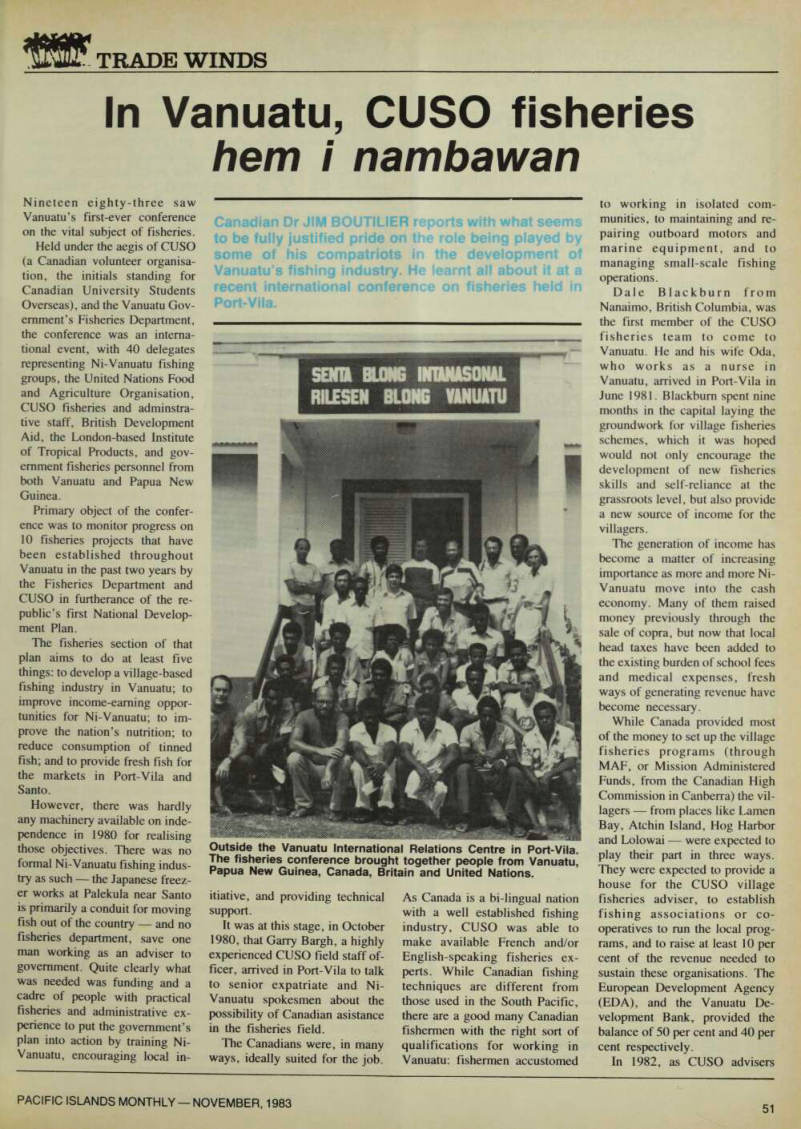
Outside the Vanuatu International Relations Centre in Port-Vila.
The fisheries conference brought together people from Vanuatu, Papua New Guinea, Canada, Britain and United Nations.
were being phased into their ap pointments throughout Vanautu, Dale Blackburn moved to the Northern Regional Office in San to to supervise another key ele ment in the fisheries scheme, boat-building. A number of catamaran and 5.5-metre mono hull, Hartley-design, craft have been built and fitted out with hand reels developed by the South Pacific Commission for bottom fishing at depths up to 300 metres.
Villages usually try to make two or three four-man crews av ailable so that these fishing ves sels enjoy maximum usage. Red snapper is the principal catch, and CUSO advisers, in addition to providing practical fisheries advice, maintain records of daily catches. These records are essen tial if a profile of fish populations is to be developed, and fishing quotas established for various
regions.
Catching fish is one thing.
Preserving and marketing the catch is quite another, particular ly for Ni-Vanuatu in remote areas without electricity. Some fisheries associations have ac
quired ice-making machines with
the aid of EDA funds, while others employ coolers until they can move their catches to the two main towns. Air transport is ex pensive: it costs 29 vatu (US3Oc) per kilo to send fish by air from Lanem Bay to Port-Vila.
CUSO is exploring the possi bility of the Lobri Fishing Com pany on Atchin Island using a small inter-island refrigerated vessel to collect catches from the village fisheries in central Vanuatu and deliver them to the
capital.
While CUSO has provided volunteers the number now is over 30 to work in health, education, forestry, handicrafts and a number of other fields, its major contribution to Vanuatu has been in the area of fisheries.
The August 1983 fisheries con ference, with its workshops, field trips, and lectures on the latest fisheries techniques, sug gests that this contribution has been a very valuable one.
The conference, conducted in Bislama, gave Ni-Vanuatu fishermen the opportunity to compare problems and accom plishments, and to realise that
they were part of a national ef fort. The feeling that emerged from our discussion, Garry Bargh observed, was “very posi tive”. Frequently, he added, Canadian aid programs seem to have been, if anything, under keyed. In this case, however, the Vanuatu village fisheries prog ram, with its emphasis on simple technology and local initiative, seems to have been clearly nam
bawan.
Jim Boutilier.
First sugar
sold by
PNG Ramu
Papua New Guinea’s newest in dustry, the production of sugar, made its first export consignment in October at a price which in dustry leaders and the govern ment regarded as “very satisfac tory”. But there were warnings at the same time that the new industry would have to watch its costs closely to remain competitive.
The October shipment was nearly 7000 tonnes of sugar, sold to Sri Lanka in a deal worth just over $1 million. Ramu Sugar, the company behind the new industry, is backed by govern ment, commercial and small holder interests. It was establish ed in the Ramu valley of main land PNG and its exports are being made through the port of Lae.
The major guideline for the PNG sugar industry was to re duce local dependence on the Australian sugar export market and to become internally self sufficient in sugar. In three years the industry has seen production develop rapidly, but there has been criticism of the price. There has been widespread public be lief that local production would cause a marked drop in the price, but this did not happen.
The General Manager of Ramu Sugar, Mr Brian Awford, described the sale to Sri Lanka as a major breakthrough which should lead to other orders. He said the company had confidence in the standard of the PNG pro duction and in reliability to meet export orders. The Sri Lanka sale was negotiated in England by agents who also handle Aust ralian sugar production.