Unanimous vote sounds death knell
p. 11 · Read in the full issue
Saipan: 23Rd South Pacific Conference
Unanimous vote sounds death knell of the old ‘CRPG’ club
The 23rd South Pacific Confer ence in Saipan in October will certainly occupy a place of note in the history of these confer ences, and of the South Pacific Commission itself.
The unanimous decision to ex tend full voting rights to all 27 member countries and territories at one stroke swept away a num ber of irksome old structures and practices, and “freed up” the conference atmosphere.
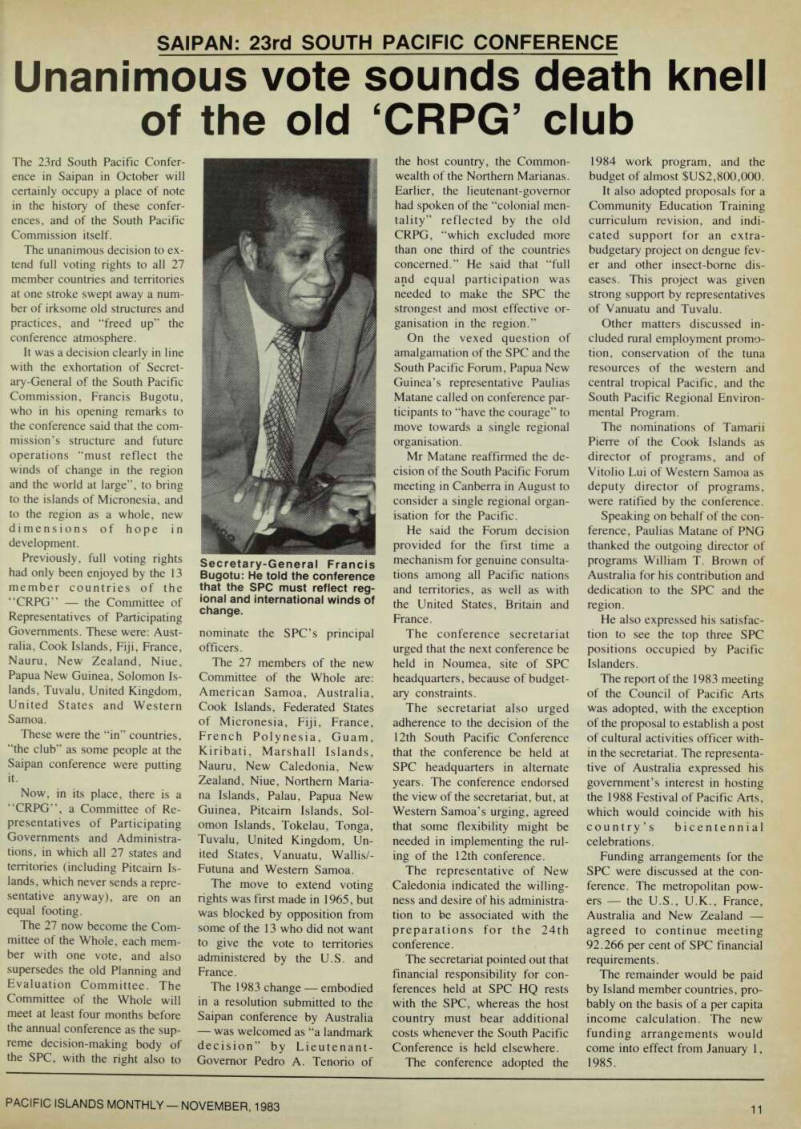
It was a decision clearly in line with the exhortation of Secret ary-General of the South Pacific Commission, Francis Bugotu, who in his opening remarks to the conference said that the com mission’s structure and future operations “must reflect the winds of change in the region and the world at large”, to bring to the islands of Micronesia, and to the region as a whole, new dimensions of hope in
development.
Previously, full voting rights
had only been enjoyed by the 13 member countries of the “CRPG” the Committee of
Representatives of Participating
Governments. These were: Aust ralia, Cook Islands, Fiji, France, Nauru, New Zealand, Niue, Papua New Guinea, Solomon Is lands, Tuvalu, United Kingdom, United States and Western Samoa.
These were the “in” countries, “the club” as some people at the Saipan conference were putting it.
Now, in its place, there is a “CRPG”, a Committee of Re presentatives of Participating Governments and Administra tions, in which all 27 states and territories (including Pitcairn Is lands, which never sends a repre sentative anyway), are on an
equal footing.
The 27 now become the Com mittee of the Whole, each mem ber with one vote, and also supersedes the old Planning and Evaluation Committee. The Committee of the Whole will meet at least four months before the annual conference as the sup
reme decision-making body of
the SPC, with the right also to
nominate the SPC’s principal officers.
The 27 members of the new Committee of the Whole are: American Samoa, Australia, Cook Islands, Federated States of Micronesia, Fiji, France, French Polynesia, Guam, Kiribati, Marshall Islands, Nauru, New Caledonia, New Zealand, Niue, Northern Maria na Islands, Palau, Papua New Guinea, Pitcairn Islands, Sol omon Islands, Tokelau, Tonga, Tuvalu, United Kingdom, Un ited States, Vanuatu, Wallis/- Futuna and Western Samoa.
The move to extend voting rights was first made in 1965, but was blocked by opposition from some of the 13 who did not want to give the vote to territories administered by the U.S. and France.
The 1983 change - embodied in a resolution submitted to the Saipan conference by Australia was welcomed as “a landmark decision” by Lieutenant- Governor Pedro A. Tenorio of
the host country, the Common wealth of the Northern Marianas.
Earlier, the lieutenant-governor had spoken of the “colonial men tality” reflected by the old CRPG, “which excluded more than one third of the countries concerned.” He said that “full and equal participation was needed to make the SPC the strongest and most effective or ganisation in the region.”
On the vexed question of amalgamation of the SPC and the South Pacific Forum, Papua New Guinea’s representative Paulias Matane called on conference par ticipants to “have the courage” to move towards a single regional organisation.
Mr Matane reaffirmed the de cision of the South Pacific Forum meeting in Canberra in August to consider a single regional organ isation for the Pacific.
He said the Forum decision provided for the first time a mechanism for genuine consulta tions among all Pacific nations and territories, as well as with the United States, Britain and France.
The conference secretariat urged that the next conference be held in Noumea, site of SPC headquarters, because of budget ary constraints.
The secretariat also urged adherence to the decision of the 12th South Pacific Conference that the conference be held at SPC headquarters in alternate years. The conference endorsed the view of the secretariat, but, at Western Samoa’s urging, agreed that some flexibility might be needed in implementing the rul ing of the 12th conference.
The representative of New Caledonia indicated the willing ness and desire of his administra tion to be associated with the preparations for the 24th conference.
The secretariat pointed out that financial responsibility for con ferences held at SPC HQ rests with the SPC, whereas the host country must bear additional costs whenever the South Pacific Conference is held elsewhere.
The conference adopted the
1984 work program, and the budget of almost $U52,800,000.
It also adopted proposals for a Community Education Training curriculum revision, and indi cated support for an extra budgetary project on dengue fev er and other insect-bome dis eases. This project was given strong support by representatives of Vanuatu and Tuvalu.
Other matters discussed in cluded rural employment promo tion, conservation of the tuna resources of the western and central tropical Pacific, and the South Pacific Regional Environ mental Program.
The nominations of Tamarii Pierre of the Cook Islands as director of programs, and of Vitolio Lui of Western Samoa as deputy director of programs, were ratified by the conference.
Speaking on behalf of the con ference, Paulias Matane of PNG thanked the outgoing director of programs William T. Brown of Australia for his contribution and dedication to the SPC and the region.
He also expressed his satisfac tion to see the top three SPC positions occupied by Pacific Islanders.
The report of the 1983 meeting of the Council of Pacific Arts was adopted, with the exception of the proposal to establish a post of cultural activities officer with in the secretariat. The representa tive of Australia expressed his government’s interest in hosting the 1988 Festival of Pacific Arts, which would coincide with his
country’s bicentennial
celebrations.
Funding arrangements for the SPC were discussed at the con ference. The metropolitan pow ers the U.S., U.K., France, Australia and New Zealand agreed to continue meeting 92.266 per cent of SPC financial requirements.
The remainder would be paid by Island member countries, pro bably on the basis of a per capita income calculation. The new funding arrangements would come into effect from January 1, 1985.
Secretary-General Francis
Bugotu: He told the conference that the SPC must reflect reg ional and international winds of change.