a Swedish forest
p. 13 · Read in the full issue
The Month
Bounty lurks in a Swedish forest
Smoland province in southern Sweden, from which we have just returned after a much-needed two-month holiday, is a rugged sort of place, covered with dense pine and fir forests, and in habited by elks, trolls and giants.
The soil is poor and strewn with stones and rocks, which genera tions of farmers have toiled to clear evidence of their labors is to be seen all around in the cairns and stone walls around the scattered fields.
All this helps to explain why, in the 19th century, when Ameri ca and Australia shone as pro mised lands for the poor and downtrodden of Europe, Smo landers contributed heavily to the Swedish component of European emigration. Except along the Baltic coast, Smoland is also among the most unpromising places for any kind of maritime activity.
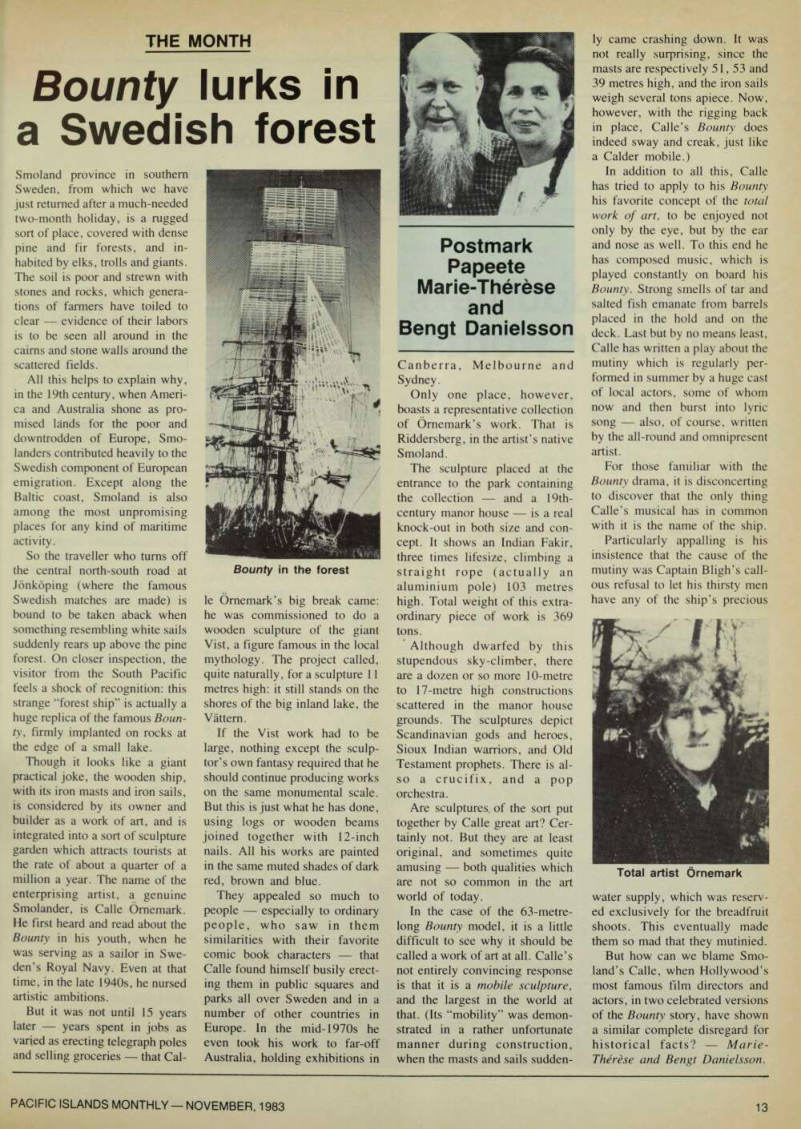
So the traveller who turns off the central north-south road at Jonkoping (where the famous Swedish matches are made) is bound to be taken aback when something resembling white sails suddenly rears up above the pine forest. On closer inspection, the visitor from the South Pacific feels a shock of recognition; this strange “forest ship” is actually a huge replica of the famous Boun ty, firmly implanted on rocks at the edge of a small lake.
Though it looks like a giant practical joke, the wooden ship, with its iron masts and iron sails, is considered by its owner and builder as a work of art, and is integrated into a sort of sculpture garden which attracts tourists at the rate of about a quarter of a million a year. The name of the enterprising artist, a genuine Smolander, is Calle Omemark.
He first heard and read about the Bounty in his youth, when he was serving as a sailor in Swe den’s Royal Navy. Even at that time, in the late 19405, he nursed artistic ambitions.
But it was not until 15 years later years spent in jobs as varied as erecting telegraph poles and selling groceries that Cal-
le Omemark’s big break came: he was commissioned to do a wooden sculpture of the giant Vist, a figure famous in the local mythology. The project called, quite naturally, for a sculpture 11 metres high: it still stands on the shores of the big inland lake, the Vattem.
If the Vist work had to be large, nothing except the sculp tor’s own fantasy required that he should continue producing works on the same monumental scale.
But this is just what he has done, using logs or wooden beams joined together with 12-inch nails. All his works are painted in the same muted shades of dark red, brown and blue.
They appealed so much to people especially to ordinary people, who saw in them similarities with their favorite comic book characters that Calle found himself busily erect ing them in public squares and parks all over Sweden and in a number of other countries in Europe. In the mid-1970s he even took his work to far-off Australia, holding exhibitions in
Canberra, Melbourne and Sydney.
Only one place, however, boasts a representative collection of Omemark’s work. That is Riddersberg, in the artist’s native Smoland.
The sculpture placed at the entrance to the park containing the collection and a 19th century manor house is a real knock-out in both size and con cept. It shows an Indian Fakir, three times lifesize, climbing a straight rope (actually an aluminium pole) 103 metres high. Total weight of this extra ordinary piece of work is 369 tons.
Although dwarfed by this
stupendous sky-climber, there are a dozen or so more 10-metre to 17-metre high constructions scattered in the manor house grounds. The sculptures depict Scandinavian gods and heroes, Sioux Indian warriors, and Old Testament prophets. There is al so a crucifix, and a pop orchestra.
Are sculptures, of the sort put together by Calle great art? Cer tainly not. But they are at least original, and sometimes quite amusing both qualities which are not so common in the art world of today.
In the case of the 63-metre long Bounty model, it is a little difficult to see why it should be called a work of art at all. Calle’s not entirely convincing response is that it is a mobile sculpture, and the largest in the world at that. (Its “mobility” was demon strated in a rather unfortunate manner during construction, when the masts and sails sudden
ly came crashing down. It was not really surprising, since the masts are respectively 51, 53 and 39 metres high, and the iron sails weigh several tons apiece. Now, however, with the rigging back in place, Calle’s Bounty does indeed sway and creak, just like a Calder mobile.) In addition to all this, Calle has tried to apply to his Bounty his favorite concept of the total work of art, to be enjoyed not only by the eye, but by the ear and nose as well. To this end he has composed music, which is played constantly on board his Bounty. Strong smells of tar and salted fish emanate from barrels placed in the hold and on the deck. Last but by no means least, Calle has written a play about the mutiny which is regularly per formed in summer by a huge cast of local actors, some of whom now and then burst into lyric song also, of course, written by the all-round and omnipresent artist.
For those familiar with the Bounty drama, it is disconcerting to discover that the only thing Calle’s musical has in common with it is the name of the ship.
Particularly appalling is his
insistence that the cause of the mutiny was Captain Bligh’s call ous refusal to let his thirsty men have any of the ship’s precious
water supply, which was reserv ed exclusively for the breadfruit shoots. This eventually made them so mad that they mutinied.
But how can we blame Smo land’s Calle, when Hollywood’s most famous film directors and actors, in two celebrated versions of the Bounty story, have shown a similar complete disregard for historical facts? Marie- Therese and Bengt Danielsson.
Bounty in the forest
Postmark Papeete Marie-Therese and Bengt Danielsson
Total artist Ornemark