A burning
pp. 7-9 · Read in the full issue
Letters
of books
for Honiara?
Is there to be a book burning in Honiara? Is Solomon Islands his tory to be politically censored?
The book that is causing the fuss is my account, with Peter Corns, of the 1927 massacre of District Officer Bell and others on Malai ta, Lightning Meets the West Wind.
Why all the fuss? There was not one massacre in 1927, but two. The first, the killing of Bell, his cadet Lillies, and 13 Islanders by Basiana and his Kwaio war riors, caused a sensation at the time and has a prominent place in colonial histories. The second massacre was the killing of some 70 Kwaio, mainly unarmed pris oners but including women and children, by the subsequent puni tive expedition; not the “Breath less Army” of planter volunteers or the malaria-ridden Australians from H.M.A.S. Adelaide, but North Malaita police and ex police intent on avenging their slain relatives tenfold. This mas sacre was hidden and whitewash ed by the British Solomon Is lands Protectorate administra tion, and has been mainly ig nored by colonial historians. Our book tells the true story, naming names and places, as it had to do to be accurate and credible, giv ing long quotes from protagon ists on both sides.
The old skeletons are out of the closet.
Malaita Premier Stephen To nafalea wants these skeletons back in the closet again by banning the book in the Sol
omons, burning copies already
there if he can. The reasons are not too obscure. It is Tonafalea’s To’abaita relatives and wantoks who directed the carnage, or dered the shooting of prisoners, the desecration of shrines, the burning and looting of settle ments. Tonafalea and his North Malaita supporters and Provin
cial Assembly colleagues would
like the evidence of history suppressed.
They are not the first ones to try to keep the skeletons hidden.
For 10 years I was denied access
to the Bell files, even after the access rule was changed to 30 years and other Pacific historians were given access to the files. It was not until I confronted the Chief Secretary of the Western Pacific in 1970, and told him that the book would be written with or without access to the files (with an apology for factual er rors, and an explanation that it had been written without the co operation of H. M. Government) that I was grudgingly allowed to see most of the Bell files.
The paranoia about the second massacre goes far back in time.
Usuli Tefu’i, survivor of the first massacre and enthusiastic par ticipant in the second, refused at first to talk to me because he had 50 years earlier been sworn to secrecy by the resident commis sioner and commandant of police.
But the truth is out docu mented by many hours of taped interviews, many directly
“Those who did the killing were proud of their deeds, not ashamed”
quoted. And why not? Those who did the killing 55 years ago were proud of their deeds, not ashamed. They had avenged their dead in culturally approved style. Usuli, in his 80s and now in Honiara, speaks dispassionate ly of how he and his patrol shot most of the prisoners they took, how the jungle stank with rotting corpses: exactly what the mis sionaries had warned at the time, trying to halt the carnage; “If they were taken to the coast they were tied up. But anyone we found in the bush we killed all of them. If you went in the bush you couldn’t stand the smell, there were bodies everywhere along the sides of the path . . .
“The British officers had said, ‘lt’s up to you. Because you lost 13 men, with the two govern ment officers. If you want to take someone alive, the he lives. If you think “You’re to die in the bush,’’ that’s up to you be cause that’s the way of your anger. We’re not in charge of you. It’s your business and it’s a war’.”
All this has been known on Malaita for years, from men who
bragged of their exploits. Why, then, does Tonafalea now want the truth suppressed? Does he really think the book is stirring up old conflicts and enmities?
Certainly not among the pagan Kwaio of the interior. Thanks to half a century of government neglect none of them can read though they still remember.
Some Kwaio leaders would like to claim compensation for the damage and desecration by the punitive expedition. But this idea, fomented by coastal Chris tians like Lee Silamo and M. P.
Daniel Fa’asifoaba’e, emerged three years before the book was published. In this ill-conceived quest, the book is incidental.
The real reason why Tonafalea wants the book banned seems to be that he is locked in a power struggle with Kwaio Fadanga, the council of pagan leaders, over the issues of taxation and cultural autonomy issues that date back 60 years. Portrayal of
the Kwaio side of the Bell mas sacre, as well as the other, erodes the stereotypes of the Kwaio as dark savages that have been used to justify decades of government
neglect.
Reflective Solomon Islanders, including P. M. Mamaloni, real ise that the issues of freedom of the press and the truths of history go beyond local political inter ests and family secrets. But others, whatever their motives, would welcome an opportunity for expatriate-bashing in new guise. The book may yet be banned, even burned. In the meantime, sales in Honiara are
booming.
Roger M. Keesing
(Professor of Anthropology) Australian National University, Canberra. ACT.
Australia.
Matters of dress
and undress
Rather to my astonishment I notice, when sailing through Pacific ports, whether they are attached to big bustling cities, or are in more remote, untouched
regions, that a number of visiting yacht people seem very inclined to discard their clothing to vary ing degrees. This habit, although no doubt fitting on the beaches of the French Riviera, California, or New South Wales, may not be quite so in Tonga, Papua New Guinea, or Palau. Otherwise
apparently responsible people
seem totally oblivious of local dress codes, and therefore offend and generally create a poor im age of visiting boatmen. It is not difficult to establish the accepted dress code by following local example, and the age-old advice “When in Rome, do as the Ro mans do” and shed no more.
This is not a call for prudish ness, but for propriety. Along with the privilege of cruising these beautiful areas comes the responsibility of representing your own country and leaving in your wake an image of pride and
friendship.
I hope the peoples of the Pacif ic who have had contact with these insensitive individuals real ise that among us there are also those who enter their countries with great respect for and interest in their cultures.
Diana White
Yacht Zenie P. II Cebu
Philippines
What happened at
Apia’s hospital?
From my reading of a report in the Papua New Guinea Post- Courier, PNG’s national paper, it seems that one of PNG’s in jured Rugby Union players at the recent Seventh South Pacific Games was refused treatment at the hospital in Apia and had to be sent home to Port Moresby for treatment. If this is so, it is sad and disappointing. It was just lucky he didn’t die on the way home. Matters of this nature are important, and whichever coun try hosts the Games should have a sense of responsibility towards those injured in the course of the various events.
If such an attitude is to con tinue, there would seem to be no point in keeping the Games go ing. They should be abolished, and we’ll play our own little independent Games back home.
As a concerned citizen of PNG I have pride in my country’s sportsmen and women, and would be most disheartened to learn of behavior of this kind at any time in the future.
We’ll see how New Caledonia as the next host will treat us in 1987.
Philip Anda
Mt Hagen Papua New Guinea
Tattoos a call
for help
As I have been granted special leave to study traditional body tattoo, I require specific informa tion as to places islands, and places therein where such body decoration is practised or can still be found, or people who are tattooed and would be willing to talk to me and have their tattoos documented.
Without such information the precious time at my disposal could be quickly lost. Should anyone have any information that would assist me in my search for traditional body tattoo, I would be more than grateful to receive it at the earliest possible moment.
I am appealing for assistance from people of the South Pacific!
Lindsay Gordon
(Lecturer in Art) Kuring-gai College of Advanced Education P.O. Box 222 Lindfield NSW, Australia, 2070
Of Mead, Coombe,
Stevens, and others
After good old Margaret Mead has closed her eyes and can’t defend herself any more, the heroes who knew everything and nothing creep up and raise their ugly heads and voices.
Margaret Mead was never anything else but what the people made of her and it was Papua New Guineans and Samoans in particular who glorified her wherever she went. But those in the know never accepted her im aginative litanies for fact.
The same seems to go for Christine Coombe. So long as she was there in Vanuatu, no one dared open his mouth, or take up
the poison pen. Now she has gone all hell breaks loose over her in the same heroic fashion.
The amazing fact remains, however, that those who put Jim my Stevens in jail and condemn ed the backers of the “revolu tion” are today exactly the same people who are asking for money from those same neo-colonial or ganisations that backed the “re volution”. But poor old Jimmy Stevens remains in jail, despite the fact that he was never any thing but the greedy, obedient lackey of one or the other capital ist interest just like most of the other Big Leaders of today.
As long as we continue to suck on the World Bank and neo colonialist development aid bot tle, and as long as those ex colonial kiaps and neo colonialist businessmen are in charge of affairs, there is little sense in fouling the beautiful Pacific air with wild racist paranoia especially as after so
many years of “independence” we still can’t stand on our own very wobbly legs.
Vitaliz Paingame
Caims Qld Australia
A Rotuman
Mamasa
Mamasa is a beautiful Rotuman ceremony. It is performed to welcome someone who has re cently returned from overseas.
The period of absence need not have been long.
I attended a Mamasa (the world means “dry” or “to dry”) at Delainavesi a month ago. It was performed to welcome a young married couple who had been to Australia for a five weeks vacation.
A large “koau” is prepared, early in the morning, to roast the pig, chickens and ground food.
The size of the “koau” depends on the size of the pig and the number of guests expected to attend.
Mats are folded and a low dais is made, roughly two metres by one. Usually an “apei” (white mat) is spread on top of this.
The new arrival is requested to
sit on the dais. A “tefui” (lei) is placed around his neck. A “tefui” is made of about 10 different scented blooms. You can im agine the scent.
Next, perfumed oil is poured lavishly on the head, a “umefe” (low table) is put in front of the honored one. The “Koau” is opened. Girls and young women appear. They spread banana leaves on the table and sit down ready to prepare the food. Some fan the guest. (Oh, yes, he or she gets the VIP treatment on the
day).
The pig, chicken, “fekei” (a dessert), and other foods are brought in, also coconut to drink and fruit in season.
A man well versed in Rotuman custom comes and sits near the roast pig. He starts to describe in a loud singsong voice all the food that is there. It may include a carton of corned beef or tinned fish. The pig’s head is cut off and placed on the table, facing the person sitting on the dais. The girls peel taro, yam and choice pieces of pork, and spread them on the table. None of the guests eat until the favored person has finished his meal. Water, soap and towel are brought for him to wash his hands.
Then all the food is taken away to the lawn where coconut fronds and banana leaves are spread. Guests are called and, after a short prayer, all eat.
Oney A. Foster
Suva, Fiji.
Find of a Cape
York beachcomber
From old notes of a day’s beach combing on Cape York Peninsula: Sunday December 14: Captain Billy Creek. A Drambuie bottle with about a teaspoon left in it.
Nice!
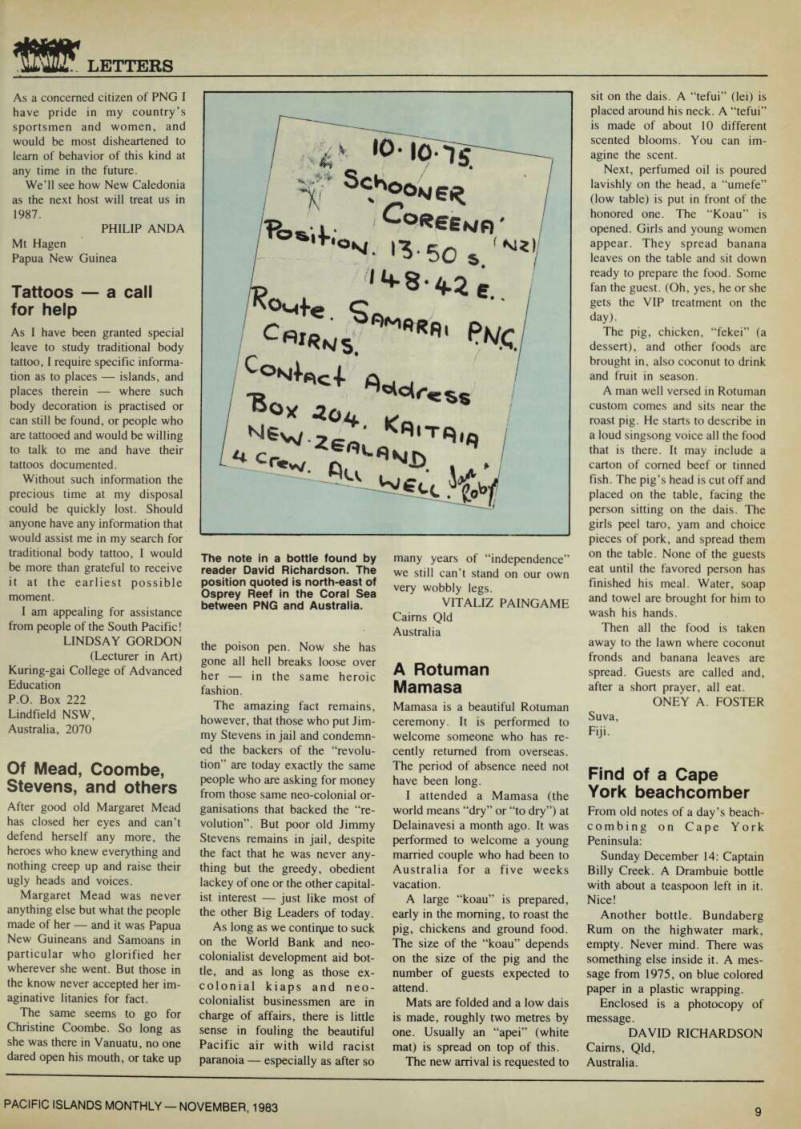
Another bottle. Bundaberg Rum on the high water mark, empty. Never mind. There was something else inside it. A mes sage from 1975, on blue colored paper in a plastic wrapping.
Enclosed is a photocopy of message.
David Richardson
Cairns, Qld, Australia.
The note in a bottle found by reader David Richardson. The position quoted is north-east of Osprey Reef in the Coral Sea between PNG and Australia.