People
pp. 27-29 · Read in the full issue
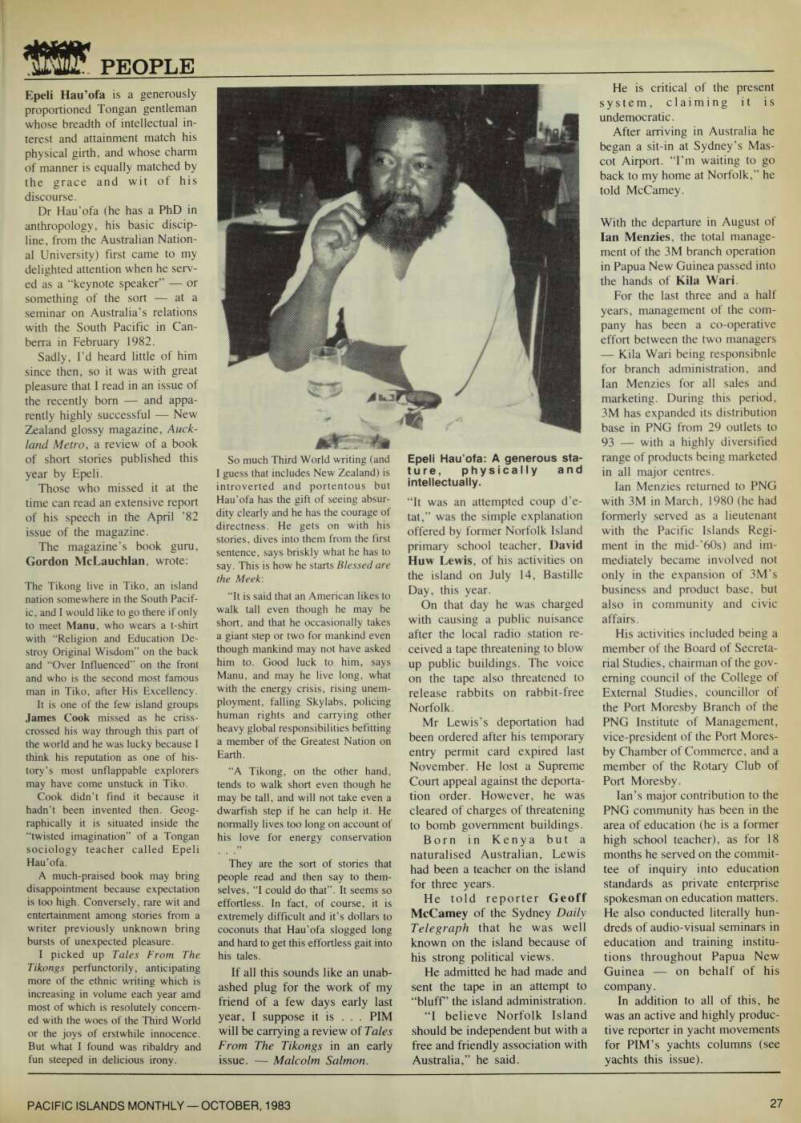

Epeli Hau’ofa is a generously
proportioned Tongan gentleman
whose breadth of intellectual in terest and attainment match his physical girth, and whose charm of manner is equally matched by the grace and wit of his discourse.
Dr Hau’ofa (he has a PhD in anthropology, his basic discip line, from the Australian Nation al University) first came to my delighted attention when he serv ed as a “keynote speaker” or something of the sort at a seminar on Australia’s relations with the South Pacific in Can berra in February 1982.
Sadly, I’d heard little of him since then, so it was with great pleasure that I read in an issue of the recently bom and appa rently highly successful New Zealand glossy magazine, Auck land Metro, a review of a book of short stories published this
year by Epeli.
Those who missed it at the time can read an extensive report of his speech in the April ’B2 issue of the magazine.
The magazine’s book gum, Gordon McLauchlan, wrote: The Tikong live in Tiko, an island nation somewhere in the South Pacif ic, and I would like to go there if only to meet Manu, who wears a t-shirt with “Religion and Education De stroy Original Wisdom” on the back and “Over Influenced” on the front and who is the second most famous man in Tiko, after His Excellency.
It is one of the few island groups James Cook missed as he criss crossed his way through this part of the world and he was lucky because I think his reputation as one of his tory’s most unflappable explorers may have come unstuck in Tiko.
Cook didn’t find it because it hadn’t been invented then. Geog raphically it is situated inside the “twisted imagination” of a Tongan sociology teacher called Epeli Hau’ofa.
A much-praised book may bring disappointment because expectation is too high. Conversely, rare wit and entertainment among stories from a writer previously unknown bring bursts of unexpected pleasure.
I picked up Tales From The Tikongs perfunctorily, anticipating more of the ethnic writing which is increasing in volume each year amd most of which is resolutely concern ed with the woes of the Third World or the joys of erstwhile innocence.
But what I found was ribaldry and fun steeped in delicious irony.
So much Third World writing (and I guess that includes New Zealand) is introverted and portentous but Hau’ofa has the gift of seeing absur dity clearly and he has the courage of directness. He gets on with his stories, dives into them from the first sentence, says briskly what he has to say. This is how he starts Blessed are the Meek: “It is said that an American likes to walk tall even though he may be short, and that he occasionally takes a giant step or two for mankind even though mankind may not have asked him to. Good luck to him, says Manu, and may he live long, what with the energy crisis, rising unem ployment, falling Skylabs, policing human rights and carrying other
heavy global responsibilities befitting
a member of the Greatest Nation on Earth.
“A Tikong, on the other hand, tends to walk short even though he may be tall, and will not take even a dwarfish step if he can help it. He normally lives too long on account of his love for energy conservation They are the sort of stories that people read and then say to them selves, “I could do that”. It seems so effortless. In fact, of course, it is extremely difficult and it’s dollars to coconuts that Hau’ofa slogged long and hard to get this effortless gait into his tales.
If all this sounds like an unab ashed plug for the work of my friend of a few days early last year, I suppose it is . . . PIM will be carrying a review of Tales From The Tikongs in an early issue. Malcolm Salmon.
“It was an attempted coup d’e tat,” was the simple explanation offered by former Norfolk Island primary school teacher, David Huw Lewis, of his activities on the island on July 14, Bastille Day, this year.
On that day he was charged with causing a public nuisance after the local radio station re ceived a tape threatening to blow up public buildings. The voice on the tape also threatened to release rabbits on rabbit-free Norfolk.
Mr Lewis’s deportation had been ordered after his temporary entry permit card expired last November. He lost a Supreme Court appeal against the deporta tion order. However, he was cleared of charges of threatening to bomb government buildings.
Born in Kenya but a naturalised Australian, Lewis had been a teacher on the island for three years.
He told reporter Geoff McCamey of the Sydney Daily Telegraph that he was well known on the island because of his strong political views.
He admitted he had made and sent the tape in an attempt to “bluff’ the island administration.
“I believe Norfolk Island should be independent but with a free and friendly association with Australia,” he said.
He is critical of the present system, claiming it is undemocratic.
After arriving in Australia he began a sit-in at Sydney’s Mas cot Airport. “I’m waiting to go back to my home at Norfolk,” he told McCamey.
With the departure in August of lan Menzies, the total manage ment of the 3M branch operation in Papua New Guinea passed into the hands of Kila Wari.
For the last three and a half years, management of the com pany has been a co-operative effort between the two managers Kila Wari being responsibnle for branch administration, and lan Menzies for all sales and marketing. During this period, 3M has expanded its distribution base in PNG from 29 outlets to 93 with a highly diversified range of products being marketed in all major centres. lan Menzies returned to PNG with 3M in March, 1980 (he had formerly served as a lieutenant with the Pacific Islands Regi ment in the mid-’6os) and im mediately became involved not only in the expansion of 3M’s business and product base, but also in community and civic affairs.
His activities included being a member of the Board of Secreta rial Studies, chairman of the gov erning council of the College of External Studies, councillor of the Port Moresby Branch of the PNG Institute of Management, vice-president of the Port Mores by Chamber of Commerce, and a member of the Rotary Club of Port Moresby. lan’s major contribution to the PNG community has been in the area of education (he is a former high school teacher), as for 18 months he served on the commit tee of inquiry into education standards as private enterprise spokesman on education matters.
He also conducted literally hun dreds of audio-visual seminars in education and training institu tions throughout Papua New Guinea on behalf of his company.
In addition to all of this, he was an active and highly produc tive reporter in yacht movements for PlM’s yachts columns (see yachts this issue).
Epeli Hau’ofa: A generous sta ture, physically and intellectually.
Kila Wari, who now takes over the reins of the company, is also a man who believes that buinessmen should be involved in community affairs. Currently on the executive of the Port Moresby Chamber of Com merce, a councillor with the Port Moresby Branch of the PNG Institute of Management, and a member of the board of the Port Moresby International High School, Kila’s most recent ap pointment was as chairman of the board of directors of the Postal and Telecommunications Corpo ration, the country’s largest cor poration. Kila is also active in youth affairs at both rural and urban areas.
Originally from Irupara village
in the Rigo district of Central Province, Kila was educated at both Kambubu High and Keravat National High School before completing a Bachelor of Sci ence degree at the University of Papua New Guinea. Kila’s man agement experience has varied from several appointments in both the Departments of Forests and Commerce, to serving as production manager at Tanubada Dairies. His development has been enhanced by attendance at various management courses in Japan, Australia, India and Austria. 3M commenced its localisa tion program in April 1980 at that time there were four expat riates employed within the com pany structure in PNG and had a target date of April 1984 for completion. The company is delighted that the calibre and development of local staff have been such that the program has been completed will ahead of schedule.
Dr Jacqueline Badcock, a Brit ish citizen, has joined the South Pacific Commission as nutrition ist. The appointment is in line with SPC’s long involvement in nutritional activities in the
region.
Extra-budgetary funding for
the post has been provided by the Australian Development Assist ance Bureau (ADAB). As SPC nutritionist, Dr Badcock’s ac tivities will be aimed at improv ing health and nutrition for wo men and children in particular, in accordance with a recommenda-
tion made by the Seminar of South Pacific women held in Papeete in 1981. That recom mendation was subsequently en dorsed by the Twenty-first (1981) South Pacific Conference.
In view of growing malnutri tion problems in the Pacific area
involving under-nutrition,
over-nutrition, and the ingestion
of poor quality foods priority is accorded to action programs.
These action programs will be carried out by Dr Badcock in close collaboration with other SPC program officers and offic ers of other organisations such as WHO working in related fields, and will be aimed at publ ic education and information, and at structural changes leading to a healthy, practicable, afford able diet.
In addition to formulating and implementing food and nutrition programs in the region, Dr Bad cock, in collaboration with gov ernment officials, will undertake dietary and nutrition surveys for nutritional planning and for the investigation of the cause of nut rition-related diseases.
Before joining the commis sion, Dr Badcock was regional nutritionist for Highland and Mainland Regions, based in Goroka, Papua New Guinea, for four years.
A retired Papua New Guinea soldier has been flown to Bris
bane, Australia, to have an artifi cial leg fitted.
Osi Ivaraoa, 58, who recently lost his right leg because of diab etes, was the curator at the Bomana War Cemetery.
Lance Barnard, director of the Office of Australian War Graves, which supervises the maintenance of the Bomana Cemetery, arranged for Mr Ivaraoa to receive the limb at the
Greenslopes Veterans’ Hospital.
Mr Ivaraoa was flown in a Royal Australian Air Force plane from Port Moresby to Brisbane.
He will be fitted with an artifi cial limb and given three months
physiotherapy.
Mr Ivaraoa joined the Papuan Infantry Battalion, the forerunner of the Pacific Islands Regiment, in 1943, and received four deco rations for his part in the World War II New Guinea campaign.
He remained with the armed forces after the war and reached the rank of warrant officer before his retirement in 1974. (AIS).
Elizabeth Gollan has taken up duties in Suva as assistant trade commissioner at the New Zea land High Commission in Suva.
She replaces Ross Milner who is returning to New Zealand.
While she will be based in Suva, her trade promotion re
sponsibilities extend to neighbor
ing countries including Tonga, Western Samoa, American Samoa, Cook Islands, Niue, Nauru, Kiribati and Tuvalu. In addition to promoting New Zea land’s exports to the South Pacif ic, her responsibilities will in clude giving assistance to Pacific Island exporters wishing to sell their products to New Zealand.
Kila War!
Ian Menzies
Elizabeth Gollan