Havila School
pp. 21-25 · Read in the full issue

Tropicalities
Students of Havila School tell of Fiji
The item in PIM’s “Pacific Re port” (Jul p5) was headlined “New Caledonian students in Fi ji”. It said: “Fourteen high school students from Lifou Island, in New Caledonia’s Loyalty group, arrived in Fiji in May for a three week course to improve their English and their knowledge of
neighboring countries.”
That was that. It was hardly an item to set the world on fire.
But start a fire it did.
The 14 students referred to — from the Havila School, which is run by the Evangelical Church at We, the administrative centre of Lifou Island — saw the report, and unanimously decided it was far too short. So they set out to
remedy the situation by provid
ing the wherewithal to write a longer article: they sent no fewer than 27 foolscap pages of mate rial — 20 pages of poems they had written about their trip, and seven pages of letters to PIM.
Each page was decorated with crayon artwork of their own, some of it quite beautiful. To say they enjoyed their time in Fiji would be the grossest understate ment — they loved it. Their stapled volume of poems entitled Poems — Lifu to Fiji: From 14 May 83 to 5 June 83 says it all. (“Lifu” rather than “Lifou” seems to be their preferred spel ling of the name of their home island.) The first lines in the book of poems say; “For two years we dreamt
about Fiji
And suddenly,
On the 14th May 1983, Passports in hands We left Havila — Was it but a dream?
No, for on that dark evening Tired, anxious, but thrilled, We all arrived on the Fijian land ...”
The poems go on to tell of the “big hotels” of Suva, of kava ceremonies, of dancing and sing ing, of church services, of visits to the Pacific Theological Col lege (“PTC, Suva, goodbye, But we won’t forget you”), of “huge
ice creams”, of the University of the South Pacific, of Olympic swimming pools, of their experi ences in the village of Nadrau where they stayed some time, of their impressions of the town of Lautoka with its “mountains of sugar” the list could go on and on.
But most of all the poems sing the praises of the people of Fiji, Fijian and Indian alike, who “opened their houses and their hearts” to the young visitors from across the water.
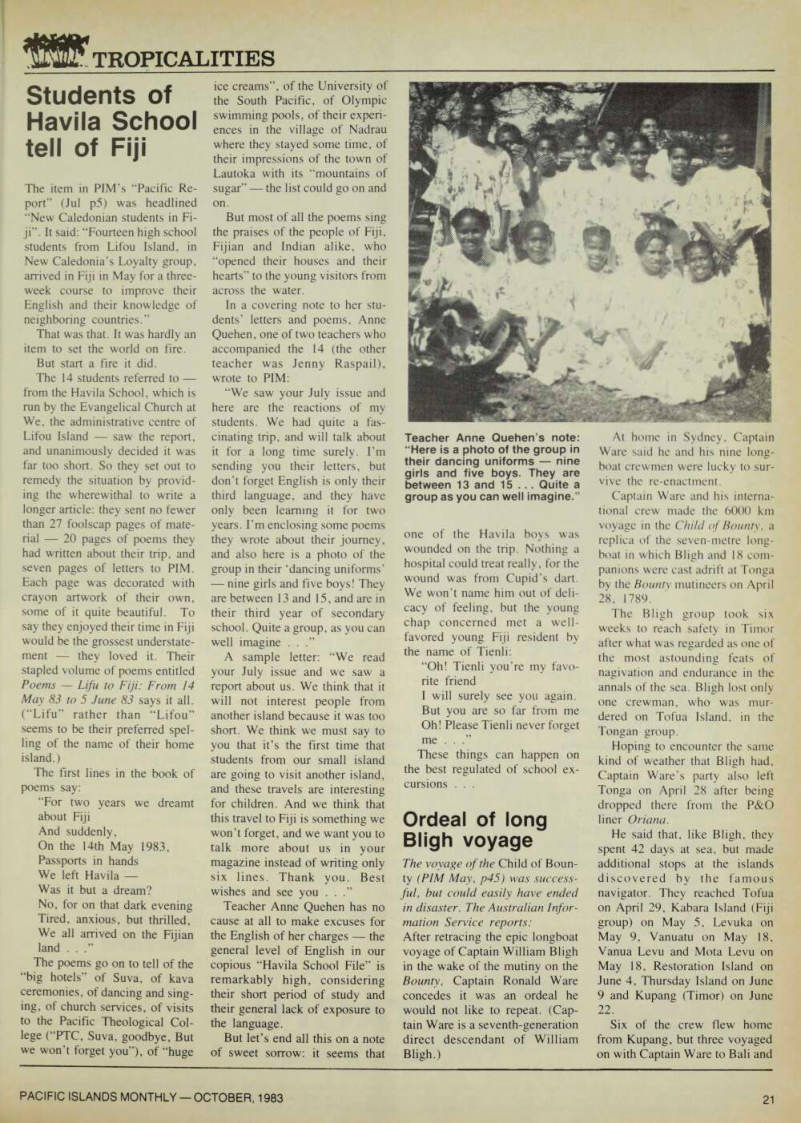
In a covering note to her stu dents’ letters and poems, Anne Quehen, one of two teachers who accompanied the 14 (the other teacher was Jenny Raspail), wrote to PIM; “We saw your July issue and here are the reactions of my students. We had quite a fas cinating trip, and will talk about it for a long time surely. I’m sending you their letters, but don’t forget English is only their third language, and they have only been learning it for two years. I’m enclosing some poems they wrote about their journey, and also here is a photo of the group in their ‘dancing uniforms’ nine girls and five boys! They are between 13 and 15, and are in their third year of secondary school. Quite a group, as you can well imagine ...”
A sample letter; “We read your July issue and we saw a report about us. We think that it will not interest people from another island because it was too short. We think we must say to you that it’s the first time that students from our small island are going to visit another island, and these travels are interesting for children. And we think that this travel to Fiji is something we won’t forget, and we want you to talk more about us in your magazine instead of writing only six lines. Thank you. Best wishes and see you ...”
Teacher Anne Quehen has no cause at all to make excuses for the English of her charges the general level of English in our copious “Havila School File” is
remarkably high, considering
their short period of study and their general lack of exposure to
the language.
But let’s end all this on a note of sweet sorrow: it seems that
At home in Sydney, Captain Ware said he and his nine long boat crewmen were lucky to sur vive the re-enactment.
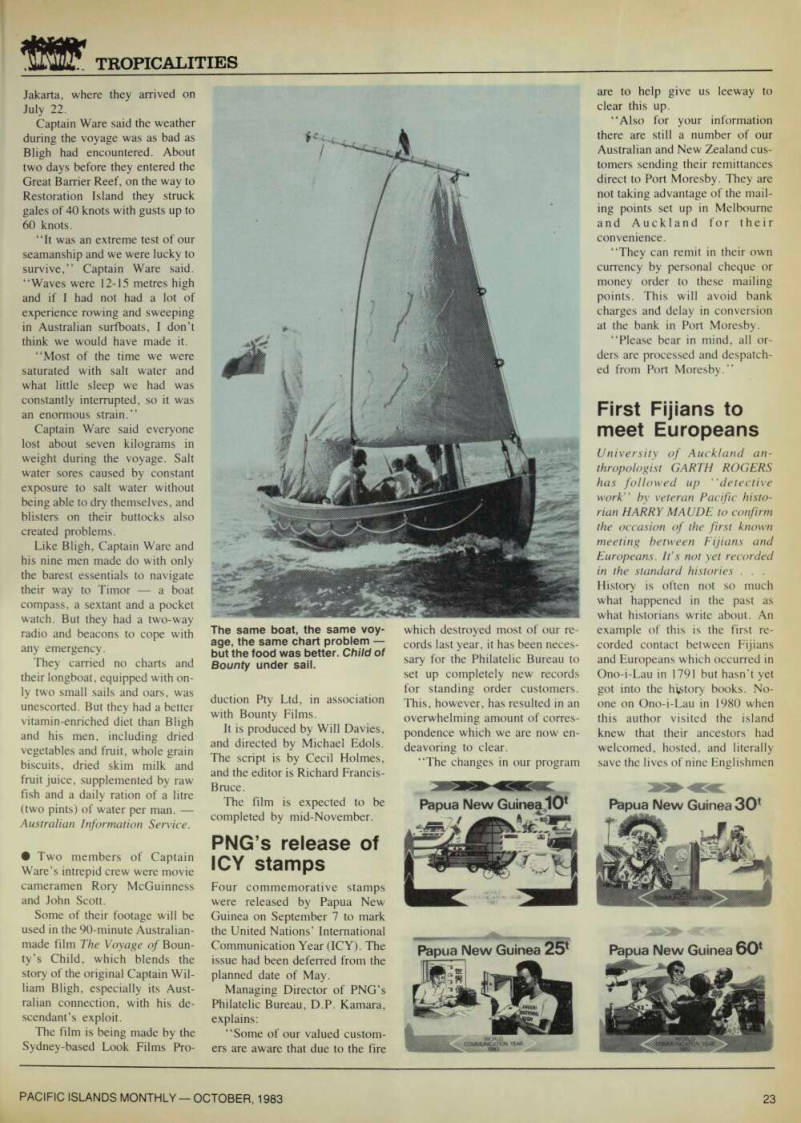
Captain Ware and his interna tional crew made the 6000 km voyage in the Child of Bounty, a replica of the seven-metre long boat in which Bligh and 18 com panions were cast adrift at Tonga by the Bounty mutineers on April 28, 1789.
The Bligh group took six weeks to reach safety in Timor after what was regarded as one of the most astounding feats of nagivation and endurance in the annals of the sea. Bligh lost only one crewman, who was mur dered on Tofua Island, in the Tongan group.
Hoping to encounter the same kind of weather that Bligh had.
Captain Ware’s party also left Tonga on April 28 after being dropped there from the P&O liner Ohana.
He said that, like Bligh, they spent 42 days at sea, but made additional stops at the islands discovered by the famous navigator. They reached Tofua on April 29, Kabara Island (Fiji group) on May 5, Levuka on May 9, Vanuatu on May 18, Vanua Levu and Mota Levu on May 18, Restoration Island on June 4, Thursday Island on June 9 and Kupang (Timor) on June 22.
Six of the crew flew home from Kupang, but three voyaged on with Captain Ware to Bali and
one of the Havila boys was wounded on the trip. Nothing a hospital could treat really, for the wound was from Cupid’s dart.
We won’t name him out of deli cacy of feeling, but the young chap concerned met a well favored young Fiji resident by the name of Tienli: “Oh! Tienli you’re my favo rite friend I will surely see you again.
But you are so far from me Oh! Please Tienli never forget me . .
These things can happen on the best regulated of school ex cursions . . .
Ordeal of long
Bligh voyage
The voyage of the Child of Boun ty (PIM May, p 45) was success ful, but could easily have ended in disaster. The Australian Infor mation Service reports: After retracing the epic longboat voyage of Captain William Bligh in the wake of the mutiny on the Bounty, Captain Ronald Ware concedes it was an ordeal he would not like to repeat. (Cap tain Ware is a seventh-generation direct descendant of William Bligh.)
Teacher Anne Quehen’s note: “Here is a photo of the group in
their dancing uniforms - nine
girls and five boys. They are between 13 and 15 . . . Quite a group as you can well imagine.”
Jakarta, where they arrived on July 22.
Captain Ware said the weather during the voyage was as bad as Bligh had encountered. About two days before they entered the Great Barrier Reef, on the way to Restoration Island they struck gales of 40 knots with gusts up to 60 knots.
“It was an extreme test of our seamanship and we were lucky to survive,” Captain Ware said.
“Waves were 12-15 metres high and if I had not had a lot of
experience rowing and sweeping
in Australian surfboats, I don’t think we would have made it.
“Most of the time we were saturated with salt water and what little sleep we had was constantly interrupted, so it was an enormous strain.”
Captain Ware said everyone lost about seven kilograms in weight during the voyage. Salt water sores caused by constant exposure to salt water without being able to dry themselves, and blisters on their buttocks also created problems.
Like Bligh, Captain Ware and his nine men made do with only the barest essentials to navigate their way to Timor a boat compass, a sextant and a pocket watch. But they had a two-way radio and beacons to cope with any emergency.
They carried no charts and their longboat, equipped with on ly two small sails and oars, was unescorted. But they had a better vitamin-enriched diet than Bligh and his men, including dried vegetables and fruit, whole grain biscuits, dried skim milk and fruit juice, supplemented by raw fish and a daily ration of a litre (two pints) of water per man.
Australian Information Service. • Two members of Captain Ware’s intrepid crew were movie cameramen Rory McGuinness and John Scott.
Some of their footage will be used in the 90-minute Australian made film The Voyage of Boun ty’s Child, which blends the story of the original Captain Wil liam Bligh, especially its Aust ralian connection, with his de
scendant’s exploit.
The film is being made by the Sydney-based Look Films Pro-
duction Pty Ltd, in association with Bounty Films.
It is produced by Will Davies, and directed by Michael Edols.
The script is by Cecil Holmes, and the editor is Richard Francis- Bruce.
The film is expected to be completed by mid-November.
PNG’s release of
ICY stamps
Four commemorative stamps were released by Papua New Guinea on September 7 to mark the United Nations’ International Communication Year (ICY). The issue had been deferred from the planned date of May.
Managing Director of PNG’s Philatelic Bureau, D.P. Kamara, explains: “Some of our valued custom ers are aware that due to the fire
which destroyed most of our re cords last year, it has been neces sary for the Philatelic Bureau to set up completely new records for standing order customers.
This, however, has resulted in an overwhelming amount of corres pondence which we are now en deavoring to clear.
“The changes in our program
are to help give us leeway to clear this up.
“Also for your information there are still a number of our Australian and New Zealand cus tomers sending their remittances direct to Port Moresby. They are not taking advantage of the mail ing points set up in Melbourne and Auckland for their convenience.
“They can remit in their own currency by personal cheque or money order to these mailing points. This will avoid bank charges and delay in conversion at the bank in Port Moresby.
“Please bear in mind, all or ders are processed and despatch ed from Port Moresby.”
First Fijians to
meet Europeans
University of Auckland an thropologist GARTH ROGERS has followed up “detective work ” by veteran Pacific histo rian HARRY MAUDE to confirm the occasion of the first known meeting between Fijians and Europeans. It’s not yet recorded in the standard histories . . .
History is often not so much what happened in the past as what historians write about. An example of this is the first re corded contact between Fijians and Europeans which occurred in Ono-i-Lau in 1791 but hasn’t yet got into the history books. No one on Ono-i-Lau in 1980 when this author visited the island knew that their ancestors had welcomed, hosted, and literally save the lives of nine Englishmen
The same boat, the same voy age, the same chart problem but the food was better. Child of Bounty under sail.
who stayed nearly five weeks off their island, before any other recorded contact in Fiji between Fijian and European. Captain
Stanley Brown obviously didn’t
know about it when he wrote Men from Under the Sky in 1973, and Kim Gravelle didn’t metion it in his Fiji’s Times: A History of Fiji (1979).
The men, as pointed out by Robert Langdon in an article in PIM in August 1961 (p. 29), were William Oliver (vessel comman der, aged 21), David Renouard (midshipman aged 16, and au thor of the only extant record of the voyage), and seven others, who were sailing the Matavy from Tahiti to Java as a tender to H.M.S. Pandora, captain Edwards.
Having lost contact with their captain in the Pandora these nine men ran out of food, then water, and were nearly dead with expo sure and weakness when they discovered and hove-to off “Three Islands” to the south west of Tutuila believing them to be the southern Tongan islands where they were supposed to rendezvous with the Pan dora. The problem is, and it has taxed historians from Basil Thomson to Robert Langdon, where did these mariners sojourn for nearly five weeks in close and peaceful contact with South Sea Islanders?
The answer has come from veteran Pacific historian Harry Maude who published his results in The Mariner’s Mirror, vol. 50, 1964. Working sleuth-like from Renouard’s journal (which
he reproduced in his article), old chants, and obscure 19th-century writings, Maude came to the conclusion that the mystery is land was Ono-i-Lau in Fiji, that the Matavy’s crew were the “first Europeans to have any intercourse with the Fijian peo ple, and the first to land on Fijian soil.”
In June 1980 this author visited Ono-i-Lau with the ex press purpose of trying to vali date or disprove Maude’s claim from local evidence, and came to the conclusion that Maude is correct and that future historians will have to change the story of Fiji. My evidence is all from geography and from discussion with Ono people.
Maude deduced that the vessel was running due west when Re nouard sighted “land ahead in the form of two sugar loaves.”
And, sure enough, viewed from the east, the high point on Onolevu called Delailoa (113 m), and the highest peak of Doi called Naisoyaga (85m), both ash-cones, appear side by side on the horizon, like two clenched fists (see photo), with no other prominent peak in the vicinity.
Renouard described how, on June 27, 1791, the Matavy closed with the eastern reef about 4 pm, how canoes unsuccessfully attempted to come off through the heavy surf, and how both parties met later when the canoes came out of a “bay” and pulled
alongside with life-giving
coconuts.
Maude’s identification of the Mana islets as the original land
fall is fully borne out by my
investigations. People were visit
ing uninhabited Marra in June and July 1980 to fish and to gather coconuts, and there is a barrier reef running north from that point to the northeast pas sage which appears from the east to be a large bay or indentation in the northern reef.
Renouard declares they dis covered three islands, whereas to any Fijian speaker, Ono-i-Lau obviously denotes six. But as Maude astutely points out there are just three central volcanic islands and three limestone reef islets. Anyone knowing the Pacific would agree that it is often difficult to decide just what constitutes an island. Moreover, as Robert Langdon observes (PIM Aug ’6l p. 33), Renouard probably wrote up his narrative several years after his return to England when the memory of their search for Tonga’s “three islands’’ was stronger than the reality of the number of islands, islets, and sandbanks at Ono-i- Lau.
Renouard claims they took in water at “A small island situated about five leagues from Toofoa (i.e., Ono-i-Lau) ... a business rendered very tedious by the na tives who brought it off in very small quantities ... in calabashes and cocoa nut shells’’.
Two sand bays known as the Tuvanas are situated about 22 sea miles south of Ono-i-Lau and are clearly visible from the summit of Delailoa. Both islets have a permanent supply of fresh water
in a well (Tuvana-i-Colo) and a limestone cave (Tuvana-i-Ra) and either islet could have watered the Matavy.
On leaving their mystery is land, the Matavy crew took on a supply of yams “to last on an average near three months, be sides, a number of hogs and provender for them, with sundry other necessaries’’.
Ono-i-Lau is well known in Fiji for its fine yams and Ono farmers still take great pride in their yam patches and yam stores. June is the principal har vest month and July would prob ably see the greatest number in storage, thus neatly coinciding with the Matavy’s visit.
There is no doubt whatever that Maude is correct in designat ing Ono-i-Lau as the rendezvous island of the Matavy, and that this was the first recorded meet ing of Fijians with Europeans in Fiji. Maude has thus done a service to both history and to Fijians by demonstrating the un stinting generosity and lack of hostility afforded the Englishmen over so long a period for what must have been a very poor material return. In so preserving the Matavy crew, the ancient warriors of Ono-i-Lau made it possible for one Englishman to bequeath this valuable document
to their heirs.
Garth Rogers.
The island of Ono-i-Lau photo graphed from the east. The two “sugar loaves" are clearly vis ible in the generally flat ex panse of the horseshoe-shaped island. Garth Rogers picture.