Yachts
pp. 61-62 · Read in the full issue
Christine Capra
reports from Tarawa,
Kiribati:
• STARRY NIGHT. One cruiser who admits to the difficulty of stick ing to a planned cruise schedule is Julian Pulley, the British owner skipper and sometimes single-hander aboard Starry Night, a Taiwan-built CT-37 cutter. “I had planned to spend just two weeks in Kiribati, but have ended up staying for two and a half months.” He arrived in Tarawa from Alinglaplap Atoll in the Mar shall Islands, stopping at Banaba (formerly Ocean Island) on the way.
Though Tarawa lies only 452 kilometres east of Banaba, Julian spent more than a week trying to get here, battling against a powerful two knot current and light variable winds.
On Tarawa, Julian spent much of his time using a video recorder to film local canoe races, traditional
singing and dancing performances,
and village scenes for a documentary about his cruising adventures which he hopes will be shown on an Ameri can public television station. From Tarawa he sailed 150 kilometres south to Abemama, the Island of Moonlight, where in 1889 Robert Louis Stevenson sailed in on the trading schooner, Equator, and stay ed several months as the guest of Tern Binoka, King of Abemama.
Julian has found a comfortable and secure anchorage inside the lagoon, just off the Robert Louis Stevenson Hotel, which is becoming a popular stopover for cruising yachts, with its cool and attractive thatch-roof lounge, delicious crayfish dinners, shower facilities, and relaxed atmos phere. Yachties are well looked after by Henry Richer and Brian Orme, owner-managers of the hotel. Julian reports that he’s having a hard time
leaving Abemama, but plans to sail on to Tuvalu sometime in July. •FLYING LADY. There aren’t many yachts that leave port with hopes of running into an uncharted island, but Ralph and Cheryl Baker’s 10-m gaff-rigged ketch, Flying Lady, can claim that distinction. It all began in San Francisco when the couple met Joe Jarvais, author of the soon to-be published book. The Lost Star: The Last Days of Amelia Earheart.
The book is about the noted Ameri can aviatrix who disappeared in the vicinity of Howland Island in the Central Pacific during her round-the world flight attempt in 1937.
Through extensive research, Joe dug up new evidence that Amelia may have ditched her plane on an uncharted island somewhere near Howland, and Cheryl and Ralph ag reed to set off with Joe in search of his lost island. From Honolulu they had a stormy 18-day sail to the tiny and uninhabited Howland, and found it almost impossible to anchor there because the ocean bottom dropped off so sharply away from the shallow reef inside the surf line. Ralph exp lains: “We decided to put an anchor ashore through the heavy surf, but what a mistake that was, because when the current shifted the boat was swept onto the reef. Cheryl quickly cut the mooring line just as a big swell picked us up, and we were able to motor at full power out of
danger. ’ ’
Shortly after, they set the course for the lost island, as Joe had careful ly plotted it.
“Sure enough, it wasn’t long be fore we spotted a small, sparsely vegetated island that isn’t on the charts. We went ashore and had a quick look around, but we couldn’t stay long because the skies were dark and there was a big squall coming.”
From his research, Joe has dis covered that the island was first sighted by sailing ships in the early 1700 s, and again in 1860. “In both cases, they logged the location very accurately, except that they logged it as lying south of the Equator instead of north. The island lies almost ex actly on the course that Amelia had given in her last radio message,” he says.
This newly discovered island is not far from Howland, which sits less the 75 kilometres north of the Equator.
From there Flying Lady sailed west to Tarawa, where Joe got off the boat and flew back to the U.S. to begin documenting his find so that the island will appear on navigation charts in the future. “I’ve decided to name it Jarvais, after myself,” he chuckles.
In the meantime, Ralph and Cheryl will sail Flying Lady back towards Hawaii, and plan to stop at Christmas and Fanning Island along the way. • KINGS BLOOD. The second yacht to arrive in Kiribati by way of Howland Island is Kings Blood, a 12m Ingrid ketch, with owner-skipper Bob Phillips and crew members Peg gy Bekins and Marc Banks on board.
Home port is Bellingham, Washing ton, where Bob spent three years building the boat himself. After a two-year cruise around the Hawaiian Islands, Bob and his crew began their first South Pacific cruise with a 12day sail to Howland. “There wasn’t much to see there, a few bushes, some wild cats, lots of birds, the
remains of a few small buildings, and the Amelia Earheart Day Beacon,”
Bob says. The U.S. built an airstrip on Howland back in the ’3os, and the island was once a stop-over for planes flying between Australia and Hawaii.
From there they sailed to Nikinau, one of the southernmost atolls in Kiribati. When they dropped anchor off the island, a local policeman jailed out in an outrigger canoe to greet them and begin customs for malities. He informed them that Tarawa, some 440 kilometres north of Nikinau, is the official port of entry, and they were required to sail up there before being allowed to stay in Kiribati.
Kings Blood is now at anchor outside Betio harbor on Tarawa, nestled among Kiribati’s fleet of tuna boats. Bob and Peggy report that they are thoroughly enjoying their stay in Tarawa, but are looking forward to visiting some of the 15 outer islands in the Kiribati group before sailing on to the Solomons and Indonesia. • VALHALLA. An 11-m ketch ori
ginally from Tacoma, Washington,
arrived on Christmas Island eight days out of Hawaii and five days after their Saye’s self-steering vane broke apart during a severe squall en route. Skipper Jerry Monahan with crew John Burhans and Tom Dunart took turns manning the helm on their ‘‘easy sail to Christmas”, but as John said: “We’re just lazy enough to wish for relief from the monotonous two-hoilrs-on-four-off helm routine, so we decided to try and rebuild the vane.”
On Christmas they rummaged
through the heaps of rusting machin
ery and junk left over from the British and American forces and found some pieces of angle iron and galvanised pipe from which they were able to refashion their vane.
“Saye’s would shudder over the iron monstrosity we’ve created,” John says, “but we’re happy to have this hard-working crew member back in operation.” The,crew is hoping that their handiwork will hold out for the
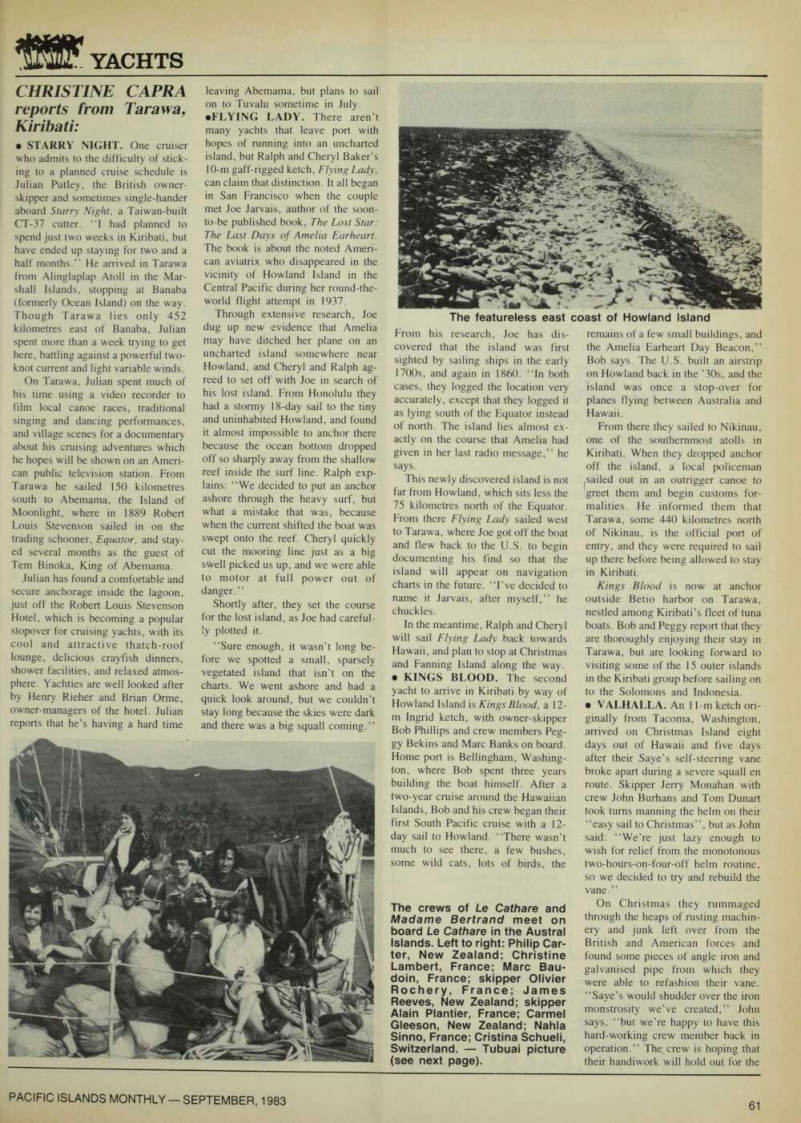
The crews of Le Cathare and Madame Bertrand meet on board Le Cathare in the Austral Islands. Left to right: Philip Car ter, New Zealand; Christine Lambert, France; Marc Bau doin, France; skipper Olivier Rochery, France; James Reeves, New Zealand; skipper Alain Plantier, France; Carmel Gleeson, New Zealand; Nahla Sinno, France; Cristina Schueli, Switzerland. - Tubuai picture (see next page).
The featureless east coast of Howland Island
sail to American Samoa, where re placement parts are waiting for them.
This is Jerry’s second Pacific cruise aboard Valhalla, having visited the Tuamotus, Marquesas, and Tahiti, in 1979. On this trip he hopes to include Tonga, Fiji and New Zealand in his cruising itinerary.
Don Travers
reports from Tubuai,
Austral Islands ,
French Polynesia:
• CONGO RED. A 13-m steel ketch from Sweden, Congo Red ar rived from Rarotonga in July with owners/builders Bengt Jacobsson, captain, and Brun Ulfhake, Lars Gollvik, Anders Martenson and Frank Wahmer, all of Sweden.
They left Stockholm on July 1, 1982, on a planned circumnaviga tion, calling at the Canary Islands, Barbados, West Indies, Panama, Galapagos, French Polynesia and the Cook Islands, where they decided to turn back, with plans to sell their yacht in the Virgin Islands. Their return voyage calls for stops at the Gambler Islands, Pitcairn, Easter Is land, Peru, Ecuador and Panama.
• Madame Bertrand. 10-M
plywood sloop of French registry, Madame Bertrand arrived from New Zealand in 16 days with skipper
Alain Plantier and Nahla Sinno, both French, and Cristina Schueli, Swiss.
The pink-painted yacht was built in La Rochelle, France, in 1977, and has since been cruising to Spain, Portugal, Morocco, Senegal, Brazil, West Indies, San Bias Islands, Pana ma, Las Perlas Islands, Galapagos,
Marquesas, Societies, Tonga, Fiji,
and New Zealand. • LE CATHARE. A 12.4-m steel ketch from France arrived from New Zealand with captain Olivier Rochery, and crew Marc Baudoin and Christine Lambert, all three French, and James Reeves, Phil Car ter, and Carmel Gleeson, all three of them from New Zealand. Le Cathare has cruised extensively in the South Pacific, and spent time in New Caledonia before visiting New Zealand.
Both French yachts were in Tubuai for the July 14 festivities, and stayed nearly a month. They left on the same day, in a race for Raiatea.
Neither yacht had firm plans for the future.
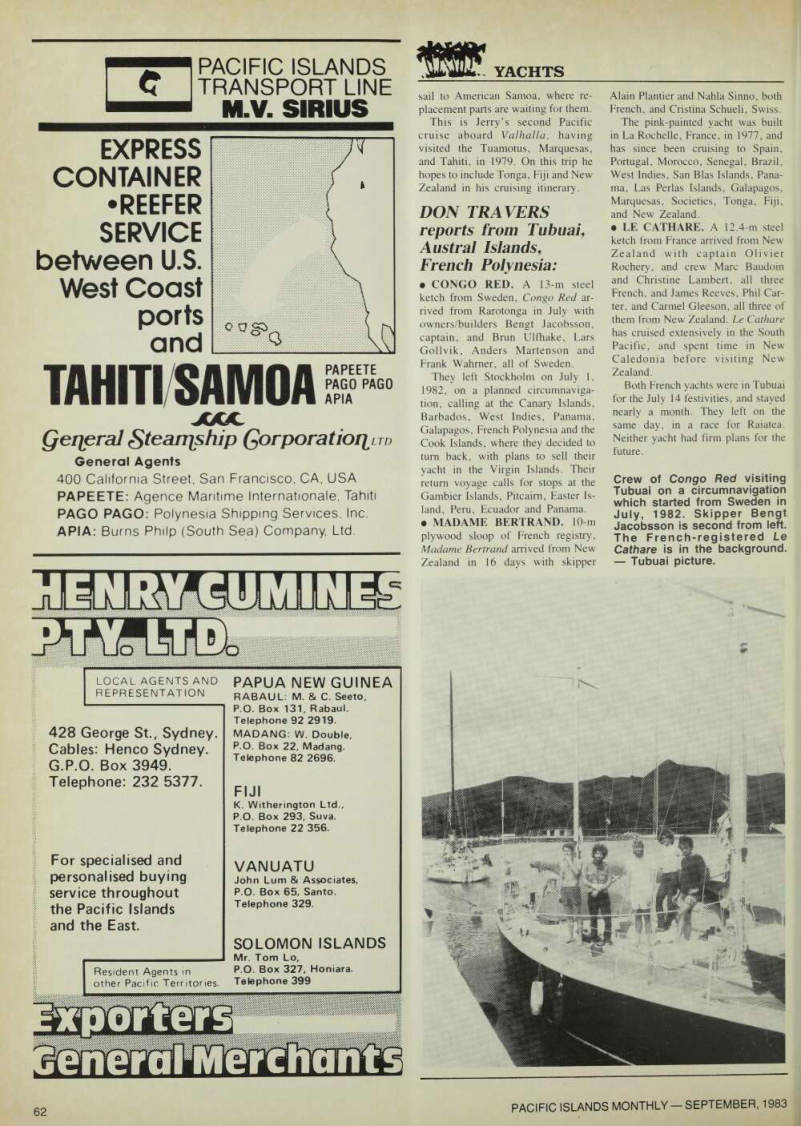
Crew of Congo Red visiting Tubuai on a circumnavigation which started from Sweden in July, 1982. Skipper Bengt Jacobsson is second from left.
The French-registered Le Cathare is in the background. - Tubuai picture.