blows nobody any good
pp. 55-59 · Read in the full issue

Trade Winds
Copra Prices Soar
It’s an ill wind that blows nobody any good
The extraordinary weather pat terns of 1983 have caused disas ters in many South Pacific coun tries. But there have been other and happier consequences for them.
Following a cyclone which de vastated the Philippines earlier this year, the South Pacific’s copra producers have been cash ing in on sky-rocketing world prices for the product.
The Philippines is the world’s largest copra producer, but its 1983 production could be down by half as a result of the cyclone.
In Papua New Guinea in Au gust, copra producers were re ceiving the equivalent of SASO extra per tonne from the Copra
Marketing Board.
The price rises were also ex pected to help boost PNG’s Cop ra Stabilisation Fund, which was exhausted last year after several years of very low prices.
The PNG Government has an nounced a new formula for the payment of levies into, and bounties from, the fund. Prime Minister Michael Somare said the new formula should help av oid a recurrence of the 1982 situation, when the government had to step in and guarantee loans to keep the industry operat ing when the fund ran out.
PNG displays
its products
The first trade display to be held in Australia devoted solely to products from Papua New Guinea was held in Melbourne in July and created wide interest.
The displays showed furniture and other timber products, beer, ornaments, clothing, foodstuffs and handcrafts. The display was organised by the PNG Depart ment of Foreign Affairs and Trade in co-operation with the International Trade Development Centre which Australia main tains. The development centre is supported by the Australian De velopment Assistance Bureau as part of a general aid program for
developing countries seeking market outlets.
Australia is PNG’s third largest market, buying signific ant consignments of cocoa beans, coffee beans, tea, sawn timber, rubber, plywood and fish. PNG is also a significant market for Australian exports, and there has been some criti cism that the balance of trade is too much in Australia’s favour.
However, Australian policy is directed towards boosting im ports from PNG and other Pacific regional centres.
The Melbourne display was opened by the Regional Director for the Department of Trade, Mr R. Bolduan who said there were signs that recent trade recessions were declining, and that Aust ralia and PNG should experience improvement in their mining and agriculture industries.
New owner for
Fiji Gateway
Castaway Resorts (Fiji) Ltd has signed and exercised an agree ment with Bums Philp (South Sea) Co. Ltd to purchase the Fiji Gateway Hotel in Nadi for an undisclosed amount.
Bums Philp managing direc
tor, Bryan Perry, said the agree ment calls for Castaway to take over the hotel on the completion of major renovations. The reno vations have already started, and the takeover will probably be on October 1.
The Gateway is directly across the road from Nadi International Airport. When renovations are completed it will offer 93 inter national deluxe rooms, two new restaurants, a new portico and terrace lounge, and a new pool area.
The move, which will include expansion of the hotel services, is expected to provide a boost for the tourist industry in Fiji.
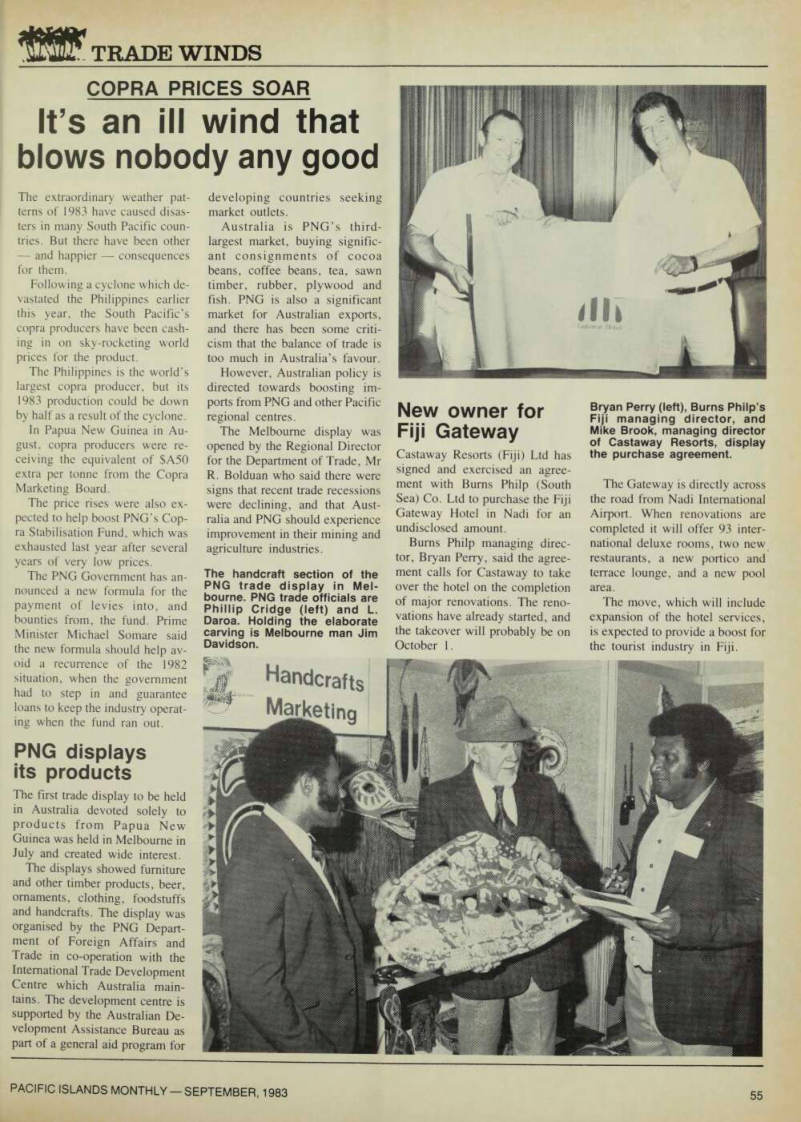
Bryan Perry (left), Burns Philp’s Fiji managing director, and Mike Brook, managing director of Castaway Resorts, display the purchase agreement.
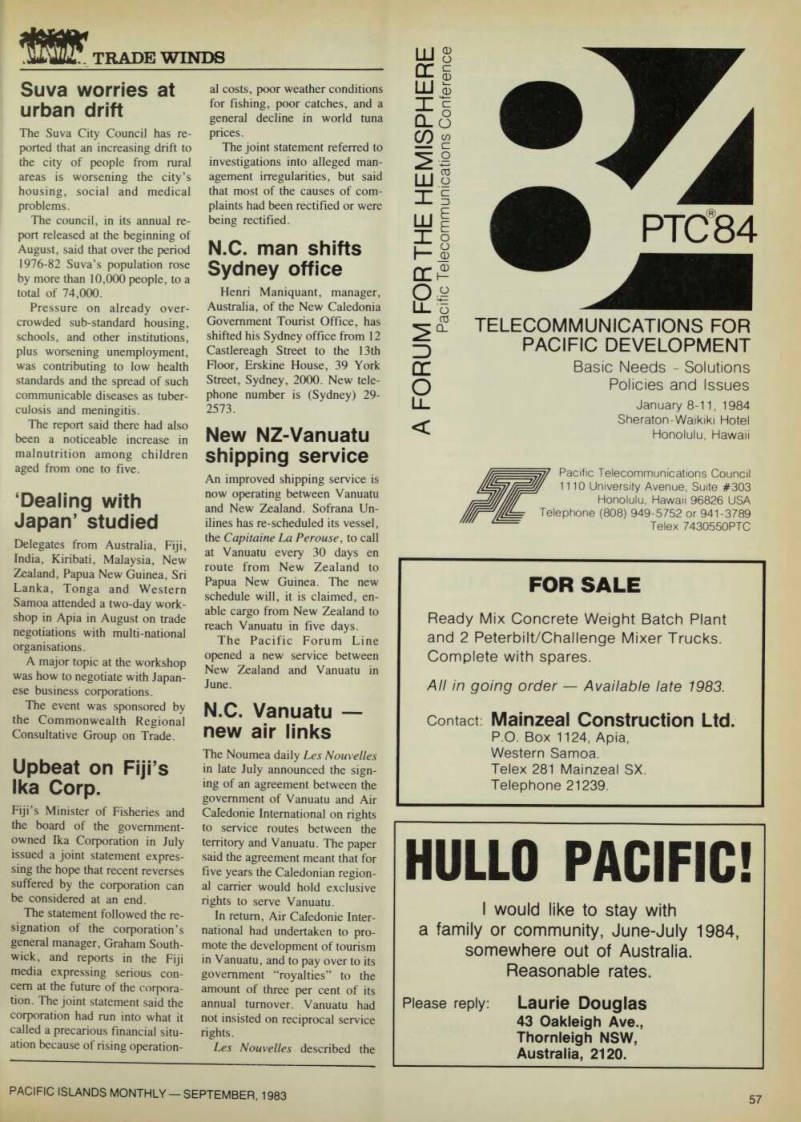
The handcraft section of the PNG trade display in Mel bourne. PNG trade officials are Phillip Cridge (left) and L.
Daroa. Holding the elaborate carving is Melbourne man Jim Davidson.
New interests
for Motibhai
Motibhai Australia, a subsidiary of the Fiji Motibhai group, has acquired the whole of the issued share capital of Ronson Pty Ltd Australia.
Ronson has operated for 26 years in Australia, employing 68 people and making shavers, ap pliances, lighters and allied arti cles. The purchase price was not disclosed. The deal adds a new series of products to the big range of goods either manufac tured or retailed by the Motibhai group.
The new owners plan to in crease the range of Ronson pro ducts in Australia.
Signing the contract: Seated left is Chiman Patel and right Mahendra Patel of Motibhai.
Brian Hunter Larkins for Ron son Products UK is in the centre. Standing from left are Nicholas Frome, solicitor; Mark Homan, for Ronsons; and Brian Davidson, solicitor.
Suva worries at
urban drift
The Suva City Council has re ported that an increasing drift to the city of people from rural areas is worsening the city’s housing, social and medical problems.
The council, in its annual re port released at the beginning of August, said that over the period 1976-82 Suva’s population rose by more than 10,000 people, to a total of 74,000.
Pressure on already over crowded sub-standard housing, schools, and other institutions, plus worsening unemployment, was contributing to low health standards and the spread of such communicable diseases as tuber culosis and meningitis.
The report said there had also been a noticeable increase in malnutrition among children aged from one to five.
‘Dealing with
Japan’ studied
Delegates from Australia, Fiji, India, Kiribati, Malaysia, New Zealand, Papua New Guinea, Sri Lanka, Tonga and Western Samoa attended a two-day work shop in Apia in August on trade negotiations with multi-national organisations.
A major topic at the workshop was how to negotiate with Japan ese business corporations.
The event was sponsored by the Commonwealth Regional Consultative Group on Trade.
Upbeat on Fiji’s
Ika Corp.
Fiji’s Minister of Fisheries and the board of the government owned Ika Corporation in July issued a joint statement expres sing the hope that recent reverses suffered by the corporation can be considered at an end.
The statement followed the re signation of the corporation’s general manager, Graham South wick, and reports in the Fiji media expressing serious con cern at the future of the corpora tion. The joint statement said the corporation had run into what it called a precarious financial situ ation because of rising operation
al costs, poor weather conditions for fishing, poor catches, and a general decline in world tuna prices.
The joint statement referred to investigations into alleged man agement irregularities, but said that most of the causes of com plaints had been rectified or were being rectified.
N.C. man shifts
Sydney office
Henri Maniquant, manager, Australia, of the New Caledonia Government Tourist Office, has shifted his Sydney office from 12 Castlereagh Street to the 13th Floor, Erskine House, 39 York Street, Sydney, 2000. New tele phone number is (Sydney) 29- 2573.
New NZ-Vanuatu
shipping service
An improved shipping service is now operating between Vanuatu and New Zealand. Sofrana Un ilines has re-scheduled its vessel, the Capitaine La Perouse, to call at Vanuatu every 30 days en route from New Zealand to Papua New Guinea. The new schedule will, it is claimed, en able cargo from New Zealand to reach Vanuatu in five days.
The Pacific Forum Line opened a new service between New Zealand and Vanuatu in June.
N.C. Vanuatu
new air links
The Noumea daily Les Nouvelles in late July announced the sign ing of an agreement between the government of Vanuatu and Air Caledonie International on rights to service routes between the territory and Vanuatu. The paper said the agreement meant that for five years the Caledonian region al carrier would hold exclusive rights to serve Vanuatu.
In return, Air Caledonie Inter national had undertaken to pro mote the development of tourism in Vanuatu, and to pay over to its government “royalties” to the amount of three per cent of its annual turnover. Vanuatu had not insisted on reciprocal service rights.
Les Nouvelles described the
breakdown of shareholdings in the new company as: Air Caledonie (the existing local company) 33.3%; Socomer 33%; Socalda 15%; Groupe Paribas et Caldew 7.14%; Sodetratour 11.41%.
‘Cautious hope’
in PNG
The economic outlook for Papua New Guinea in the next 18 months was one of cautious op timism, according to Finance
Minister Philip Bouraga.
“Things are getting better but they are getting better slowly,” he told Parliament in August.
Papua New Guinea’s balance of payments had steadied after restraint in Government and pri vate expenditure, he said.
At the bottom of the interna tional recession in 1982, foreign currency reserves fell by 18 mill ion kina ($A23.8 million).
He now expected a reasonable improvement in the balance of payments. This would lift foreign currency reserves com
fortably above danger levels.
“Our experience since inde pendence has shown us that in vestment does not pick up quick ly after a slump,” he said. “The business community takes time
to respond.
“We need to ensure that such a delay does not occur this time.
The Government has decided to
introduce immediately a package
of measures to boost income and create more jobs.”
Solomons crafts
show in Brisbane
From October 17 to 28 an exhibi tion and sale of Solomon Islands handicrafts will be staged in the fifth-floor gallery of David Jones’ Queen Street store in Bris bane, capital of Queensland, Australia.
Well-known Bellona-born Solomon Islands carver Frank Haikiu will be present, demon strating the skills that go into the distinctive carved handicrafts of the Solomons. Among Mr Haikiu’s works are a two-metre high crucifixion carving in the Holy Cross Cathedral, Honiara, and a carved bust of former
Solomon Islands prime minister and present Leader of the Oppos ition Sir Peter Kenilorea.
The exhibition is jointly spon sored by Bruce Saunders of BJS Agencies Ltd, Honiara, and Sol air/Air Pacific, national flag carriers of Solomon Islands and Fiji.
It aims both to promote Sol omon Islands handicrafts, and also the country itself as a tourist destination.
Fiji to boost
kava growing
Fiji farmers are likely to concen trate on growing the kava root (called yaqona in Fiji) which, according to a British economist, Dr Frank Ellis, could be de veloped into an important, easily tended cash crop, supplying the domestic market and markets in other island countries which use kava as a ceremonial and social drink. Income from sales in 1982 totalled nearly SFII million. Ka va, as the powdered root' mixed with water, is used in Fiji, Ton ga, the Samoas, Vanuatu and Micronesia.
Incensed over
incense imports
The import into Fiji of 432,000 incense sticks from India will put 60 women out of work, said the chairman of the Nadi Industrial
Co-operative Society, Ratu
Napolioni Dawai in August, in a protest against the import. The society, in partnership with an
Indian religious trust, employed
the women to make incense sticks. Since entry of the sticks from India, local production has dropped from 3000 dozen pack ets a week to 500. Narsi Raniga, secretary for economic planning and development, defended the granting of an import licence, saying the imported sticks were “dhoop sticks” and not incense sticks, and their use was con fined to the ritual ending Hindu
religious ceremonies.
Later, the Fiji Minister for Economic Planning and De velopment, Ratu David To ganivalu, said the ministry had made a mistake in allowing the incense sticks into the country. It would not happen again.
A big hydro
power success
story from
Tahiti
July 29 saw the inauguration of Tahiti’s third hydro-electric pow er station at Hitiaa O Tera on the island’s east coast.
The new Faatuita station, to gether with the existing west coast stations of Vaite (inau gurated in June 1981) and Vaihiria (November 1982), will bring Tahiti’s annual hydro electricity production to 20 mill ion kWh, or about 13 per cent of all electricity produced on the island. This represents a saving on fuel imports of about six million litres, worth about CFP3OO million ($A2.5 million).
Pioneering hydro-electricity production on the island is the local firm Marama Nui. Its direc tor-general, Dominique Auroy, speaking at the inauguration ceremony of the Faatuita plant, predicted that by 1985 electricity generated by the company’s hyd ro-electric plants will account for half of the island’s total electrici ty production. It has several other stations under construction.
The new station had been completed on schedule and under budget, Mr Auroy said. He told the gathering that representatives of the public power authority, Electricite de Tahiti (EDT), had estimated that the Faatuita pro ject would cost about CFPI bill ion. “We did it for 260 million,” he said, with obvious pride. “Not bad, eh?”
Local observers see part of the reason for Marama Nui’s success in the strong self-motivation of its workers. The company em ploys about 300 of its own share holders, one hundred of whom worked in extremely arduous physical conditions on the Faatuita project.
Fiji’s Garrick
Reserve
A large area of rainforest in Navua, Fiji, has been presented to the National Trust of Fiji by one of Fiji’s pioneering families.
The donation of 439 hectares (1055 acres) of hilly freehold land at Calia West, Navua, was
made in August on behalf of the Garrick Estate by Douglas Gar rick and his wife, Helen Garrick, at a ceremony in the Fiji Visitors Bureau boardroom in Suva.
It will be known as the J. H.
Garrick Reserve.
The Minister of State without Portfolio, Akariva Nabati, re ceived the title from Mr Garrick.
The title dates back to 1908 but it is not known how the land was initially acquired by the Garrick family. Mrs Garrick said the land had been bought from people who had been given Crown grants.
The area will be converted into a national park and native forest reserve.
“At a time when there is worldwide concern over the di minishing resources of rain for ests, and in particular, and more recently, the rapidly dwindling resources of our own forests here in Fiji, it is heartening to be able to set aside an area of our nation al heritage for the enjoyment of future generations,” the chair man of the National Trust of Fiji, Mr Robin Mercer, said when thanking the Garricks.
“The Garrick family has had a long association with Fiji and it is gratifying to see that Mr and Mrs Garrick are not only main taining that association but strengthening the bond.
“Too often we can cast our minds around to those who have benefited greatly from this won derful country of ours, but who in return have left little,” Mr Mercer said.
Drought slashes
Fiji sugar take
Drought is expected to cost Fiji’s sugar industry about SF7O mill ion this year in lost income.
Fiji’s cane-producing belt has been in the grip of drought since April. The country normally earns more than $l3O million annually from sugar sales.
The drought followed Cyclone Oscar, which had already devas tated most of the cane crop.
The Fiji Sugar Corporation said in a July statement that prospects for next year also look bleak because only about 11 per cent of the normal crop has been planted.
Bid for
Carpenters
Griffin East Pty. Ltd., an Aust ralian mining and oil group, in August launched a bid for control of the big islands’ trading firm of W.R. Carpenter Holdings Ltd., which is based in Sydney.
Griffin East was offering a cash price of $A2.35 a share for all the stock units in Carpenters, but the offer was conditional on acquisition of 90 per cent of Carpenter stock.
According to C.H. V. Carpent er, the company chairman, the offer terms were ridiculously low. The Carpenter family and associates are believed to own between 23 per cent and 25 per cent of the equity, and, without their co-operation, Griffin East appeared to have no chance of attaining its 90 per cent ceiling.
Weather skills to protect trade links: Solomon Islanders Fred die Ferrah, Chris Karau and Festus Ahikau in Melbourne with Australian weather official Bob Crowder after they graduated as weather observers.