to Majuro
p. 19 · Read in the full issue
The Month
All eyes turn to Majuro
Majuro, perhaps more than any other government centre in Mic ronesia, has a somnolent air.
There’s none of the hustle and bustle found on Saipan, or the sense of sub-surface tension one finds on Koror, capital of the Republic of Palau. Even Kolonia, Ponape, which marches to the beat of its own slow-paced tropical drummer, is a livelier and more colorful town.
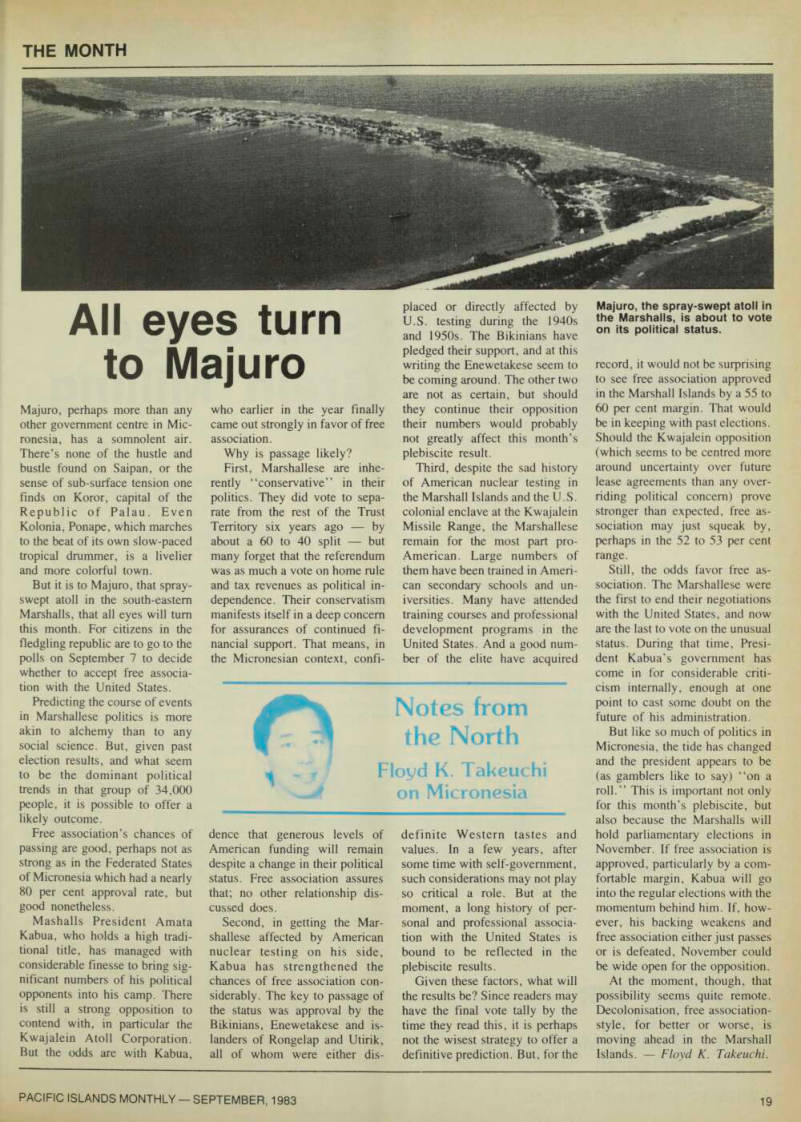
But it is to Majuro, that spray swept atoll in the south-eastern Marshalls, that all eyes will turn this month. For citizens in the fledgling republic are to go to the polls on September 7 to decide whether to accept free associa tion with the United States.
Predicting the course of events in Marshallese politics is more akin to alchemy than to any social science. But, given past election results, and what seem to be the dominant political trends in that group of 34,000 people, it is possible to offer a likely outcome.
Free association’s chances of passing are good, perhaps not as strong as in the Federated States of Micronesia which had a nearly 80 per cent approval rate, but good nonetheless.
Mashalls President Amata Kabua, who holds a high tradi tional title, has managed with considerable finesse to bring sig nificant numbers of his political opponents into his camp. There is still a strong opposition to contend with, in particular the Kwajalein Atoll Corporation.
But the odds are with Kabua,
who earlier in the year finally came out strongly in favor of free association.
Why is passage likely?
First, Marshallese are inhe rently “conservative’’ in their politics. They did vote to sepa rate from the rest of the Trust Territory six years ago by about a 60 to 40 split but many forget that the referendum was as much a vote on home rule and tax revenues as political in dependence. Their conservatism manifests itself in a deep concern for assurances of continued fi nancial support. That means, in the Micronesian context, confi-
dence that generous levels of American funding will remain despite a change in their political status. Free association assures that; no other relationship dis cussed does.
Second, in getting the Mar shallese affected by American nuclear testing on his side, Kabua has strengthened the chances of free association con siderably. The key to passage of the status was approval by the Bikinians, Enewetakese and is landers of Rongelap and Utirik, all of whom were either dis
placed or directly affected by U.S. testing during the 1940 s and 19505. The Bikinians have pledged their support, and at this writing the Enewetakese seem to be coming around. The other two are not as certain, but should they continue their opposition their numbers would probably not greatly affect this month’s plebiscite result.
Third, despite the sad history of American nuclear testing in the Marshall Islands and the U.S. colonial enclave at the Kwajalein Missile Range, the Marshallese remain for the most part pro- American. Large numbers of them have been trained in Ameri can secondary schools and un iversities. Many have attended training courses and professional development programs in the United States. And a good num ber of the elite have acquired
definite Western tastes and values. In a few years, after some time with self-government, such considerations may not play so critical a role. But at the moment, a long history of per sonal and professional associa tion with the United States is bound to be reflected in the plebiscite results.
Given these factors, what will the results be? Since readers may have the final vote tally by the time they read this, it is perhaps not the wisest strategy to offer a definitive prediction. But, for the
record, it would not be surprising to see free association approved in the Marshall Islands by a 55 to 60 per cent margin. That would be in keeping with past elections.
Should the Kwajalein opposition (which seems to be centred more around uncertainty over future lease agreements than any over riding political concern) prove stronger than expected, free as sociation may just squeak by, perhaps in the 52 to 53 per cent range.
Still, the odds favor free as sociation. The Marshallese were the first to end their negotiations with the United States, and now are the last to vote on the unusual status. During that time, Presi dent Kabua’s government has come in for considerable criti cism internally, enough at one point to cast some doubt on the future of his administration.
But like so much of politics in Micronesia, the tide has changed and the president appears to be (as gamblers like to say) “on a roll.” This is important not only for this month’s plebiscite, but also because the Marshalls will hold parliamentary elections in November. If free association is approved, particularly by a com fortable margin, Kabua will go into the regular elections with the momentum behind him. If, how ever, his backing weakens and free association either just passes or is defeated, November could be wide open for the opposition.
At the moment, though, that possibility seems quite remote.
Decolonisation, free association style, for better or worse, is moving ahead in the Marshall
Islands.
Floyd K. Takeuchi.
Majuro, the spray-swept atoll in the Marshalls, is about to vote on its political status.
Notes from the North Floyd K. Takeuchi on Micronesia