Easter Islanders petition the U.N.
pp. 17-18 · Read in the full issue
Followers Of The Spirit
Easter Islanders petition the U.N. for a vote on independence
The Followers of the Spirit of the Navel of the World the translated name of an Easter Island organisa tion have produced a petition asking for the independence of Easter Island from Chile. A RIM writer backgrounds the move which Chile has de scribed as the work of “foreign agitators”.
Stirrings of revolt among the inhabitants of Easter Island have surfaced with a petition address ed by them to the United Nations Committee of 24 the commit tee on decolonisation. The peti tion seeks the committee’s help in securing a referendum on the independence of Easter Island.
Sponsoring the petition is a committee known as Mana te Pukuraga o te Pito o te henua Rapa Nui. A very rough transla tion would be Followers of the Spirit of the Navel of the World (the Easter Islander’s old name for their island) Rapa Nui (a more recent name for the island).
Dismissed by authorities in Santiago as the work of “foreign agitators”, the petition never theless has a decidedly home grown tone to it.
It does not, for example, go in for Latin-style rhetoric about “Liberty or Death”, but soberly acknowledges the real relation ship of strength between the Chi lean authorities on the one hand and the Easter Islanders on the other, when it says: “We have hesitated a long time ... be cause we are afraid of reprisals”.
The preamble to the petition says: “In everything but name our island is a colony, and a
colony of the worst and most oppressive type, for we islanders have no say in our own affairs. In fact, the whole island was taken from us when the Chileans hoist ed their flag in 1888, and our land has since been used as a sheep station for the benefit of foreign companies.
“We are constantly being told that we are free Chilean citizens, and in fact we are citizens of Chile. But this works to our disadvantage because we are so few there are only 1200 of us.
So our votes carry no weight in national elections, and all deci sions are made over our heads on the mainland. We have no way of making our voice heard, for there is no democratically elected council on the island, which is
governed by a military comman der, aided by a local man called a “mayor”. But he is appointed by the military governor, and is no thing more than his errand boy. ”To help the governor rule us, the island is full of Chilean bureaucrats, soldiers and police about 800 altogether to see to it that we are kept ‘in our place’. Our youth must also serve in the Chilean army, and to mould them as good patriots, they are sent to Spanish-language schools. To increase our depend ence, the economy is controlled by the colonial power, and our only source of income is to make sculptures for the tourists, who have eyes only for the monu ments of our forefathers, and care nothing for us Easter Islan
ders who live on the island today.
“Since General Pinochet took over Chile and has been running it with his soldiers, it has become impossible for us to voice any protests in our own island. This is why we have sent the enclosed petition to the United Nations Committee on Decolonisation.
We have hesitated a long time before doing so, because we are afraid of reprisals. But here it is, and let our voice be heard. Why should we alone of all colonial peoples not be entitled to FREE
Dom And Independ
Ence?”
The petition addressed to the UN committee says in part: . .
The Chileans arrived in 1888.
They forbade our national flag, the flag of reimiro. They sent our forefathers to work from sunrise to sunset, without pay, only dol ing out some clothes to them like slaves. They threatened them and punished them. They took away their land and animals.
“Our land was rented out to foreign companies. The Rapa Nui were treated like aliens on their own soil, and had to seek permits to do the smallest thing.
The administrators treated them like children or inferiors, without any respect for their persons or
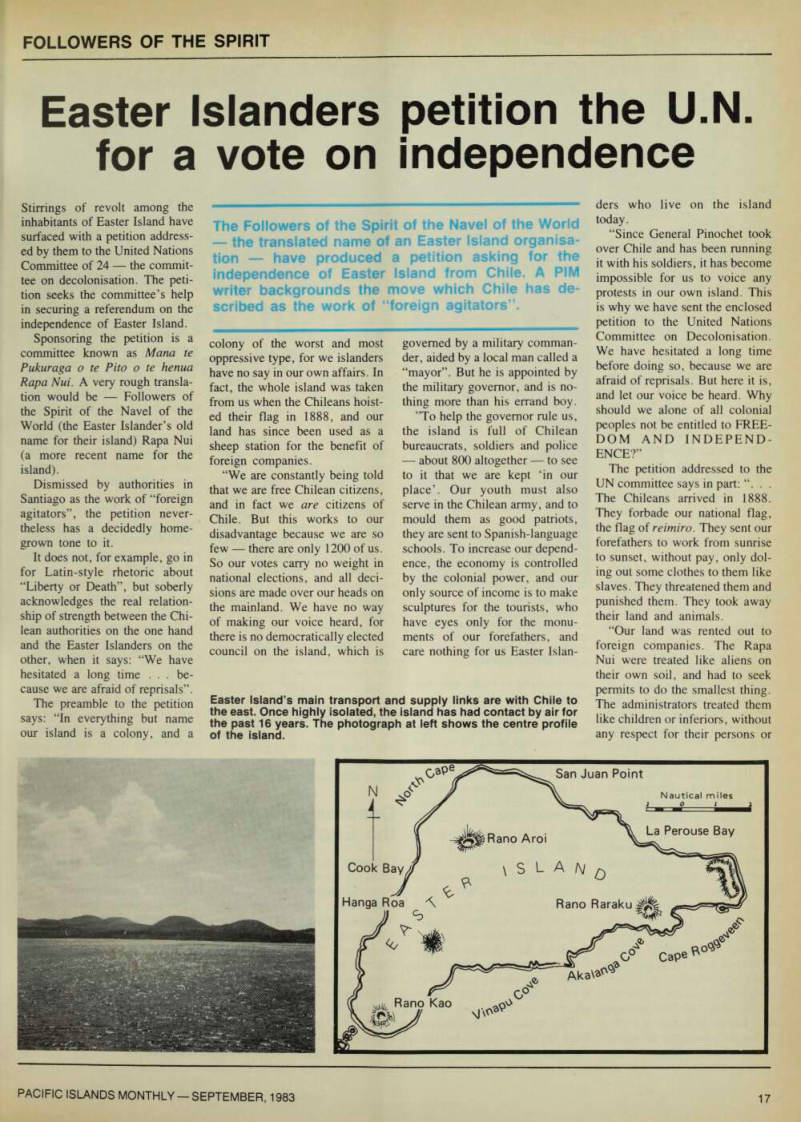
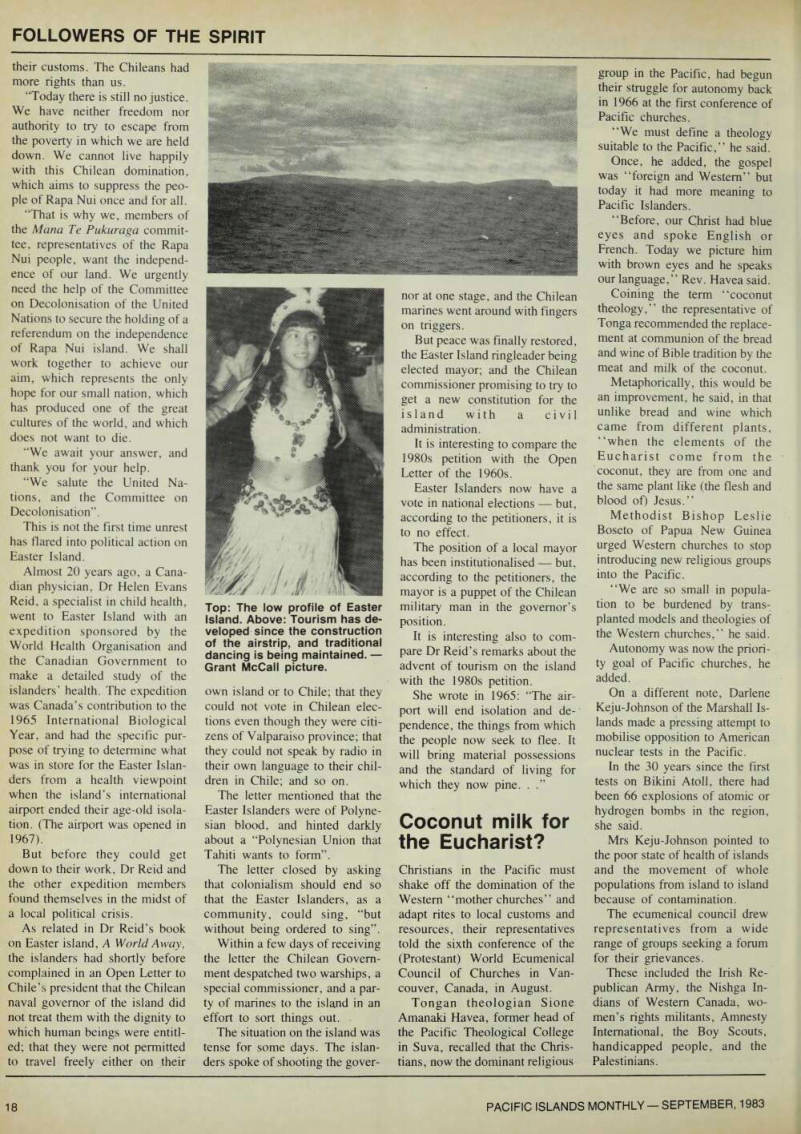
Easter Island’s main transport and supply links are with Chile to the east. Once highly isolated, the island has had contact by air for the past 16 years. The photograph at left shows the centre profile of the island.
their customs. The Chileans had more rights than us.
“Today there is still no justice.
We have neither freedom nor authority to try to escape from the poverty in which we are held down. We cannot live happily with this Chilean domination, which aims to suppress the peo ple of Rapa Nui once and for all.
“That is why we, members of the Mana Te Pukuraga commit tee, representatives of the Rapa Nui people, want the independ ence of our land. We urgently need the help of the Committee on Decolonisation of the United Nations to secure the holding of a referendum on the independence of Rapa Nui island. We shall work together to achieve our aim, which represents the only hope for our small nation, which has produced one of the great cultures of the world, and which does not want to die.
“We await your answer, and thank you for your help.
“We salute the United Na tions, and the Committee on Decolonisation”.
This is not the first time unrest has flared into political action on Easter Island.
Almost 20 years ago, a Cana dian physician, Dr Helen Evans Reid, a specialist in child health, went to Easter Island with an expedition sponsored by the World Health Organisation and the Canadian Government to make a detailed study of the islanders’ health. The expedition was Canada’s contribution to the 1965 International Biological Year, and had the specific pur pose of trying to determine what was in store for the Easter Islan ders from a health viewpoint when the island’s international airport ended their age-old isola tion. (The airport was opened in 1967).
But before they could get down to their work, Dr Reid and the other expedition members found themselves in the midst of a local political crisis.
As related in Dr Reid’s book on Easter island, A World Away, the islanders had shortly before complained in an Open Letter to Chile’s president that the Chilean naval governor of the island did not treat them with the dignity to which human beings were entitl ed; that they were not permitted to travel freely either on their
own island or to Chile; that they could not vote in Chilean elec tions even though they were citi zens of Valparaiso province; that they could not speak by radio in their own language to their chil dren in Chile; and so on.
The letter mentioned that the Easter Islanders were of Polyne sian blood, and hinted darkly about a “Polynesian Union that Tahiti wants to form”.
The letter closed by asking that colonialism should end so that the Easter Islanders, as a community, could sing, “but without being ordered to sing”.
Within a few days of receiving the letter the Chilean Govern ment despatched two warships, a special commissioner, and a par ty of marines to the island in an effort to sort things out.
The situation on the island was tense for some days. The islan ders spoke of shooting the gover
nor at one stage, and the Chilean marines went around with fingers on triggers.
But peace was finally restored, the Easter Island ringleader being elected mayor; and the Chilean commissioner promising to try to get a new constitution for the island with a civil administration.
It is interesting to compare the
1980 s petition with the Open
Letter of the 19605.
Easter Islanders now have a vote in national elections but, according to the petitioners, it is to no effect.
The position of a local mayor has been institutionalised but, according to the petitioners, the mayor is a puppet of the Chilean military man in the governor’s position.
It is interesting also to com pare Dr Reid’s remarks about the advent of tourism on the island with the 1980 s petition.
She wrote in 1965: “The air port will end isolation and de pendence, the things from which the people now seek to flee. It will bring material possessions and the standard of living for which they now pine. . .”
Coconut milk for
the Eucharist?
Christians in the Pacific must shake off the domination of the Western “mother churches” and adapt rites to local customs and resources, their representatives told the sixth conference of the (Protestant) World Ecumenical Council of Churches in Van couver, Canada, in August.
Tongan theologian Sione Amanaki Havea, former head of the Pacific Theological College in Suva, recalled that the Chris tians, now the dominant religious
group in the Pacific, had begun their struggle for autonomy back in 1966 at the first conference of Pacific churches.
“We must define a theology suitable to the Pacific,” he said.
Once, he added, the gospel was “foreign and Western” but today it had more meaning to Pacific Islanders.
“Before, our Qhrist had blue eyes and spoke English or French. Today we picture him with brown eyes and he speaks our language,” Rev. Havea said.
Coining the term “coconut theology,” the representative of Tonga recommended the replace ment at communion of the bread and wine of Bible tradition by the meat and milk of the coconut.
Metaphorically, this would be an improvement, he said, in that unlike bread and wine which came from different plants, “when the elements of the Eucharist come from the coconut, they are from one and the same plant like (the flesh and blood of) Jesus.”
Methodist Bishop Leslie Boseto of Papua New Guinea urged Western churches to stop introducing new religious groups into the Pacific.
“We are so small in popula tion to be burdened by trans planted models and theologies of the Western churches,” he said.
Autonomy was now the priori ty goal of Pacific churches, he added.
On a different note, Darlene Keju-Johnson of the Marshall Is lands made a pressing attempt to mobilise opposition to American nuclear tests in the Pacific.
In the 30 years since the first tests on Bikini Atoll, there had been 66 explosions of atomic or hydrogen bombs in the region, she said.
Mrs Keju-Johnson pointed to the poor state of health of islands and the movement of whole populations from island to island because of contamination.
The ecumenical council drew representatives from a wide range of groups seeking a forum for their grievances.
These included the Irish Re publican Army, the Nishga In dians of Western Canada, wo men’s rights militants, Amnesty International, the Boy Scouts, handicapped people, and the Palestinians.
Top: The low profile of Easter Island. Above: Tourism has de veloped since the construction of the airstrip, and traditional
dancing is being maintained. -
Grant McCall picture.