and smoke effects,
pp. 13-14 · Read in the full issue
New Caledonia
Lack of sound and smoke effects, reluctant actors spoil the drama of Koindé
Koinde is a sleepy little Kanak village 130 km north of Noumea.
It is hidden in the mountain chain which runs through the centre of la Grande Terre. About 150 peo ple live there.
On January 10 this year, a convoy of gendarmes came through Koinde early in the morning to recover sawmill equipment belonging to Mr Bar bou, European owner of a saw mill operating in the locality.
The equipment had been taken and held by the villagers in the course of a dispute over pollution caused by the sawmill to the drinking water and yabbie supply of the village. As the gendarmes attempted to leave Koinde a fight occurred, two gendarmes were killed, and six other people wounded. (See report PIM Feb p!5).
The Kanaks claim that after
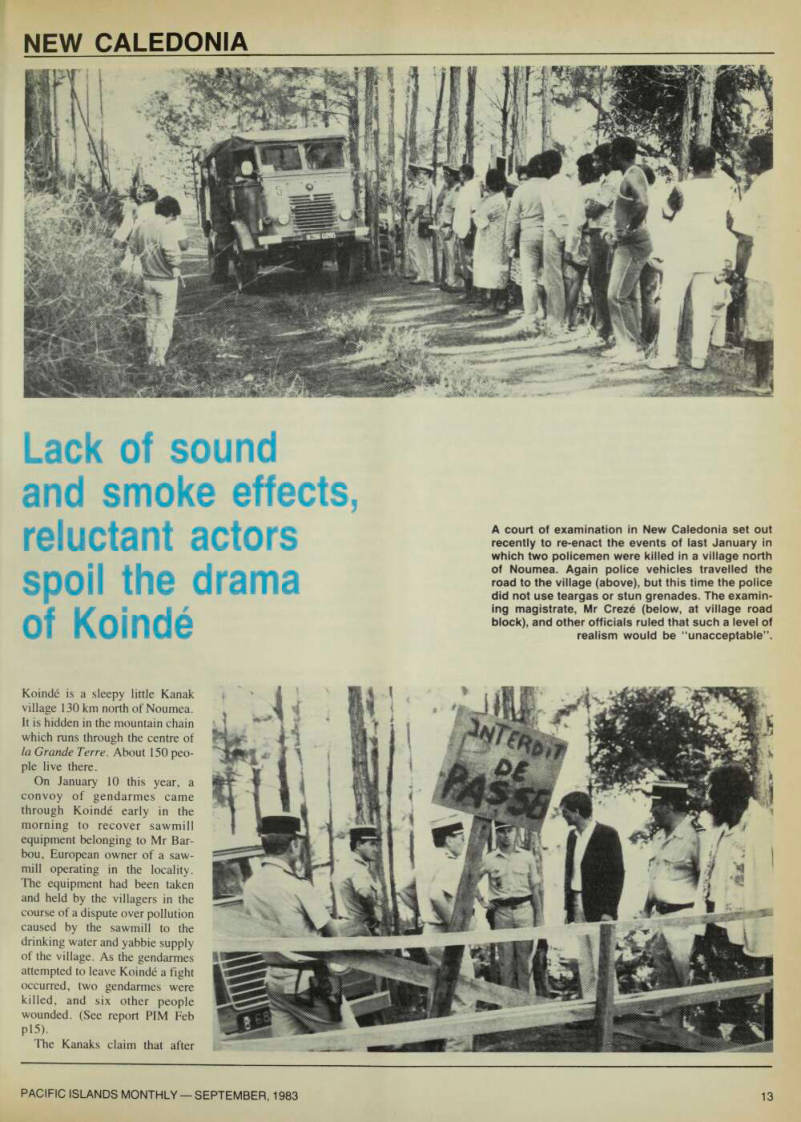
A court of examination in New Caledonia set out recently to re-enact the events of last January in which two policemen were killed in a village north of Noumea. Again police vehicles travelled the road to the village (above), but this time the police did not use teargas or stun grenades. The examin ing magistrate, Mr Creze (below, at village road block), and other officials ruled that such a level of realism would be “unacceptable".
they threw rocks and other mis siles the gendarmes replied with dozens of teargas and stun grenades fired from a distance of 15 to 20 metres. With this, and helicopters hovering overhead, they believed a form of war had broken out and panicked. It was then, they say, that they rushed to their huts, got their hunting guns, and fired into the cloud of teargas, killing the gendarmes.
The gendarmes claim the Kanaks fired first, and that the teargas was fired from a long way off.
On July 19, early in the morn ing, a convoy of gendarmes came again to Koinde around 150 men, numerous vehicles, and a helicopter. Their purpose was to assist in a re-enactment of the January drama. (Re enactment of serious crimes is normal procedure under French law). Also present were the ex amining magistrate, Mr Creze, other judicial authorities, and the two defence lawyers, Francois Roux and Gustave Tehio.
The six men in Noumea’s pris on, Camp Est, were brought back to their home to take part in
the re-enactment. The six are on charges of assassination and at tempted assassination.
By late morning, the sun had warmed the little valley, and the convoy of gendarmes was in place. However, only the latter took part in the re-enactment.
Defence counsel Roux and Tehio had asked Mr Creze for the gendarmes again to fire the tear gas and stun grenades to demons trate the atmosphere and fear of panic. Mr Roux, who had come from France for the replay, told PIM it would also show just how close the gendarmes were when the teargas was fired.
The central point of the de fence argument, he said, is legiti mate defence. For the Kanaks maintain teargas was fired direct ly at them, not up into the air as the gendarmes claim. Mr Tehio explained that if the grenades had been shot upwards they would have landed in the river, some distance away.
The petit chef of Koinde, Mr Monefara, says it was when his family saw him knocked down after being hit in the face by a teargas grenade, that they rushed for their arms and fired at the convoy.
However, the gendarmes and the judicial authorities found the request for a replay of the teargas unacceptable, and defence coun-
sel instructed the six accused to decline to participate in the re play, and to ask to be returned to Camp Est. The villagers of Koinde also refused to assist in
the replay.
Messrs Roux and Tehio told newsmen: “The refusal to allow a proper re-enactment was a viola tion of the rights of the defence, and a violation of Article 6 of the
European Human Rights Con
vention, which says that all men have the right to an equitable trial.
“There is no point in par ticipating if the real conditions are not re-created,” they said, “to show where the accused were at the exact moment of the crimes, and in conditions they found themselves.”
The six accused went back to Noumea after being briefly reunited with their families, the villagers went off to have lunch, and the gendarmes went ahead with the replay.
The case is not expected to come to trial for at least several months. • The gendarmes involved in the January drama at Koinde have been recalled to France in ac cordance with the practice fol lowed when they suffer death in their ranks. A different squad took part in the replay.
Sawmill owner Barbou, and the other civilians who had help ed in the January operation for the recovery of the sawmill equipment, declined to take part in the replay. Their parts were played by gendarmes. Helen Fraser.
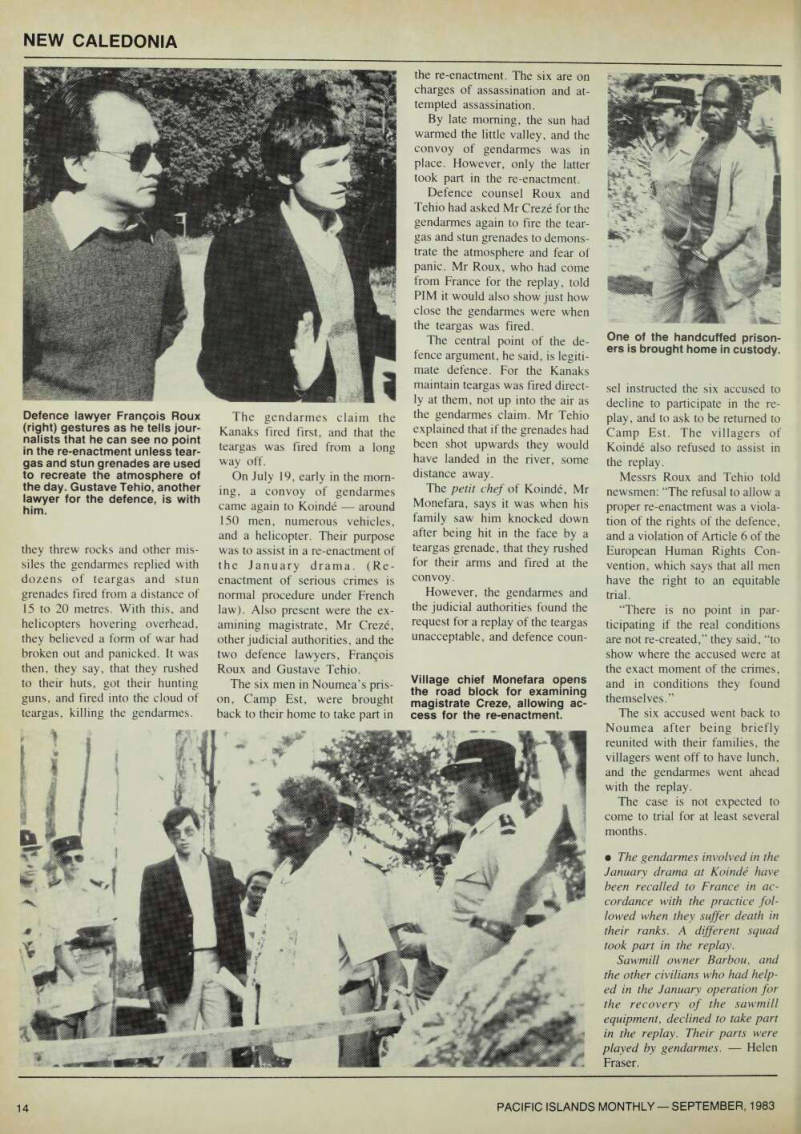
Defence lawyer Francis Roux
(right) gestures as he tells jour nalists that he can see no point in the re-enactment unless tear gas and stun grenades are used to recreate the atmosphere of the day. Gustave Tehio, another lawyer for the defence, is with him.
Village chief Monefara opens the road block for examining magistrate Creze, allowing ac cess for the re-enactment.
One of the handcuffed prison ers is brought home in custody.