Superman
pp. 7-11 · Read in the full issue

Letters
Wilhelm Solf:
Good, but no
Superman
As a Pacific historian with a special interest in Samoan socie ty and in Germany’s under publicised role in the history of the islands, I would like to ap
plaud Joseph Theroux’s attempt
(PIM July) to bring the colonial governor, Wilhelm Solf, out of his dusty obscurity.
It is not that little has been written about this large personal ity over the years; indeed there are several journal articles and chapters in books which bring Solf to life in one way or other and analyse his role in Samoa.
But, as Theroux points out, there is as yet no major biography of him in the English language which, for people in the Pacific region, puts Solf in global con text as an administrator with a large humane vision within an aggressive imperial Germany.
However Theroux’s article on Solf falls into the same trap of
European presumption into
which most other casual obser vers of islands history have fallen over the years.
Theroux gives a remarkably small role to the Samoan people themselves in shaping their soci ety under Self’s paternalistic rule. The fact is that, despite Self’s unusual sensitivity to Sa moan politics and his undoubted shrewdness, he did not stride irresistibly across the Samoan
political and social landscape
dictating European political and land reforms to a grateful and
acquiescent people.
The German period in Samoa like the New Zealand period after it was a time of constant negotiation between the German administration and the Samoan elites and people about shared power and about how far along the road of European develop ment Samoans would allow themselves to be pushed.
Solf was challenged consis tently all along that road by one group or another who matched his authority and shrewdness with authority and political skills of their own. Thus the land re forms of 1906 were negotiated between Solf and the chiefs, not
thrust upon them. Similarly, the changes that were made to the political system had to take into account the strength of Samoan political movements all along the line. And, finally, Self’s politic al objectives were never fully realised either during his time or after he left because of the pre ssure Samoan leaders brought to bear on the German administration.
Solf deserves greater recogni tion, which I hope to further
myself by providing that missing
English language biography. But
he was no Übermensch who sim ply dominated weak, disor ganised and primitive Samoans.
They always shared in the crea tion of colonial Samoa through a century of political manipulation which ended in a new begin ning with Western Samoa in 1962 becoming the Pacific’s first independent island nation.
Peter Hempenstall
University of Newcastle Newcastle, NSW Australia
Knocking Smiley’s
Plan
In its issue of November 1982, PIM reported the plans of Mr Arthur (“Smiley”) Ratliff for Henderson and Pitcairn Islands.
I am a conservationist, and have visited Henderson Island. I was also a friend of the late Flight-Lieutenant Alf Fletcher,
who led a survey party and spent six weeks on Henderson Island in early 1944.
I am appalled at the plan to develop Henderson Island along the lines being suggested.
As pointed out in Rod Hay’s article enclosed herewith, Pit cairners themselves, with the help of professional advice, have the means to construct an airstrip on Pitcairn. This would enable the air service already establish ed between Tahiti and Mangare va to call at Pitcairn in an emergency.
Rod Hay has authorised me to submit his article and would be grateful if it were published in
Pim.
Nelson Dyett
Wellington New Zealand
The article by Rod Hay Hen derson Island Smiley’s Dream, Nature’s Demise will be published in a future issue of PIM. Mr Hay is South Pacific Project Officer, Royal Forest and Bird Protection Society, and International Council for Bird Preservation.
Not three, but four
film-makers ...
I was pleased with Dr W. G.
Coppell’s film review on Namaki (PIM Mar p2l). I share his opin ion that Namaki is an ethnog
raphic film of major signifi
cance. However I would like to correct some of his information on the making of the film. The film was actually made by a team of four people, the three former students of the Australian School of Film and Television whom he named and Gilles Artur, the di rector of the Gauguin Museum in Tahiti.
Gilles Artur is not an an
thropologist as stated by Dr Cop
pell, but a former film-maker, museum director and specialist on Paul Gauguin. It is easy to assume that he might be an an
thropologist, particularly since
Artur was one of the first Euro peans to live for several months with the Big Nambas in Amok and to speak their dialect. Artur first stayed with the Big Nambas in June 1953, and it was at this time that he began filming their culture. He returned to shoot
more footage in 1954 and reaf firm his friendship with the peo ple. His film was shown private ly and shared with interested colleagues and anthropologists.
After a number of years Artur returned to visit the Big Nambas, who by 1979 had firmly stated that they did not want to be studied, filmed or photographed.
In short, the Big Nambas did not invite the Australian group to film their Namaki ceremony.
The Big Nambas were initially reluctant, and it was because of the action taken by Artur, with the support of the Reverend Greig Fox, the Reverend Father Rodet, and Kirk Huffman, that the Australians were allowed to film. From June to September 1980 Artur took over 2000 photographs and prepared the way for the shooting of the 135 minutes of 16 mm rushes of the Namaki ceremony during five days in early September when the three Australians, Knaus, Cooksedge and Burstow joined him.
In 1981 Artur went twice to Sydney to work on the editing of the film’s new and old footage footage he provided. The four of them agreed to give their au thor’s copyright to the Big Nam bas, and they offered them a copy of the film, a graded copy of all the rushes, and a cinema projector. They also provided the
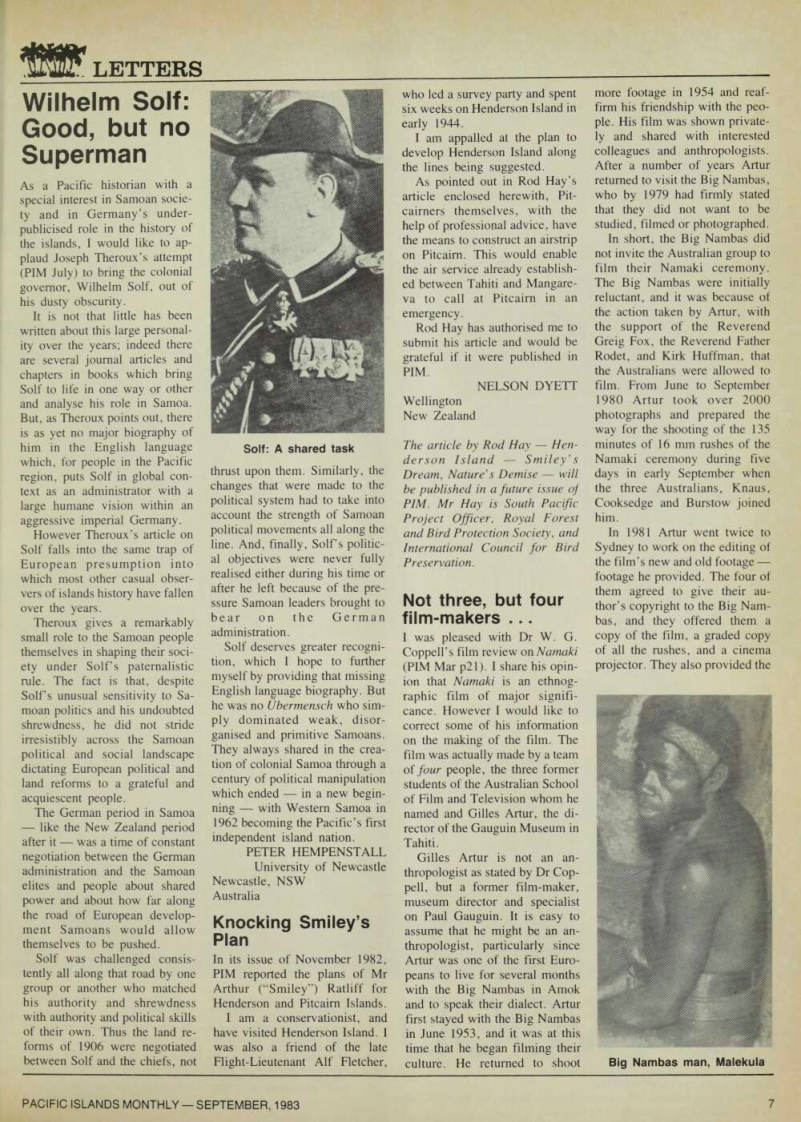
Solf: A shared task
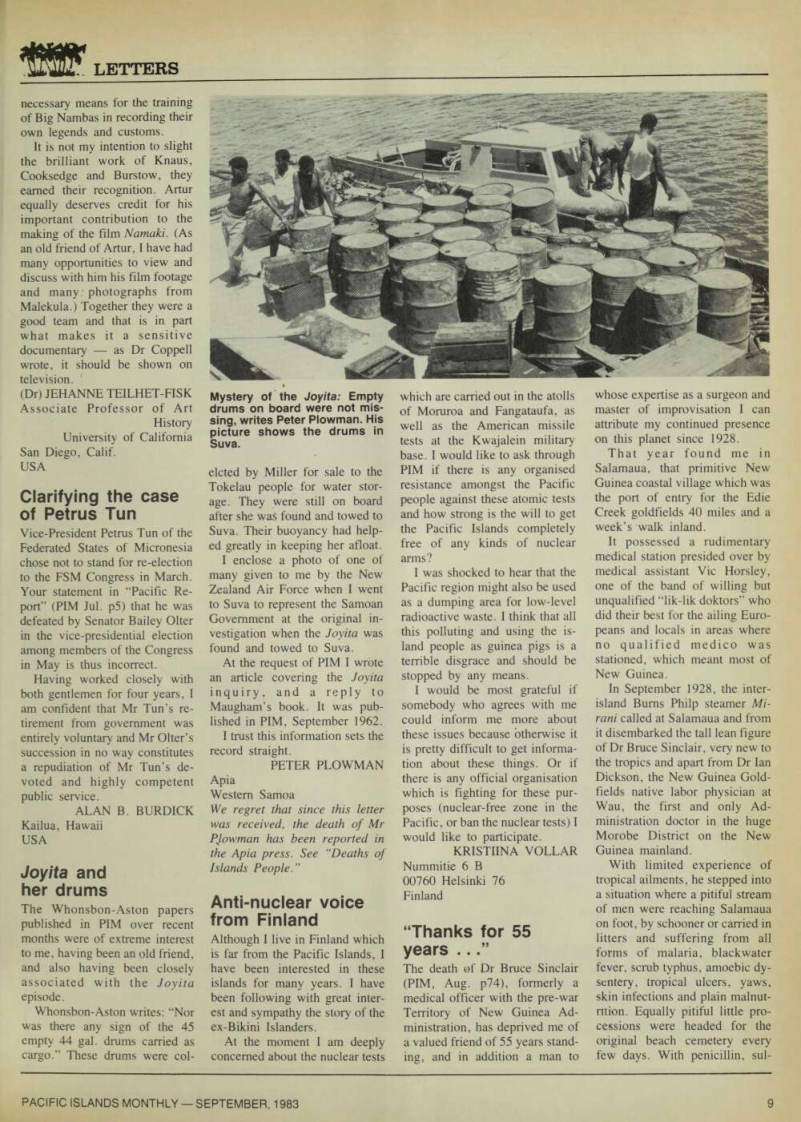
Big Nambas man, Malekula
necessary means for the training of Big Nambas in recording their own legends and customs.
It is not my intention to slight the brilliant work of Knaus, Cooksedge and Burs tow, they earned their recognition. Artur equally deserves credit for his important contribution to the making of the film Namaki. (As an old friend of Artur, I have had many opportunities to view and discuss with him his film footage and many photographs from Malekula.) Together they were a good team and that is in part what makes it a sensitive documentary as Dr Coppell wrote, it should be shown on television.
(Dr) Jehanne Teilhet-Fisk
Associate Professor of Art
History
University of California San Diego, Calif.
Usa
Clarifying the case
of Petrus Tun
Vice-President Petrus Tun of the Federated States of Micronesia chose not to stand for re-election to the FSM Congress in March.
Your statement in “Pacific Re port” (PIM Jul. p 5) that he was defeated by Senator Bailey Olter in the vice-presidential election among members of the Congress in May is thus incorrect.
Having worked closely with both gentlemen for four years, I am confident that Mr Tun’s re tirement from government was entirely voluntary and Mr Olter’s succession in no way constitutes a repudiation of Mr Tun’s de voted and highly competent public service.
Alan B. Burdick
Kailua, Hawaii
Usa
Joyita and
her drums
The Whonsbon-Aston papers published in PIM over recent months were of extreme interest to me, having been an old friend, and also having been closely associated with the Joyita episode.
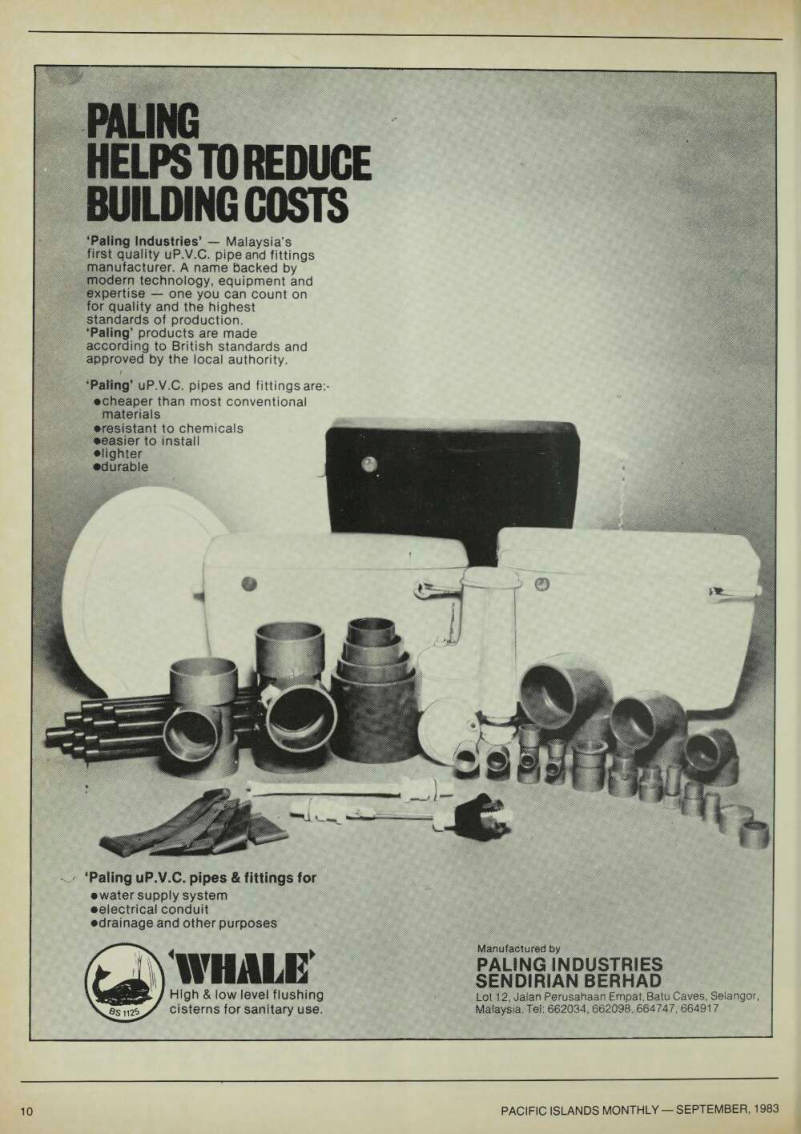
Whonsbon-Aston writes: “Nor was there any sign of the 45 empty 44 gal. drums carried as cargo.” These drums were col-
elcted by Miller for sale to the Tokelau people for water stor age. They were still on board after she was found and towed to Suva. Their buoyancy had help ed greatly in keeping her afloat.
I enclose a photo of one of many given to me by the New Zealand Air Force when I went to Suva to represent the Samoan Government at the original in vestigation when the Joyita was found and towed to Suva.
At the request of PIM I wrote an article covering the Joyita inquiry, and a reply to Maugham’s book. It was pub lished in PIM, September 1962.
I trust this information sets the
record straight.
Peter Plowman
Apia Western Samoa We regret that since this letter was received, the death of Mr Plowman has been reported in the Apia press. See “Deaths of Islands People."
Anti-nuclear voice
from Finland
Although I live in Finland which is far from the Pacific Islands, I have been interested in these islands for many years. I have been following with great inter est and sympathy the story of the ex-Bikini Islanders.
At the moment I am deeply concerned about the nuclear tests
which are carried out in the atolls of Moruroa and Fangataufa, as well as the American missile tests at the Kwajalein military base. I would like to ask through PIM if there is any organised resistance amongst the Pacific people against these atomic tests and how strong is the will to get the Pacific Islands completely free of any kinds of nuclear arms?
I was shocked to hear that the Pacific region might also be used as a dumping area for low-level radioactive waste. I think that all this polluting and using the is land people as guinea pigs is a terrible disgrace and should be stopped by any means.
I would be most grateful if somebody who agrees with me could inform me more about these issues because otherwise it is pretty difficult to get informa tion about these things. Or if there is any official organisation which is fighting for these pur poses (nuclear-free zone in the Pacific, or ban the nuclear tests) I would like to participate.
Kristiina Vollar
Nummitie 6 B 00760 Helsinki 76 Finland
“Thanks for 55
years ...”
The death of Dr Bruce Sinclair (PIM, Aug. p 74), formerly a medical officer with the pre-war Territory of New Guinea Ad ministration, has deprived me of a valued friend of 55 years stand ing, and in addition a man to
whose expertise as a surgeon and master of improvisation I can attribute my continued presence on this planet since 1928.
That year found me in Salamaua, that primitive New Guinea coastal village which was the port of entry for the Edie Creek goldfields 40 miles and a week’s walk inland.
It possessed a rudimentary medical station presided over by medical assistant Vic Horsley, one of the band of willing but unqualified “lik-lik doktors” who did their best for the ailing Euro peans and locals in areas where no qualified medico was stationed, which meant most of New Guinea.
In September 1928, the inter island Bums Philp steamer Mi rani called at Salamaua and from it disembarked the tall lean figure of Dr Bruce Sinclair, very new to the tropics and apart from Dr lan Dickson, the New Guinea Gold fields native labor physician at Wau, the first and only Ad ministration doctor in the huge Morobe District on the New Guinea mainland.
With limited experience of tropical ailments, he stepped into a situation where a pitiful stream of men were reaching Salamaua on foot, by schooner or carried in litters and suffering from all forms of malaria, blackwater fever, scrub typhus, amoebic dy sentery, tropical ulcers, yaws, skin infections and plain malnut rition. Equally pitiful little pro cessions were headed for the original beach cemetery every few days. With penicillin, sul-
Mystery of the Joyita: Empty drums on board were not mis sing, writes Peter Plowman. His picture shows the drums in Suva.
phas, antibiotics and other won der drugs yet to evolve, the doc tor carried on with quinine, aspi rin, iodine and hard work. His only chance for another opinion lay in the six-weekly visit of the Bums Philp passenger ship from Australia with its ship’s doctor.
Three days after his arrival in Salamaua I contracted acute ap pendicitis. By mid-aftemoon Dr Sinclair decided that surgery was imperative and told me that in the lack of most instruments, operat ing theatre, sterilising facilities and lighting he would do his best.
While I sat on the verandah of his small two-roomed timber re sidence watching several New Guineans swabbing down the walls of his bedroom with disin fectant he busied himself with boiling some sheets in a bucket, scrubbing down a kitchen table, sharpening several rusty old scal pels and cutting up and sterilising a catgut fishing line for sutures.
Finally, the four helpers were sent to the beach to scrub up with wet sand and sea water.
By nightfall all was ready and action commenced with the four helpers at each comer of the table holding aloft kerosene lamps.
The local barman was recruited as being the most suitable man to administer an anaesthetic and he did a stupefying job. Straight chloroform was used because of the risk of using ether in the presence of naked lights.
Suffice to say all went well. I left the “hospital” a week later in good shape thanks to luck in timing and the skill of the doctor in surgery and resourcefulness in a difficult situation.
Bert E. Weston
Wollstonecraft, NSW Australia
Guadalcanal
cassettes May I bring your attention to the report from the February issue of PIM concerning cassettes of the 40th anniversary observances of the Guadalcanal Campaign in August 1982.
It is a mystery here as to how the cassette information found its way into the pages of PIM. (Not that we are upset for the publicity rendered to Solomon Islands Broadcasting Corporation, or to our organisation, Guadalcanal Campaign Veterans.) We here have already received cassette orders from Australia and Fiji, cannot afford to reship cassettes already airshipped here from Solomon Islands for only SUSB, and so we have returned bank drafts received here.
Overseas cassette orders
should be directed to: Solomon Islands Broadcasting Corpora tion, Box 654, Honiara, Guadal canal, Solomon Islands. Attn: Mr Martin Hadlow, News/Prog ram Trainer.
Al Bonney
Executive Director, Guadalcanal Campaign Veterans Brunswick Maine
Usa
From the Palace
Office, Nukualofa
PIM has recently received a lengthy statement from the Palace Office of the Kingdom of Tonga objecting to a report head lined “Tonga’s King Sacks Fi nance Minister” and appearing in our issue of May 1982.
The statement says that it was incorrect to report that the minis ter concerned, Mahe Tupouniua, was “sacked”, because, it says, Mr Tupouniua resigned at his own request, and it quotes a statement by him to this effect appearing in The Tonga Chroni cle of March 26, 1982.
It was also incorrect, the state ment says, to suggest that the “sacking” was due to the minis ter’s refusal to provide extra public funds for the King’s travel. It goes on: “There were certainly discussions between the Palace Office and Treasury, but these were about the payment of expenses already incurred . . .
the accounts under discussion were not just for transport either, they were for other expenses as well. Such discussions are nor mal between any Treasury and all government departments.”
The statement adds: “That the amount required by the Palace office was above that allocated in the budget is quite correct. What the article failed to do, however, was to point out that it would be a rare exception indeed for any department not to require extra funds above its budget alloca tion. The extra funds approved by the government of Tonga above the budgets for the finan cial years July 1979 to June 1982 amounted to $10,051,749. Only $155,294 of this total was for the Palace office. The extra expenses for Their Majesties’ attendance at the wedding of Their Royal Highness Prince Charles and the Princess of Wales, July, 1981, as well as the hospitality for the visit of the Prime Minister of India, Indira Gandhi, October 1981, fell within this period.”
Not two, as claimed in the article, but one senior finance man had resigned at the time, the statement says, and the resigna tion had nothing to do with the “sacking”. This man has since been reappointed to a high gov ernment post.
The statement says that the PIM article’s suggestion that the incident would have important political repercussions in the post-cyclone conditions of the time was “ill-founded”. “No political repercussions have oc curred and Tonga’s recovery af ter the cyclone has been miracul ously rapid,” the statement says.
The statement makes two other substantial points, saying: “The only initiative taken by His Majesty concerned the timing of Mr Tupouniua’s resignation. Mr Tupouniua had mentioned Oc tober 1982. His Majesty brought this forward to March 1982 in order to allow the new minister of finance to prepare his own budget for the July 1982 to June 1983 financial year. Secondly, HRH Prince Tu’ipelehake, prime minister of Tonga and His Ma jesty’s brother, fully supported Mr Tupouniua’s nomination in August 1982 to return to SPEC, again as its director.”
Salamaua, as it was about half a century ago. Dr Sinclair re cruited a barman, “skilled at
stupefying”, to give an
anaesthetic.