After the storm,
pp. 21-23 · Read in the full issue

calm consensus
June in Vanuatu saw the second meeting of parliament for the year and a determined attempt by both sides to overcome par liamentary hostilities left over from the vote of no-confidence in April (PIM May p 5).
The Opposition had refused then to pass an amendment to the constitution which would have solved a tangle hindering valid elections later this year. That refusal a silent abstention had been part of the preliminary manoeuvring for the vote of no confidence in the Vanuaaku Par ty’s Prime Minister Walter Lini.
Accordingly, the day before the second meeting was to have opened, a tri-partite meeting of Lini, the Union of Moderate Par ties’ new Secretary-General Vin cent Boulekone, and the Vanuatu Independents’ Alliance Party’s Thomas Reuben Seru, hammered out a consensus approach to the amendment. Things seemed set for a smooth passage. But during the week the consensus-seekers encountered unexpected squalls.
The meeting got off to a bad start when a late entrance by a
number of Opposition members on Monday morning meant that the sitting had to be abandoned.
That afternoon saw a series of extra-parliamentary meetings, as members talked over their views.
Op Tuesday morning, too, a quorum was not present. Tues day afternoon the business of the session began. The amendment was to be left to last, as it required a special sitting.
Education Minister Onneyn Tahi introduced the long-overdue Bill for the Teaching Service Act of 1983. Vanuatu’s teachers have for a long time felt themselves to be the neglected poor relations of the professional class, and there has been a large wastage of teachers to other employment.
The Vanuatu Teachers’ Federa tion had had stormy discussions at its annual conference in May, with hints that a salary rise of 80 per cent might be demanded. The bill was passed after short discus sion, with approval from mem bers of all parties, and particular ly those who had formerly taught.
Other bills also passed easily
the Citizenship Regulation (Amendment) Act, and the Land Reform (Amendment) Act.
Friday, June 3 was the day set aside for the special sitting to debate the constitutional amend ment. It was introduced by Prime Minister Lini, and instantly de bate snagged. Whatever had been the consensus before, the Opposition now found itself un able to agree with certain sec tions of the amendment. The problem was the exact status and method of appointment of the newly-created post of Principal Electoral Officer whether this should be a presidential appoint ment or a public service position, and if a public service position, whether the appointee would be responsible to the Public Service Commission.
This delay seems to have taken both sides of the parliament by surprise. Certainly both sides were anxious that the process of consensus should not fall into disrepute; each stressed that “misunderstandings” were the cause of the delay, not intransi gence or political deviousness.
This anxiety was not lost on the Speaker, Maxime Carlot, who observed dryly “the parliamen tary method does not involve consensus. We use the par liamentary system”.
After a further emergency meeting to find a new consensus,
the revised amendment was pass ed on the afternoon of June 3.
The constitutional effect of this is that the Speaker of Parliament is
no longer automatically appoint
ed chairman of the Electoral Commission. Instead, the post of Principal Electoral Officer is created. It is an ordinary Public Service Commission appoint ment, but with the appointee primarily responsible to the Elec toral Commission. As this would be a permanent post, the former constitutional difficulties would be overcome.
The immediate political effect is that there will be elections, for the first time in independent Vanuatu, later this year. And there was a third effect: consen sus, as a method of resolving
political difficulties, had proved
itself, and the special session of parliament closed amid a general air of relief.
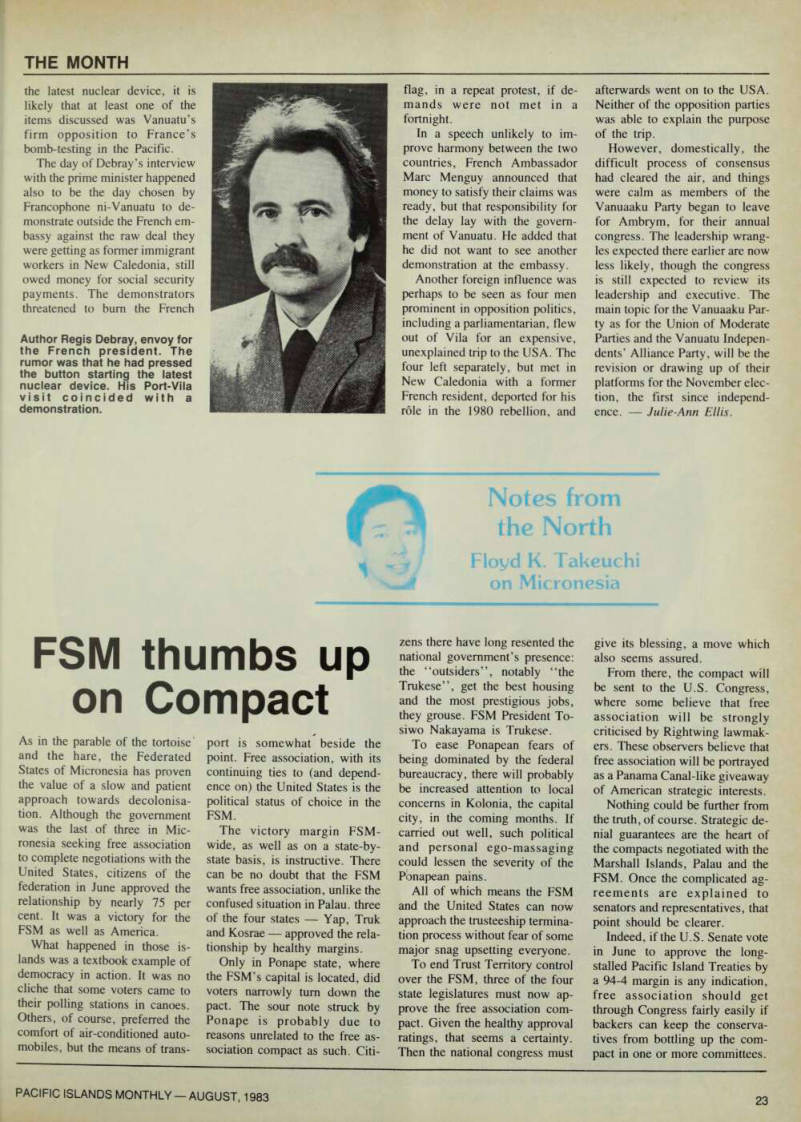
But if things at home seem calmer, relationships with other governments, and other overseas interests, still seem likely to cause some tensions. Author Re gis Debray ( Revolution in the Revolution, Leftist primer of the ’6os), turned up in Port-Vila as a special envoy of President Mit terrand to discuss “matters of interest to both governments”.
As Debray had come straight from Tahiti, where rumor had it that he had pressed the button for
Report from Vanuatu Julie-Ann Ellis
the latest nuclear device, it is likely that at least one of the items discussed was Vanuatu’s firm opposition to France’s bomb-testing in the Pacific.
The day of Debray’s interview with the prime minister happened also to be the day chosen by Francophone ni-Vanuatu to de monstrate outside the French em
bassy against the raw deal they
were getting as former immigrant workers in New Caledonia, still owed money for social security payments. The demonstrators threatened to bum the French
flag, in a repeat protest, if de mands were not met in a
fortnight.
In a speech unlikely to im prove harmony between the two countries, French Ambassador Marc Menguy announced that money to satisfy their claims was ready, but that responsibility for the delay lay with the govern ment of Vanuatu. He added that he did not want to see another demonstration at the embassy.
Another foreign influence was perhaps to be seen as four men
prominent in opposition politics,
including a parliamentarian, flew
out of Vila for an expensive, unexplained trip to the USA. The four left separately, but met in New Caledonia with a former French resident, deported for his role in the 1980 rebellion, and
afterwards went on to the USA.
Neither of the opposition parties was able to explain the purpose of the trip.
However, domestically, the difficult process of consensus had cleared the air, and things were calm as members of the Vanuaaku Party began to leave for Ambrym, for their annual congress. The leadership wrang les expected there earlier are now less likely, though the congress is still expected to review its leadership and executive. The main topic for the Vanuaaku Par ty as for the Union of Moderate Parties and the Vanuatu Indepen dents’ Alliance Party, will be the revision or drawing up of their platforms for the November elec tion, the first since independ
ence.
Julie-Ann Ellis.
Author Regis Debray, envoy for the French president. The rumor was that he had pressed the button starting the latest nuclear device. His Port-Vila visit coincided with a demonstration.