Fiji hurricane
pp. 54-58 · Read in the full issue
“The Worst For 50 Years”
Wide damage in Fiji hurricane
Nine deaths, property losses of more than $lOO million and widespread disruption followed Fiji’s Hurricane Oscar in March. ROBERT KEITH-REID in Suva tells the story.
“The worst for 50 years”. This was the description applied to Hurricane Oscar by Fiji Prime Minister Ratu Sir Kamisese Mara after he inspected the devastation inflicted by a hurricane which swept the south-west part of Viti Levu, Fiji’s largest island, in
early March. At least nine deaths were attributed to the hurricane and its economic consequences are expected to cost more than $lOO million.
By mid-March the government had estimated that the cost of repairing shattered schools, tele
communications equipment, roads, water supplies and other infrastructure would be about $32 million. About $2O million was being mentioned as a conser vative estimate in terms of re pairs needed by resort hotels.
However the Fiji tourist industry was frantically trying to convince Australian tourists that it was still in business with plenty of accom modation to spare, and that tour ists should not cancel the holi days they had booked.
Thousands however made cancellations.
Part of the vital sugar crop was affected, although how much ex actly is something that the Fiji
Sugar Corporation won’t know
until late April.
The Fiji Pine Commission re
ported that more than 6000 hec tares of pine planted in the Nabou and Nadi areas an investment with a potential value of tens of millions of dollars would be a write-off without emergency resuscitation efforts which could cost around $6 million.
Just over 100,000 people will have to be fed by the government for three months because of the destruction of their food crops and for months to come tens of thousands of people will be liv ing under the cover of army tents
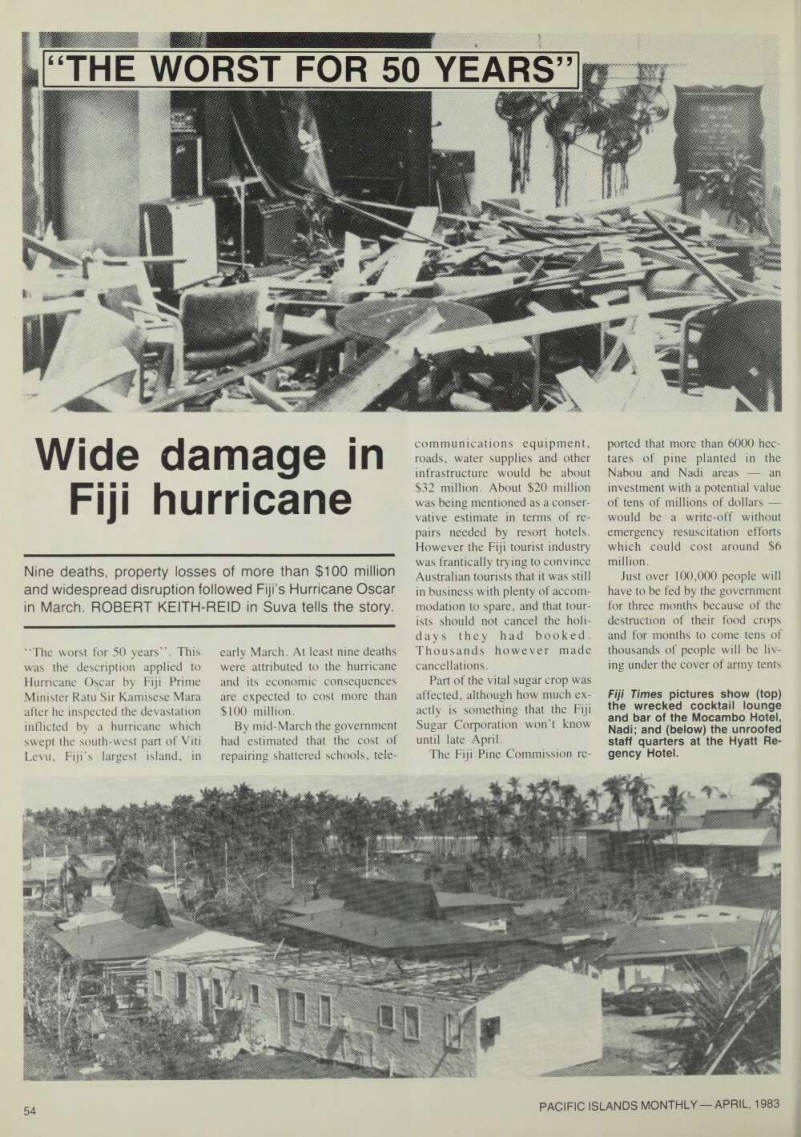
Fiji Times pictures show (top) the wrecked cocktail lounge and bar of the Mocambo Hotel, Nadi; and (below) the unroofed staff quarters at the Hyatt Re gency Hotel.
until their houses can be repaired or rebuilt entirely.
Government disaster survey teams counted about 10,000 houses and other buildings de stroyed or damaged in the area between Nadi town and Sigato ka, about 55 km away.
At first Hurricane Oscar did not appear likely to cause much nuisance when it was spotted to the north west of Fiji at the end of February as a depression with winds of 70 to 80 knots near its centre. But it began swinging towards the big island of Viti Levu and it rapidly intensified.
The Fiji weather office at Nadi International Airport upped Os car’s strength to gusts of 110 knots in a 40 km radius around its centre, with gale force winds up to 280 km from it. Later people were warned to brace themselves for steady blasts of 100 knots with gusts to 140 knots.
Oscar began pounding the Yasawa and Mamanuca islands on March 1 and then, moving slowly, it worked over the coas tal region from Nadi to Sigatoka.
The centre turned on a more southerly track about 70 km short of Suva, where gusts of only 60 to 70 knots were briefly ex perienced, then hit the islands of Vatulele, Beqa and part of Kadavu before roaring on a south-west track out of Fiji.
It was several days before the extent of damage in western Viti Levu was fully realised by the government. This was due to the destruction of communication links, in particular a microwave link tower near Nadi that was supposed to be able to withstand 150 knot wind forces. The tower was destroyed, cutting all tele phone contact between Suva and Nadi during the hurricane. Radio Fiji, which stayed on the air all night to broadcast hurricane warnings, had to rely on reports relayed to it from Wellington in New Zealand because the Nadi weather office was uncontactable.
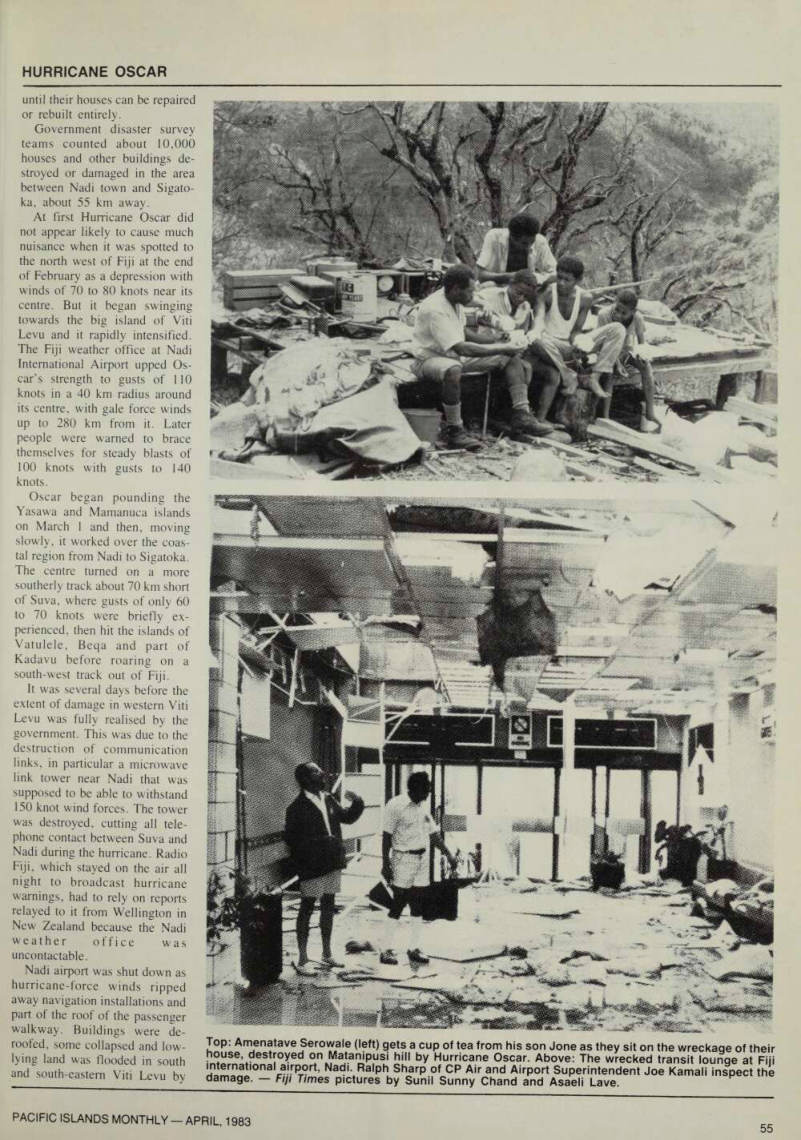
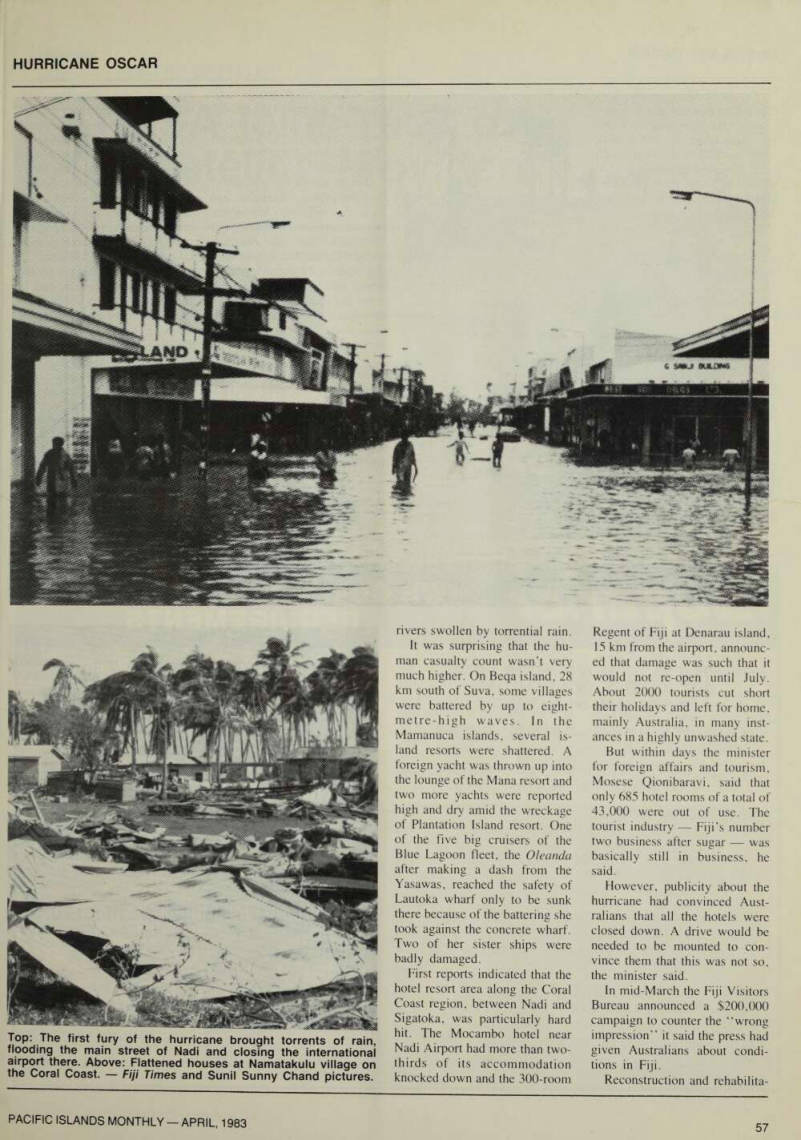
Nadi airport was shut down as hurricane-force winds ripped away navigation installations and part of the roof of the passenger walkway. Buildings were de roofed, some collapsed and low lying land was flooded in south and south-eastern Viti Levu by
Top: Amenatave Serowale (left) gets a cup of tea from his son Jone as they sit on the wreckage of their house, destroyed on Matanipusi hill by Hurricane Oscar. Above: The wrecked transit lounge at Fiji international airport, Nadi. Ralph Sharp of CP Air and Airport Superintendent Joe Kamali inspect the damage. - Fiji Times pictures by Sunil Sunny Chand and Asaeli Lave.
rivers swollen by torrential rain.
It was surprising that the hu man casualty count wasn’t very much higher. On Beqa island, 28 km south of Suva, some villages were battered by up to eight metre-high waves. In the Mamanuca islands, several is land resorts were shattered. A foreign yacht was thrown up into the lounge of the Mana resort and two more yachts were reported high and dry amid the wreckage of Plantation Island resort. One of the five big cruisers of the Blue Lagoon fleet, the Oleanda after making a dash from the Yasawas, reached the safety of Lautoka wharf only to be sunk there because of the battering she took against the concrete wharf.
Two of her sister ships were badly damaged.
First reports indicated that the hotel resort area along the Coral Coast region, between Nadi and Sigatoka, was particularly hard hit. The Mocambo hotel near Nadi Airport had more than two thirds of its accommodation knocked down and the 300-room
Regent of Fiji at Denarau island, 15 km from the airport, announc ed that damage was such that it would not re-open until July.
About 2000 tourists cut short their holidays and left for home, mainly Australia, in many inst ances in a highly unwashed state.
But within days the minister for foreign affairs and tourism, Mosese Qionibaravi, said that only 685 hotel rooms of a total of 43,000 were out of use. The tourist industry Fiji’s number two business after sugar was basically still in business, he said.
Flowever, publicity about the hurricane had convinced Aust ralians that all the hotels were closed down. A drive would be needed to be mounted to con vince them that this was not so, the minister said.
In mid-March the Fiji Visitors Bureau announced a $200,000 campaign to counter the “wrong impression” it said the press had given Australians about condi tions in Fiji.
Reconstruction and rehabilita-
Top: The first fury of the hurricane brought torrents of rain, flooding the main street of Nadi and closing the international airport there. Above: Flattened houses at Namatakulu village on the Coral Coast. - Fiji Times and Sunil Sunny Chand pictures.
tion will be a major industry until the end of the year. This activity would at least temporarily relieve
unemployment, announced
Prime Minister Ratu Mara in a radio interview.
Outside aid for Fiji was quick
ly forthcoming. Australia and
New Zealand sent helicopters and aircraft to assess damage and
ferry relief supplies. Australia
and the United States, sent tents and water containers for areas where normal supplies of fresh water had been disrupted. A Un ited States military communica tions team flew in to set up temporary communications links and various other countries and international organisations sent money, food and relief supplies.
Hurricane Oscar had one bene ficial effect. It dumped rain in sugar cane areas where drought was beginning to seriously affect the 1983/84 cane harvest and the
Fiji Sugar Corporation hopes that
this will offset the losses expect ed in the Lautoka-Nadi cane areas, which could amount to about ten per cent. Oscar’s rain fall also filled up two lakes form ed behind dams built at Mono savu, in the middle of Viti Levu, and at Vaturu, near Nadi, a month before they had been ex pected to be full following their completion earlier this year.
Engineers said that but for the dams the Monosavu dam is for hydro-electricity and the Vat uru dam is to catch water for the
western districty supply -
flooding might have been much more serious than it was.
Having done its worst, Oscar then brought out the best of Fiji.
Despite their losses, a resilient people, directed by a government disaster reconstruction organisa tion that, with a dozen hurricanes in less than a dozen years on its record sheets is a highly expert one, were quickly getting down to the business of rebuilding their lives again in many cases from scratch.
Hurricane Oscar in Fiji: Waves smash over the Lautoka Wharf road while winds whip the
palms. - Fiji Times picture.