The ‘sin’ of Bishop Strong, and
pp. 51-53 · Read in the full issue
Yesterday
The ‘sin’ of Bishop Strong, and the Seventh Commandment
Philip Nigel Warrington Strong, Fourth Bishop of New Guinea, arrived before the weekend, a pleasant smiling friendly soul.
His speech, somewhat staccato, evidenced his close contacts with the “Wee Geordie” world he had just foresaken. He was a Cambridge man with his home in Oxford, and had been ordained by that fascinating character, Hensley Henson, of Durham.
His sense of the humorous in later years would bring him to relate his life with Henson, with appropriate gestures and action.
He was a thorough comedian.
He was also the new unknown quantity ready to plunge into the unknown and was to prove his worth in the face of great tribula tion. He was accompanied by Father Benson, a former monk.
The rains departed, the sun shone forth, the seas calmed.
There was even the evidence of dust raised by the quiet pad of over 2000 calloused bare feet that bore naked bodies, some hillmen clothed in simply a few shreds of grass caught up on a thing around the waist, as they wended their way in silence to the long thatched building that was to serve as a temporary cathedral.
In the afternoon there was the New Guinea people’s own recep tion to their new bishop, with speeches and dances. There was drama in the opening speech the New Guinea man beginning to seek deeper than the surface.
Later it became clear that the orator had been “primed” by some anti-Mission element.
“Bishop,” he cried, “Why have you come here?” At least that was the interpretation given of the Wedauan dialect in which he spoke. This sounded like an opening gambit, but, after a space, he repeated: “Bishop, why have you come here?” The silence that followed suggested a form of rhetoric, but when it was asked a third time, it carried an implication; just what are you
In this fourth extract from the memoirs of the late Charles William Whonsbon-Aston, Anglican Archdeacon Emeritus of Polynesia, he describes the eventful arrival of a new bishop, the decline in his own health, and his final departure from Papua.
getting out of us? He required an answer, and the answer the bishop gave was that he felt sure he had been called of God to come to New Guinea. From the standpoint of material gain, he profited in no way.
The bishop, entirely new to conditions and looking forward to a triumphant entrance into his heritage, reached the Mamba and the model station there, coupled with the softly spoken personali ty and genuine hospitality of Romney Gill. He could not but
be impressed.
One interesting tale told by James Benson about Strong’s first visit to northern Papua illus trates a point. So often newcom ers produce idioms that are readi ly intelligible to a European audi ence, but convey an entirely dif ferent interpretation to Papuans.
It would seem in New Guinea, that the only breach of the Com mandments that has the direct penalty is that of the Seventh (or Sixth in the Roman order), so that “Sin”, in the New Guinea mind, seemed to limit itself to “Sex”.
It was at Isivita, Benson would retail, that the bishop stood with an interpreter before a great body of tribesmen, many of them still “hearers”, or people just on the fringe. Range upon range of shining dark eyes gazed up as the bishop out of dark faces crowned with fuzzy hair, or long maiden like curls. The bishop based his remarks on his experience at the reception at Dogura. “I have been asked,” he said, “why have I come here?” His in terpreter said his piece. “All have sinned,” he continued.
There was a lowering of heads, for they knew what “Sin” meant from the newcomer’s viewpoint.
“You have sinned” and the heads, according to Fr Benson, bent even lower and, had they been properly instructed, they would have beaten their breasts with a “Mea maxima culpa”.
Then the bombshell: “I have
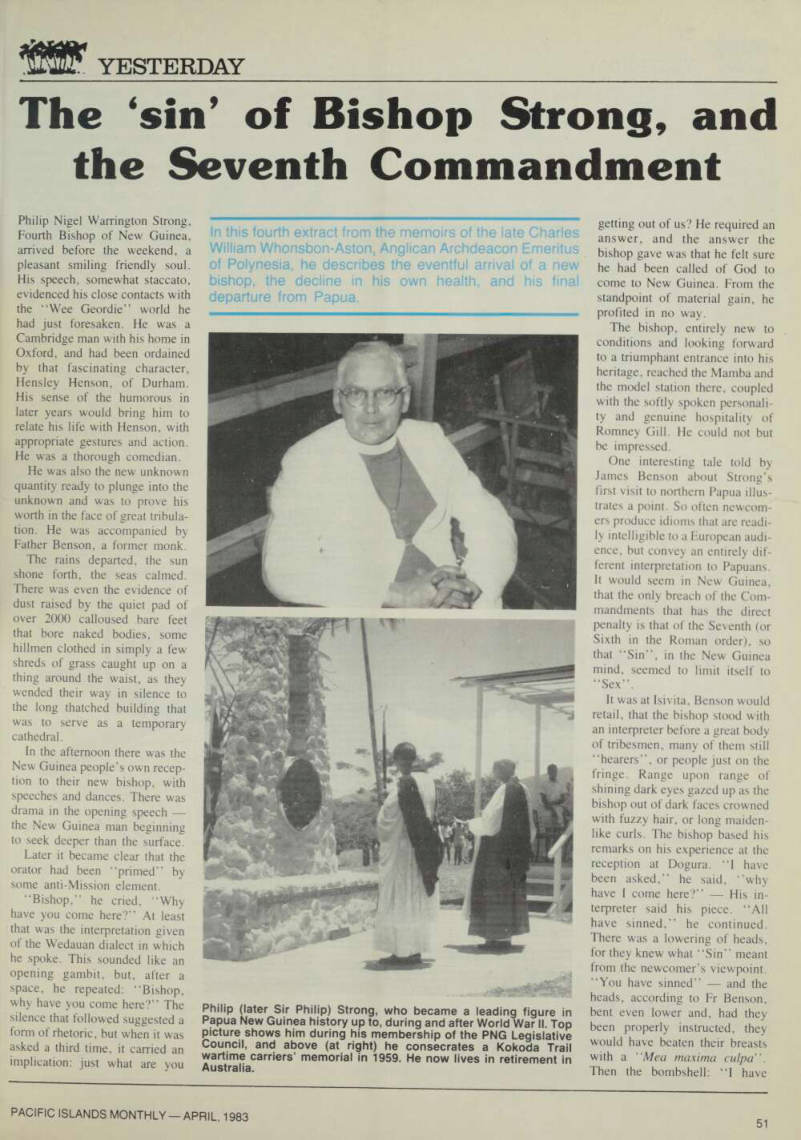
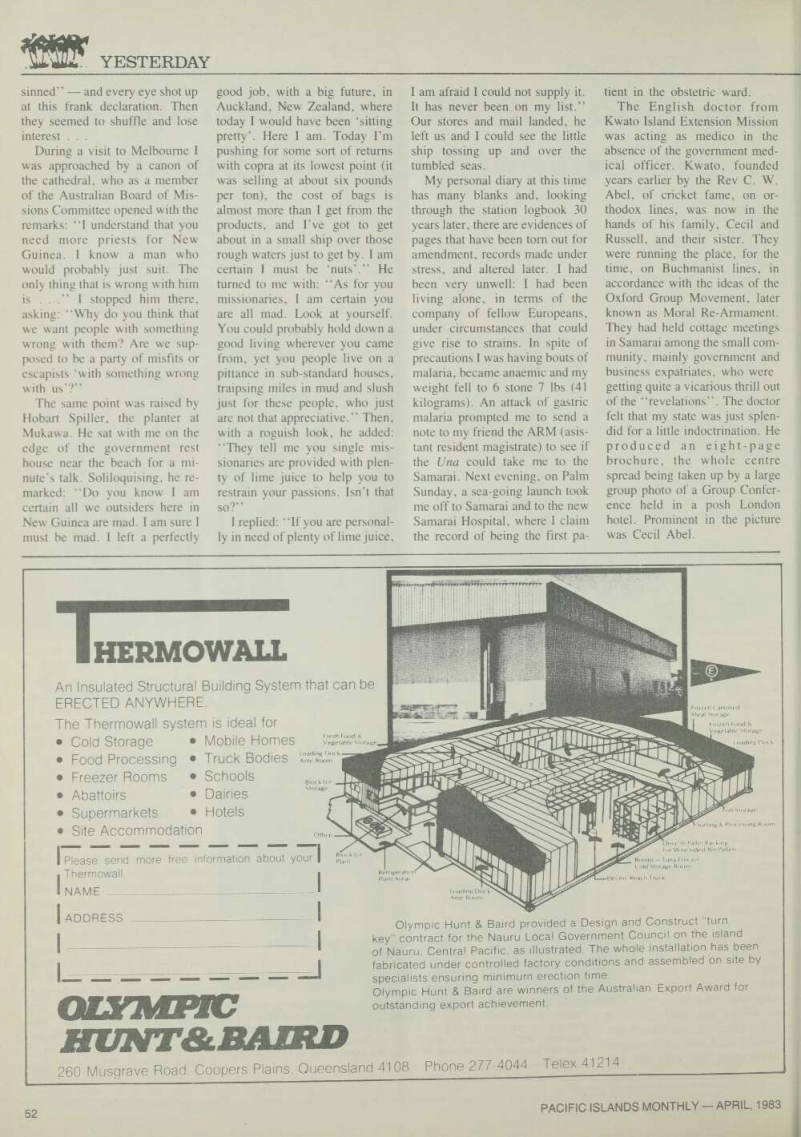
Philip (later Sir Philip) Strong, who became a leading figure in Papua New Guinea history up to, during and after World War II. Top picture shows him during his membership of the PNG Legislative Council, and above (at right) he consecrates a Kokoda Trail wartime carriers’ memorial in 1959. He now lives in retirement in Australia.
sinned” and every eye shot up at this frank declaration. Then they seemed to shuffle and lose interest . . .
During a visit to Melbourne I was approached by a canon of the cathedral, who as a member of the Australian Board of Mis sions Committee opened with the remarks: “I understand that you need more priests for New Guinea. I know a man who would probably just suit. The only thing that is wrong with him is ...” I stopped him there, asking: “Why do you think that we want people with something wrong with them? Are we sup posed to be a party of misfits or
escapists ‘with something wrong
with us’?”
The same point was raised by Hobart Spiller, the planter at Mukawa. He sat with me on the edge of the government rest house near the beach for a mi nute’s talk. Soliloquising, he re marked: “Do you know I am certain all we outsiders here in New Guinea are mad. I am sure I must be mad. I left a perfectly
good job, with a big future, in Auckland, New Zealand, where today I would have been ‘sitting pretty’. Here I am. Today I’m pushing for some sort of returns with copra at its lowest point (it was selling at about six pounds per ton), the cost of bags is almost more than I get from the products, and I’ve got to get about in a small ship over those rough waters just to get by. lam certain I must be ‘nuts’.” He turned to me with: “As for you missionaries, I am certain you are all mad. Look at yourself.
You could probably hold down a good living wherever you came from, yet you people live on a pittance in sub-standard houses, traipsing miles in mud and slush just for these people, who just are not that appreciative.” Then, with a roguish look, he added: “They tell me you single mis sionaries are provided with plen ty of lime juice to help you to restrain your passions. Isn’t that so?”
I replied: “If you are personal ly in need of plenty of lime juice,
I am afraid I could not supply it.
It has never been on my list.”
Our stores and mail landed, he left us and I could see the little ship tossing up and over the tumbled seas.
My personal diary at this time has many blanks and, looking through the station logbook 30 years later, there are evidences of pages that have been tom out for amendment, records made under stress, and altered later. I had been very unwell: I had been living alone, in terms of the company of fellow Europeans, under circumstances that could give rise to strains. In spite of precautions I was having bouts of malaria, became anaemic and my weight fell to 6 stone 7 lbs (41 kilograms). An attack of gastric malaria prompted me to send a note to my friend the ARM (asis tant resident magistrate) to see if the Una could take me to the Samarai. Next evening, on Palm Sunday, a sea-going launch took me off to Samarai and to the new Samarai Hospital, where I claim the record of being the first pa
tient in the obstetric ward.
The English doctor from Kwato Island Extension Mission was acting as medico in the absence of the government med ical officer. Kwato, founded years earlier by the Rev C. W.
Abel, of cricket fame, on or thodox lines, was now in the hands of his family, Cecil and Russell, and their sister. They were running the place, for the time, on Buchmanist lines, in accordance with the ideas of the Oxford Group Movement, later known as Moral Re-Armament.
They had held cottage meetings in Samarai among the small com
munity, mainly government and
business expatriates, who were getting quite a vicarious thrill out of the “revelations”. The doctor felt that my state was just splen did for a little indoctrination. He
produced an eight-page
brochure, the whole centre spread being taken up by a large group photo of a Group Confer ence held in a posh London hotel. Prominent in the picture was Cecil Abel.
I spent three days of my con valescence on Kwato, which did not attract me in any way to the Group movement. However, though commercialised, the practical training of Papuans in engineering and boat-building seemed to me a more practical approach to the people’s needs.
They had, of course, the advan tage of having lived nearer to European influences for some years. In a less sophisticated, much more primitive world, Romney Gill was doing similar work at the Mamba, in a diffe rent field. Insofar as the Group Movement was concerned, I felt that far from being “with it”, it seemed to border on the eccentric.
The repairs effected in Samarai to my health seemed to be but temporary and the young Queenslander assistant with me insisted that he felt some respon sibility and, for his sake, further medical advice should be sought.
I went once again to Samarai, where the very general diagnosis was malaria, hookworm, whip worm, all contributing to tropical neurasthenia. I should take a year away.
With a glance over my shoul der to the past, I must say that I am grateful for having had this opportunity of living with Pa puans in an atmosphere that will probably never be encountered again.
In April, 1967, immediately after my retirement, I decided on a sentimental journey back to New Guinea. Port Moresby had grown into a very presentable city, attractive and with an indi viduality, but a great contrast to the real New Guinea.
It seemed a great pity that is was found necessary to draw young men completely away from their environment to a city of today’s complicated political, economic and social problems, and expect them to go back to that great hinterland as leaders.
After “city lights”, a consider ably higher scale of living, and higher learning, can they be ex pected to take readily to life in the villages? The old song rings true; “How’re we going to keep ’em down on the farm, now that they’ve seen Paree?” • Next month; Chaplain in Western Samoa.
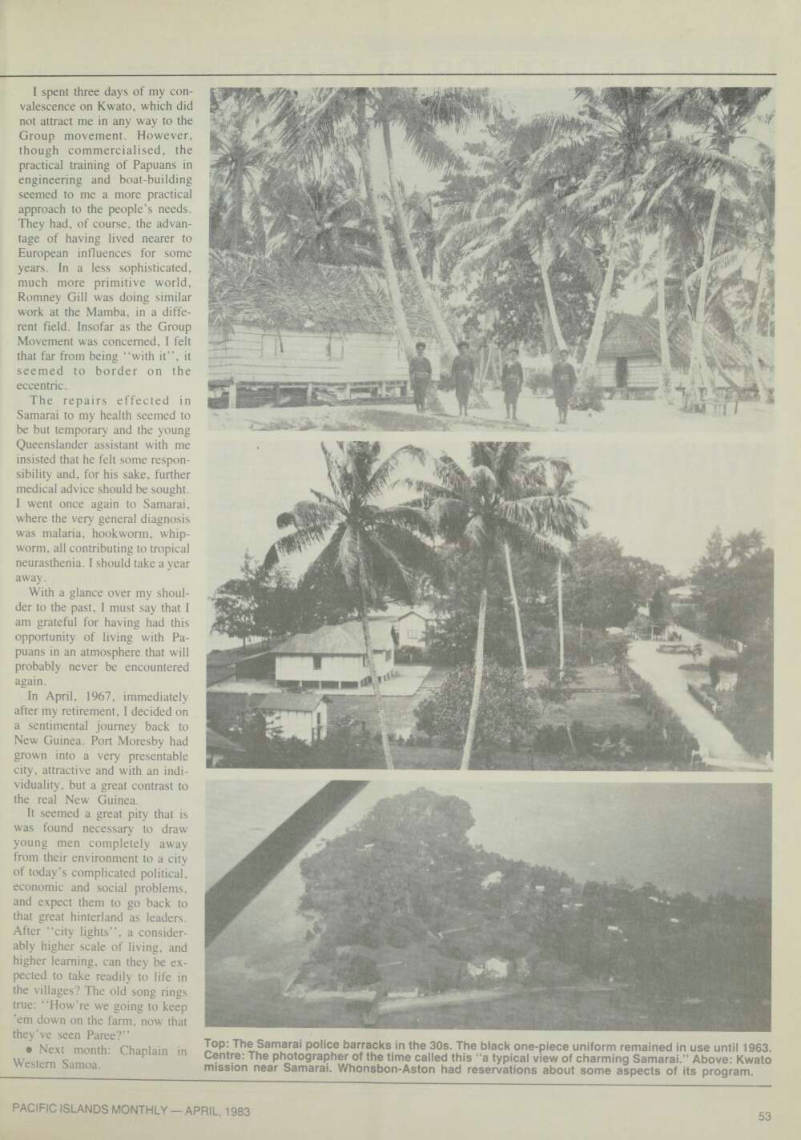
Top: The Samarai police barracks in the 30s. The black one-piece uniform remained in use until 1963.
Centre: The photographer of the time called this “a typical view of charming Samarai.” Above: Kwato mission near Samarai. Whonsbon-Aston had reservations about some aspects of its program.