NASA joins race of
pp. 59-61 · Read in the full issue

Trade Winds
NASA joins race of the satellite providers
LIZ FELL, an Australian freelance journalist specialising in telecommunications, takes us behind the scenes of the big race to become Satellite Provider to the Pacific.
Proposals for constructing an elaborate telecommunications system using the latest in satellite technology will be at the top of the agenda when government heads get together at the annual South Pacific Forum meeting in Australia later this year.
The use of space technology to solve some of the inter and intra island communication problems has been a high priority since the 1980 Forum meeting in Kiribati.
Satellite providers were informed of this interest, and for the past two years they have had the economic, social and technical requirements of the South Pacific region under close investigation.
The most recent study of rural telecommunication needs was commissioned by the South Pacific Bureau for Economic Co operation (SPEC), the Forum’s secretariat, which covers 12 Is land nations; Western Samoa, the Cook Islands, Fiji, Kiribati, Federated States of Micronesia, Nauru, Niue, Papua New Guinea, Solomon Islands, Ton ga, Tuvalu and Vanuatu.
The recommendations from this study are now being assessed and discussed by the various na tions, and one of the key deci sions will be the choice of the satellite provider.
There is a high level of com petition for this lucrative and strategic market. At this stage, America and Japan are front runners, with Australia and Canada sitting in the wings.
America’s satellite presence in the South Pacific is most visible through the growing number of large earth stations constructed by the U.S. consortium, Com munications Satellite Corpora tion (COMSAT). This year,
there are plans to complete seven new stations in Micronesia alone.
All these stations provide in ternational links via satellites owned by the International Satel lite Consortium (INTELSAT).
As COMSAT is the major share holder in this consortium, it stands to benefit from this new business. Since 1978, the num ber of Pacific earth stations link ed to INTELSAT satellites has increased by 115 per cent.
However, INTELSAT’s monopoly over Pacific space communications is about to be challenged following a recent de cision by the U.S. Federal Com munications Commission. This permits U.S. domestic satellite providers, such as IBM or ATT, to operate internationally.
In an effort to seek out new business, INTELSAT is moving into the domestic market. For the Pacific, they have proposed a scheme to link island centres with isolated or remote areas.
Called a ‘‘low density tele
phone service,” this scheme was presented to SPEC’s regional telecommunications meeting last November, and discussed in de tail at the recent Pacific Tele communications Conference in Hawaii.
The service provides for reg ional telephone, telex and low speed data links via shared IN TELSAT capacity and the con struction of small 4-5 metre earth stations.
INTELSAT estimates the costs of each earth station at between $U.5.20,000 and $40,000 while the cost of the leased space segment will be between $200,000 and
$Boo,Ooo.
However, as INTELSAT read ily acknowledges, these costs are only a small portion of the over all cost for island nations. Most will require a terrestrial system, using VHP radio telephone or cable, to connect the stations to public call boxes in remote and sparsely populated areas.
In January this year, another
satellite scheme was announced by the Japanese Research Insti tute of Telecommunications and Economics. The Japanese have almost caught up with the Ameri cans in space technology and are ahead in fibre optic cable tech nology, so the Pacific is an im portant and obvious market to capture.
Their scheme would be much more costly than that of INTEL SAT since it involves the con struction of two satellites beam ing over the Pacific. One would serve the telephone needs of the remote islands and the other would service mainly business users needing data, facsimile or video links between the islands and the major cities on the Pacif ic Rim.
The Japanese claim that their proposal is still at the conceptual stage and could not commence before 1987. Meanwhile, they are interested in finding partners to assist in the development and funding of their proposal.
Another surprise entrant in the South Pacific market race is the U.S. National Aeronautics and Space Administration (NASA).
For years, NASA has had a
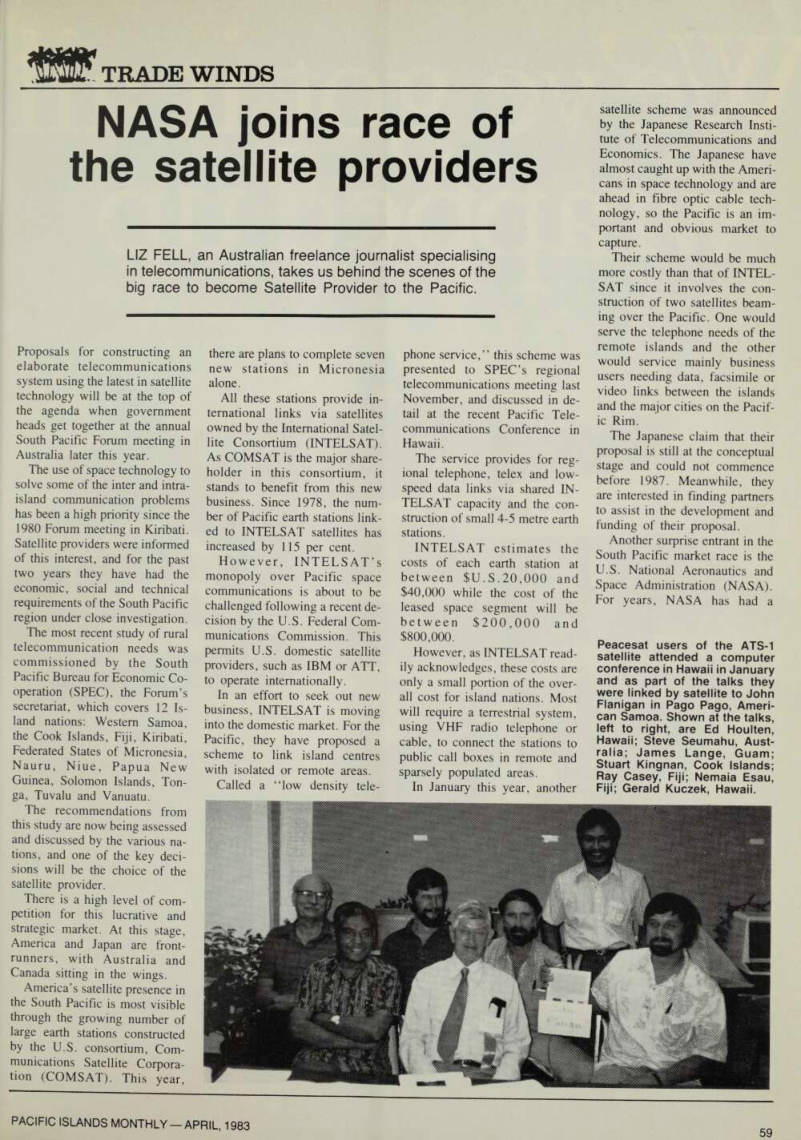
Peacesat users of the ATS-1 satellite attended a computer conference in Hawaii in January and as part of the talks they were linked by satellite to John Flanigan in Pago Pago, Ameri can Samoa. Shown at the talks, left to right, are Ed Houlten, Hawaii; Steve Seumahu, Aust ralia; James Lange, Guam; Stuart Kingnan, Cook Islands; Ray Casey, Fiji; Nemaia Esau, Fiji; Gerald Kuczek, Hawaii.
presence in the Pacific through its experimental communications satellite (ATS-1).
Some years ago, NASA be came aware of the limited life of this satellite and funded a region al study of user needs in the Pacific to see what was required in the way of space technology.
The results of this study have been invaluable in helping other satellite providers design their own proposals. Meanwhile, it was thought that NASA had withdrawn from the field until a surprise announcement at the Pacific Telecommunications Conference in January this year.
NASA recently spent $216 million repurchasing space on one of its new Tracking and Data Relay Satellites (TDRS), and now this space could be made available for South Pacific use. It will require some technical ad justment which NASA is already
studying.
The TDRS satellites have been designed to track the space shut tle and other earth-orbiting satel lites. The first will be launched by the shuttle this year, and it will be the largest and most powerful of the U.S. satellites so far. All satellites in this series
will be equipped with huge wing like solar panels providing 1850 watts of power.
This power in the sky gives the NASA satellite proposal consid erable advantages over the others. It means that earth sta tions can be cheaper and smaller and can be used to service the communication needs of unelec trifled rural areas.
It will be up to the U.S. government to give NASA per mission to use the satellite space for the South Pacific, and this is sure to be opposed by its U.S. competitor COMSAT.
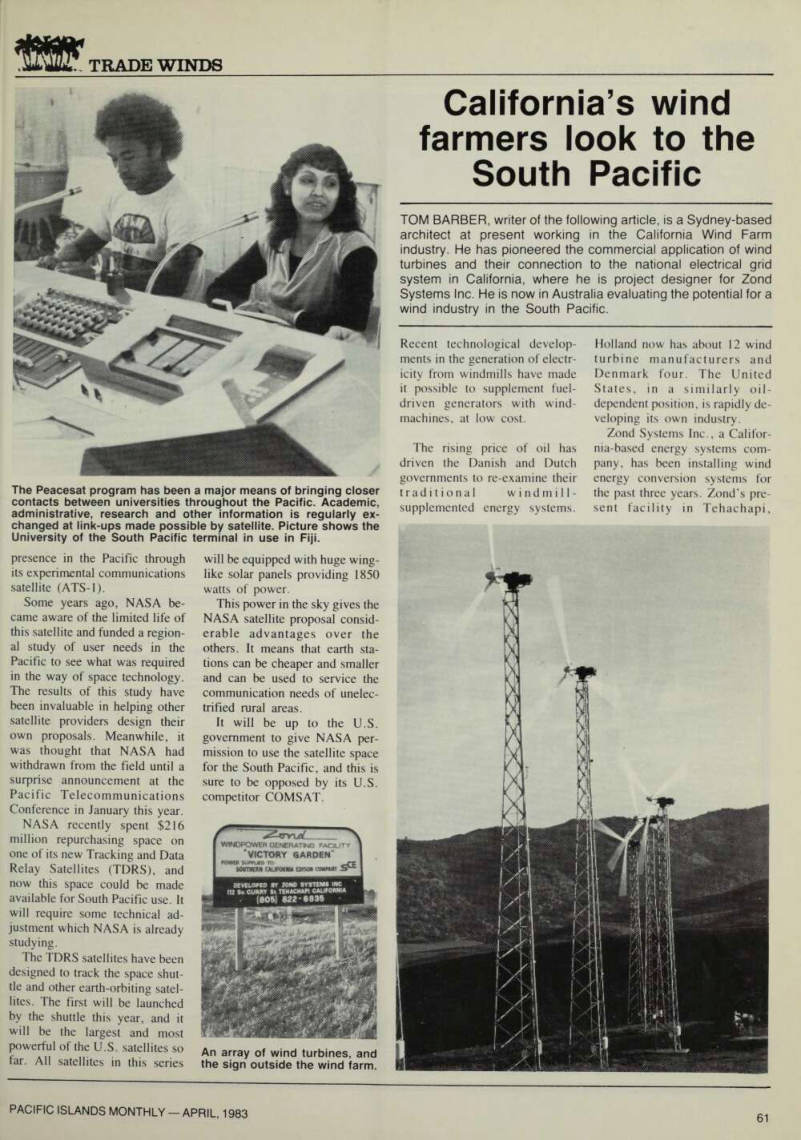
The Peacesat program has been a major means of bringing closer contacts between universities throughout the Pacific. Academic, administrative, research and other information is regularly ex changed at link-ups made possible by satellite. Picture shows the University of the South Pacific terminal in use in Fiji.
An array of wind turbines, and the sign outside the wind farm.