prophet Rua
p. 45 · Read in the full issue
Salute to Maori prophet Rua
Mihaia, The Prophet Rua Kenana and his Community at Maungapohatu. By Judith Bin ney, Gillian Chaplin and Craig Wallace. Published by Oxford University Press, Wellington, 1979. 208 pp, lavishly illus trated, $24 (paper). ISBN 0 19 558042 7 cloth; ISBN 0 19 558052 4 paper. Rua and the Maori Millennium. By Peter Webster. Published by Victoria University Press, Wellington, 1979. 328 pp, illustrated, $l5.
Isbn 0 7055 0695 9.
Out of relative obscurity the Ma ori prophet and leader Rua Kena na has emerged as a fascinating historical figure eminently worthy of the two substantial books about his life and move ment that have been published recently.
Before 1979 the long tradition of Maori prophet leaders had attracted much attention, and the names and lives of Te Ua, Te Whiti, Te Kooti and Ratana were well known, but Rua, although he claimed direct links with this prophetic line through Te Kooti, had not been studied. The facts that his following was small and his successes limited may partly explain this.
Rua Kenana, a Tuhoe, was bom in 1869 during the closing phase of the Anglo-Maori wars, which left the Maoris defeated but in no way reconciled to the loss of land, authority and digni ty they had suffered during the conflict, and which they con tinued to suffer throughout the ensuing decades.
The Tuhoe lived in the rugged Urewera ranges on the east coast of the North Island, largely re moved from Pakeha presence and pressures. But by the turn of the century they faced tragic population loss due largely to introduced diseases, a stark con trast between Pakeha wealth and their own poverty, and a white demand for land that could no longer be resisted.
Amongst these people Rua
slowly gained a following and he
first attracted European notice in January 1906 with his prophecy that King Edward would come to Gisborne, New Zealand, later that year, and return all the land to the Maoris, while most Pakehas would be expelled. King Edward’s non-appearance did not deter Rua, who led his people to a new settlement at Maun gapohatu in the heart of the
Urewera, where they attempted
to create an autonomous prosper ous farming community. Its his tory and fate, which both Binney and Webster cover, and the life of Rua after he had served a
Pakeha-imposed prison term,
which Binney explores, make
compelling reading.
Mihaia was first conceived as
a photographic history by Craig
Wallace, who recognised the ex tent and potential of the pictorial record of Rua and his people that had been preserved. Later the project expanded to include re cent photos of places and surviv-
ing Rua followers, documentary archival research and the collec tion of oral evidence from Maori and Pakeha who remembered Rua.
The result is a superb selection of photographs that accompanies a sensitive biography of Rua and his people in which the author of the text, Judith Binney, has re corded Maori opinion about the prophet, both positive and nega tive, but has scrupulously re frained from stating her own judgments or opinions.
Peter Webster’s book, which belongs more clearly in the academic, anthropological tradi tion, focuses on the millenarian aspects of Rua’s movement. His theoretical discussion of millena
rian movements in general, and his analysis of Rua’s movement within this framework, is master ly. But his audience will remain largely academic.
It is the Binney-Chaplin- Wallace approach through image and word that evokes the spirit and ethos of Rua and his people, and which is therefore more like ly to win a large Maori audience, as well as a more general one.
Audiences aside, both books have much to offer and together they make an important contribu tion to the history of the Maori
people
Caroline Ralston.
(Below): One of the fascinating period pictures from the book: Police prepare for the controv ersial march on Maungapohatu to arrest Rua in 1916. (Below right) Rua’s meeting house, sometimes called the temple, in 1908. Rua is third from the left on the top landing.
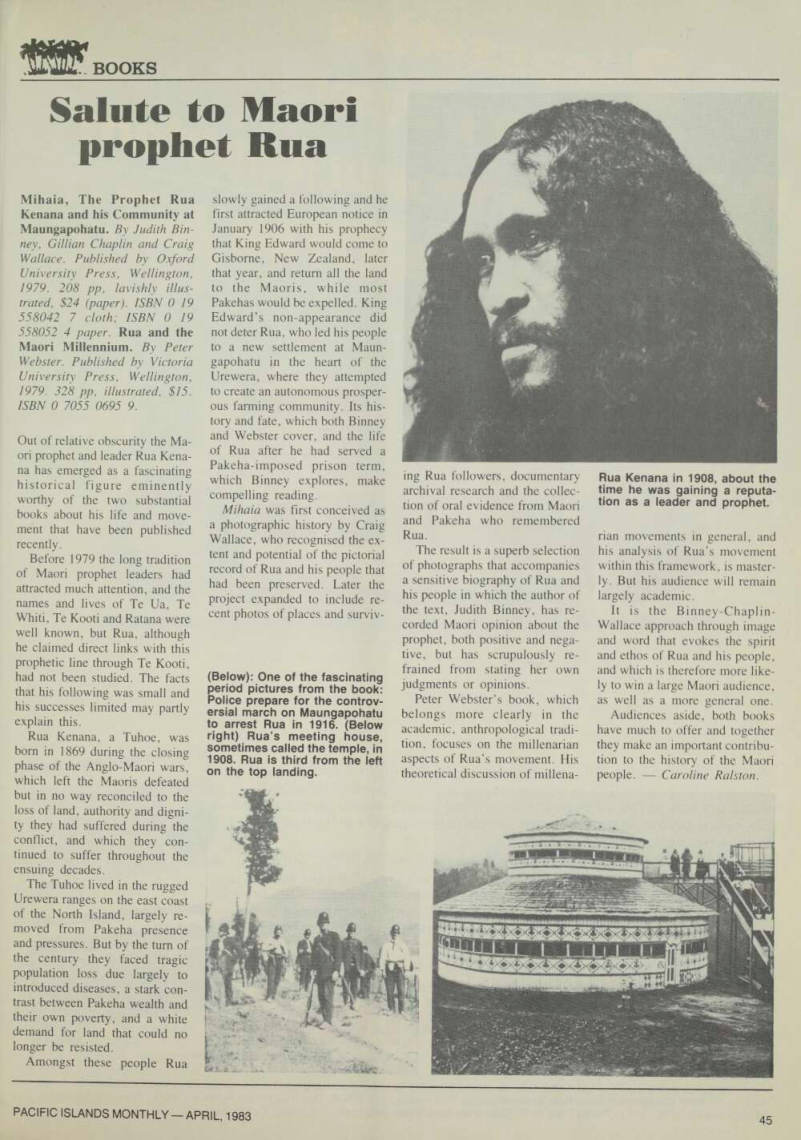
Rua Kenana in 1908, about the time he was gaining a reputa tion as a leader and prophet.