Stone Age patterns of
pp. 47-48 · Read in the full issue

Papua New Guinea Highlands
Stone Age patterns of life not so ‘unchanging '
New Guinea Stone Age Trade By lan Hughes. Published by the Department of Pre-History, Re search School of Pacific Studies, Australian National University. 247 pp, 17 plates, 7 maps. ISBN 0 909 846 02 2. Price SA7.
What were the New Guinea high lands like when the whites ar rived there in the early 20th century?
On the face of it, most of us would think that was a fairly simple question, which could be answered by looking at the ex plorers’ accounts, interviewing old inhabitants and reading the works of anthropologists. One of the major results of Hughes’ study is to show that such a conclusion would be seriously inaccurate. Highlands societies were not, as many whites think, unchanging stone age ones, where the daily and yearly pat terns of life ground on unchang ed through the centuries. They changed constantly, and in major features: the arrival of Europeans speeded up on-going processes as much as it added new ones.
Hughes’ study is concerned with trade: what was moved around, where did it come from and go to, how much was traded and who participated? He inves tigated these questions mostly through a series of more than 300 interviews conducted in 1967- 1968, and through documentary and archaeological research. The interviews were mostly with old er men. He discusses fully the problems involved with research ing oral history the need for open-ended questions, for con stant cross checking, the tenden cy among people to conflate events into a short-term past. He points out that a consistent and realistic story is obtainable, at least for the last century or so.
In order to obtain this story, Hughes had to be clear about the
changes which had occurred in the highlands during the 30 years or so between white contact and his study. I can mention only two examples of such changes here.
The first is the changed value of shells. Seashells have been im ported into the highlands for at least 10,000 years. They must always have been rare, and pre sumably valuable, items cer tainly this was so in the early 20th century.
When the white explorers, pat rol officers and missionaries found that men would work all day for one small cowrie shell they used these shells, flown in by the planeload from the coast, as money. Within a decade bet ween five and 10 million new shells were put into circulation.
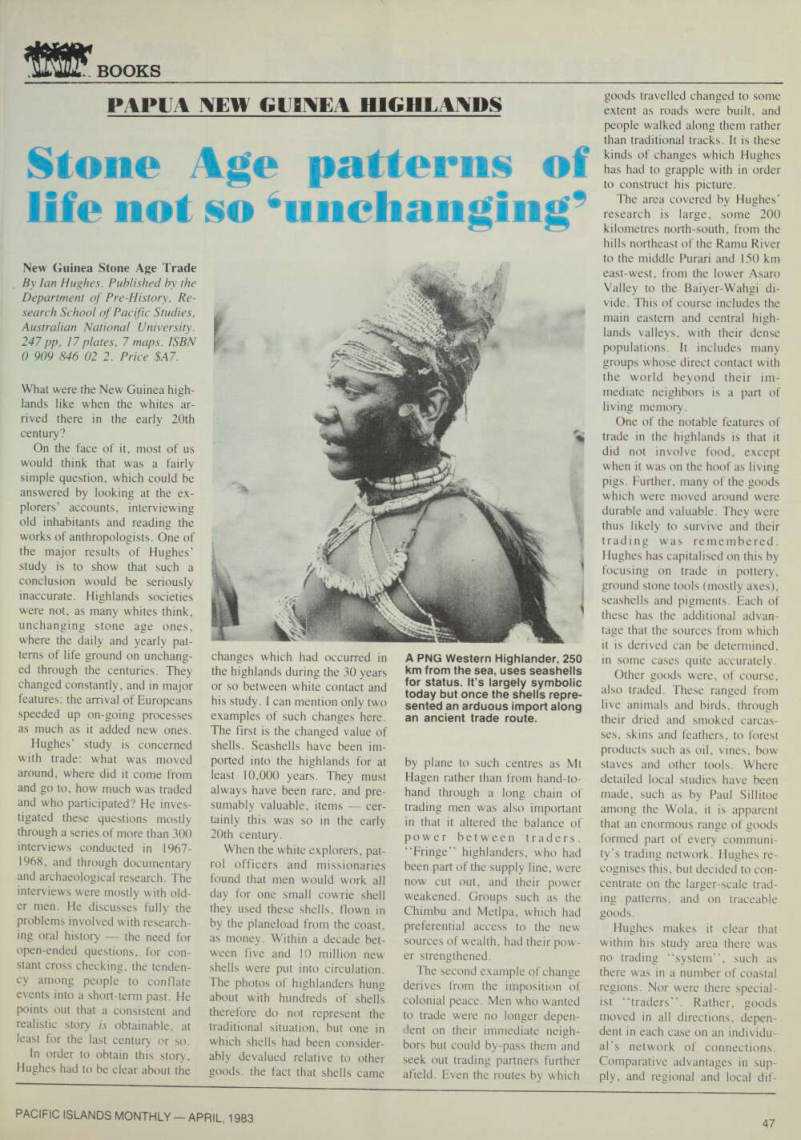
The photos of highlanders hung about with hundreds of shells therefore do not represent the traditional situation, but one in which shells had been consider ably devalued relative to other goods, the fact that shells came
by plane to such centres as Mt Hagen rather than from hand-to hand through a long chain of trading men was also important in that it altered the balance of power between traders.
“Fringe” highlanders, who had
been part of the supply line, were now cut out, and their power weakened. Groups such as the Chimbu and Metlpa, which had preferential access to the new sources of wealth, had their pow er strengthened.
The second example of change derives from the imposition of colonial peace. Men who wanted to trade were no longer depen dent on their immediate neigh bors but could by-pass them and seek out trading partners further afield. Even the routes by which
goods travelled changed to some extent as roads were built, and people walked along them rather than traditional tracks. It is these kinds of changes which Hughes has had to grapple with in order to construct his picture.
The area covered by Hughes’ research is large, some 200 kilometres north-south, from the hills northeast of the Ramu River to the middle Purari and 150 km east-west, from the lower Asaro Valley to the Baiyer-Wahgi di vide. This of course includes the main eastern and central high lands valleys, with their dense populations. It includes many groups whose direct contact with the world beyond their im mediate neighbors is a part of living memory.
One of the notable features of trade in the highlands is that it did not involve food, except when it was on the hoof as living pigs. Further, many of the goods which were moved around were durable and valuable. They were thus likely to survive and their trading was remembered.
Hughes has capitalised on this by focusing on trade in pottery, ground stone tools (mostly axes), seashells and pigments. Each of these has the additional advan tage that the sources from which it is derived can be determined, in some cases quite accurately.
Other goods were, of course, also traded. These ranged from live animals and birds, through their dried and smoked carcas ses, skins and feathers, to forest products such as oil, vines, bow staves and other tools. Where detailed local studies have been made, such as by Paul Sillitoe among the Wola, it is apparent that an enormous range of goods formed part of every communi ty’s trading network. Hughes re cognises this, but decided to con centrate on the larger-scale trad ing patterns, and on traceable goods.
Hughes makes it clear that within his study area there was no trading “system”, such as there was in a number of coastal regions. Nor were there special ist “traders”. Rather, goods moved in all directions, depen dent in each case on an individu al’s network of connections.
Comparative advantages in sup ply, and regional and local dif
A PNG Western Highlander, 250 km from the sea, uses seashells for status. It’s largely symbolic today but once the shells repre sented an arduous import along an ancient trade route.
ferences in demand, mean that patterns in trading can be observ ed, but these will certainly have altered over time both as a result of warfare and of changing alliances.
I will not, in this review, elaborate the detailed trading pat terns which Hughes describes for each of his major goods. His work, which was originally writ ten as a PhD thesis at the Aust ralian National University, is thorough and careful, the results both fascinating and convincing.
When Hughes researched, many people were able to inform him; now, 15 years later, the number is many fewer. It was intelligent of Hughes to make such a study and to do it so well. He has made a substantial and elegant con tribution to the history of the
highlands.
J. Peter White.
Books received
Hailstorm Over Truk Lagoon. By Klaus P. Lindemann. Published by Maruzen Asia, 5-9 F, Block 7, Ayer Rajah Industrial Estate, Republic of Singapore 0513. ISBN paperback 962 220 116 4, hardback 962 220 117 2. Price SU.S.I7 and $22 respectively.
Disaster Preparedness and Disaster Ex perience in the South Pacific. By Angela Franco, Michael Hamnett and James Makasiale, with contributing authors.
Published 1982 by the East-West Center, 1777 East-West Road, Honolulu, Hawaii 96848. No price given.
Fragile Paradise: The Discovery of Fletcher Christian Bounty Mutineer. By Glynn Christian. Published 1982 by Ham ish Hamilton Ltd, 57-59 Long Acre, Lon don WC2E 9JZ. Distributed by Thomas Nelson Australia, 89 Jones Street, Ultimo, NSW 2007. ISBN 0 241 10757 1. Price $29.95.
Stori Bilong Pere. By Barbara Honeyman Roll. Printed 1982 by Commercial Press of Monterey. Distributed by author, 26030 Rotunda Drive, Carmel, CA U5A93923.
No ISBN or price given.
Man This Reef. By Gerald Knight. Pub lished 1982 by Micronitor News & Print ing Company, P.O. Box 14, Majuro, Marshall Islands, 96960. Price $U.5.8.95 plus postage. No ISBN given.
Fiji’s Sugar Tramways 1882-1982. By Peter Dyer and Bob McKillop. Published 1982 by Light Railway Research Society of Australia, P.O. Box 21, Surrey Hills, Vic. 3127. Distributed by LRRSA Sales, P.O. Box 32, Momington, Vic. 3931, Desai Bookshops Suva, Fiji, and New Zealand Railway & Locomotive Society, Wellington, NZ. ISBN 0 909340 18 8.
Price $3.95.
Honu La Tortue and L’Origine Du Uru.
In French by Francine Margueron, Tahi tian by Paparai Arapari, and English by Marguerite Vernier. Published 1981 by Haere Po no Tahiti, Papeete, Tahiti. ISBN 2 904171 02 9 and 2 904171 00 2 respectively. Price CFPBOO each with dis counts for schools.