time Solomons,
p. 43 · Read in the full issue
Memories of old time Solomons, New Guinea
Yield Not To The Wind. By Margaret Clarence. Published by Management Development Publishers Pty. Ltd., Sydney 1982. Distributed by the author, 3/18 Ramsay Street, Collaroy, NSW 2097. Price $A9.50. ISBN 0 909633 07 X.
There can be few things harder to assess objectively than the lives of loved ones. That Margaret Clarence has succeeded in doing so in such an interesting work as this is a tribute to her sense of proportion as well as to her pa rents, Charles and Kathleen Bignell.
The story is set in Solomon Islands and New Guinea in the period between 1911 and 1945, and was compiled from Kathleen Bignell’s diaries and from episodes related to the author by her father. It describes the setting up of a plantation in the Sol omons, the managing of a hotel and plantation in New Guinea, and Kathleen Bignell’s imprison ment in Japan during World War 11.
The book is well-written in an easy straight-forward style and is illustrated with black and white photographs of the era. It is good reading for anyone interested in the life of European settlers in the area in the first half of this century.
Charles Bignell was bom in Dungog, NSW, in 1892. He be gan his career as a cabin boy at the age of 12, and spent the next three years travelling around the world. He then joined the Mino ta, a large yacht owned by trader Captain Oscar Svensen, used in the Solomons for recruiting labor and transporting stores.
The Minota’s job was to open new trading posts in the Sol omons, and it was decided that 17-year-old Charles Bignell would be responsible for overse eing Gozoruru Plantation on San ta Isabel for 18 months. So began the Bignells’ involvement with the Solomons.
On termination of his contract with Captain Svensen, Charles Bignell decided to buy his own plantation, along with two whale boats for trading purposes. His enterprise was successful, and rapidly expanded. In 1913 he met Scottish-born Kathleen Dorothy Freeman, who had been visiting her sister in Beki, and a year later they were married.
Thus began an interesting but rather erratic marriage relationship.
The author writes in the pre face that she has tried to present the story in “as clear, frank, unsentimental and sympathetic manner” as she could, and I think she has been successful.
The book is an honest and genuine account of the conflicts that can arise between the ties of family and home, and for me the unsentimental and intriguing look at colonial-style married life is one of the story’s great charms. Older expatriates will possibly recall days with the Big nells at Beki Island and Fulakora Plantation, and at Waranvula and the Rabaul Hotel with Kathleen Bignell. Many, many names come into the story of early settlers in the Solomons and the friendships bom there.
The book is liberally scattered with Kathleen Bignell’s poetry and doggerel, as she was a prolif ic writer. I thoroughly enjoyed these additions to the text and I am sure there must be an audi ence who would delight in the
vivid imagery and free-swinging
rhythms that Kathleen conjured
up so powerfully and resonantly, should Margaret Clarence care to release more of her mother’s work.
I am very moved by the lacon ic style of the five chapters de voted to Kathleen’s imprison ment in Japan, and the war ser vice of Charles. In these chapters the author quotes very extensive
ly from her mother’s writings, with the minimum of comment, so emphasising the first-hand na ture of the account of the ordeal.
It is a particularly vivid and moving part of the book and contains some of the most poig nant of Kathleen’s verses.
Two minor remarks: the New Britain mission is really Vunapope, not Vunapopu. And the use of the word “native” to mean non-European resident is now considered derogatory.
To add a personal note, it was not until I was half-way through the book that I realised that as a child in 1949-50, I met the re doubtable Kathleen Bignell at Springwood, NSW, when my family were holidaying next door. She was still tremendously energetic, but was having to slow down. She entertained us, and let us three young strangers, plus her grand-daughter, work with her. I remember she treated us as individuals, a refreshing and not very common experience for
children in those days.
Wil-
Ham Sharpe-Dunn.
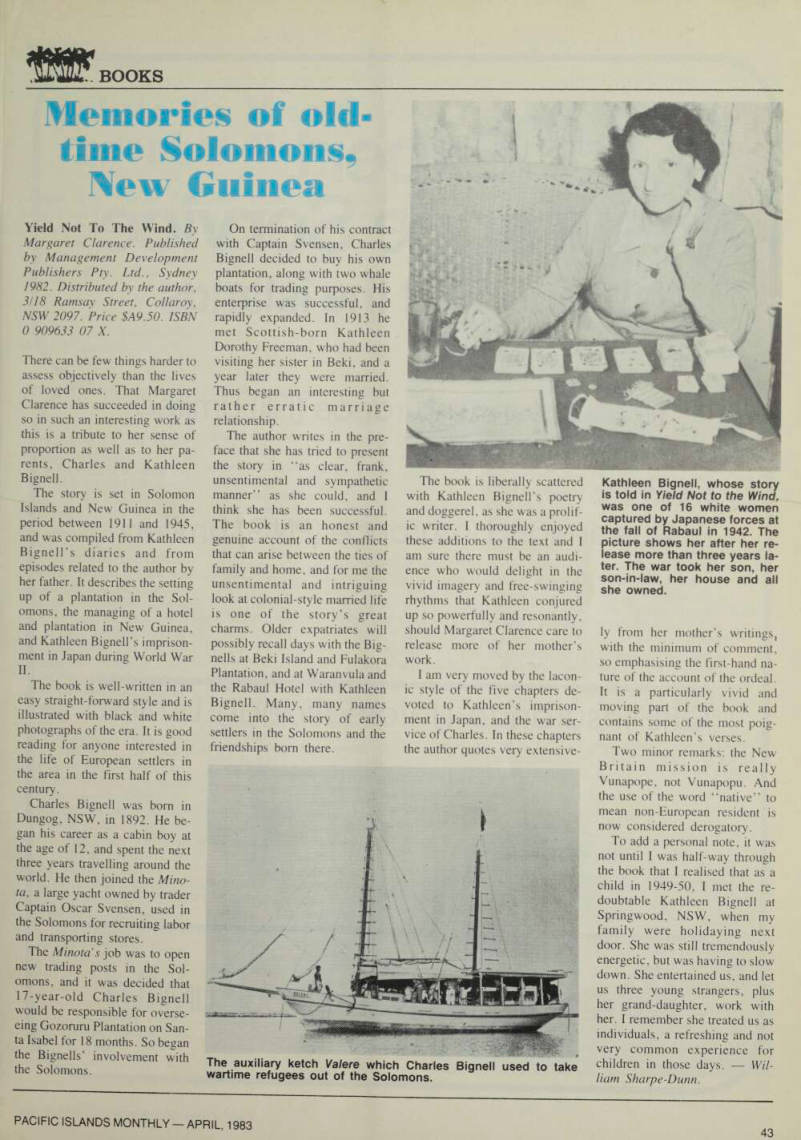
The auxiliary ketch Valere which Charles Bignell used to take wartime refugees out of the Solomons.
Kathleen Bignell, whose story is told in Yield Not to the Wind, was one of 16 white women captured by Japanese forces at the fall of Rabaul in 1942. The picture shows her after her re lease more than three years la ter. The war took her son, her son-in-law, her house and all she owned.