sour ‘epilogue'
p. 41 · Read in the full issue
Books
Travel book with a sad, sour ‘epilogue'
Journey to the End of the World A three-year adven ture in the New Hebrides. By Charlene Gourguechon. Pub lished by Charles Scribner’s Sons, New York, 1977. No price given. ISBN 0 684 14847 1. pp 338.
The reason why it seems worth while in 1983 to review a book published six years ago is not only that the book has some intrinsic merit. It is also, and perhaps especially, because the book has a social “epilogue” which has universal significance and which is not yet at all widely known.
Journey to the End of the World is actually a translation into English by the author of her own work I’Archipel des Tabous dans les mers du sud une femme affronte les interdits (Edi tions Roberts Laffont, Paris, 1974). It is a travel book written in rather sensationalistic vein by a young American woman who joined a photographic and film ing expedition in Vanuatu (the then New Hebrides) during 1968-71. The photographer and leader was Kal Muller; the film cameraman Jacques Gour guechon, whom the author mar ried on Santo in 1970. The book concentrates mainly on personal recollections of visits to some of the areas of Vanuatu where as pects of the traditional lifestyles were still strong: areas of Malekula, Pentecost, Ambrym and Tanna.
The expedition or the series of expeditions amassed a large collection of photographs and films of great ethnographic importance, of which the Vanuatu Cultural Centre is trying to obtain copies. Examples of the photographic coverage can be found in Kal Muller’s various articles for National Geographic in the early 19705, and his vari ous ethnographic notes published in the Journal de la Societe des Oceanistesi Paris).
An occasional fellow-traveller with the expeditions was Louis Nedjar, who had his (rather thin) reminiscences in Peuples Oub lies des Nouvelles Hebridespuh lished in Montreal in 1974.
The rather sad “epilogue” to the book lies in the unfulfilled promises made by the expedition to the inhabitants of at least two areas of Vanuatu.
The people of Bunlap village, south-east Pentecost, were pro mised several thousand dollars in return for permission and assist ance in filming traditional and ceremonial life in Bunlap, and the people of Fanla village, north-central Ambrym, were also promised money in return for permitting the crew to film and photograph ceremonial life.
The Vanuatu Cultural Centre, on behalf of these villages, has been trying to obtain for them the monies promised over 10 years ago, but so far without result.
We have found that the film made in Bunlap, called Land Divers of Melanesia, is available commercially from Phoenix
Films Inc., 468 Park Avenue South, New York, NY 10016, for $U.5.450. The Fanla films, still unedited, are in Paris.
The moral of this story is: Olgeta waet man we oli kam stap (ivin long sotfala taem nomo) long Pasifik oli mas respektem kastom mo kalja blong olgeta man pies. Taem yu givem wan promts yu mas kipim. Ino gud long spoilem ol man pies.
For non-speakers of Bislama, the gist of the above is: Outsiders coming to the Pacific should re spect the local traditions. In Vanuatu an oral promise can traditionally be as binding as a legal document. Do not make promises and then conveniently forget them. This shows non respect, and can create problems for others in the future . . .
There is a cynical saying in English: “Promises are like pie crusts, made to be broken.”
For the peoples of the Pacific,
they aren’t.
Kirk Huffman .
*Kirk Huffman is Curator (Museum), Vanuatu Cultural Centre, Port-Vila.
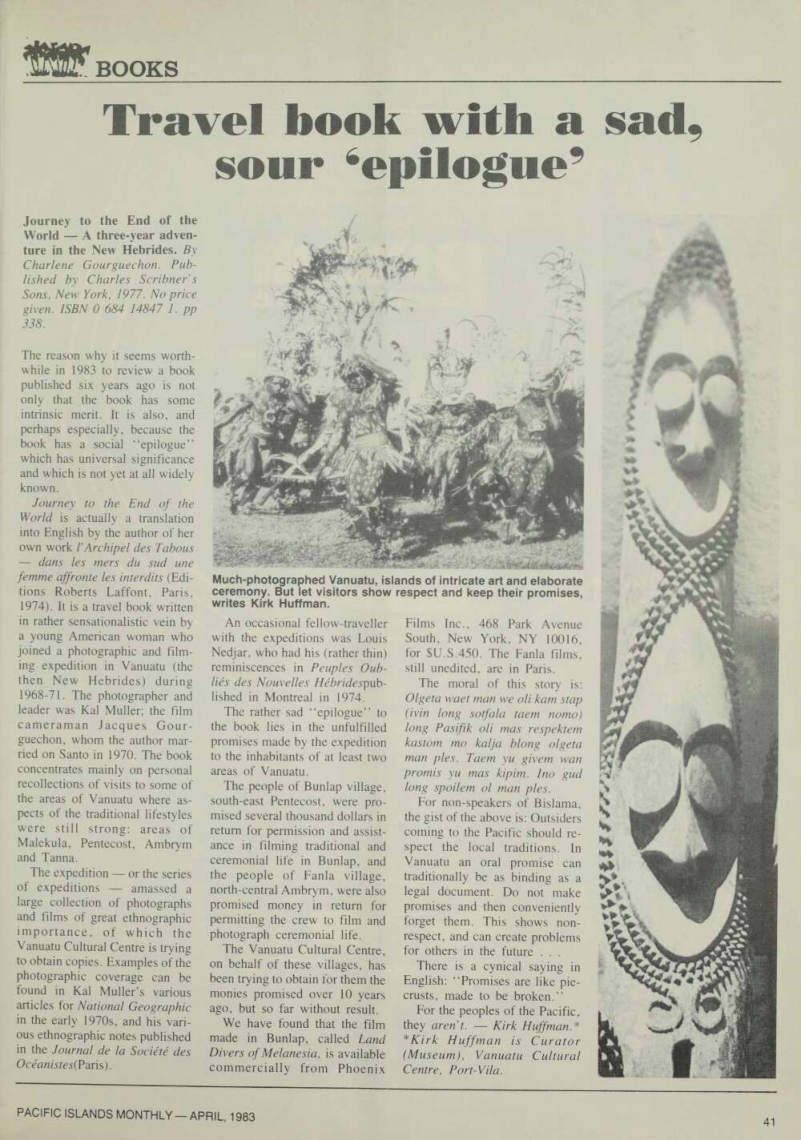
Much-photographed Vanuatu, islands of intricate art and elaborate ceremony. But let visitors show respect and keep their promises, writes Kirk Huffman.