The super tangle
pp. 23-25 · Read in the full issue
that is Palau
Question: when is a majority a
minority?
Answer: When it votes in an election in Palau.
If that seems nonsensical, it gives one an indication of some of the so-called analyses of that
fledgling republic’s February
plebiscite on the Compact of Free Association.
This is how the “logic” is developed: Yes, it is true that nearly 60 per cent of the 7000 Palauans who voted in the plebis
cite supported the compact.
That’s a clear majority, in any body’s book.
But because the Palauans did not approve by the requisite 75 per cent the changing of their constitution to allow the transit and storage of nuclear material (as in U.S. navy ship reactors or in weapons), the compact is “dead.” That is the operative phrase.
The actual vote on the nuclear question was split, about 50-50.
A third ballot question was also divided in about the same way on whether independence or a closer relationship with the U.S. should be pursued should free associa tion be disapproved.
Obviously there is a problem in Palau. The constitution is out of step with the compact, and the U.S. has maintained that unless the offending section of the con stitution is altered, Washington cannot fulfil its defence obliga tions as outlined in the compact.
Notes from the North Floyd K. Takeuchi on Micronesia
Now the strict constructionists would maintain that the constitu tion takes precedence. Hence, a
new political relationship must
be negotiated. (It should be add ed here that there are a number of interested Americans who have followed the “progress” in Palau with considerable fascina tion. They tend to see or perhaps hope that Palau will become a truly nuclear-free Is land state, and often view all issues from that standpoint).
But anyone who has followed Micronesian politics, and the peculiar brand that is practised in the Palau Islands, should know that there is no such thing as a strict constructionist approach.
Politics in those islands is dy namic in the extreme. There are no real ground rules. And in the case of the free association com pact, where each step establishes
new precedent, anything goes.
What that means in Palau’s case is that there is considerable latitude in considering options to this apparent stalemate. It also means that the compact is very much alive, and should not be counted out of the picture.
It remains a significant factor
because of that 60 per cent vote.
Palau’s politicians have a well deserved reputation in Mic
ronesia for being especially wily,
and being good pols, they know
a majority when they see one.
That 60 per cent is essentially a resounding yes for the $1 bill ion the U.S. has agreed to pour into Palau over the next 50 years.
A lot of Palauans have their dreams tied up in that sum.
So for a local leader now to claim that the compact is dead, and with it the $1 billion, would be tantamount to political suicide. The people may be am bivalent about the possibility of U.S. Marines using part of Babelthuap as a training base, but they clearly want the big
bucks promised by Washington.
That is why the compact of free association remains the cent ral option. That is why U.S.
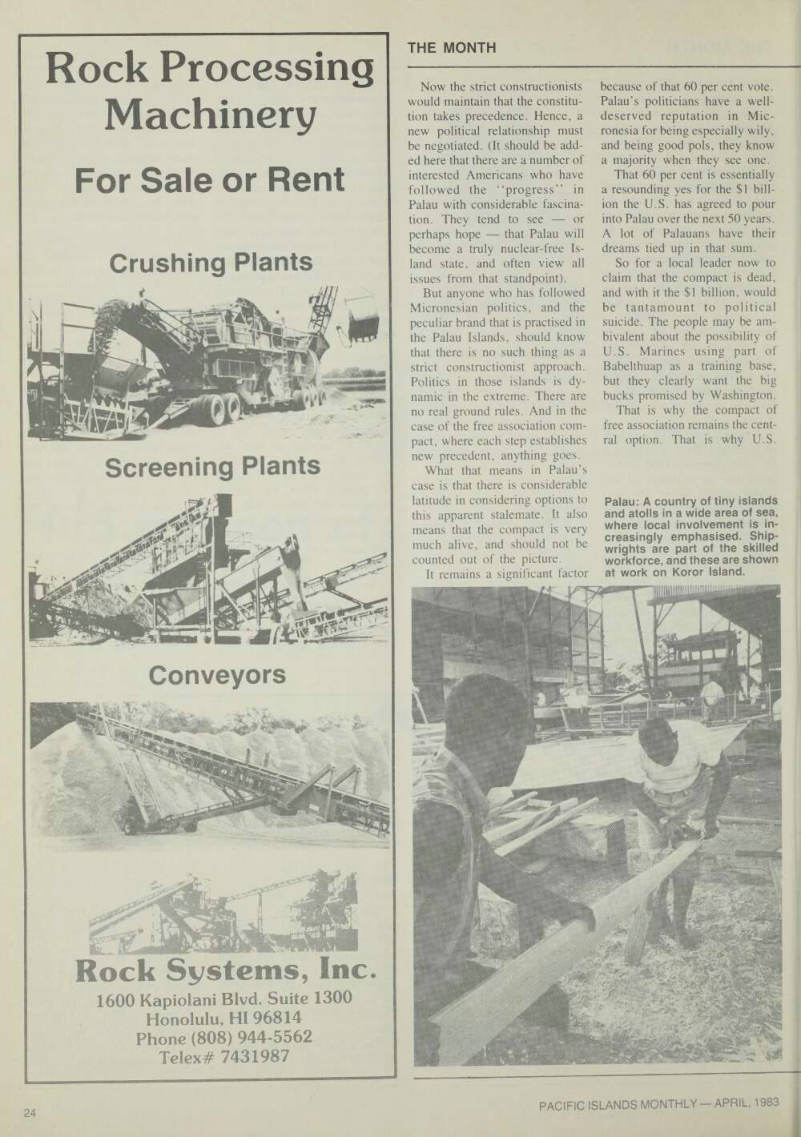
Palau: A country of tiny islands and atolls in a wide area of sea, where local involvement is in
creasingly emphasised. Ship
wrights are part of the skilled workforce, and these are shown at work on Koror Island.
Ambassador Fred Zeder says, and rightly so, that the question of how to adjust the discrepancy between the compact and con stitution is a Palauan matter.
Should the Palauans decide, by whatever methods they choose, to prevent a U.S. milit ary presence, Washington has a ready response; the value of the package would be lowered. How low it might go would depend on how complete the ban on the military is.
In February, voters were in effect saying “we want the money but keep the Marines out.” That’s an understandable stance, but hardly a realistic one given the American defence obli gation as described in the com pact. There’s an inescapable trade-off.
Sooner or later, that trade-off will take place in Palau because the political dynamics are such that there is really no other viable option.
Complete independence with Palauan leaders calling all the shots? Not likely. The plebiscite
showed how divided voters are over that delicate issue, If voters had the choice bet ween free association as now defined and independence, it is likely the vote for the compact would be even larger than 60 per cent.
Most Palauans, like a good number of other Micronesians, are too concerned about where the money will come from for economic development, for material goods, and for other services to want the scary un known of independence, That may be different in a few years. Palauans are particularly adept at functioning in the out side world, and doing well at it.
But for the time being, inde pendence as the chosen post trusteeship status does not seem on the cards, On a political spectrum, that would leave closer ties with the United States at the other ex treme. That choice would prob ably face stiff opposition from younger Palauans, many educated in the U.S. who cor
rectly feel that a commonwealth type arrangement would guaran tee them a dependent status in the worst possible way.
That leaves a compromise pos ition, which is what free associa tion is. It maintains a certain level of dependency, less than commonwealth and possibly less than independence, but gives Palauans a well-defined financial security blanket, too.
There is a need, then, to see the Palauan situation in those terms. This is a political strug gle, with few rules, considerable emotion, and much flux.
But the essential issue is money; how much the U.S. is willing to give, and at what price. This is not, as some would portray it, a “nuclear” debate.
This is definitely not, as two Americans recently wrote in The Los Angeles Times, a matter of “principle above expediency.”
The post-plebiscite struggle in Palau is expediency in spades.
And the referendum results were, in a sense, expediency over principle.
There is a moral aspect to the debate. One must approach it with considerable trepidation, for we do not always understand the values of others. But it plays a role.
Undoubtedly there are Palauans who strongly believe their lush islands should not be a player in the international madness that we call the nuclear arms race. They swear by their constitution’s anti-nuclear provisions.
But the sad fact is that they cannot have it both ways. They cannot proclaim their nuclear neutrality and still expect to have the millions upon millions from America.
The odds greatly favor a deci sion to make the necessary ad justments to allow in a U.S. military presence. The power and lure of $1 billion should not
be discounted.
Floyd K.
Takeuchi.
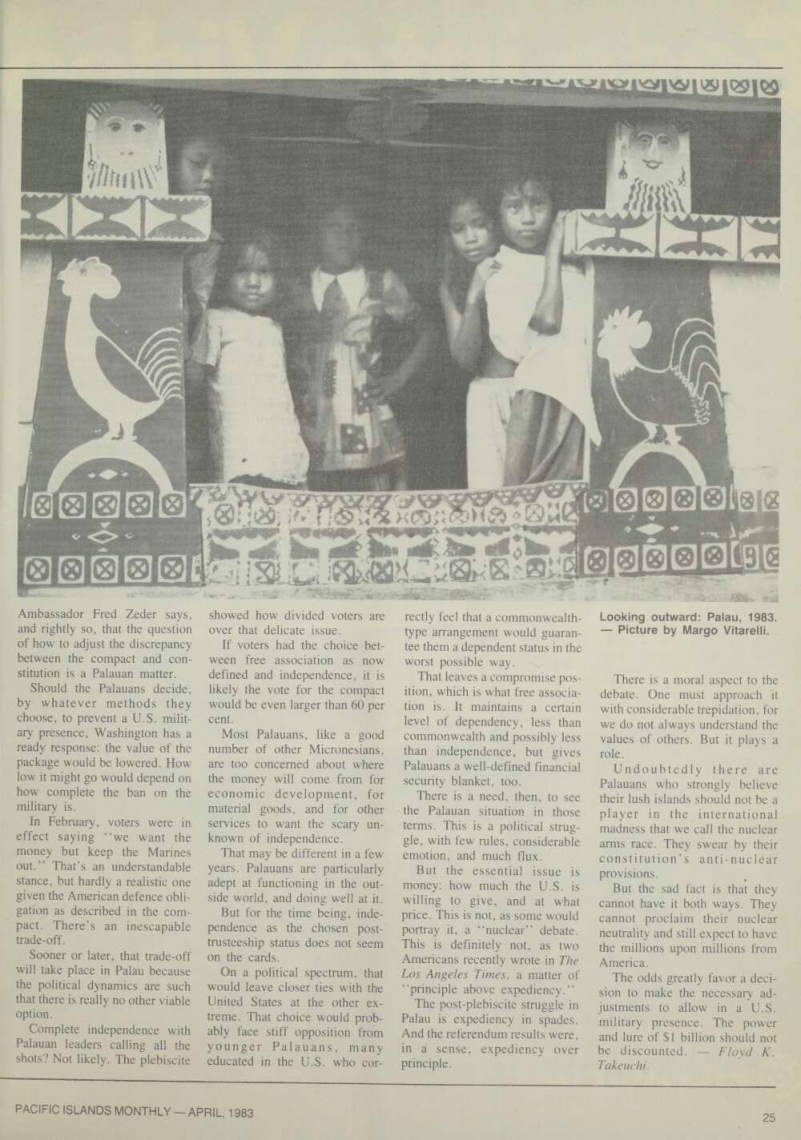
Looking outward: Palau, 1983. - Picture by Margo Vitarelli.