Pro and con of
pp. 22-23 · Read in the full issue
the PBDC
As recalled in the debut of this column last month, in the late 19705, and after a period of neglect following World War 11, the United States began to redis cover the Pacific. As one manifestation of the renewed in terest in the islands, three inter national conferences were held in Honolulu during 1979 and 1980, and each led to the formation of a
new organisation. For example,
last month’s column reviewed the founding of the East-West Center’s Pacific Islands De
velopment Program.
The concerns leading to a sec ond conference had their origins in what have been called the
“American flag islands”. They
are represented in the organisa tion and at the annual meetings of the Western Governors’ Con ference also included are Alaska, Hawaii, and the 11 wes ternmost of the adjacent 48 states and in 1978, Hawaii’s Gover nor George Ariyoshi chaired the conference which met in Honolulu.
The concerns of the western
states are often different from those of the State of Hawaii and the island territories. Ariyoshi urged that the interests and needs of the islands be given more attention, and federal agencies responded. With the Department of Commerce taking the lead, it and the Departments of Energy and Interior and the four island governments of American Samoa, Guam, Hawaii, and the Northern Mariana Islands co sponsored the Pacific Basin De velopment Conference in Hawaii in February, 1980.
The island governors generated a “wish list” of over 300 developmental proposals in nine functional areas; fisheries, coastal zone management, tele communications, ports, transpor tation, trade, tourism, energy, and municipal services. The most tangible result, however, was the formation of the Pacific Basin Development Council
(Pbdc).
PBDC is a non-profit corpora tion with its office in Honolulu, and it serves as a joint agency of
the four island entities. The four governors are the members of PBDC and also constitute its board of directors. According to their responsibilities as defined by PBDC’s by-laws, they ap pointed Mr Jerry Norris as ex ecutive director in July, 1980, to administer the organisation. He brought to the office his experi ence as director, Western Office, Council of State Governments (the organisation noted above) from 1970 to 1979.
PBDC’s staff is small. Ms Carolyn Imamura serves as di rector of planning and programs.
A planning position is currently
vacant, and PBDC hopes to fill it with a Pacific Islander. A fiscal officer and two secretaries round out the permanent staff. Two research internships are reserved for islanders. They are at present occupied by Mr Marcelino Ac touka (Ponape) and Mr Vince Diaz (Guam).
There are two main sources of funding: the Department of Com merce provides $150,000 annu ally, and each of the four govern ments makes a yearly contribu tion of $40,500. Other funds are derived from federal grants and the private sector.
PBDC’s goals are several: to assess the economic and social needs of the member islands; examine development strategies;
promote co-operation between members, the federal govern ment, and the private sector; ar ticulate the views of the islands to those outside the region; col lect and distribute useful infor mation to the region.
PBDC’s basic position is that the only viable approach to de velopment is an integrated one.
For example, the development of
a fishing industry requires that all
components of such a venture be considered. These might range from the physical plant to other variables such as relevant social/ cultural factors, access to mar kets, federal and local regula tions, etc.
PBDC has been working since July 1980, with little publicity.
Norris reports several accom plishments. On a general level, involvement with PBDC has convinced the four governors of the value of co-operating with each other and dealing with fed eral agencies as a collective body. More concretely, informa tional profiles (overviews) of the island entities have been pre
pared. Development plans (es
sentially feasibility studies) for developments in fisheries and tourism have been completed, and substantial progress has been made on an assessment of the essential air services required by the islands. During 1982, PBDC
A View from Honolulu Robert C. Kiste
reported involvement in a total of 64 projects.
As would be expected with any new and ambitious organisa tion, PBDC has encountered some difficulties. As suggested by the number of projects noted above, its resources are stretched thin. Federal agencies are not organised in ways conducive to an integrated approach to de velopment. For example, energy and commercial concerns are the bailiwicks of separate depart ments, and a magician would be required to bring them together in common cause. Officials in far-off Washington DC, exhibit an infamous lack of familiarity with the islands; hence the coun try profiles, and Norris reports that perhaps one-third of PBDC’s time is spent in educational efforts.
A handicap for PBDC is a lack of direction from Washington DC. The February 1980 confer ence was an initiative of the Carter administration. To date, the Reagan administration has yet to articulate any policy re garding the flag islands or the larger Pacific region. Further, the governors have not been pleased with the absence of Pacific expertise on the part of Reagan appointees who adminis ter Pacific affairs in the nation’s capital. The governors have gone
on record to express their disple asure with the latter (PIM Sept. ’Bl, p. 11), and they have publ icly opposed any further dump ing of nuclear wastes which could contaminate marine re sources. Given Reaganomics, there is also the spectre that federal funding will be discontinued.
Normally, PBDC’s governors meet twice yearly, and they select from their ranks a presi dent for a one-year term. Their first meeting was in October 1980 in Honolulu, and Governor Ariyoshi was named president.
The 1981 meetings were in Hon olulu and Guam, and Governor
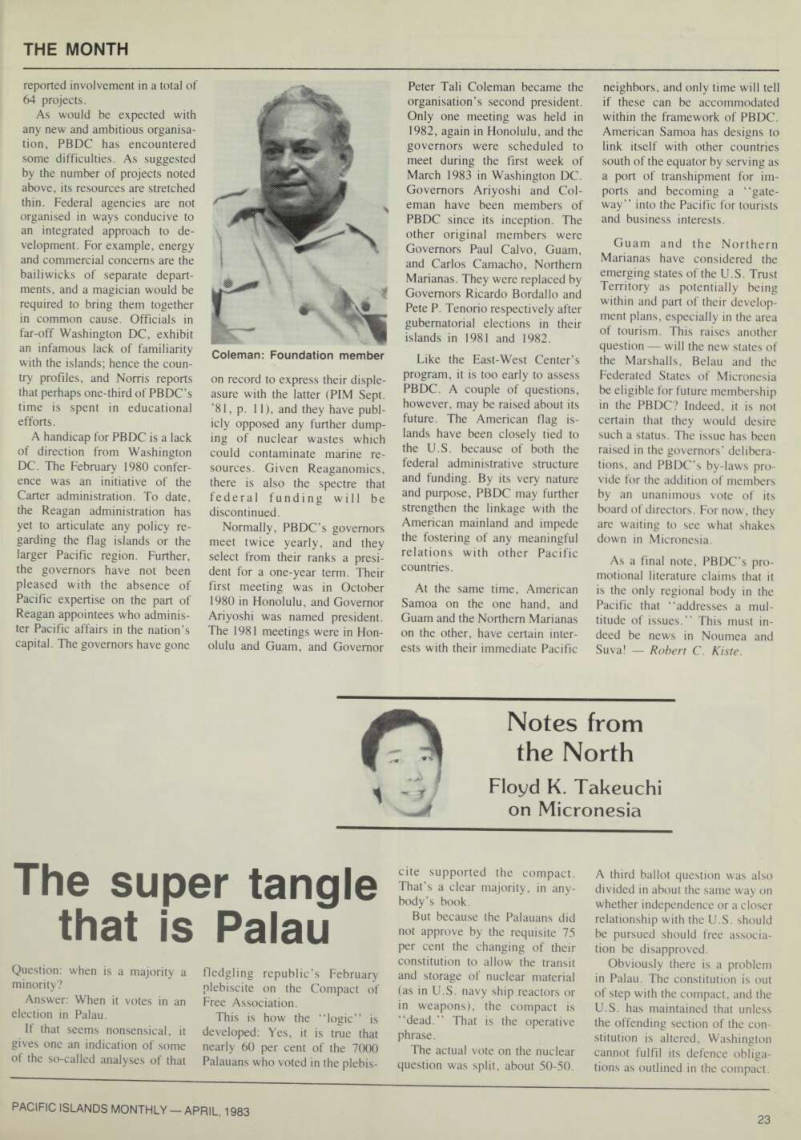
Peter Tali Coleman became the organisation’s second president.
Only one meeting was held in 1982, again in Honolulu, and the governors were scheduled to meet during the first week of March 1983 in Washington DC.
Governors Ariyoshi and Col eman have been members of PBDC since its inception. The other original members were Governors Paul Calvo, Guam, and Carlos Camacho, Northern Marianas. They were replaced by Governors Ricardo Bordallo and Pete P. Tenorio respectively after gubernatorial elections in their islands in 1981 and 1982.
Like the East-West Center’s program, it is too early to assess PBDC. A couple of questions, however, may be raised about its future. The American flag is lands have been closely tied to the U.S. because of both the federal administrative structure and funding. By its very nature and purpose, PBDC may further strengthen the linkage with the American mainland and impede the fostering of any meaningful relations with other Pacific countries.
At the same time, American Samoa on the one hand, and Guam and the Northern Marianas on the other, have certain inter ests with their immediate Pacific
neighbors, and only time will tell if these can be accommodated within the framework of PBDC.
American Samoa has designs to link itself with other countries south of the equator by serving as a port of transhipment for im ports and becoming a “gate way” into the Pacific for tourists and business interests.
Guam and the Northern Marianas have considered the emerging states of the U.S. Trust Territory as potentially being within and part of their develop ment plans, especially in the area of tourism. This raises another question will the new states of the Marshalls, Belau and the Federated States of Micronesia be eligible for future membership in the PBDC? Indeed, it is not certain that they would desire such a status. The issue has been raised in the governors’ delibera tions, and PBDC’s by-laws pro vide for the addition of members by an unanimous vote of its board of directors. For now, they are waiting to see what shakes down in Micronesia.
As a final note, PBDC’s pro motional literature claims that it is the only regional body in the Pacific that “addresses a mul titude of issues.” This must in deed be news in Noumea and
Suva!
Robert C. Kiste.
Coleman: Foundation member