Tales of great
pp. 27-29 · Read in the full issue
Pacific rowers
Over the next few months the following warning should be broadcast regularly throughout the South Pacific: If you should encounter on the high seas a bearded man in a small rowboat named Hele on Britannia, drifting aimlessly or rowing like mad, please do not attempt to rescue him. He is not the last survivor of some great maritime disaster, but an ordi nary British eccentric named Pe ter Bird, who, of his own free will, is rowing across the Pacific from California to Australia.
According to American press reports, this lonely long-distance rower left San Francisco on Au gust 23, 1982, in a home-made plastic boat 10 metres long and a metre and a half wide. His inten tion? To beat the world endur ance record of another Englishman, John Fairfax, who, it seems, took 180 days to row across the Atlantic back in 1969.
To succeed, Peter Bird had of course to choose a larger ocean.
This meant the Pacific.
At least here in Tahiti, nothing more was heard about this not terribly interesting attempt until mid-February when Bird’s very British promoter, Kenneth Crutchlow, disembarked at Papeete’s Faaa international air port. Equipped with an enormous Queen’s Guard royal moustache, Mr Crutchlow informed us with a completely straight face that he owned a fleet of London taxi cabs, operating out of Sonoma, California. He then turned on the
old trick of trying to make Peter Bird appear as some kind of shy hero, claiming that he couldn’t swim and was mortally afraid of sharks.
Luckily, these silly claims
were quickly brushed aside by news of the very real achieve ment of the lone sculler: Peter Bird had already covered 4790 miles in 177 days, and was at that time drifting at the end of a sea anchor in rough seas 146 miles north-west of Borabora.
He was therefore clearly set to beat the existing world record within a few days perhaps even on his birthday, February 19, when he turned 36.
Mr Crutchlow, it appeared, was on the look-out for some
kind-hearted yachtsman willing
to take him and a bottle of cham pagne out to meet the record breaker all for no charge, of course. It’s true he also proposed to take out some fresh food, but this was hardly essential since Peter had taken on board supplies for 300 days before he left San Francisco. As for water, he had desalination equipment aboard.
We also learned that Peter was a film cameraman by profession, and carried with him no fewer than 10 still and movie cameras with which to record his experiences.
In spite of all this, Mr Crutch low was accompanied by a TV crew so that he could film the meeting ceremonies from his own angle.
A third British eccentric, Jeff Allen, now came on the scene. A veterinarian by profession, Allen has been cruising the Pacific on a trimaran known as Dick’s Song for the past 10 years. He finally yielded to Crutchlow’s request to undertake the Bird hunt.
The junction took place on February 20, when Peter had been at sea for 181 days, and had thus established the new record.
On his return to Taihiti from the great rendez-vous, Crutchlow was rather tight-lipped. (Perhaps he was saving the big story for a fat “exclusive rights” deal?) All he would say was that Peter had read 45 of the 100 books in his boat’s library, that he spent most of his waking hours listening to the BBC or to recorded music, and that he had given himself two birthday pre sents (hidden on board since he left San Francisco). They were a pullover, and a travel guide,
Postmark Papeete Marie-Thérèse and Bengt Danielsson
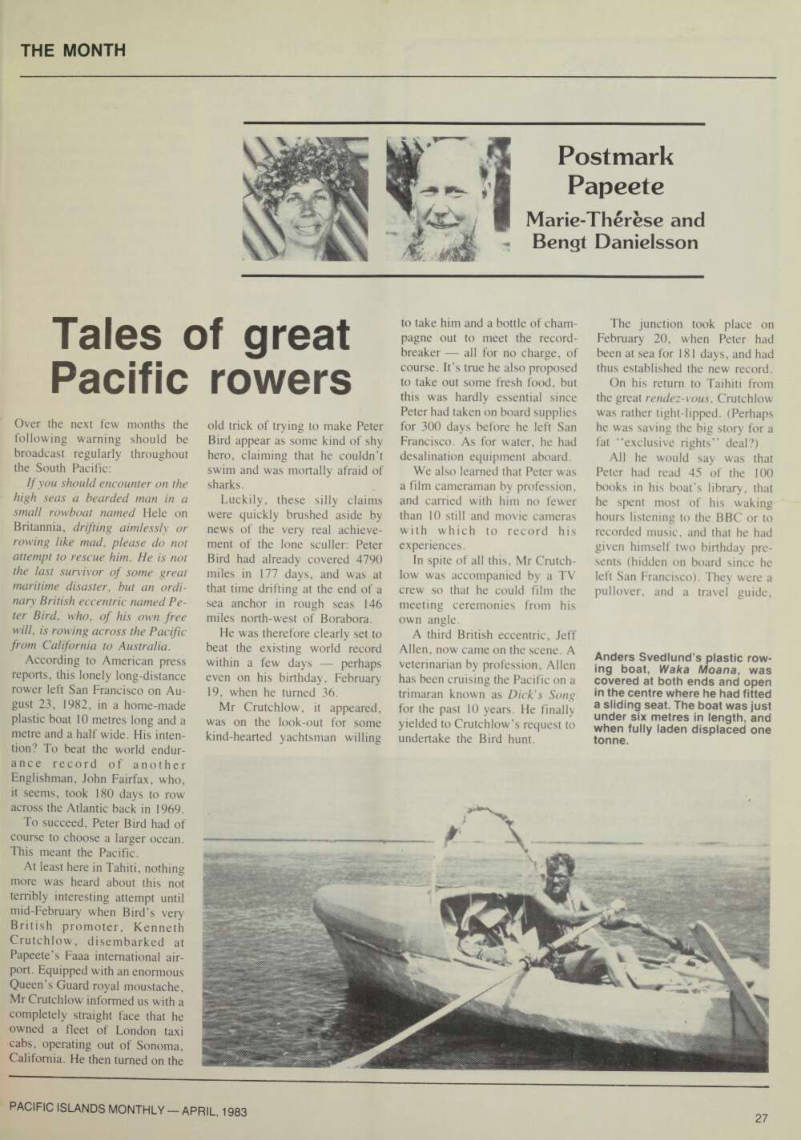
Anders Svedlund’s plastic row ing boat, Waka Moana, was covered at both ends and open in the centre where he had fitted a sliding seat. The boat was just under six metres in length, and when fully laden displaced one tonne.
Australia on $2O a Day. (Since at the earliest he will reach Aust ralia in August or September, will he really need the pullover?
And in view of Australia’s cur rent inflation rate, won’t his book be a bit out of date by then?) While congratulating Peter Bird on his remarkable perform ance, and wishing him bon voy age all the way to Australia, we cannot help feeling that the title “Great Pacific Rower’’ still be longs to the Swedish-born, naturalised New Zealander, An ders Svedlund.
We first met him in July 1974, when he quietly stepped ashore from his plastic five-and-a-half metre boat right in front of our home here at Papehue, on the west coast of Tahiti, during a
truly epic trip across the Pacific.
The sole reason why Anders repeatedly escaped to the sea was his love of nature, and the peace of mind he experienced when lost in the solitary contemplation of it.
Unlike Peter Bird, he cared very little for records, shunned all publicity, and never kept a log or wrote down the story of his
many exploits.
For instance, in 1971, after
accomplishing the amazing feat
of rowing across the Indian Ocean from Fremantle to Madagascar in 64 days, he went straight back to Auckland, and,
without telling a soul where he had been, resumed his old trade as a house painter.
After three years the time it took him to save enough money he set out again on what was to become an even greater adventure.
The point of departure was Huasco in Chile, which he left on February 27, 1974, at the oars of the same old plastic boat he had used for his Indian Ocean trip, but now renamed Waka Moana.
His only aim was to follow the sun for as long as he could. He rowed with such determination, however, that he sighted his first Polynesian island after only two months. Since he had no naviga tional instruments, and it was uninhabited, he never found out its name.
But he didn’t at all mind being alone on land for a change, and managed to pick and open a few green coconuts.
The next island he came across seemed on the contrary to be
definitely over-populated, and
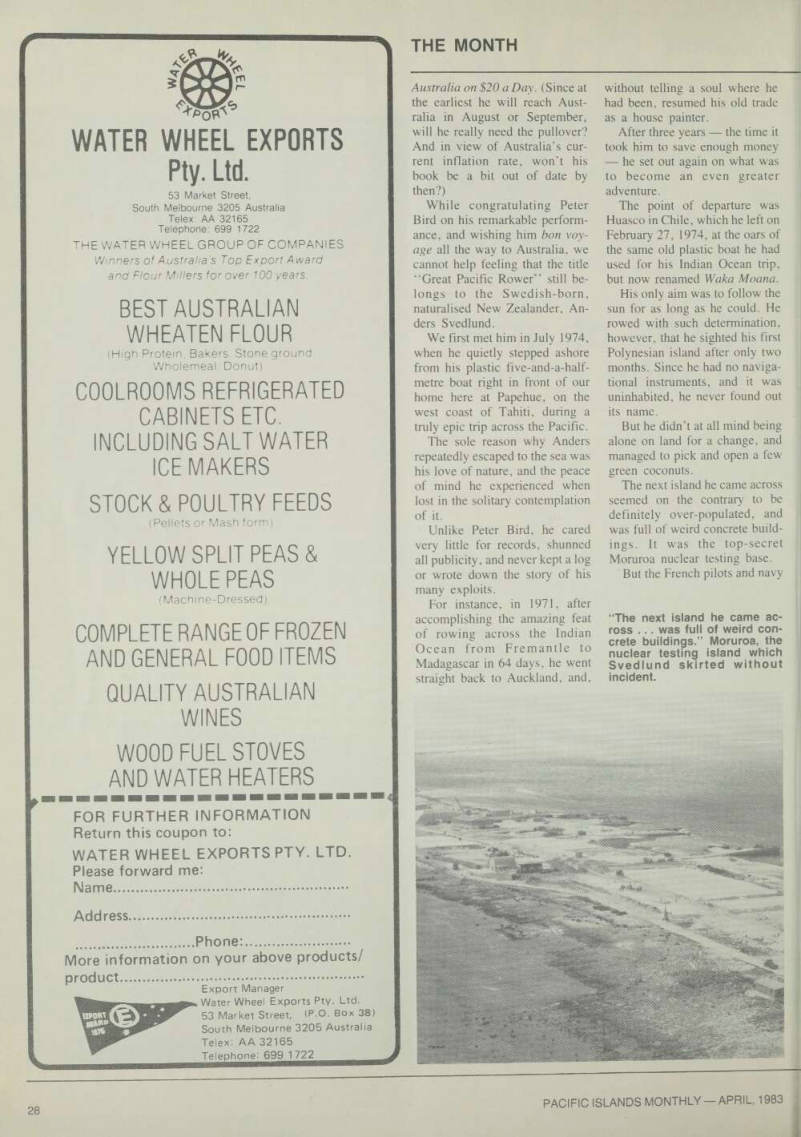
was full of weird concrete build ings. It was the top-secret Moruroa nuclear testing base.
But the French pilots and navy
“The next island he came ac ross . . . was full of weird con crete buildings.” Moruroa, the nuclear testing island which Svedlund skirted without incident.
men patrolling the area never imagined for a moment that peo ple could come all the way from South America in a small boat of the sort they used for fishing and fun. So he rowed all day un noticed along the northern coast of the island, within shouting distance of the shore.
Moruroa is situated at 22 de grees south latitude, and Anders made the mistake of trying to reach the Austral Islands still further south, which involved him in a losing battle against strong westerlies. Luckily for him, the captain of an inter island cargo boat, whom he en countered at Rimatara, took pity on him, and brought both him and the Waka Moana to Papeete, whence he rowed on the calm lagoon waters out to our home.
We immediately took a great liking to Anders, whose only fault was his excessive modesty
and gentleness.
He devoted his first week in Tahiti to mountain-climbing which he considered the best way “to stretch old sealegs.”
But we cornered him eventual ly, and got very straightforward answers to some questions that
had long intrigued us.
For example, he had no radio and no books, so we suspected he must have felt mightily bored at times. No, he said, the sea offered a splendid, ever changing spectacle, which he never tired of watching. It actual ly made him so happy he often burst into song. Mostly he sang old Swedish folksongs he had learnt as a child. He could go on singing for hours. He made up poems, too. Or he discussed
philosophical and religious prob
lems with himself.
We were equally interested however in the more practical sides of his spiritual quest, among other things how much sleep he managed to get. Anders assured us that he slept very soundly for 10 hours a night. He slept on a mattress in the forward “cabin” which was so low that he had to crawl in and out of it.
He added that Waka Moana, when left to her own devices, had a most fortunate propensity to turn her nose to the wind, which prevented her from capsiz ing. The one thing he regretted was that she heaved and rolled so
much that it was absolutely im possible for him to stand on his head for any length of time. To function normally one must stand on one’s head for at least an hour a day, he said.
During his first rowing adven ture in the Indian Ocean, Anders had equipped himself with a kerosene stove. But it didn’t work well, and he soon ran out of kerosene. This time he made all possible space available for the storage of food. When he left Chile he had in his aft cabin 250 kilograms of flour made from roasted South American quinoa wheat. It kept better for having been pre-roasted, he said. Twice a day he mixed this flour with water to make cold porridge. He also carried a good supply of honey which he poured over the porridge. For desserts, he had about 50 kilograms of dried fruit.
His water supply did not exceed 300 litres. But he had been able to catch some rain water. Final ly, he took the wise precaution of
swallowing a vitamin C tablet every day.
What surprised us most was that Anders had no fishing gear.
But the explanation was simple: he was a vegetarian (and a teetotaller, as well).
When, at the end of July, Anders decided to continue his voyage, we gave him what we considered a most appropriate farewell gift: a sackful of green, slow-ripening grapefruit, likely to last him for several weeks.
With this last sack loaded aboard, the weight of the water and food supplies was over 600 kilograms. Since the canoe itself weighed 360 kg, it was more than a ton that Anders had to drag across the ocean with the help of his two tiny oars. It was not without serious apprehension that we watched the heavily loaded Waka Moana confront the choppy seas outside the reef and disappear in a westerly direction “towards Australia,” as An ders himself in very broad terms had formulated his sailing direc tion and destination.
As we learned two months later, Anders had kept rowing in his usual style towards the setting sun at an average speed of about 40 miles a day. But he eventually had to give up because of our grapefruit!
They simply did not agree
with his accustomed diet of cold porridge, and before he could bring himself to throw them overboard he was suffering from chronic colic which caused him such severe pain that he had to put into Apia harbor. His date of arrival was September 9, which meant that his whole Pacific trip had lasted six and a half months.
We saw Anders a few years later in Auckland. It was obvious from-his dejected air that the sort of urban life he was then leading made him even sicker than our Tahitian grapefruit had. His solu tion was, of course, to go to sea again. But before he could do so, quite unexpectedly, he set out on another, much longer, voyage, as related by the following brief item in an Auckland newspaper of April 23, 1979:
Ocean Rower Dies In
KITCHEN: Anders Svedlund, who achieved international fame in the early 1970 s for two marathon solo rows across thousands of miles of open ocean, died on Friday night after a fall in his kitchen. The police first thought that he might have been shot. But a post-mortem examination established that he had struck his head on the side of a table following a fall.
Marie-Thérèse and Bengt Danielsson.
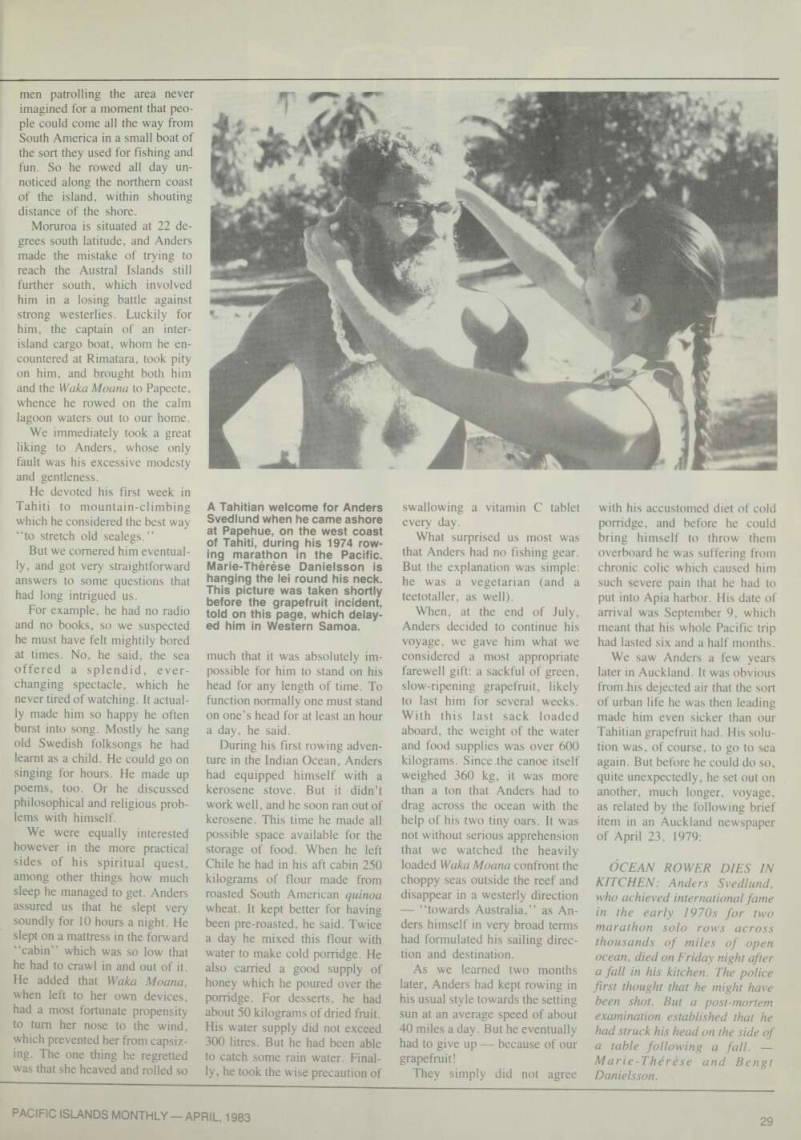
A Tahitian welcome for Anders Svedlund when he came ashore at Papehue, on the west coast of Tahiti, during his 1974 row ing marathon in the Pacific.
Marie-Thérèse Danielsson is hanging the lei round his neck.
This picture was taken shortly before the grapefruit incident, told on this page, which delay ed him in Western Samoa.