radio-active waste disposal
pp. 15-17 · Read in the full issue
Political Currents
Pacific is favored for sub-seabed radio-active waste disposal
It is now just over 40 years since the first self-sustaining chain reaction was initiated at the Un iversity of Chicago. Since that time, we have seen the develop ment of nuclear weapons such that each of the superpowers now has a massive arsenal of these weapons. We have also seen the development of civilian nuclear reactor programs.
Nuclear reactors for power generation were first built in Bri tain in the 1950 s but are now
appearing in increasing numbers
throughout the industrial world and in some Third World coun tries. The reasons for this are not hard to find.
In a world where fossil fuels represent a finite resource, nuc lear power is seen as a cheap means of supplying energy which can bridge the gap until a
more sophisticated technology
(such as the fusion reactor) can be developed. We are therefore entering a nuclear era in which an increasing amount of energy will be produced by nuclear means and which will supersede the coal era and the petroleum era which have so far fuelled the industrial revolution. Ultimately, the world is likely to develop a “plutonium economy”. Dr Wal ter Marshall, chairman of the UK Atomic Energy Agency, has sug gested a possible “plateau scenario” of about 3000 nuclear reactors worldwide in the year 2020.
One of the by-products of nuc lear power generation is radio active waste. This falls into two categories.
High-level wastes are the re sult of the re-processing of spent nuclear fuel elements and repre sent 99 per cent of the total radio active wastes to be disposed of.
These wastes consist of longlived radio-isotopes of which plutonium is probably the most
important.
Low-level waste, on the other hand, represents the normal dis charge from a nuclear reactor
Dr G.P. GLASBY* writes on plans for the sub-seabed disposal of high-level radio-active wastes. The north central Pacific is regarded as the most promising area for the practice, and, says Dr Glasby, there is need for “a Pacific voice” to be heard on the issue.
during operation, as well as from radio-chemical experiments.
It is now apparent that the long-term disposal of high-level radio-active waste is one of the major strategic problems con fronting the nuclear industry.
Two principal methods of radio active waste disposal can be em ployed, either localisation (or storage) of the waste so that it does not contaminate the envi ronment or dilution (usually in seawater) to a level below which it ceases to be a significant en vironmental contaminant.
For high-level waste, the only viable option is storage. At pre sent, high-level waste is stored on a temporary basis and the search is going on in many indus trialised nations for suitable, long-term, storage sites. Because of the long-lived nature of the radio-isotopes involved, storage on a time scale of 100,000 to 1,000,000 years is required. This is much longer than the timescale of human institutions.
Much debate has centred on what to do with these wastes and a number of suggestions were made in the early days. These included: (i) transmutation of the elements; (ii) removal from the earth by rocket into outer space; (iii) disposal in a terrestrial environment. ’ Careful examination has eliminated many of the options originally discussed (such as the polar ice-caps) which might have appeared attractive at first glance. The search is now on for stable areas of the earth’s crust where long-term storage might be possible. One of the options being studied, particularly in the US and UK, is that of sub-seabed
disposal of the waste. This has been the subject of an article in Science (1981, v. 213, p. 1321- 6). It must be emphasised that, in each country, land-based prog rams are also being evaluated and a final decision on dumping is still a number of years away.
For the sub-seabed disposal option, the area selected must (i) be geologically stable over a long time period (of the order of a million years); (ii) be geograph ically isolated; (iii) have no re source potential; (iv) permanent disposal must be possible.
Present investigations are cen tred on the so-called mid plate/mid-gyre regions, as in the central north Pacific. These are red clay regions far from land in deep water (5000 m). These reg ions are known to be geological ly very stable with no known earthquake or volcanic risks, and the over-lying ocean water has low biological productivity. A considerable amount of effort in the US is being directed towards evaluating the geology of this area as a first step in establishing the viability of the sub-seabed disposal option. Correlation of the sediment history of the red clays taken in ultra-long piston cores over small areas are an important part of this program.
The idea behind sub-seabed disposal of nuclear waste is the “multiple-barrier principle”. In this, the waste is incorporated as a glass or ceramic into a canister.
The canister would then be in troduced, probably by free fall, into the marine sediment.
The waste would be contained by three discrete barriers: the glass in which it is contained; the canister walls; and the sediment
in which it is incorporated. Each of the barriers would be expected to retain the radio-isotopes for a period of time until breached.
The idea is that an effective isolation lime of 100,000- 1,000,000 years would be re quired before the radio-isotopes would escape to the overlying seawater. By this time, the radio activity would have decayed to a negligible proportion of the ori ginal. Much work is being car ried out in the US and UK to assess the viability of this method. Searches are being made to find the best canister materials and sophisticated mathematical models developed to assess the response of each barrier.
I have a number of objections to this method of disposal.
Firstly, the method appears to contravene the 1972 London Dumping Convention which cov ers dumping of wastes at sea.
This convention specifically pro hibits the dumping of high-level radio-active wastes at sea. Furth er, “dumping” is defined as any “deliberate disposal at sea of wastes or other matter from ves sels . . .”.
Since the proposal to dump high-level waste beneath the sea bed would take place from ves sels, it is clearly prohibited under the terms of the convention.
The preamble to the conven tion also takes into account the
principles governing the seabed
and ocean floor and the subsoil thereof which is where the dump ing could take place. This method of dumping therefore ap pears to be prohibited under the
*Dr Glasby is a scientist at the New Zealand Oceanographic In stitute of the New Zealand De partment of Scientific and Indust rial Research. The views expre ssed in this article are not neces sarily those of the DSIR, or of the NZ Government.
terms of the London Convention (i.e. present international treaty).
It has been argued (in the Science article, for example) that this method is not “dumping”
but “precisely engineered emp
qacement within a suitable geological formation beneath the seabed”. Yet, as I have shown, the convention (written by skill ed international lawyers) chooses not to make this distinction and refers specifically to the “subsoil thereof’ ’.
I have also heard it said that it was not the intention of the con vention to consider this method of disposal and that, if one looks at the legislative history of the convention, a different interpre tation could apply. However, no where does the convention make such a disclaimer. It would seem to me (as a non-lawyer) that this method of dumping is specifical ly prohibited under the conven tion until such time as the con vention is re-negotiated.
It must be emphasised that this dumping will take place in the seabed under international waters (outside 200-mile limits and bey ond national limits of the conti nental shelf). In my view if such dumping should ever take place, it should be carried out under strict international controls. A possible body to administer this would seem to me to be the proposed International Seabed
Authority.
Secondly, no estimate of the likely scale of dumping is ever given. Assuming that a canister would contain about one cubic metre of glass or ceramic, the total amount of high-level waste per canister might be about 0.25- 0.33 cubic metres. By the year 2000, approximately 72,000
canisters might need dumping
worldwide (if this was the only method chosen) and on the time scale of the nuclear era (to the middle of the next century) about a million to 10 million canisters.
Whilst I have no objection to the idea of limited dumping of these canisters, I feel that the scale of the proposed operation could be so huge that serious attention should be given to this aspect.
Thirdly, the multiple-barrier
model depends on maintaining the integrity of three principal barriers vitrified or “syn rock” waste, the canisters, and
the sediment in which the canis ter is buried for a long period before each of the barriers is breached. The canister itself would have only a limited lifetime. A period of about 1000 years has been suggested for a canister with a 1 cm thick wall.
However, for a canister contain ing 1.5 kilowatts of high-level waste, the surface temperature of the exterior canister walls would reach 250 deg C and 150 deg C after one and 10 years respective ly. These elevated temperatures would last for tens or hundreds of years. Under such conditions, the canister would become en crusted in salt from seawater and the sediment would become acid ic. These conditions are extreme ly corrosive.
If the canister was to be breached early due to stress cor rosion at these extreme condi tions, then the glass waste would also leach rapidly. Early breaching of the canister would invalidate the entire principle on which this method is based.
Canadian workers have em phasised the importance of main taining low salt levels around the canisters, and have stated that “once in the repository, the canister plays a negligible role in preventing the dispersal of its contents. In some instances for example in salt beds rapid deterioration of the canister would be expected. However, the inherent characteristics of the geological formation will contain the waste”. These views cast grave doubts on the “multiple barrier principle”.
Fourthly, because of the likely scale of operations, the only vi able method of dumping will be the free-fall penetrometer
method. Because of the drift of the canister during descent to the seafloor, it will be impossible to determine the exact position of the canisters and burial will be essentially irreversible. It will, of course, be possible to determine the position of test canisters ex actly and recover these.
Nonetheless, my view is that, because of the extremely long time scale of the dumping, a period of at least 50 years would be required to test the method fully under the proposed condi tions. A 50-year moratorium on full-scale dumping should there fore be declared whilst the method is fully tested under in situ conditions. This is already the situation in the UK.
In my view, the approach of
sub-seabed dumping of high
level radio-active waste is an attempt to internationalise the problem of high-level waste by dumping in the last area not under national jurisdiction. I would prefer to see the problems solved by countries storing the wastes within their own territories.
In the US in particular, this is quite feasible, and extensive underground nuclear testing is already carried out in Nevada.
Nuclear waste disposal would pose less environmental damage than this.
Nonetheless, internal political pressure might prevent the choice of optimum areas for dis posal from a geological stand point. This is well illustrated by the Reagan administration’s de cision to prepare permanent dis posal sites at the nation’s tempor ary storage facilities a deci sion made without proper geological evaluation. It would seem to me that final decisions should be made only after a critical assessment of the total national and international energy budgets and that, if sub-seabed disposal is to be carried out, it should be done only after full consultation with the internation al community and not simply after agreement between the in dustrialised nations.
A Pacific voice should be heard on this issue.
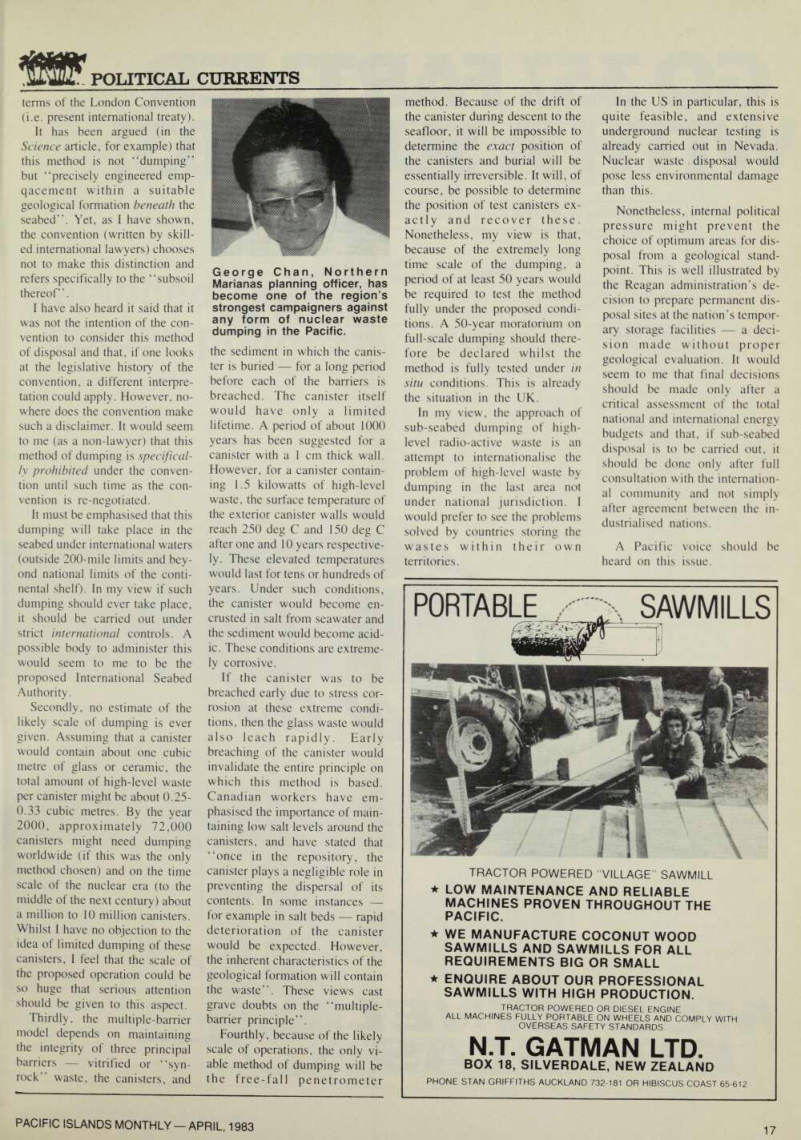
George Chan, Northern Marianas planning officer, has become one of the region’s strongest campaigners against any form of nuclear waste dumping in the Pacific.