Three faces of Samoa: Mead’s,
pp. 10-69 · Read in the full issue

Freeman’s and Wendt’s
ALBERT WENDT, Samoan poet and novelist, reviews Professor DEREK FREEMAN’S book Margaret Mead and Samoa: The Making and Unmaking of an
Anthropological Myth *
Along the way he provides many insights into how Samoans, the “objects” of the study of such anthropologists as Mead and Freeman, feel about the whole business.
He writes of the media debate on Freeman’s work: . . once again, we, the ‘informants and objects’ of Mead’s and Freeman’s research, are being ignored.
The inferences in ignoring us are that: we don’t know enough about ourselves to contribute intelligently to the debate; in terms of selling newspapers the news is Freeman slogging it out with Mead, an American institution, not us, the ‘objects.’
And when we read and hear the learned pronouncements by foreign anthropolog ists, ‘specialists’ on us, in this debate, we are doubly convinced that they are continuing to earn their comfortable livings and enhancing their reputations by using us . .
But none of this prevents Albert Wendt from warmly welcoming Professor Freeman’s book, which he calls “the most important study of us made this century by a non-Samoan.”
Derek Freeman’s Margaret Mead and Samoa: The Making and Unmaking of an An thropological Myth * is, in my view, the most important study of us made this century by a non- Samoan. It is a devastating refu tation of the most influential
study of our society Coming of
Age in Samoa by Margaret Mead, which was first published in 1928 and, appearing in 16 languages, became the best
selling of all anthropological
works.
To review Freeman’s book is really to examine two contrasting visions of Samoa held by two non-Samoans who claim to know the truth about us. Because I am Samoan and a writer who, in fiction, has built up his own Samoa, I do feel strange (that’s
the word, I think) commenting on the Samoas of Mead and Freeman.
Margaret Mead Every where: My first encounter with Margaret Mead’s Samoa was in 1958 when, as a student at Ard more Teachers’ College, in New Zealand, I had to study Coming of Age in Samoa, in one of my education courses.
Self-love is a feature of all peoples. Even for a Samoan, the tendency to see one’s country
through technicolor glasses is
strong. And Mead’s alluring idy llic depiction of my country
(especially her enticing account
of free love) appealed to me more than greatly because I had just lived through five strict years of boarding school, and I wasn’t having much free love in the puritanical New Zealand of the 19505. (I'm positive that the in stant worldwide popularity of Mead’s Samoa was due largely to her delectable portrayal of free love without guilt under the
hugely swaying palms!)
To me (and millions of other readers, particularly those living in cold climates) Mead’s Samoa offered other delicacies. Her Samoa was a place with little
conflict, no disturbing passionate commitment to causes and other people, no fights to the death, no poverty or great disasters, no wrathful gods or cannibalism.
Life was unhurried, multiple
parenting (a phrase used by my lecturer in Child Development) ensured that every child found parental love; the gifted were held back until their less gifted brethren caught up with them;
Mead and Samoa: The Making and Unmaking of an Anthropological Myth. By Derek Freeman. Published 1983 jointly by Australian National University Press, P.O. Box 4, Canberra, ACT 2600 and Har vard University Press, Cam bridge, Mass., USA. price
$A25.00. Isbn O 7081 1271 4.
caring was slight, love and hate and jealousy and revenge and sorrow lasted only briefly; and because of the harmonious social environment adolescents did not undergo the painful turmoil as sociated with adolescence else where. Our culture assured “the greatest degree of mental health in its members,” Margaret Mead persuaded me.
I too wanted to believe and wanted my unfortunate Kiwi friends to believe it too that I was from Mead’s paradise and was returning to it, promptly, gratefully, after I had survived the innumerable perils and dis eases of papalagi society. So when my lecturer asked me, in class, what I thought of Mead’s views, and especially her conclu sions about Samoan adolescence, I confessed that Mead’s Samoa was the genuine article. (I had no “solid anthropological evi dence” to base my agreement on; I had spent my adolescent years in New Zealand and had suffered, with New Zealand ado lescent boys, the often bewilder ing pain and stress that come
with pubic hair and descending testicles!) Later, even before I left train ing college, when I started writ ing seriously about Samoa, I realised the Samoa I was creating out of my childhood storehouse of images and memories was one contrary to Mead’s attractive but superficial stereotyped paradise.
It is a Samoa with all the emo tions, problems, hopes, and so on, common to all humanity. For over 20 years now, that is the Samoa I have been exploring, discovering, creating. And if I need non-Samoans to confirm the validity, the “truth”, of much of that Samoa then I can now turn to Derek Freeman and the younger anthropologists of the late 1970 s and ’Bos.
In my travels around the world I keep running into the formid able Margaret Mead everywhere.
To most non-Samoans, my coun try is Mead’s Samoa. Even when I point out to them the enormous errors in her book, most of them want to go on believing her.
Why?
A Yearning: People every-
where look to other cultures for cures for their own ills: the grass is greener elsewhere. We im agine others to be happier than us, that the inhabitants of sunny, exotic lands have fewer hangups, and enjoy emotionally healthier lives. This yearning for utopia/paradise seems more pro nounced in industrialised societies (or in pre-industrial times, in the so-called “civilised world”). I’m sure there’s also much of this in why people want to be anthropologists studying “exotic” cultures.
Throughout history, the papalagi has searched for El Dorado and the Noble Savage.
And Polynesia has suffered more than its fair share of being stereotyped as a permanently sun-tanned heaven of ease, free love, comfort, nubile maidens and noble warriors. The tourist industry today continues to ped dle the same myth and it con tinues to strike a powerful and lucrative chord in people around our sad globe. Many Polynesians themselves want to believe the myth.
However, we expect the well trained anthropologist to break through the stereotype and see “the native” (the so-called ob ject of his research) in all his dimensions, colors, meanings, depths and pretensions as he would try to understand his fel low countrymen. But, alas, even Maragaret Mead, who later be came the grand matriarch of an thropology a superstar, as it were couldn't rise above the stereotype, her own ideology, and the arrogant preconceptions about “primitive societies” of her time. As Freeman points out, no critic, in the otherwise hectic and questioning intellectual cli mate of the 1920 s questioned her extravagant claims.
Freeman recalls what David Hume wrote in 1748, that if ever we hear a traveller’s tales of foreign lands inhabited by people who are free of avarice, ambi tion, or revenge, and who are magnificently generous and public-spirited, we should im mediately suspect that traveller’s tales. But even the perpetually sceptical Bertrand Russell (and a
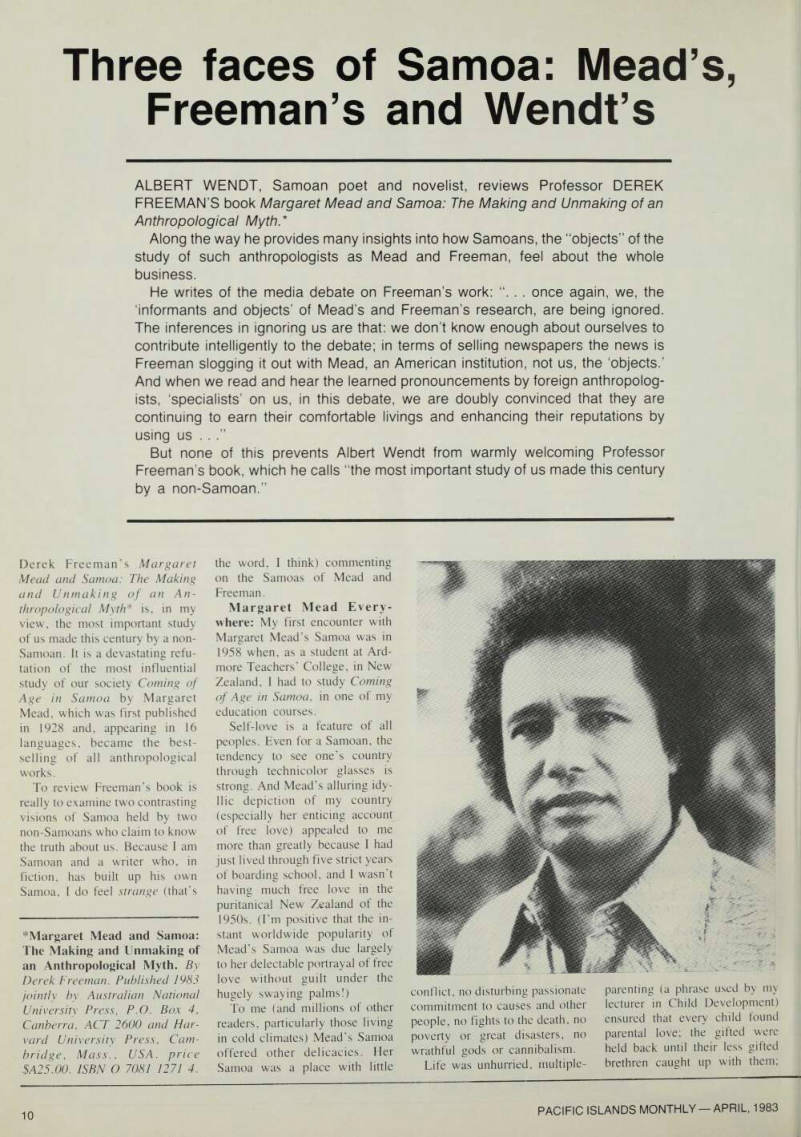
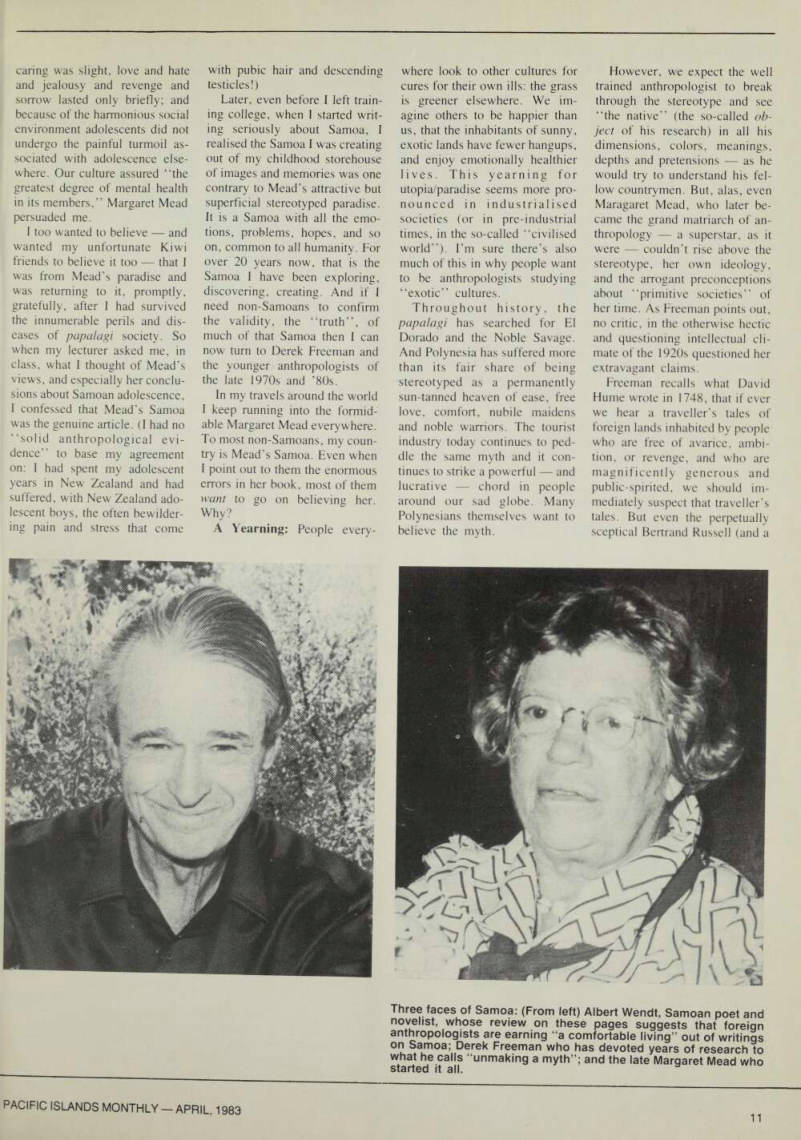
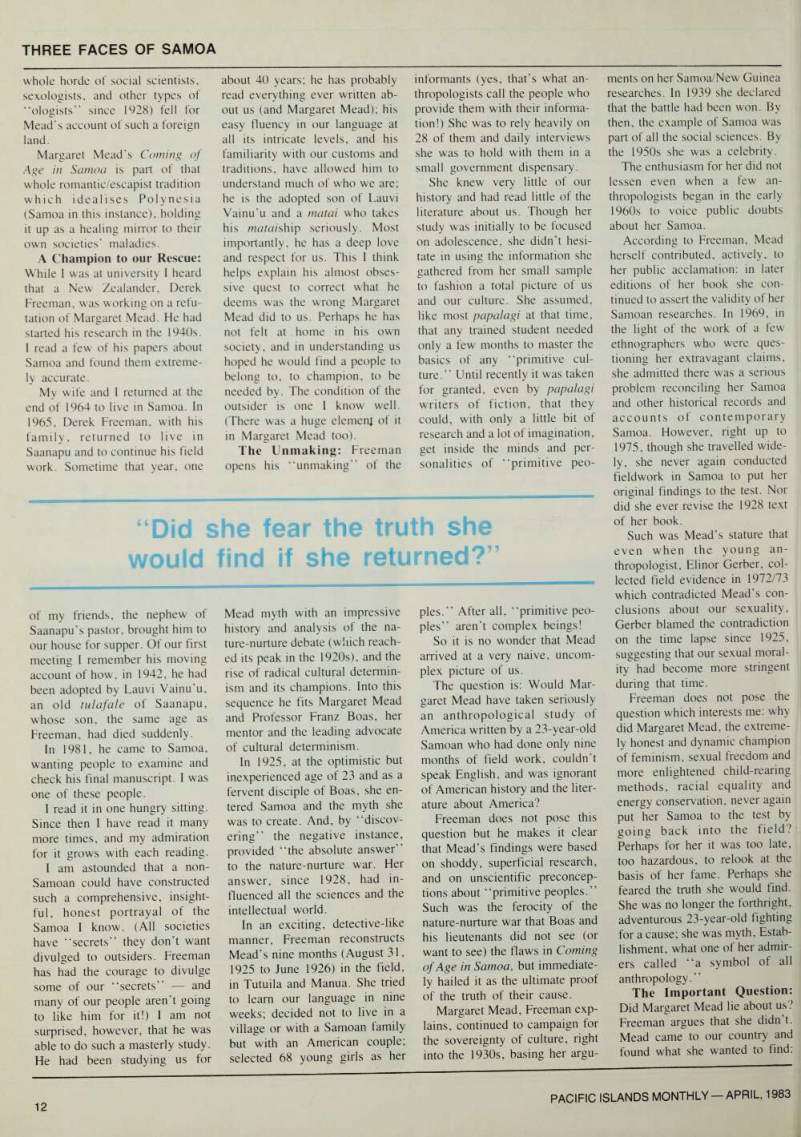
Three faces of Samoa: (From left) Albert Wendt, Samoan poet and novelist, whose review on these pages suggests that foreign anthropologists are earning “a comfortable living” out of writings on Samoa; Derek Freeman who has devoted years of research to what he calls “unmaking a myth”; and the late Margaret Mead who started it all.
whole horde of social scientists, sexologists, and other types of “ologists” since 1928) fell for Mead’s account of such a foreign land.
Margaret Mead’s Coming of Age in Samoa is part of that whole romantic/escapist tradition which idealises Polynesia (Samoa in this instance), holding it up as a healing mirror to their own societies’ maladies.
A Champion to our Rescue: While 1 was at university I heard that a New Zealander, Derek Freeman, was working on a refu tation of Margaret Mead. He had started his research in the 19405.
I read a few of his papers about Samoa and found them extreme ly accurate.
My wife and I returned at the end of 1964 to live in Samoa. In 1965, Derek Freeman, with his family, returned to live in Saanapu and to continue his field work. Sometime that year, one
“Did she fear the truth she would find if she returned?”
of my friends, the nephew of Saanapu's pastor, brought him to our house for supper. Of our first meeting I remember his moving account of how, in 1942, he had been adopted by Lauvi Vainu’u, an old tulafale of Saanapu, whose son, the same age as Freeman, had died suddenly.
In 1981, he came to Samoa, wanting people to examine and check his final manuscript. I was one of these people.
I read it in one hungry sitting.
Since then I have read it many more times, and my admiration for it grows with each reading.
I am astounded that a non- Samoan could have constructed
such a comprehensive, insight
ful, honest portrayal of the Samoa I know. (All societies have “secrets” they don’t want divulged to outsiders. Freeman has had the courage to divulge some of our “secrets” and many of our people aren’t going to like him for it!) I am not surprised, however, that he was able to do such a masterly study.
He had been studying us for
about 40 years; he has probably read everything ever written ab out us (and Margaret Mead); his easy fluency in our language at all its intricate levels, and his familiarity with our customs and traditions, have allowed him to understand much of who we are; he is the adopted son of Lauvi Vainu’u and a matai who takes his mataiship seriously. Most importantly, he has a deep love and respect for us. This I think helps explain his almost obses sive quest to correct what he deems was the wrong Margaret Mead did to us. Perhaps he has not felt at home in his own society, and in understanding us hoped he would find a people to belong to, to champion, to be needed by. The condition of the outsider is one I know well. (There was a huge elemenj of it in Margaret Mead too).
The Unmaking: Freeman opens his “unmaking” of the
Mead myth with an impressive history and analysis of the na ture-nurture debate (which reach ed its peak in the 19205), and the rise of radical cultural determin ism and its champions. Into this sequence he fits Margaret Mead and Professor Franz Boas, her mentor and the leading advocate of cultural determinism, In 1925, at the optimistic but inexperienced age of 23 and as a fervent disciple of Boas, she en tered Samoa and the myth she was to create. And, by “discov
ering” the negative instance,
provided “the absolute answer to the nature-nurture war. Her answer, since 1928, had in fluenced all the sciences and the intellectual world.
In an exciting, detective-like manner. Freeman reconstructs Mead’s nine months (August 31, 1925 to June 1926) in the field, in Tutuila and Manua. She tried to learn our language in nine weeks; decided not to live in a village or with a Samoan family but with an American couple. selected 68 young girls as her
informants (yes, that’s what an thropologists call the people who provide them with their informa tion!) She was to rely heavily on 28 of them and daily interviews she was to hold with them in a small government dispensary.
She knew very little of our history and had read little of the literature about us. Though her study was initially to be focused on adolescence, she didn’t hesi tate in using the information she gathered from her small sample to fashion a total picture of us and our culture. She assumed, like most papalagi at that time, that any trained student needed only a few months to master the basics of any “primitive cul ture.” Until recently it was taken for granted, even by papalagi writers of fiction, that they could, with only a little bit of research and a lot of imagination, get inside the minds and per sonalities of “primitive peo
pies.” After all, “primitive peo ples” aren’t complex beings!
So it is no wonder that Mead arrived at a very naive, uncom plex picture of us.
The question is: Would Mar garet Mead have taken seriously an anthropological study of America written by a 23-year-old Samoan who had done only nine months of field work, couldn’t speak English, and was ignorant of American history and the liter ature about America?
Freeman does not pose this question but he makes it clear that Mead’s findings were based on shoddy, superficial research, and on unscientific preconcep tions about “primitive peoples.”
Such was the ferocity of the nature-nurture war that Boas and his lieutenants did not see (or want to see) the flaws in Coming of Age in Samoa, but immediate ly hailed it as the ultimate proof of the truth of their cause.
Margaret Mead, Freeman exp lains, continued to campaign for the sovereignty of culture, right into the 19305, basing her argu
merits on her Samoa/New Guinea researches. In 1939 she declared that the battle had been won. By then, the example of Samoa was part of all the social sciences. By the 1950 s she was a celebrity.
The enthusiasm for her did not lessen even when a few an thropologists began in the early
1960 s to voice public doubts
about her Samoa.
According to Freeman, Mead herself contributed, actively, to her public acclamation: in later editions of her book she con tinued to assert the validity of her Samoan researches. In 1969, in the light of the work of a few ethnographers who were ques tioning her extravagant claims, she admitted there was a serious
problem reconciling her Samoa
and other historical records and accounts of contemporary Samoa. However, right up to 1975, though she travelled wide ly, she never again conducted fieldwork in Samoa to put her original findings to the test. Nor did she ever revise the 1928 text of her book.
Such was Mead’s stature that even when the young an thropologist, Elinor Gerber, col lected field evidence in 1972/73 which contradicted Mead’s con clusions about our sexuality, Gerber blamed the contradiction on the time lapse since 1925, suggesting that our sexual moral ity had become more stringent during that time.
Freeman does not pose the question which interests me: why did Margaret Mead, the extreme ly honest and dynamic champion of feminism, sexual freedom and more enlightened child-rearing methods, racial equality and energy conservation, never again put her Samoa to the test by going back into the field?
Perhaps for her it was too late, too hazardous, to relook at the basis of her fame. Perhaps she feared the truth she would find.
She was no longer the forthright,
adventurous 23-year-old fighting
for a cause; she was myth, Estab lishment, what one of her admir ers called “a symbol of all
anthropology.”
The Important Question: Did Margaret Mead lie about us?
Freeman argues that she didn’t.
Mead came to our country and found what she wanted to find:
the negative instance, final proof that culture and environment were the determinants of human personality. In this, she was aided by obliging young infor mants who. Freeman claims,
duped her.
In our culture it has always been taboo to discuss sexual mat ters publicly or freely or in mixed company. The Church’s strict Victorianism merely reinforced this. Yet here was an adult (and a papalagi woman at that) trying to get young girls (children in our terms) to divulge everything ab out their sex lives and the sex lives of their community. So Mead deservedly got the answers her informants sensed she want ed to hear.
The bulk of Freeman’s book goes on to deal with each of Mead’s conclusions about Samoa. He demolishes each one
convincingly, using very impres
sive evidence, documentation, observation and argument. He concludes that Mead’s assertions “are fundamentally in error and some of them are preposterously false.”
If the two works are compared in terms of scholarship, breadth and depth of research and vision,
reading, knowledge and interpre
tation of data, Margaret Mead’s Samoa has to be viewed as the creation of a naive 23-year-old
anthropologist-to-be.
Anthropology was still anew field, its methodology not yet highly developed, so Mead can be excused some of her errors.
But her refusal to relook at her findings cannot be excused. She died leaving the harm she had done to us unhealed.
Freeman claims that when Margaret Mead visited his un iversity in November 1964, he gave her a full explanation of the basis of his disagreement with her Samoa. They corresponded after that. In August 1978 he offered to send her a draft of his refutation. He received no reply from her. She died in November of that year.
One can only speculate as to how she must have felt knowing that, sooner or later, she would have to squarely and publicly face Freeman’s attack.
Freeman’s Samoa: Freeman’s Samoa is similar to the Samoa I know and have
depicted in my fiction. But a caution must be made: a novelist creates his own truths, an an thropologist strives to “discov er” the truths he believes exist already in a people’s way of life.
In short, a novelist does not write
anthropological studies.
Our public face is nearly al ways placid, obedient, courtly,
orderly, generous, hospitable,
considerate, impassive. Freeman knows this face well; it is the tu faatamalii, the way of the true aristocrat, the ideal on which all human behavior must be modell ed; it is a very severe and de manding way which is enforced by our elders and our churches on everyone, including our chil dren. That was as true in the
1920 s as it is today.
There is also the opposite way, the way of the tu-fanua, he who transgresses, who does not be have like a tamalii, and brings
“Freeman restores to us the virtue of being truly human”
shame to his aiga, village, coun try. Extreme anti -faatamalii be havior is described as tu faamanu, the ways of the beast.
Freeman tries to understand and describe all these opposites.
To counteract Mead’s idealised Samoa, he delves, in great depth and at length, into what he calls “the darker side” of Samoa.
This is the side of his book which has been sensationalised by the media. Some people will use his findings about rape, suicide and violence to justify their racist stereotypes of us. Freeman’s ob servations will also disturb some of our people and make them dismiss his work. Both reactions have happened to my work.
An honest reading of Freeman’s book will reveal that though he delves unflinchingly into our dark side, he does so with great concern and alofa. He says: “In refuting the conclu sions reached by Mead in the 1920 s I have necessarily had to discuss in some detail the darker side of Samoan life, which, in
constructing her negative inst
ance, she so ignored as to turn
the complexly human Samoans into characterless nonentities.
The Samoans ... do indeed have a dark side to their lives, but this, I would emphasise, is something they share with all human societies. And, as with all human societies, they also have their shining virtues.”
Here is a brief summary of Freeman’s main conclusions ab out our “darker side.” We are
highly competitive and, though
we preach group co-operation
and solidarity, there is much in tense rivalry within aiga, bet ween aiga and villages. This sometimes breaks out in vio lence, for, once we are committ ed, we will fight to the bitter end.
We suffer high rates of as sault, manslaughter, and rape.
Because we live in a highly authoritarian system where our elders rate obedience from the young as an unquestioned virtue
we suffer from many psycholog ical disturbances ranging from compulsive behavior to suicide.
The incidence of ulcers, strokes, diabetes, and other stress-related illnesses is very high.
We are very prone to jealousy, and not given to sexual promis cuity, and have one of the stric test virginity cults in the world.
So what’s new? you may ask.
It’s like any other society. That, precisely, is Freeman’s point: he is restoring to us those other dimensions of being truly hu man, dimensions denied to us by Mead.
Some Flaws: The easily dis cernible flaws in Freeman’s book stem mainly from its polemical form. To prove Mead wrong, some of his claims tend towards exaggeration and idealisation. (This idealisation is also perhaps the result of his profound trust in us).
For instance, he is correct in stating that we place a great priority on female virginity, we institutionalise it in the taupou, we forbid pre-marital and extra marital sex and promiscuity. But
it does not mean that a lot of all these various types of sex do not go on. As in other societies, what we preach publicly to be our standard of morality does not necessarily reflect how we actu ally behave. There are a great deal of double-standards in all societies. In this instance, Freeman accepts too readily the evidence of our elders, the guar dians of our public morality, who, if they are really human, often break, clandestinely, the very standards they set up.
It may be true that our high incidence of rape is due to too strict a ban on sex, but Freeman forgets that in Samoa we have always treated our women as second-class citizens to be used and dominated. Machismo has always been a supreme virtue, so, though it is correct that the tradition of moetolo is in stitutionalised rape, it is also
institutionalised bravado and machismo.
In sexual matters. Mead erred far too much on the side of free love and promiscuity, while Freeman errs on the side of sexu al purity, strictness, and absti nence. “Ask the sailors”
Freeman says rhetorically.
Meaning: sailors know that Samoa is (and was) far from being a promiscuous port. But I know that sailors know that with the right approach and persua sion the right dollar value all ports (including Samoa) will open up. Admittedly some ports are easier than others.
Even in the 1920 s Samoa wasn’t anywhere near “all vir ginity,” as it were.
An Irony: Mead’s Coming of Age in Samoa and her lifelong campaign for more sexual free dom helped bring about the so called “new morality” in the West. One can say that there is much more free love in America today than there ever was in Samoa! Many of the enforcers of our very strict public standards of
Continued on Page 69.
sexual morality journey forth from Samoa to immerse them selves, furtively but deliciously, in America’s dens of “free love.” However, when they re turn to us they continue to forbid the practice of free love. Alas!
The Controversy: Expected ly, the Mead-Freeman controver sy is raging internationally in the media. The size of the media attention and the controversy is a tribute to Margaret Mead’s sta ture and reputation. An attack on her is big news.
But once again we, the “infor mants and objects” of Mead’s and Freeman’s research, are be ing ignored. The inferences in ignoring us are that; we don’t know enough about ourselves to be able to contribute intelligently to the debate; in terms of selling newspapers the news is Freeman slogging it out with Mead, an American institution, not us, the “objects.” And when we read and hear the learned pronounce ments by foreign anthropolog ists, “specialists” on us, in this debate, we are doubly convinced
that they are continuing to earn their comfortable livings and enhancing their reputations by using us.
Some of them are saying that Freeman is being unfair to Mead by not having published his book before she died. That’s like saying that if I had wanted to disagree with someone who has died I should have done so before he attained that permanent state, These critics should also read Freeman’s magnificent study and then consider whether Mead would have been able to survive the truth and power of Freeman’s polemic.
Other critics are trying to discredit Freeman’s book by attacking him as a person. Very unscholarly behavior!
The more blase claim that Mead wasn t really an important anthropologist and her work on Samoa isn’t worth refuting. This ignores the damage her book has done to us. Her influence is present even today. In New Zealand, we find a recent book called Growing Up in Polynesia by two reputable anthropologists.
Despite the well known differences between the various present-day Polynesian cultures,
this study lumps us all together and makes huge Mead-like generalisations about our child rearing practices, and so forth.
There is little worth defending in Mead’s Coming of Age in Samoa, but Mead’s supporters will defend it.
Perhaps she should have pub lished her book as a work of fiction and her prose style is one of the most lucid I've ever read depicting the utopia she wanted the world to be. But to claim that her Samoa actually existed and was founded on an thropological truths which can be observed and measured was, ulti mately, to invite attack for giving “fanciful” information, Conclusion: The polemical nature of Freeman’s book makes it exciting reading. For me, how ever, the polemic is of secondary importance. What is of the ut most worth is Freeman’s very solid and complex vision of Samoa, a Samoa constructed painstakingly over nearly the whole of his academic life. The study, at times, attains quite poetic heights. It is apt justifica tion for his life, his mission, his
search to belong. To us.
Al-
bert Wendt.