cooler politics
pp. 19-21 · Read in the full issue

The Month
Balanced books, cooler politics
Balanced books that’s what Vanuatu can be proud of.
As the young nation heads to its first general election since independence, July 1980, it has paid all it owes.
What would many other na tions give to be in such a position?
However, this happy state very nearly didn’t come about.
Prime Minister of the island republic, Walter Lini, is said to have signed a loan agreement to borrow SUS3SO million. Now commission agents are to sue Walter Lini and the republic for their two per cent commission and expenses.
They want their money, even though the agreement was called off.
It seems there were only vague plans to raise the loan. And the country would have found itself financially crippled for genera tions if the loan, signed for by the prime minister, without cabinet consultations, had gone through.
Through the back door, cabinet learnt of the agreement, and it became part of a list of points raised last year in a motion to depose the prime minister.
But Parliament failed to agree.
The matter came to public notice again recently following the sac king of Deputy Prime Minister and Minister of Home Affairs, Fred Timakata, by the prime minister, and the resignations of two other ministers in support of Timakata.
These ministers, like Mr Timakata, were founder mem bers of the Vanuaaku Party,
headed by Walter Lini. They are former Transport and Public Works Minister, John Naupa, and Education Minister, Donald Kalpokas.
Embarrassment caused to the nation by the disqualification of five candidates, all civil servants and Vanuaaku Party supporters, on the eve of the Santo Town Council elections was given by the prime minister as his reason for sacking his deputy.
This reason falls flat. The de cision to disqualify the candi dates who weren’t eligible to stand because they had not re signed from their civil service in time was a cabinet decision.
The minister of home affairs is accused by the prime minister of not doing his job well, not or ganising the Santo elections, and not organising by-elections ear lier this year.
The turnout of voters in the
municipal elections was poor.
But as the former home minister says, the people have the right to vote in Vanuatu or not to vote, as they see fit.
Santo is a controversial island, the seat of the rebellion at inde pendence to secede from the re public. It seems definite that a splinter group on the island is putting pressure on the prime minister for representation in Parliament.
Santo and the eastern region off Santo, Ambae-Maewo, now have parliamentary representa tion. Newly appointed Home Minister is Sela Molisa, a Santo MP. He is the man who was government’s special agent on the island at the time of the rebellion. Newly appointed Edu-
cation Minister is Onneyn Tahi, MP, Ambae-Maewo.
The transport ministry slot took some filling, but at the end of February, Albert Sandy, MP Vila-Urban, was sworn in as minister.
This was a 50 per cent change in the Lini government.
“Resign, Lini,” was the cry from the opposition Vanuatu In dependent Alliance Party. Op position Leader and leader of the Union of Moderate Parties, Vin cent Boulekone, asked people to stay calm in the wake of the political crisis.
He needn’t have worried. The most significant fact emerging from the political crisis is that people are far more worried at the moment about the malaria outbreak, particularly in Port- Vila, paying fees for the start of the new school year, and the head tax they will be up for if they register as voters in the coming general election.
National radio has made fre quent appeals lately for people over the age of 18 to register as voters.
Prior to independence, and in the two years following, a polit ical crisis of this magnitude would have rocked the people.
They would have taken sides, and given the issue all their attention.
Politics dominated the think ing of people in the early days not surprisingly, with the at tempted secession on Santo a reality on independence day, and a high risk of the same happening in the south, particularly on the island of Tanna. Joint rule by Britain and France prior to inde pendence sowed the seeds of division and side-taking.
But Vanuatu is maturing and is able to look at this present crisis as a “scenario,” as a letter
Report from Vanuatu Christine Coombe
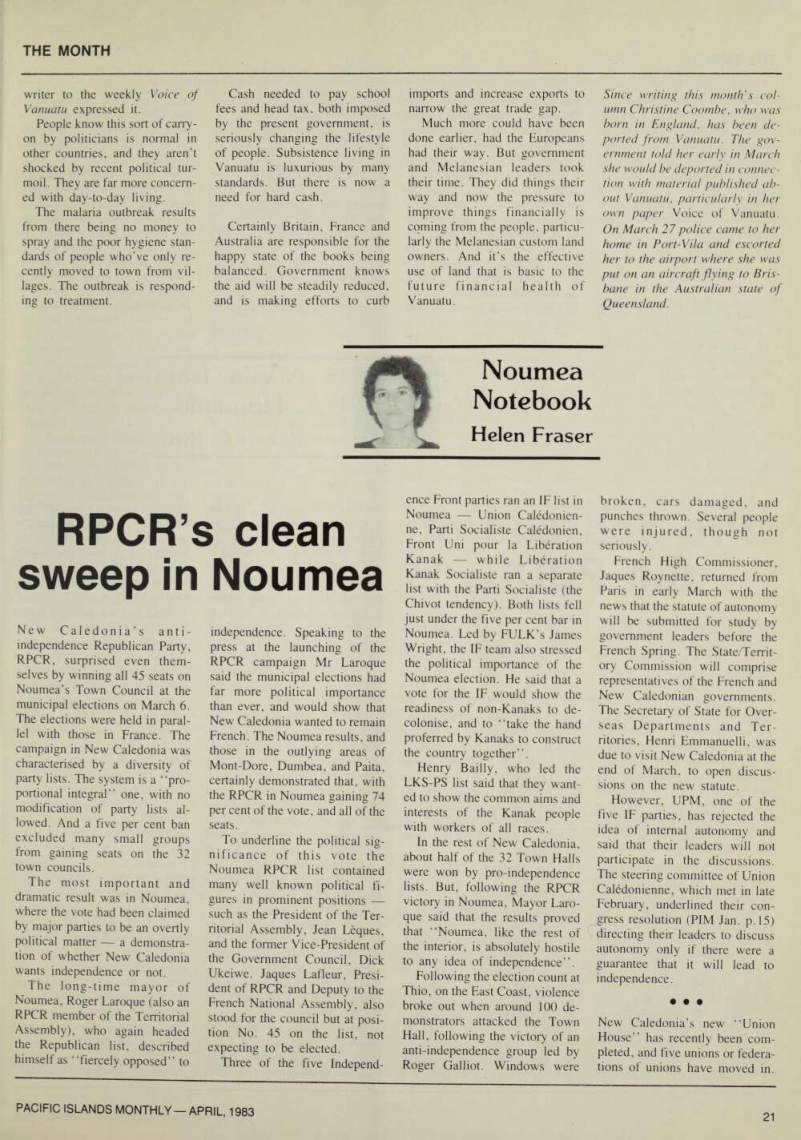
Vanuaaku Pati: It went Into power at independence calling itself the party of the real peo ple of Vanuatu, blanketing the pre-independence New Heb rides with placards and slogans and showing a high degree of internal unity. Now there are splits within the party and signs of public cynicism towards politics.
writer to the weekly Voice of Vanuatu expressed it.
People know this sort of carry on by politicians is normal in other countries, and they aren't shocked by recent political tur moil. They are far more concern ed with day-to-day living.
The malaria outbreak results from there being no money to spray and the poor hygiene stan dards of people who’ve only re cently moved to town from vil lages. The outbreak is respond ing to treatment.
Cash needed to pay school fees and head tax, both imposed by the present government, is
seriously changing the lifestyle
of people. Subsistence living in Vanuatu is luxurious by many standards. But there is now a need for hard cash.
Certainly Britain, France and Australia are responsible for the happy state of the books being balanced. Government knows the aid will be steadily reduced, and is making efforts to curb
imports and increase exports to narrow the great trade gap.
Much more could have been done earlier, had the Europeans had their way. But government and Melanesian leaders took their time. They did things their way and now the pressure to
improve things financially is
coming from the people, particu
larly the Melanesian custom land owners. And it’s the effective use of land that is basic to the future financial health of Vanuatu.
Since writing this month's col umn Christine Coombe, who was born in England, has been de ported from Vanuatu. The gov ernment told her early in March she would be deported in connec tion with material published ab out Vanuatu, particularly in her own paper Voice of Vanuatu.
On March 27 police came to her home in Port-Vila and escorted her to the airport where she was put on an aircraft flying to Bris bane in the Australian state of Queensland.