Yachts
pp. 67-69 · Read in the full issue
Jane Deridder Re
ports from Northland, New Zealand
• VAMONOS. Wrecked three days out of Rarotonga was the 11 m yacht Vamonos, a little less than a year after leaving Long Beach, California, on what was to have been a two-year cruise (PIM Feb. p. 25). The wooden sloop sank during the night of November 1 half an hour after strik ing a reef. Robert Arcs, his wife Margaret, and their son Christian, 17, spent 24 days at sea in two 2 m dinghies one rubber and one fib reglass lashed end to end. Re peatedly capsized in their makeshift lifeboat, the Aros family lost most of the food and gear they’d saved from Vamonos. Propelled by a windsurfer sail, they made their way to a desert ed sandy islet in the Lau Group of Fiji, approximately 4800 km away.
There they were found by a boatload of Fijians. The family had been sub sisting for several days of a gruel made of seabird eggs and hermit crabs. The Aros three were taken to Cikobia-i-Lau whence they were flown 240 km by helicopter to Suva.
They were treated at the Colonial War Memorial Hospital for sunburn, dehydration and malnutrition. • TASHTEGO. Tashtego and the ill-fated Vamonos left Rarotonga at about the same time en route for New Zealand, planning to meet in the Kermadec Islands. But Vamonos never arrived. The two vessels were part of a group of about 10 yachts cruising from Mexico through the Pacific Islands together, remaining in touch via ham radio contacts. Others in the group now in New Zealand are Cuisine, Joggins, Karawa and Os prey. Tashtego, a Portland-registered Westsail 32, was the sixth yacht in 15 months to call in at Raoul Island in
the Kermadecs. Tom and Mary James say that their five-day stay on Raoul Island starting November 20 was during a period of very settled weather. “The oranges were deli cious, and the fishing not to be believed!” The smallest of three grouper they caught weighed in at 30 kg • CUISINE. “Of all the various crew combinations, families work better than anything,” says Canadian cruising yachtsman Bob Kitchen.
Bob and Helen Kitchen are sailing the South Pacific on their Hunting ford-designed Solar 42 cutter Cuisine with Barbara, 13, and Bradley, 10.
“We saw a lot of ‘boat-jumping’ going on in Mexico and Papeete.
With families it just doesn’t hap pen,” he added. For 13 years Bob had his own Vancouver-based 14 K gold jewellery business which meant that besides stone-buying trips to the Orient, he was on the road 90 to 110,000 km a year covering his
British Columbia-Alberta territory, and away from home up to 40 weeks a year. Now he and his family are just “out cruising”. The children do their school lessons by correspond ence. Helen, who holds the Canadian maritime mobile amateur radio call sign VEOSBB, got her ham licence just before they left Vancouver. • JOGGINS. “The only mishap we’ve had was when a booby stole the masthead light.” Virginia and John Houk had turned on Joggins’ light to scare the persistent bird away. The double-ended semi-fin keel cruising vessel Joggins is a
Garden-designed Fast Passage 39
built in 1979 in Sidney, BC. Virginia (amateur radio callsign N7CZI) and John (callsign W7LBP) quit their jobs as nursing instructor at the Un iversity of Washington in Seattle (Virginia) and Weyerhauser timber company supervisor (John), to go cruising. They left Everett, Washing ton, in September ’Bl. After a six
month stopover in New Zealand, the couple will “continue cruising the South Pacific”. • WIND TREE. Harry Hinz (call sign KE6RJ) prepared for seven years to set off for a lengthy cruise in his Golden Hind 31 Wind Tree. The medical electronics salesman left San Francisco in April ’B2. Accompany
ing him is Nancy Araujo (KE6QI).
Nancy says that when she lived in Fortaleza, on the northeast coast of Brazil she used to watch yachts come and go and was fascinated with the stories of those on board. She says she was thrilled when Harry asked her to come along. Neither has been disappointed with cruising as a way of life. • LISSA. “The first time we hauled her we could see daylight between the planks.” But Bob and Lea
Thompson of Newport Beach,
California completely restored the 13 m Giles-designed sloop Lissa, and have been cruising now for the past three years. “We take our time.
Once we get the anchor down it takes us a long time to get it up again,” says the retired Southern California
Robert Arcs and son Christian from the wrecked sloop Vamonos after their rescue in
Fiji. - Anne Livingston picture.
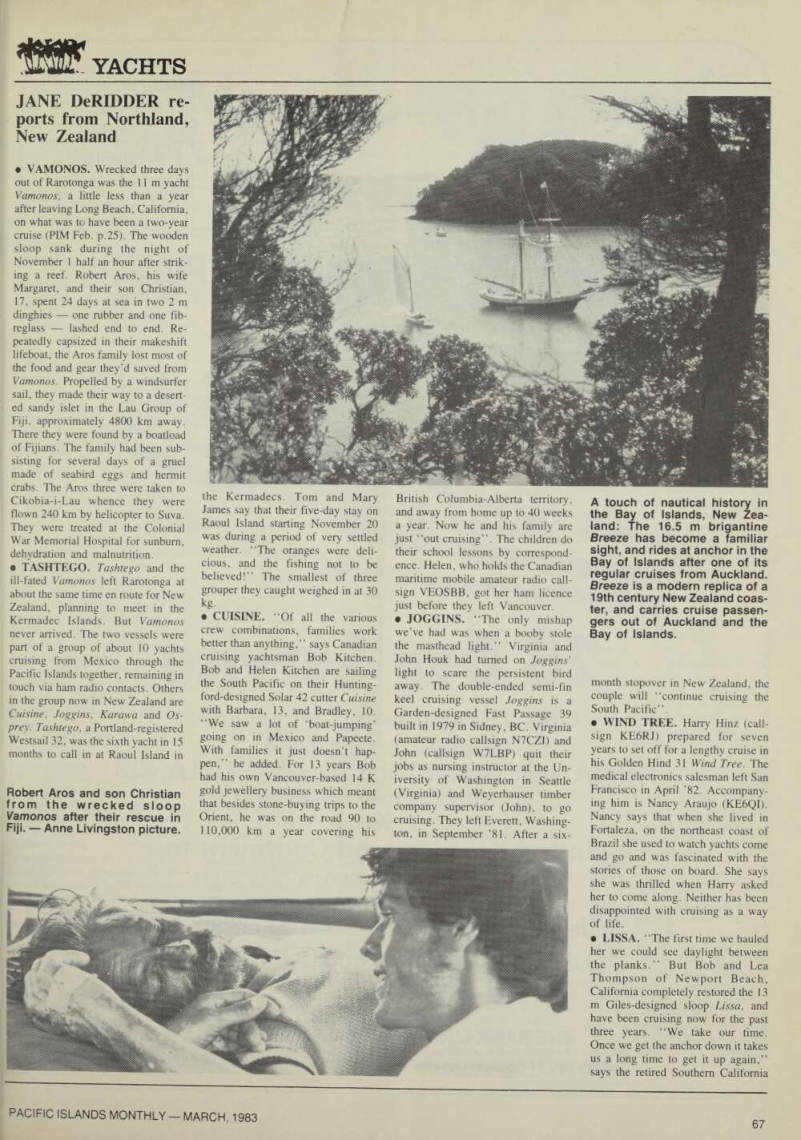
A touch of nautical history in the Bay of Islands, New Zea land: The 16.5 m brigantine Breeze has become a familiar sight, and rides at anchor in the Bay of Islands after one of its regular cruises from Auckland.
Breeze is a modern replica of a 19th century New Zealand coas ter, and carries cruise passen gers out of Auckland and the Bay of Islands.
dentist. Bob and Lea spent a year in Hawaii and a year in French Poly nesia. Lissa, built in England in 1950, has copper-riveted iroko planking over oak and elm. She’s like a big Virtue or a small Dyarchy.
She’s the vessel that Herb and Nancy Payson pumped across the Pacific, taking time out from cruising their own yacht Sea Foam to deliver Lissa back to North America for her former owner. (Herb Payson is the author of the cruising book Blown Away.) • PEPITA. Only 6.7 m long, Pepita is a one-off plywood chine sloop in which the Yorkshire lad, Wayne Humphries of Scarborough, left the U.K. six and a half years ago at age 18 to sail single-handed from adven ture to adventure. He’d just com pleted a three year wood tuming
/wood finishing apprenticeship. He
works as he travels, in boatyards, in Panama Canal maintenance, in com mercial fishing in whatever. Back in New Zealand for a second visit the first was in 1979 Wayne found and bought a 10 m kauri whale boat in the Taipa River in Northland’s Doubtless Bay. She’s reputed to be at least 60 years old. He took her in tow behind his engineless Pepita for two and a half days only to be caught in a north-westerly gale. The whale boat “leaks like a sieve” and in order to keep her afloat Wayne had to bail out 60 buckets of water an hour, com muting up and down the towrope in a rubber dinghy in Force 7 and 8 winds. Wayne plans to rebuild and restore the kauri-planked vessel up the Waikare Inlet inside Marriot Is land. Work begins with burning off the accumulated layers of paint, and tightening the copper rivets. Wayne hopes to equip her with the lug rig she may once have sported, and then to continue his voyaging in the larger vessel. • LA FILLE D’OR. “The golden girl” of Gibraltan registry is a quad ruple-skin kauri ketch built by Grams Shipyard in Whangarei and launched July 1982. Her owner. Melbourne born lawyer James Luxnor, worked fulltime on the luxury vessel through out her construction. As a fitting finishing touch, Luxnor and first mate Janet Prince of Auckland ap plied five coats of two-part Everdur epoxy preservative to the interior of the hull bilges and all and 12 coats of satin polyurethane varnish to the interior cabin sides. La Fille d’Or is an adaptation of Herrischoffs 1931 Bounty design, with modifica tions suggested by Alan Oram. Line and construction drawings were ex ecuted by Janet, who is a
draughtsman and graphic artist by
trade. The magazines Wooden Boat and Yachting World contain further construction details. Oram’s ship wright Graham Salter will accom
pany James and Janet in April when they leave for Tahiti, a wonderful opportunity for the craftsman to ap preciate his own handiwork. • SABRA. “I would never go sail ing again without Sat Nav. At $5OOO I consider it the cheapest insurance available,” says Sabra’s owner/skip per Ted Salvin of his US-made Tracer satellite navigation system, a comment made more interesting by the fact that Ted used to teach a course in celestial navigation. One time general manager of International Yacht Sales in Santa Ana, California, holder of amateur radio call signs T3OBS/3D2TS/T2TCS, Ted carries an interesting array of electronics,
including an ICOM 720 A transceiv
er. Because he has with him a certain amount of test gear including a fre quency counter, Salvin is able to do electronic repairs for fellow yachtsmen as he cruises on his S&S 38 Sabra. Sabra’s tow propeller generator charges the batteries when underway, while a small portable generator takes care of power re quirements at anchor. Ted served as radio relay between the Dutch yacht Frisia and Auckland Marine Radio to arrange for dangerously seasick fami ly members to be taken off the vessel between Auckland and Suva. • HUMMINGBIRD. One year and 18,000 km ago, the 15 m ketch Hummingbird left Galveston, Texas.
Her owner Tim Bonge, offshore in vestment consultant, met Teri, one time Virgin Islands underwater tour guide, when with another girl she was running a CT 34 charter yacht in the Caribbean. “It was a great year till we left Polynesia,” Tim and Teri agree. “Then it rained for four and half months.” (Actually they admit to having had three weeks of sun shine in that period.) One of the highlights of their year’s cruising was a circumnavigation of Fiji. One of the interesting systems on their ferro vessel is the use of the 56-cm three bladed propeller coupled to an alter nator by means of a 28-cm pulley on the shaft to generate electricity to operate water-maker and gear when under sail. • PUKA PUKA 11. (The name
translates to “Floating Sounds.”).
Only three to five Japanese yachts a year head off blue-water cruising, estimates Hirotu Manila. This year one of them is Puka Puka 11, an SK
31Watanake design from Wakayama
near Osaka. She is owned and cruised by stockbroker Hiroto and his florist wife Midori. Japan to Hon olulu was a difficult two-month pas sage for them. Their wind vane broke, so they had to handsteer most of the way. They then visited Califor nia, calling in to ports from San Francisco to San Diego before head ing on to Mexico, Polynesia, Samoa,
Tonga, Fiji and New Zealand. The Manilas will go to Brisbane and Noumea before heading back to Ja pan where they’ll go back to work but not as a stockbroker, Hiro insists.
His hours of work in that job were from 6 a.m. to 11 p.m. He will instead set up some sort of import/ex port business. • STARGAZER. Mike and Jeannie Kuick with a roster of paying crew members have been “cruising from waterfall to waterfall” throughout the South Pacific on their Columbia 50 Stargazer. They list their favorite waterfalls as being the Wairora Falls on the Rewa River in Fiji, the Vanuatu Cascades just outside Port- Vila, the falls in New Caledonia’s Baie de Prony in the northwest cove, and Rainbow Falls in Kerikeri, New Zealand. They plan on being at the Cruising Yacht Club in Sydney’s Rushcutters Bay for three weeks from mid-February to mid-March be fore continuing their adventurous cir cumnavigation. Anyone interested in signing on for short (or long) hops might get in touch with them there.
Mike and Jeannie are really on a bushman’s holiday for their normal occupation is chartering their 25 m aluminium schooner Queen of Sheba out of St. Thomas in the Virgin Islands after which the 15 m Stargazer seems “a mere toy”. • MAGIC DRAGON. Canadian yacht Magic Dragon, bound for New Zealand for a sixth visit, from New
Caledonia where we’d spent five months of 1982, stopped at Norfolk Island for three days in December.
Due to heavy surge we were unable to land at Kingston or Cascade Bay.
However we did manage to get ashore on the boulder beach at Ball Bay for a few hours, long enough to meet Norfolk Island ornithologist and amateur radio operator John Ander son, VK9JA, before he flew to Hon olulu for the Pacific Seabird Confer ence. John is highly regarded for his daily weather reports for yachts voy aging throughout the South Pacific.
He maintains that he is not a weather forecaster, preferring to call himself a “weather interpreter.” John gathers information from Morse coded reports from around the Pacific a challenge made easier by his back ground as “Sparky” (ship’s radio operator). The info so gleaned he uses to draw up weather charts, a device which enables him to assess and interpret the assembled informa tion, which he then passes on to cruising yachts in the form of weath er situation reports and route anal yses. The whole process takes the better part of two hours a day. Yach ties lie in wait for John’s daily reports by tuning in to “Tony’s Net,” a 20 mamateur radio Maritime Mobile Net run by ZLIATE, Tony Babich of Auckland, on 14.315 mHz beginning at 2100 GMT. We were interested to learn that John’s seemingly uncanny weather sense is a spin-off from a lifelong observance of weather and climate, for he started keeping a detailed weather diary on Norfolk Island. John and his wife Florence have the Sony dealership on Norfolk Island with two outlets. Florence, who loves to garden, says: “Garden ing is an inexact science about which one is always learning.” So is meteorology, John Anderson reckons.
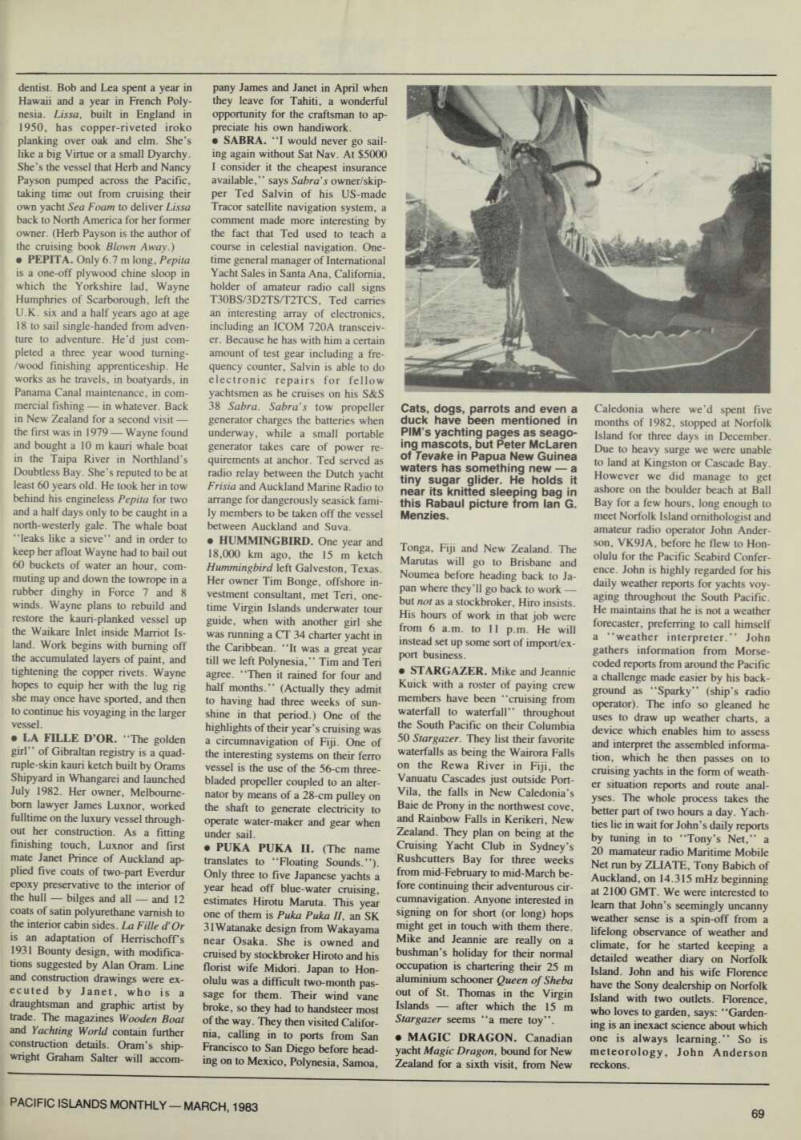
Cats, dogs, parrots and even a duck have been mentioned in PIM’s yachting pages as seago ing mascots, but Peter McLaren of Tevake in Papua New Guinea
waters has something new - a
tiny sugar glider. He holds it near its knitted sleeping bag in this Rabaul picture from Ian G.
Menzies.