Product review
pp. 65-66 · Read in the full issue
Sawmill
having
Fiji display
A portable sawmill which can be used on the site of trees being felled is being demonstrated in April in Fiji. It is the Australian manufactured Forestmil which is produced in Melbourne, and has already been exported to a num ber of countries including Fiji.
The original exports to Fiji were made following a govern ment order, and this has led to additional interest which has re sulted in the April demonstrations.
The first Forestmil was built 18 years ago by MacQuarrie In dustries, the company which is still producing and marketing the units. Since the first production more than 1200 units have been made. Forestmils are now being used in 28 countries.
The unit is powered by a small diesel, but electric motor power can be used in areas where electr icity is available. Horizontal and vertical saw blades powered by the engine can produce hard wood or softwood sawn timber
up to 30 cm by 15 cm in section and up to 5.5 m in length. The log to be sawn is held in a stationary clamp and the saw blades travel along a track.
The output is about 16 cubic metres of sawn timber in eight hours, and the saw blades use replaceable teeth. The machine in service is supported on four adjustable comer posts which do not require special foundations.
No special equipment is needed to dismantle it and move it from one site to another.
Markets
expand
for buildings
George Hudson Homes, an Aust ralian firm based in Sydney, is extending its export to the Pacific of pre-designed buildings which are erected on site. They are using a surface material known as Therma-Panel which acts as an insulator in extremes of cli mate and is resistant to water.
The material consists of a sand wich sheet of Polystyrene in the centre and cement fibre board on each side.
The buildings, which are de signed and constructed to stan dard patterns or to the specifica tions of buyers, are exported as compact consignments and can
be erected on site with compara tively unskilled labor.
Some of the recent applica tions of the Hudson buildings have been for airport terminals in Papua New Guinea, a holiday resort in Vanuatu, an Australian diplomatic residence in Tonga and a number of specialised rural buildings in several countries.
Each panel weighs about 45 kg, and can be lifted and put into position by two people during construction. Once the walls are assembled they are effectively finished because there are no architraves, skirtings or mould ings to put into position. The timber trussed roof is cut and shaped in the factory before ex port and is bolted into position.
One of the interesting features of the design is the inclusion of pre-fitted pipes for the plumbing.
Copper tube is used within the panels. Electrical wiring is not built in, but space is provided to run the necessary wires.
New
generation
of windmills
Papua New Guinea, Fiji and a number of other Island countries in the Pacific are continuing their research into the use of energy sources which can be used as alternatives to petroleum fuels.
The biggest single drain on inter national funds among the bigger Islands countries is to pay for petroleum fuels.
PNG already has a number of pilot plants operating to use coconut wood fuels for stationary equipment and Fiji is well ad vanced in research on organic additives for petroleum fuels.
Both countries use hydro power for electricity, although still rely ing heavily on imported fuels.
An Australian-based com pany, Antelope Engineering of Sydney, is now attempting to interest Islands countries in the use of wind power to generate electricity. The firm is importing equipment designed and built in Denmark and already sold in USA and Europe.
Wind powered electrical generators have a long history in some parts of the world, and a
number of Australians who de veloped plantations in Papua New Guinea experimented with them nearly 50 years ago.
The new units from Denmark, known as Wind-Matic, are a modem development of an old idea. Attention has been given to overcoming some of the draw backs of earlier types. This has meant designing a unit which will have reasonable efficiency over a wide range of different wind speeds, and also designing a unit which will not suffer mechanical or electrical damage
at excessively high wind speeds.
The Wind-Matic units are de signed to operate in wind speeds as light as six metres a second and are available in a number of
models. Antelope Engineering
describes them as “a cost efficient supplement to any pow
er supply.”
In Denmark, groups of the windmills have been used in con junction with standard electric supply grids. The mills supple ment the normal supply and the amount of load they carry is governed by the strength of the prevailing winds and the de mands of the grid. Electronic control links exist between the
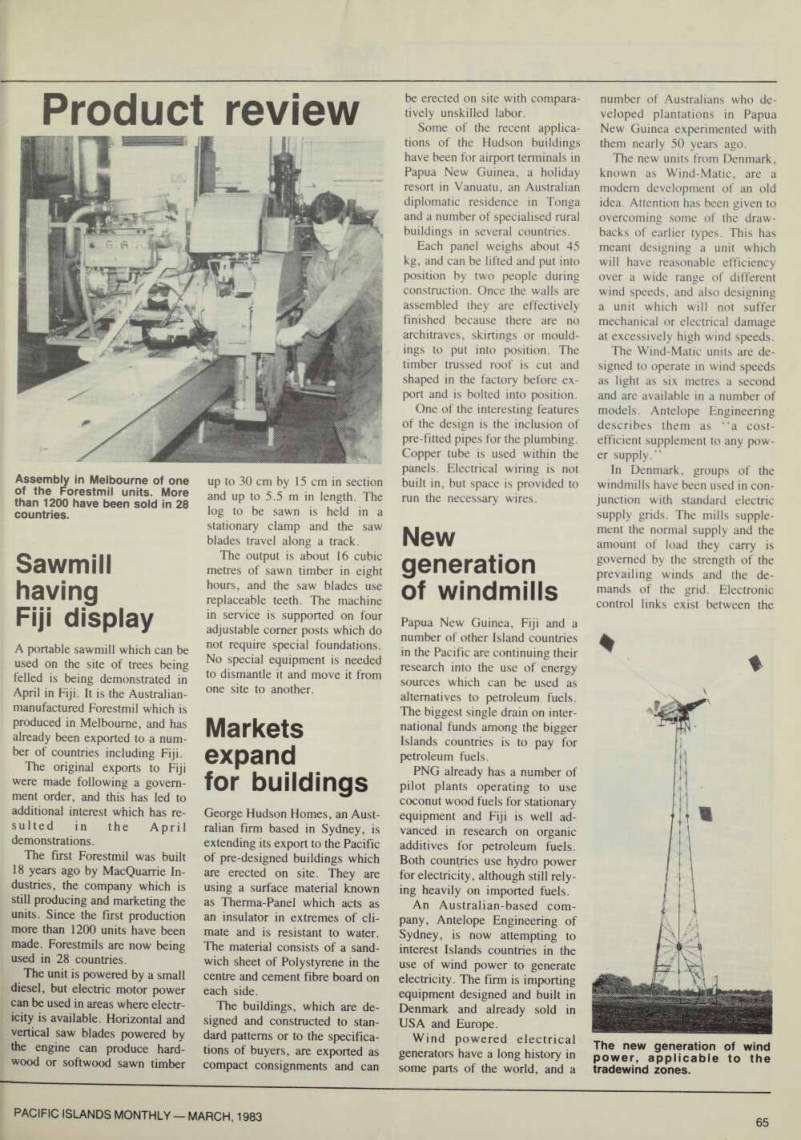
Assembly in Melbourne of one of the Forestmil units. More than 1200 have been sold in 28 countries.
The new generation of wind power, applicable to the tradewind zones.
wind generators and the reticula
tion grid.
The Pacific agents for the windmills plan to attempt to in terest governments in establish ing similar links in Pacific Is lands generating grids, and also to sell single units for isolated
applications.
Timber firm’s
modular town
Marlin Modular Constructions, an Australian modular building company based in Brisbane, has completed a $2.4 million project in Solomon Islands to supply and construct 263 modular-system buildings. These are pre
designed buildings exported in
kit form for erection on site.
The contract involved the con struction of what amounted to a complete town on North New Georgia Island. Rolo Builders Limited of Honiara were involv ed in the on-site construction.
The work was carried out for Levers Pacific Timbers Limited to establish a base for expanded
logging and timber operations.
Included in the project were houses for management, super visors and staff, offices, work shops, a power station, a hospital and clinic, a medical centre, a school, stores, butchery, rest house and staff club facilities.
More than 2000 tonnes of housing materials were involved in the base order. The materials were packed in 130 containers
and were shipped in kit form to Honiara. Coastal shipping was then used to take the material on to the site. In addition, a large quantity of building material was
locally purchased in Honiara.
The only access to the site was by sea, and canoes and special shipping were used to take the workforce to the site. The main problem which was experienced during the construction work was the heavy rainfall from time to time. On occasions it exceeded 1000 mm a month.
The work was carried out by trained supervisors and teams of local workers. Marlin provided the supervisors who also trained the local workforce, but later many of the local workers pro vided sub-contract teams to take the work to completion.
Radio links between the site and Honiara provided the main communications network to keep the operation on schedule.
Marlin Modular Constructions have also carried out supply con tracts to a number of other Is lands countries. These included the supply of defence force houses to Tonga. Other major projects have been in Vanuatu, through Pacific Modular Limited of Port Vila, and to Papua New Guinea, through Logan Modular Homes Pty. Ltd.
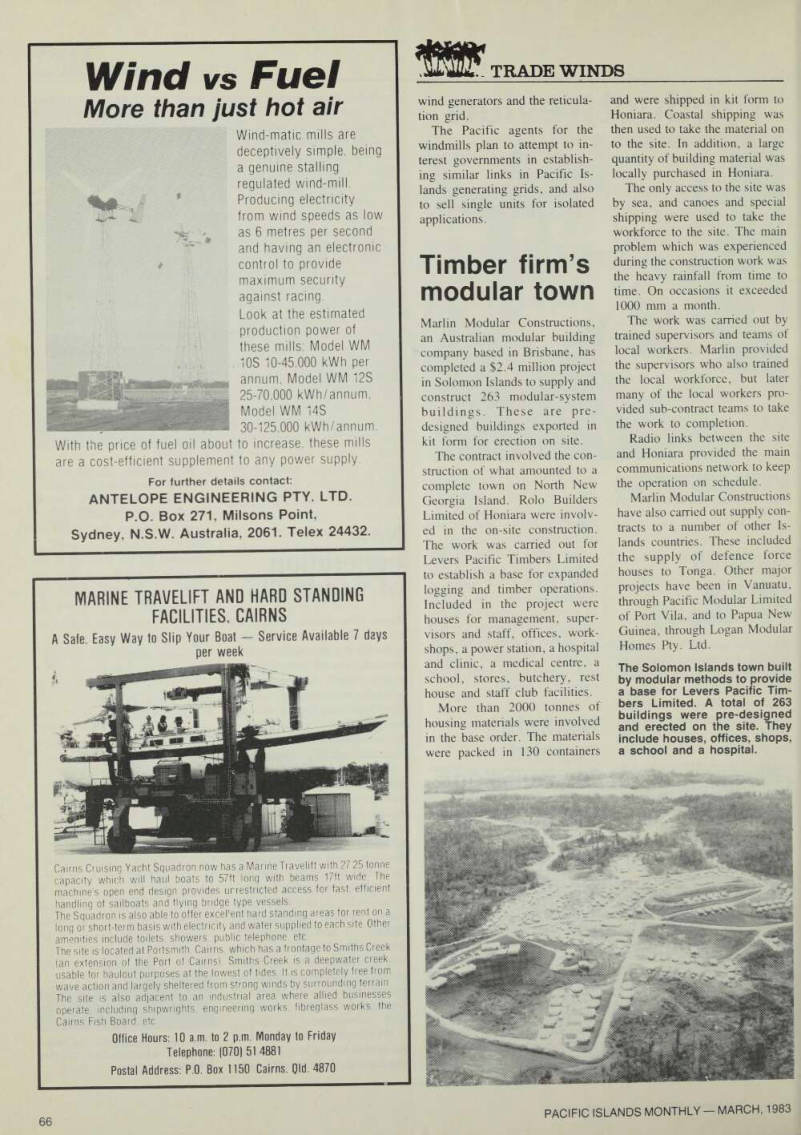
The Solomon Islands town built by modular methods to provide a base for Levers Pacific Tim bers Limited. A total of 263 buildings were pre-designed and erected on the site. They include houses, offices, shops, a school and a hospital.