Nellie and the witch doctor:
pp. 57-59 · Read in the full issue
Yesterday
Nellie and the witch doctor: A tale of brain and brawn
This third extract from the memoirs of the late Archdeacon Charles William Whonsbon- Aston “Whizzbang” to many of his friends continues the story of his missionary work in Papua in the 19305.
Though I can never remember feeling lonely, there were times when I wondered whether New Guinea was just my particular field. When I received a letter from England from my former bishop suggesting that I return to Polynesia, Bishop Newton of New Guinea asked me to recon sider the matter. He said he felt I had won the confidence of the local people. Moreover, more cutters had been dropping anchor in the mission anchorage at Mukawa than ever before. The bishop knew that I usually had a whisky before dinner, and was often joined by some of the hard cases from the ships. They never hesitated to open their minds on mission activities, and were of ten very critical of them. They were able to get answers to many of their criticisms at my place, and these evening chats had done a great deal to help our image. (As an aside, it could hardly be said that out of 25 pounds a year for clothing, books, etc, I had the place awash with spirits!). I ac cepted the bishop’s request and stayed on. It was not a difficult decision.
My days were becoming varied and full. Up before 6 a.m., the early Mass, then, back to the house to prepare the bread for baking three days a week, until the houseboys got the knack, and made excellent bread breakfast, and then into the dispensary, working there until near noon, then to the school, where the headmaster was the finely built Christopher Osembo.
Big Christopher, if the weather was propitious, would be seen going off after Evensong, with his dogs and spear, to hunt wild pigs, an activity in which he was
fairly successful.
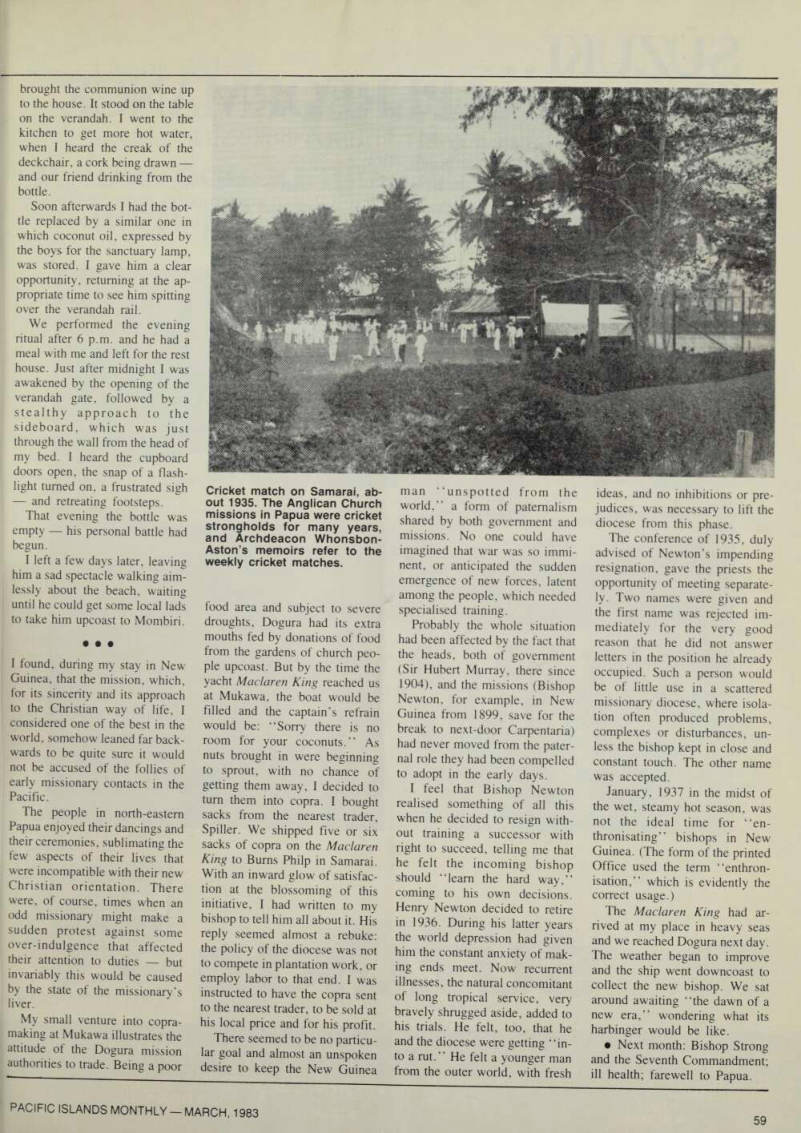
After Evensong many of the young men would play football or cricket, moving in on my verandah until I had finished my evening meal and the boys had washed up. They would excited ly look through London Illus trated News, Sphere, Graphic, and such papers, while some would play records on a gramophone. Sundays followed a different pattern, after a very quiet Saturday, when most peo ple would be in their gardens gathering food in for Sunday.
Within a short time the whole station seemed to be moving
along happily. The schoolchil
dren were a bright bunch gener ally. One could never have fore
because they got bad sickness when they were all at labor.
“Remember their bodies are lying at Owen Stanley Range, but their souls are in Paradise.
Owen Stanley is very rough place, cold and many mountains.
Remember we were first labor ers. We helped the Australian armies and carried the stretchers with the wounded men on them.
Douglas Viogo.”
• • • On a trip to the Northern District, we called at the island of Naniu, where reigned Nellie Hullett, “the Queen of Naniu”, com pletely and undoubtedly mistress of the situation. An Australian missionary, she was built on fair ly generous lines and, like most healthily stout folk, had a great sense of humor.
On one occasion she was faced with the activities of a witch
seen that many of the lads would, not many years hence, leave their bones on the Kokoda Trail, part of the great party of the “Fuzzy- Wuzzies”. Here is an extract from a letter I received after the war from one of those who served: “These poor boys, I will let you know their names, Vernon Dumuripani, Clarence Arada and Wenceslas Damadama, were killed at Owen Stanley Range,
doctor leading a taro cult, putting forward the idea that if you did not placate the taro spirit your gardens would fail. These cul
lists, at their meetings, became hysterical, doing a type of “holy roller”, with great fear and much body-shaking. Nellie Hullett became fed up, rushed into the midst of the business, waving her heftiness in a sort of Spanish fandango, showing how silly the whole business was. Her bulk and gesticulations had them all in shrieks of laughter, the tension was broken, along with the authority of the witch doctor, and she was able to give them some sound and straight advice.
Not long before my visit Nel lie Hullett had gone on a patrol overland to visit Fr. Romney Gill. Two impressions remain from that trek. First, she was placed in the stem of the ship’s dinghy to go ashore through the surf at Oro Bay, but her weight turned the boat clean over her she arrived ashore soaking wet, but laughing. Then, crossing one of those long lawyer-cane sus pension bridges that the local people erect across rivers, she crashed through the footway, just caught by her armpits by the long canes through which the footway is threaded. The trouble was that every time anyone got near enough to ease her up and out, she would see the humor of the situation and the whole bridge would shake with her laughter.
Eventually she was rescued, but the episode was the talk of the district. • • • One day I was dealing with the few cases at the dispensary when shouts from the village passed along the coast to us revealed an auxiliary cutter bearing down on us. The dinghy was lowered and a European man came ashore. I had sent the boys to put the kettle on. “My name is . . . You may have heard of me. I looked after Spider’s place (a planter) when he was away.” I welcomed him suggesting a cup of tea, which he countered by “To be honest, I’ve been very seasick. I started out with a bottle of whisky when I
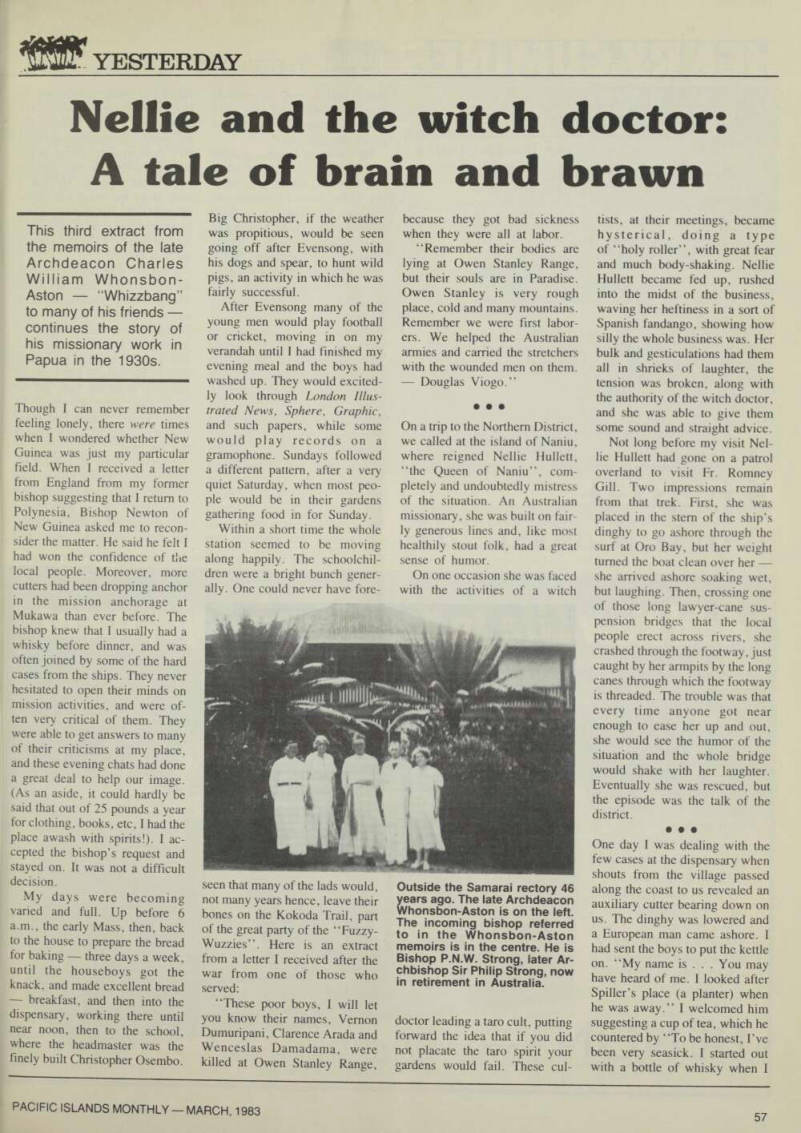
Outside the Samarai rectory 46 years ago. The late Archdeacon Whonsbon-Aston is on the left.
The incoming bishop referred to in the Whonsbon-Aston memoirs is in the centre. He is Bishop P.N.W. Strong, later Ar chbishop Sir Philip Strong, now in retirement in Australia.
left. I find it good for seasick ness. The boat heeled over and I lost it overboard. I wonder, have you a drop by you?”
He came up to my verandah and I brought out all I had, about half a bottle, with a glass stop per, and he poured a portion with a shaky hand. Tea came in and I proceeded to pour for him, but he asked could he have a further whisky. I now gathered some thing from his appearance. I re plied: ”Yes, you can have another and that will be the last for now.”
I had just moved away towards the dispensary when I heard the glass stopper clink. I called to one of the boys to bring the bottle to me, but I had overlooked the brandy bottle still on the sideboard from Christmas. In no time I heard the pop of the cork from that.
The man had gone from Samarai on the cutter up to the Mombiri Plantation, now dere lict, above me, to see if it could be brought back into production.
Urged by his thirst he had
called into Spider’s at Menapi, to find him missing, away at his other store at Cape Nelson. He had called the houseboy and ask ed if there were any spirits in the storeroom, and the boy had re plied in the negative. He took a walk along the beach and, as he returned, the missionary, Frere Lane, had come out to meet him.
He had told Fr. Lane the story of the lost bottle.
Later, he had helped the boy up to take the screening from over the planter’s storeroom door and ransacked the place. I men tioned to him that I would be leaving in a few days to go north and would certainly be seeing Spiller. He pleaded that I should put in a word for him, for he must have emptied about 24 small bottles. Spiller had some cogent remarks to make when I did see him.
I let him sleep on in the gov ernment rest house. Near four o’clock I sent to ask him up for a cup of tea. I did not then realise that the server in the morning, for some unknown reason, had
brought the communion wine up to the house. It stood on the table on the verandah. I went to the kitchen to get more hot water, when I heard the creak of the deckchair, a cork being drawn and our friend drinking from the bottle.
Soon afterwards I had the bot tle replaced by a similar one in which coconut oil, expressed by the boys for the sanctuary lamp, was stored. I gave him a clear opportunity, returning at the ap propriate time to see him spitting over the verandah rail.
We performed the evening ritual after 6 p.m. and he had a meal with me and left for the rest house. Just after midnight I was awakened by the opening of the verandah gate, followed by a stealthy approach to the sideboard, which was just through the wall from the head of my bed. I heard the cupboard doors open, the snap of a flash light turned on, a frustrated sigh and retreating footsteps.
That evening the bottle was empty his personal battle had begun.
I left a few days later, leaving him a sad spectacle walking aim lessly about the beach, waiting until he could get some local lads to take him upcoast to Mombiri. • • • I found, during my stay in New Guinea, that the mission, which, for its sincerity and its approach to the Christian way of life, I considered one of the best in the world, somehow leaned far back wards to be quite sure it would not be accused of the follies of early missionary contacts in the Pacific.
The people in north-eastern Papua enjoyed their dancings and their ceremonies, sublimating the few aspects of their lives that were incompatible with their new Christian orientation. There were, of course, times when an odd missionary might make a sudden protest against some over-indulgence that affected their attention to duties but invariably this would be caused by the state of the missionary’s liver.
My small venture into copra making at Mukawa illustrates the attitude of the Dogura mission authorities to trade. Being a poor
food area and subject to severe droughts, Dogura had its extra mouths fed by donations of food from the gardens of church peo ple upcoast. But by the time the yacht Maclaren King reached us at Mukawa, the boat would be filled and the captain’s refrain would be: “Sorry there is no room for your coconuts.’’ As nuts brought in were beginning to sprout, with no chance of getting them away, I decided to turn them into copra. I bought sacks from the nearest trader, Spiller. We shipped five or six sacks of copra on the Maclaren King to Bums Philp in Samarai.
With an inward glow of satisfac tion at the blossoming of this initiative, I had written to my bishop to tell him all about it. His reply seemed almost a rebuke: the policy of the diocese was not to compete in plantation work, or employ labor to that end. I was instructed to have the copra sent to the nearest trader, to be sold at his local price and for his profit.
There seemed to be no particu lar goal and almost an unspoken desire to keep the New Guinea
man unspotted from the world,’’ a form of paternalism shared by both government and missions. No one could have imagined that war was so imminent, or anticipated the sudden emergence of new forces, latent among the people, which needed specialised training. probably the whole situation had been affected by the fact that the heads, both of government (Sir Hubert Murray, there since 1904), and the missions (Bishop Newton, for example, in New Guinea from 1899, save for the break to next-door Carpentaria) had never moved from the paternal role they had been compelled to adopt in the early days.
I feel that Bishop Newton realised something of all this when he decided to resign without training a successor with right to succeed, telling me that he felt the incoming bishop should leam the hard way,’’ coming to his own decisions.
Henry Newton decided to retire in 1936. During his latter years the world depression had given him the constant anxiety of making ends meet. Now recurrent illnesses, the natural concomitant of long tropical service, very bravely shrugged aside, added to his trials. He felt, too, that he and the diocese were getting “into a rut. He felt a younger man from the outer world, with fresh
ideas, and no inhibitions or pre judices, was necessary to lift the diocese from this phase.
The conference of 1935, duly advised of Newton’s impending resignation, gave the priests the opportunity of meeting separate ly. Two names were given and the first name was rejected im mediately for the very good reason that he did not answer letters in the position he already occupied. Such a person would be of little use in a scattered missionary diocese, where isola tion often produced problems, complexes or disturbances, un less the bishop kept in close and constant touch. The other name was accepted.
January, 1937 in the midst of the wet, steamy hot season, was not the ideal time for “en thronisating” bishops in New Guinea. (The form of the printed Office used the term “enthron isation,” which is evidently the correct usage.) The Maclaren King had ar rived at my place in heavy seas and we reached Dogura next day.
The weather began to improve and the ship went downcoast to collect the new bishop. We sat around awaiting “the dawn of a new era,’’ wondering what its harbinger would be like. • Next month: Bishop Strong and the Seventh Commandment; ill health; farewell to Papua.
Cricket match on Samarai, ab out 1935. The Anglican Church missions in Papua were cricket strongholds for many years, and Archdeacon Whonsbon- Aston’s memoirs refer to the weekly cricket matches.