Pigs don’t fly - but
p. 56 · Read in the full issue
people are on the move
Your Own Pigs You May Not Eat: A Comparative Study of New Guinea Societies. By Paula G. Rubel and Abraham Rosman.
Published by Australian National University Press, Canberra,
1978. Isbn 0 7081 1753 8.
$25.00 Change And Move ment: Readings on Internal Migration in Papua New Guinea. B\ R.J . May. Published by Australian National Universi ty Press, Canberra. 1977. ISBN 0 7081 0477 0. $10.95.
Pigs don’t fly, not even in Papua New Guinea, but in that country they have an important role in traditional socio-economic sys tems. In Your Own Pigs You May Not Eat. Rubel and Rosman compare some aspects of 13 trad itional societies in PNG. They do not say what they mean by “soc iety” but I assume it to be the people of a limited locality who have a language in common.
Rubel and Rosman spent a few months of 1974 doing field work to gather information from villa gers and, they state, they observ
ed exchange ceremonies in sev eral areas. It is my guess, howev er, that 95 per cent of the mate rial on which they base their findings comes from “desk study”. Some of this material, such as Margaret Mead on the Arapesh, Gregory Bateson on the latmul, lan Hogin on the Wogeo, and Marie Reay on the Kuma, has earned its authors wide ac claim. Mead’s quote of a Arap esh maxim is mentioned in this book and merits a place here.
Other people’s
mothers
Other people’s
sisters
Other people’s pigs
Other people’s
yams which they have piled up You may eat.
Your own mother Your own sister Your own pigs Your own yams which you have
piled up
You may not eat.
The authors seek to show that there are a number of socio economic systems within each society. These systems are over shadowed and, to some extent, regulated by a main system of exchange which involves the giv
. c mg and receiving of pigs, women j i ... xiL and other things. The authors ... b , „ conclude that everyone does not j eat his or her own pigs because, . . . , . . .. bv giving one s pigs to other y , , , .u people, links with them are H • created and structures of social organ.sa.ton evolve There are several good points made - for example, that the exchange systems may have in fluenced changes in techniques of subsistence agriculture as much as those changes have in fluenced these systems. But there is a lot of dross, too, and, worst of all, the language used by the authors is of the hyper-esoteric, extremely specialised kind that graces (or disgraces) many theses written by BA Honors candi dates. Sentences such as: “In a single society, if the structure of each cultural domain can be
mapped isomorphically one upon
the other, then it can be said that a single structure underlies these different cultural domains.” The authors’ use of a quasi mathematical model into which various variables are “fed”, en sure the smallest possible reader ship for this book. Mathematical models, by the way, are falling into disrepute even amongst econometrists and rightly so, because the human variable(s)
defy quantification.
Reading the classics such as R.M. Glasse and M.J. Meggitt, eds., Pigs, Pearlshells and Wo men: Marriage in the New Guinea Highlands (1969); A.J.
Strathem, The Rope of Moka: Big-men and Ceremonial Ex change in Mount Hagen (1971); and lan Hogbin, The Leaders and the Led: Social Control in Wogeo, New Guinea (1978), will enable you to make up your own mind about some of PNG’s tradi tional exchange systems. And you won’t be foxed by esoteric language, either.
Change and Movement, another book which has been around for some time, contains 15 papers about internal migra tion in PNG. Some of these are now more than 10 years old and have been overtaken by the con tinuing drift to the cities and towns which presents the coun try’s politicians with a major problem. Dr Marion Ward, one of the authors, sees urbanisation as essential to innovation, “places where there is a ferment of ideas’’, but, as Dr John Con roy points out, huge slums are likely to result. Such slums do, of course, breed misery, not na tional pride or individual hap piness. It is my guess that the next census in PNG will show more than 15 per cent urbanisa tion, with a concomitant pauper isation of most of those who live in cities and towns.
It is sometimes argued that migration studies are of little use unless they concern the situation during the past two or three years. This argument falls into the “History is bunk’’ category and, I believe, is foolish. After reading Joseph F. Koroma’s pap er on the Bundi people in Goroka (the only paper by a Papua New Guinean), you will surely recog nise that PNG’s current problems of urbanisation need to be solved if they can be solved in their historical context.
Politicians and their bureauc rats, in particular their planners, would do well to accord com plete intellectual freedom to academic and other researchers into migiition, if they wish to have before them the best poss
ible information.
Jackman.
Harry H.
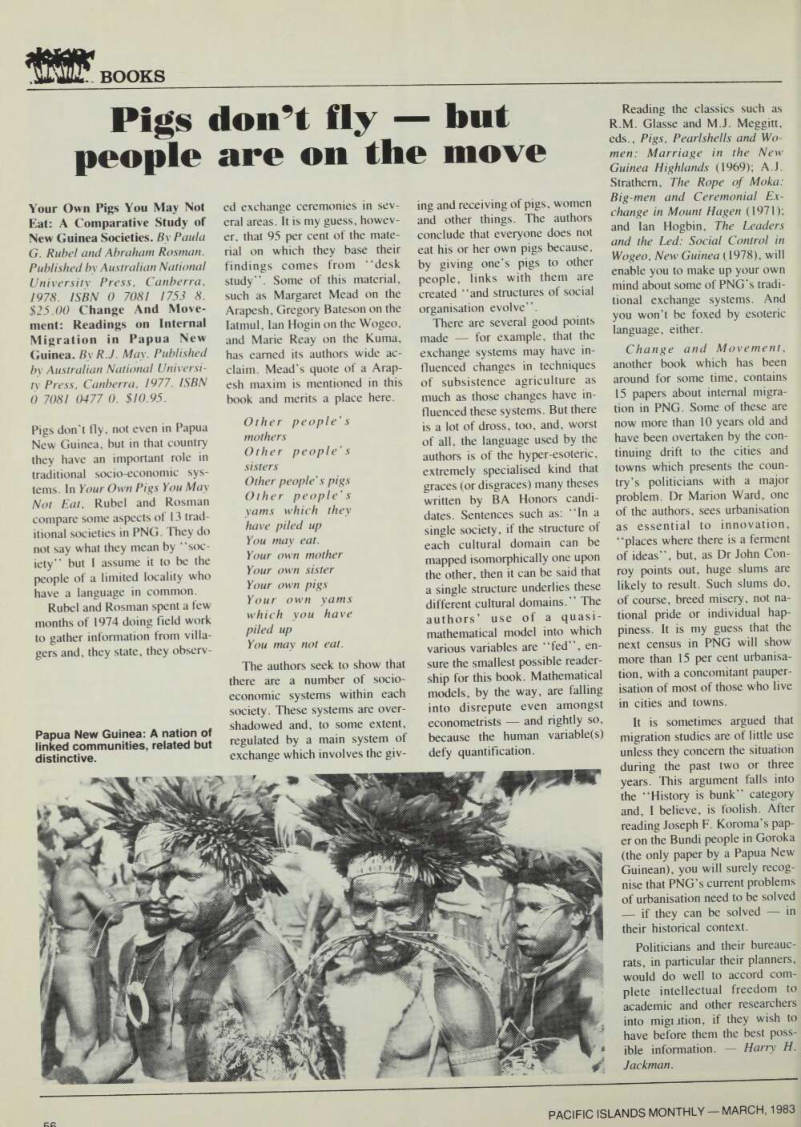
Papua New Guinea: A nation of linked communities, related but distinctive.