Sepik Diary
p. 53 · Read in the full issue
Books
Rain-smeared pages in this Sepik Diary
Sepik Diary. By Frank Hodgkin son. Published by Richard Grif fin, Melbourne, 1982, and dis tributed by Pacific Publications. 144 pp. Clothbound $5O, plus postage $5, leather-bound limited edition, bound to order at $295.
Frank Hodgkinson is a well known Australian artist who lives in an artistic house he and his wife built with their own hands in bushland on the out skirts of Sydney. But in 1977 he was the first artist in residence at the National Art School in Port Moresby.
During his time there he and his wife Kate, who is a potter, made a trip down the Sepik from Pagui to the coast, and this book is the record of that journey. It is an artist’s book thoughtful and sensitive, and earthy like the people it depicts.
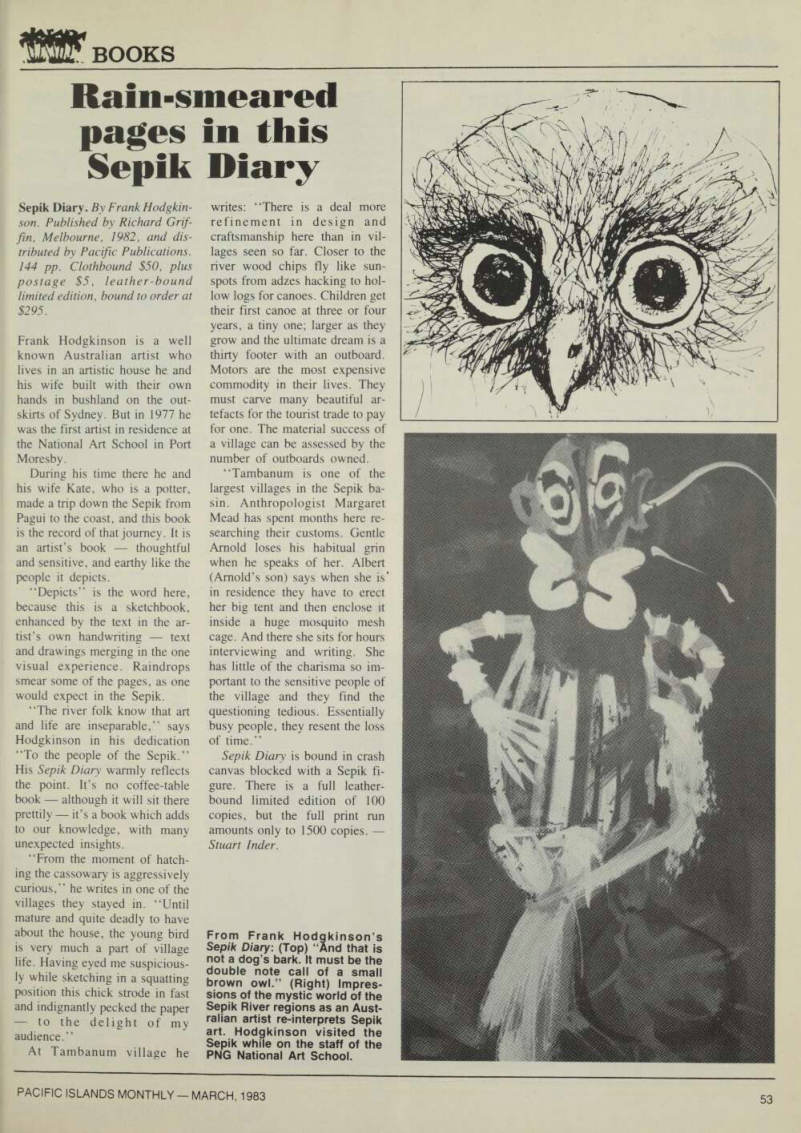
“Depicts” is the word here, because this is a sketchbook, enhanced by the text in the ar tist’s own handwriting text and drawings merging in the one visual experience. Raindrops smear some of the pages, as one would expect in the Sepik.
“The river folk know that art and life are inseparable,” says Hodgkinson in his dedication “To the people of the Sepik.”
His Sepik Diary warmly reflects the point. It’s no coffee-table book although it will sit there prettily it’s a book which adds to our knowledge, with many unexpected insights.
“From the moment of hatch ing the cassowary is aggressively curious,” he writes in one of the villages they stayed in. “Until mature and quite deadly to have about the house, the young bird is very much a part of village life. Having eyed me suspicious ly while sketching in a squatting position this chick strode in fast and indignantly pecked the paper to the delight of my audience.”
At Tambanum village he
writes: “There is a deal more refinement in design and craftsmanship here than in vil lages seen so far. Closer to the river wood chips fly like sun spots from adzes hacking to hol low logs for canoes. Children get their first canoe at three or four years, a tiny one; larger as they grow and the ultimate dream is a thirty footer with an outboard.
Motors are the most expensive commodity in their lives. They must carve many beautiful ar tefacts for the tourist trade to pay for one. The material success of a village can be assessed by the number of outboards owned.
“Tambanum is one of the
largest villages in the Sepik ba
sin. Anthropologist Margaret
Mead has spent months here re searching their customs. Gentle Arnold loses his habitual grin when he speaks of her. Albert (Arnold’s son) says when she is in residence they have to erect her big tent and then enclose it inside a huge mosquito mesh cage. And there she sits for hours
interviewing and writing. She
has little of the charisma so im portant to the sensitive people of the village and they find the
questioning tedious. Essentially
busy people, they resent the loss
of time.”
Sepik Diary is bound in crash canvas blocked with a Sepik fi gure. There is a full leather bound limited edition of 100 copies, but the full print run amounts only to 1500 copies.
Stuart Inder.
From Frank Hodgkinson’s Sepik Diary: (Top) “And that is not a dog’s bark. It must be the double note call of a small brown owl.” (Right) Impres sions of the mystic world of the Sepik River regions as an Aust ralian artist re-interprets Sepik art. Hodgkinson visited the Sepik while on the staff of the PNG National Art School.