People
pp. 49-52 · Read in the full issue

Western Samoa’s Chief Justice J. R. Callander has resigned,
citing “personal reasons”. His
resignation, effective from April
30, comes eight months short of his full term which was due to end on December 31.
Mr Callander was originally appointed for a period of three months, but this was later twice extended, first under the Va’ai Kolone government and then under that of Tupuola Efi.
Commenting on the resigna
tion, Prime Minister Tofilau Eti said that in its quest for a replace ment the government would not be limiting itself to New Zea land, as had been past custom, but would be seeking applica tions from other Commonwealth countries as well.
Western Samoa’s Head of State Malietoa Tanumafili II hosted
an inaugural fund-raising dinner
at Government House, Vailima, in February, to launch fund raising activities for the Seventh South Pacific Games, to be held in Apia from September 5 to 16.
The public relations sub committee for the games has announced the appointment of Gus Hanneman of Hawaii, PR consultant for the games in the
Usa.
Mr Hanneman said the main purpose of the games promotion would be to create awareness of events and encourage U.S.-based Samoans to visit Apia for the games. He confirmed arrange ments for a Western Samoan cultural group to travel to Hawaii for fund-raising purposes.
Sulusulumaivasa John Willis has taken over the management of the Nauru Air and Shipping Agency in Apia from Fred Atiga who has retired.
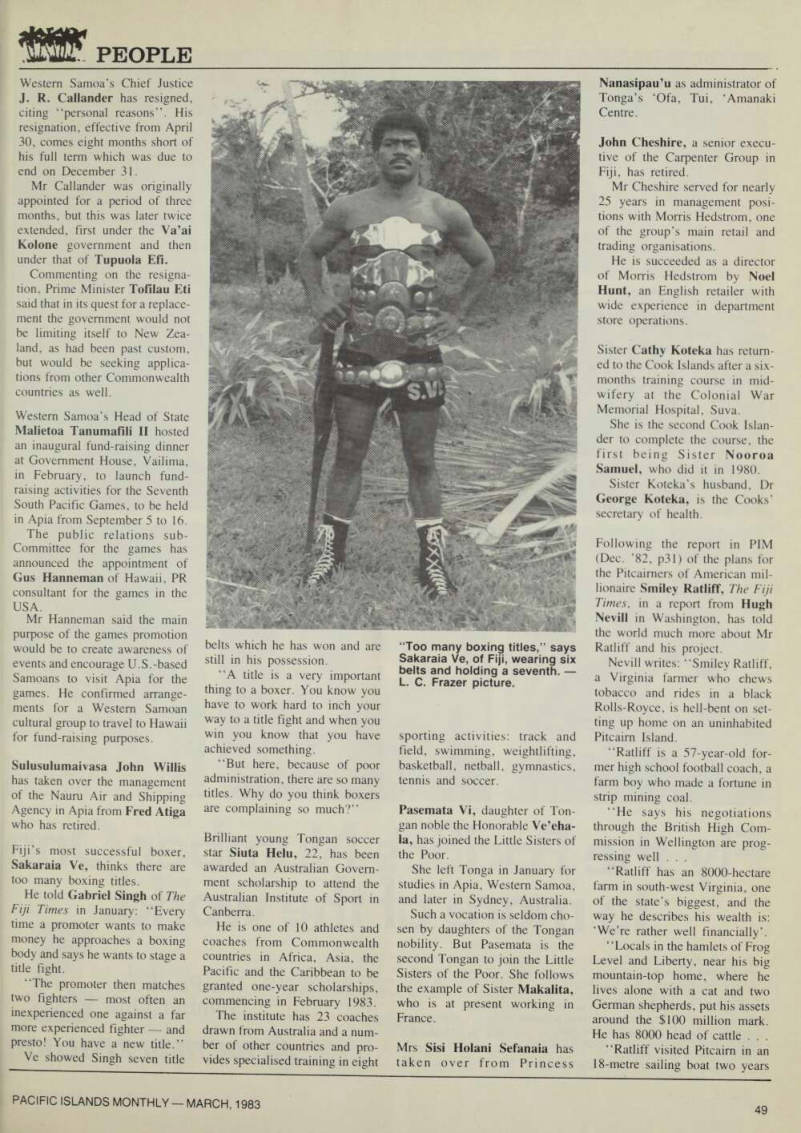
Fiji’s most successful boxer, Sakaraia Ve, thinks there are too many boxing titles.
He told Gabriel Singh of The Fiji Times in January: “Every time a promoter wants to make money he approaches a boxing body and says he wants to stage a
title fight.
“The promoter then matches two fighters most often an inexperienced one against a far more experienced fighter and presto! You have a new title.”
Ve showed Singh seven title
belts which he has won and are still in his possession.
“A title is a very important thing to a boxer. You know you have to work hard to inch your way to a title fight and when you win you know that you have achieved something.
“But here, because of poor administration, there are so many titles. Why do you think boxers are complaining so much?’’
Brilliant young Tongan soccer star Siuta Helu, 22, has been awarded an Australian Govern ment scholarship to attend the Australian Institute of Sport in Canberra.
He is one of 10 athletes and coaches from Commonwealth countries in Africa, Asia, the Pacific and the Caribbean to be granted one-year scholarships, commencing in February 1983.
The institute has 23 coaches drawn from Australia and a num ber of other countries and pro vides specialised training in eight
sporting activities; track and field, swimming, weightlifting, basketball, netball, gymnastics, tennis and soccer.
Pasemata Vi, daughter of Ton gan noble the Honorable Ve’eha la, has joined the Little Sisters of the Poor.
She left Tonga in January for studies in Apia, Western Samoa, and later in Sydney, Australia.
Such a vocation is seldom cho sen by daughters of the Tongan nobility. But Pasemata is the second Tongan to join the Little Sisters of the Poor. She follows the example of Sister Makalita, who is at present working in France.
Mrs Sisi Holani Sefanaia has taken over from Princess
Nanasipau’u as administrator of Tonga’s ‘Ofa, Tui, ‘Amanaki Centre.
John Cheshire, a senior execu tive of the Carpenter Group in Fiji, has retired.
Mr Cheshire served for nearly 25 years in management posi tions with Morris Hedstrom, one of the group’s main retail and trading organisations.
He is succeeded as a director of Morris Hedstrom by Noel Hunt, an English retailer with wide experience in department store operations.
Sister Cathy Koteka has return ed to the Cook Islands after a six months training course in mid wifery at the Colonial War Memorial Hospital, Suva.
She is the second Cook Islan der to complete the course, the first being Sister Nooroa Samuel, who did it in 1980.
Sister Koteka’s husband. Dr George Koteka, is the Cooks’ secretary of health.
Following the report in PIM (Dec. ’B2, p3l) of the plans for the Pitcairners of American mil lionaire Smiley Ratliff, The Fiji Times, in a report from Hugh Nevill in Washington, has told the world much more about Mr Ratliff and his project.
Nevill writes: “Smiley Ratliff, a Virginia farmer who ehews tobacco and rides in a black Rolls-Royce, is hell-bent on set ting up home on an uninhabited Pitcairn Island.
“Ratliff is a 57-year-old for mer high school football coach, a farm boy who made a fortune in strip mining coal.
“He says his negotiations through the British High Com mission in Wellington are prog ressing well . . .
“Ratliff has an 8000-hectare farm in south-west Virginia, one of the state’s biggest, and the way he describes his wealth is: ‘We’re rather well financially’.
“Locals in the hamlets of Frog Level and Liberty, near his big mountain-top home, where he lives alone with a cat and two German shepherds, put his assets around the $lOO million mark.
He has 8000 head of cattle . . .
“Ratliff visited Pitcairn in an 18-metre sailing boat two years
“Too many boxing titles," says Sakaraia Ve, of Fiji, wearing six belts and holding a seventh. - L. C. Frazer picture.
ago. He says the islanders are the finest, kindest people he has ever met.
“I was just overwhelmed with joy,” he told the New Zealand Press Association at the time. “I absolutely fell in love with them.
They’re just what man should be.
They have no jealousies or any thing. They all help each other.
It’s what life used to be. They’re so kind to you-all when you go through.”
Ratliff told Nevill he is a workaholic who is tired of the business jungle.
“I work around the clock and I’m just kinda beat,” he said.
“When you get old you know you just sometimes get aggrieved to hear a phone ring.
“My proposition was to help the Pitcairn people and find me a refuge where I could get away from the phone calls.”
The word, according to Nevill, is that Ratliff is thinking of a sum of about SUSBOO,OOO to be doled out “to help the islan ders help themselves.”
Ratliff says: “The islanders’ wooden houses are in terrible shape, eaten away by termites and with their corrugated iron roofs rusted by the sea winds.”
He has already built a prototy pe concrete block house on his farm. With sand, water and gravel available on Pitcairn, he says the islanders would need only to import cement to build similar houses. He thinks asphalt might be a more serviceable roofing material on Pitcairn rather than corrugated iron.
As well as offering the money, he plans to build an airstrip on Henderson Island, which is 150 kilometres northeast of Pitcairn, another on Pitcairn itself, take in three small planes, a small cargo boat, landing craft, a pay loader “and things like that to help us and to help the people there.”
He sees his project as helping the Pitcairn people in a variety of ways. For example, in medical emergencies “their greatest fear,” says Mr Ratliff one of his planes could fly sick or in jured people in Tahiti for treatment.
He says he could overcome the crippling delays in meeting or ders for Pitcairn carvings in a similar way by posting them from Papeete or some other big
town once a month or so.
He could help secure the islan ders’ water supply by drilling wells.
“I’d just love to help them,” he says.
But he looks for help from the Pitcairners too with his own pet project of settling himself and some of “his men” on unin habited Henderson.
“We envisage having some of our men help them like on con struction of their houses and then the islanders could come over and help us do some things. It’s what in the old days you called swapping labor, and everyone learns by it. They could teach us a lot about the sea that we don’t know. We could teach them some building practices.”
As for settling on Henderson, Ratliff says he foresees the initial landings as “being me and a cook and about eight of my men who have been with me a long time.
“Some of them are pilots and some are carpenters. We round out pretty good, do about any thing we need to do.”
He is sceptical of claims that the uninhabited five-square kilometres island has no water.
“No one knows that,” he says.
“It’s so thickly vegetated that no one has ever penetrated it. I
landed on it with a machete and couldn’t go anywhere. Like I was telling the (British High) Commission (in Wellington) you might go in there a thousand feet and find a spring. And you can still collect rainwater in cisterns.’’
Ratliff’s idea is that he will spend about half his time on the island initially, and retire there for good some day.
Whatever happens to the bold, generous and humane, plans of Smiley Ratliff, if they come off they will as Hugh Nevill says “change the way of life of the Pitcairn Islanders forever.’’
Their names in English both start with “F” and they are both made up of islands. But that’s about the beginning and end of paral lels between the Falklands and Fiji.
However, it is a Fijian who has charge of a group of men doing one of the most dangerous jobs around on the Falklands
these days: clearing the islands of mines, mortar shells, bullets, rockets, missiles, grenades and all the other lethal paraphernalia left over from last year’s war. He is Warrant Officer 2 Dave Rosa, 39, of the 49 (Explosive Ordi nance Disposal) Squadron, Roy al Engineers.
His father, Netani Moce, lives on Fiji’s Gau Island.
“The boys are doing marvell ously well,’’ Dave Rosa told The Fiji Times in an interview. “One of my tasks is to ensure they continue to do so safely. It is my job to remind them that there is danger and to see that they don’t take unnecessary risks.’’
Dave, who joined the British army in 1961, will complete his service next year. Then he plans to return to Fiji with his Scottish wife Anne.
One of the longest serving pas tors in the Cook Islands Christian Church, the Rev Isaia Willie, has retired.
Mr Willie has served the church in 10 different posts since 1938.
His last post, held since 1978, was with Nikeo village.
The 70-year-old pastor and his wife were laden with gifts after an umukai in January. Among presents they received from members of the Nikeo congrega tion was a free trip to New Zealand.
One person who’s been affected more than most by the recent changes in government in West ern Samoa is Maiava lulai To ma, the country’s former ambas sador to the United Nations and the United States, and high com missioner to Canada.
He was recalled from these posts by the government of To filau Eti in January. It was one of the government’s first actions after taking office, just as the recall of Maiava was one of the first things the government of Va’ai Kolone did when it took office early last year.
After Va’ai’s ousting from parliament following an election petition, the new government of Tupuloa Efi promptly sent Maiava back to New York on the grounds that Maiava’s services were more urgently needed there.
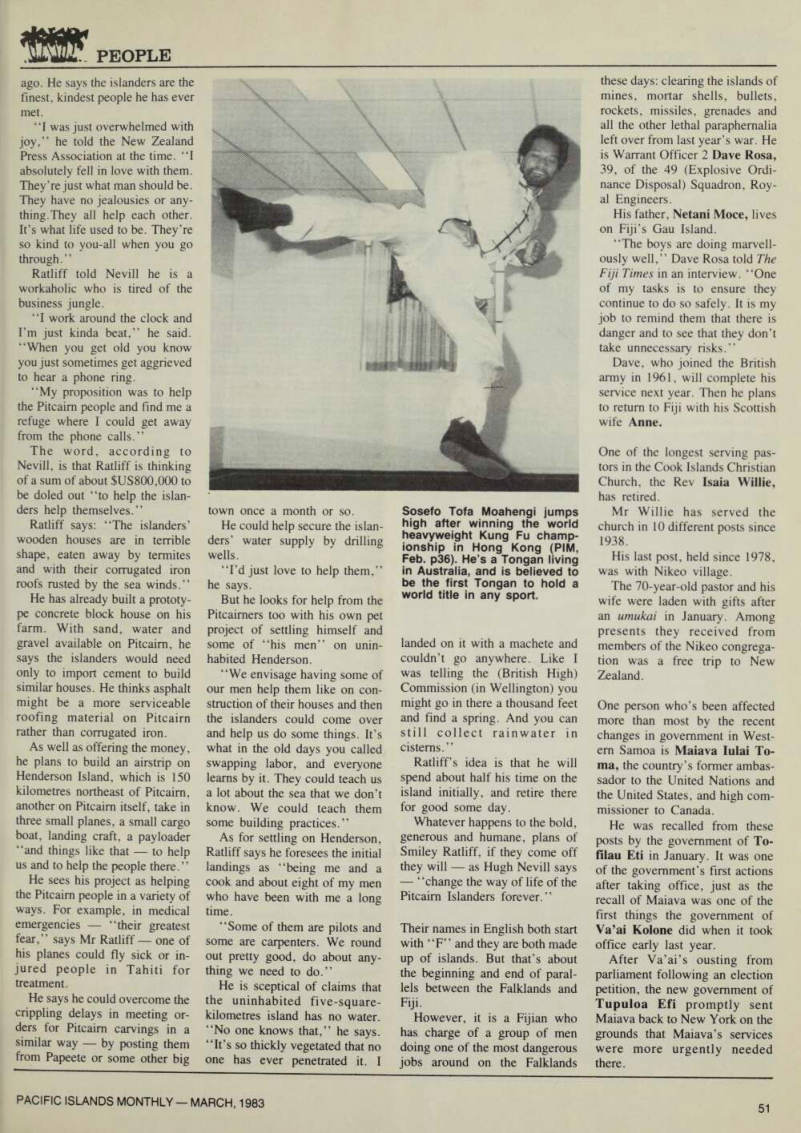
Sosefo Tofa Moahengi jumps high after winning the world heavyweight Kung Fu champ ionship in Hong Kong (PIM, Feb. p36). He’s a Tongan living in Australia, and is believed to be the first Tongan to hold a world title in any sport.
No doubt Maiava, back in his old job as secretary to govern ment, is hoping for a period of
political stability in Apia.
Prime Minister Tofilau said he
was considering downgrading
the New York office. “We don’t like to be like many Third World African countries, which live on aid but have posh diplomatic offices and drive limousines,” he said.
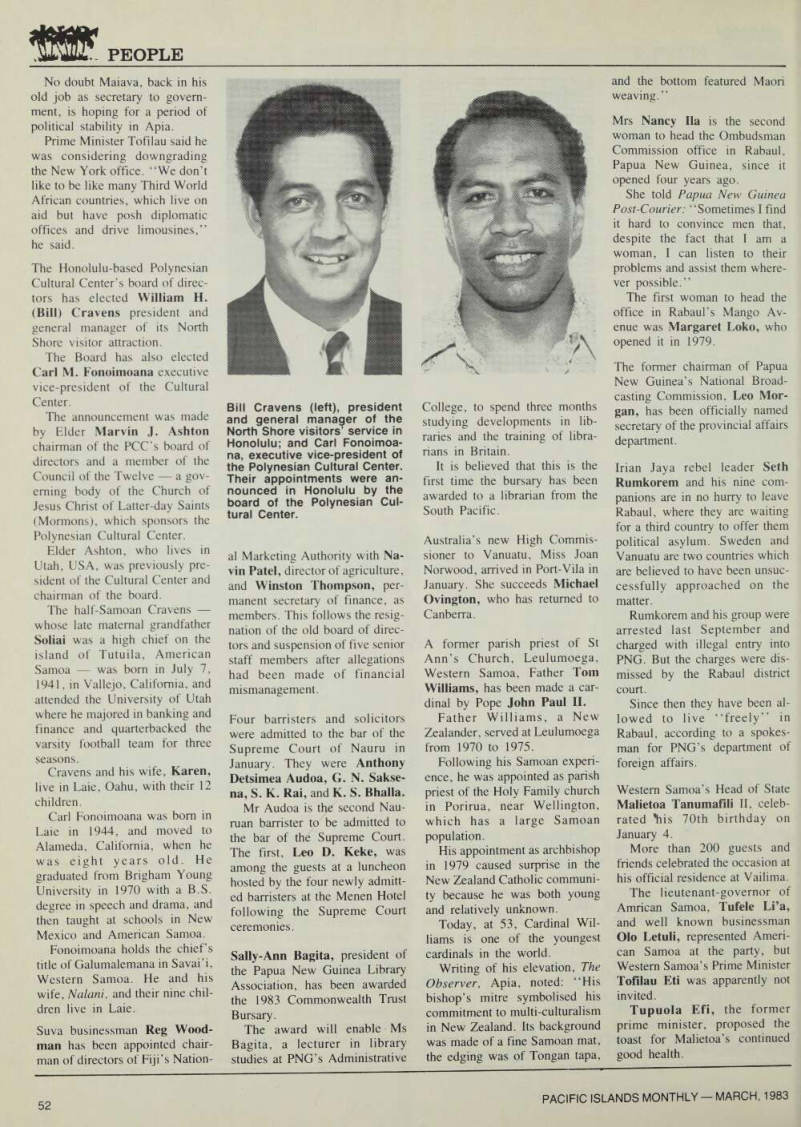
The Honolulu-based Polynesian Cultural Center’s board of direc tors has elected William H. (Bill) Cravens president and general manager of its North Shore visitor attraction.
The Board has also elected Carl M. Fonoimoana executive vice-president of the Cultural Center.
The announcement was made by Elder Marvin J. Ashton chairman of the PCC’s board of directors and a member of the Council of the Twelve a gov erning body of the Church of Jesus Christ of Latter-day Saints (Mormons), which sponsors the Polynesian Cultural Center.
Elder Ashton, who lives in Utah, USA, was previously pre sident of the Cultural Center and chairman of the board.
The half-Samoan Cravens whose late maternal grandfather Soliai was a high chief on the island of Tutuila, American Samoa was bom in July 7, 1941, in Vallejo, California, and attended the University of Utah where he majored in banking and finance and quarterbacked the varsity football team for three seasons.
Cravens and his wife, Karen, live in Laie, Oahu, with their 12 children.
Carl Fonoimoana was bom in Laie in 1944, and moved to Alameda, California, when he was eight years old. He
graduated from Brigham Young
University in 1970 with a B.S. degree in speech and drama, and then taught at schools in New Mexico and American Samoa.
Fonoimoana holds the chief’s title of Galumalemana in Savai’i, Western Samoa. He and his wife, Nalani, and their nine chil dren live in Laie.
Suva businessman Reg Wood man has been appointed chair man of directors of Fiji’s Nation-
al Marketing Authority with Na vin Patel, director of agriculture, and Winston Thompson, per manent secretary of finance, as members. This follows the resig nation of the old board of direc tors and suspension of five senior staff members after allegations had been made of financial mismanagement.
Four barristers and solicitors were admitted to the bar of the Supreme Court of Nauru in January. They were Anthony Detsimea Audoa, G. N. Sakse na, S. K. Rai, and K. S. Bhalla.
Mr Audoa is the second Nau ruan barrister to be admitted to the bar of the Supreme Court.
The first, Leo D. Keke, was among the guests at a luncheon hosted by the four newly admitt ed barristers at the Menen Hotel following the Supreme Court ceremonies.
Sally-Ann Bagita, president of
the Papua New Guinea Library Association, has been awarded the 1983 Commonwealth Trust Bursary.
The award will enable Ms Bagita, a lecturer in library studies at PNG’s Administrative
College, to spend three months studying developments in lib raries and the training of libra rians in Britain.
It is believed that this is the first time the bursary has been awarded to a librarian from the South Pacific.
Australia’s new High Commis sioner to Vanuatu, Miss Joan Norwood, arrived in Port-Vila in January. She succeeds Michael Ovington, who has returned to Canberra.
A former parish priest of St Ann’s Church, Leulumoega, Western Samoa, Father Tom Williams, has been made a car dinal by Pope John Paul 11.
Father Williams, a New Zealander, served at Leulumoega from 1970 to 1975.
Following his Samoan experi ence, he was appointed as parish priest of the Holy Family church in Porirua, near Wellington, which has a large Samoan population.
His appointment as archbishop in 1979 caused surprise in the New Zealand Catholic communi ty because he was both young and relatively unknown.
Today, at 53, Cardinal Wil liams is one of the youngest cardinals in the world.
Writing of his elevation, The Observer, Apia, noted: “His bishop’s mitre symbolised his commitment to multi-culturalism in New Zealand. Its background was made of a fine Samoan mat, the edging was of Tongan tapa,
and the bottom featured Maori weaving.”
Mrs Nancy Ha is the second woman to head the Ombudsman Commission office in Rabaul, Papua New Guinea, since it opened four years ago.
She told Papua New Guinea Post-Courier: “Sometimes I find it hard to convince men that, despite the fact that I am a woman, I can listen to their problems and assist them where
ver possible.”
The first woman to head the office in Rabaufs Mango Av enue was Margaret Loko, who opened it in 1979.
The former chairman of Papua New Guinea’s National Broad casting Commission, Leo Mor gan, has been officially named secretary of the provincial affairs department.
Irian Jaya rebel leader Seth Rumkorem and his nine com panions are in no hurry to leave Rabaul, where they are waiting for a third country to offer them
political asylum. Sweden and
Vanuatu are two countries which are believed to have been unsuc
cessfully approached on the
matter.
Rumkorem and his group were arrested last September and charged with illegal entry into PNG. But the charges were dis missed by the Rabaul district court.
Since then they have been al lowed to live “freely” in Rabaul, according to a spokes man for PNG’s department of foreign affairs.
Western Samoa’s Head of State Malietoa Tanumafili 11, celeb rated Iris 70th birthday on January 4.
More than 200 guests and friends celebrated the occasion at his official residence at Vailima.
The lieutenant-governor of Amrican Samoa, Tufele Li’a, and well known businessman 010 Letuli, represented Ameri can Samoa at the party, but Western Samoa’s Prime Minister Tofilau Eti was apparently not invited.
Tupuola Efi, the former
prime minister, proposed the
toast for Malietoa’s continued good health.
Bill Cravens (left), president
and general manager of the North Shore visitors’ service in Honolulu; and Carl Fonoimoa na, executive vice-president of the Polynesian Cultural Center.
Their appointments were an nounced in Honolulu by the board of the Polynesian Cul tural Center.