monster trade imbalance
pp. 51-55 · Read in the full issue
Trade Winds
Australia And The Islands
New circumstances cut back a monster trade imbalance
Many small island nations of the South Pacific have long labored under a massive trade imbalance with Australia.
For example, for every SAB worth of goods Fiji buys from Australia it manages to sell Aust ralia only $1 worth. In the case of Papua New Guinea the ratio is six to one, while for New Caledonia it is a staggering 27 to one.
But while this imbalance still exists, a variety of factors com bined in 1981-82 in part at least to reduce the islands’ historic trade deficit with their big neighbor.
Two of these factors the weakening of the Australian dol lar and the slide in the price of oil were unequivocally favorable developments for the tiny Pacific states.
The third the slump in commodity prices was a much more mixed blessing since this one acted to bring down the trade imbalance with Australia only through its recessionary impact on the island economies.
The direct consequence of this was some tough economic belt tightening. This resulted in lower consumption and reduced com pany inventories and so a drop in imports from countries such as Australia.
Indicative of the tough economic times suffered in the South Pacific in 1981-82 was the profit slump of Australia’s two main Pacific traders Bums Philp and Co. Ltd. and W. R.
Carpenter Holdings Ltd. by 51 per cent and 74 per cent respectively.
As a result of the combination of these three factors the imbal ance of trade in Australia’s favor was sharply cut back in 1981-82.
In the case of Fiji a 1980-81 imbalance of $153.4 million was reduced to $139.3 million, a drop of 9.2 per cent.
Solomon Islands and Vanuatu
Finance writer PETER FREEMAN analyses pluses and minuses in the 1981-82 trading relationships with Aust ralia of a number of Pacific Island nations.
The weakened Australian dollar, the reduced price of oil, and the slump in prices of islands-produced com modities each in its different way helped to reduce their massive trade imbalances with Australia.
But long-term solutions to the problem, Freeman says, seem as elusive as ever, with tourism offering the best prospects of at least some short-term relief.
performed even better, cutting their trade imbalance with Aust ralia by almost 23 per cent to $17.6 million and $10.3 million respectively. New Caledonia re corded a cut of 17 per cent, while Western Samoa reduced its im balance by 10 per cent.
PNG, heavily dependent on coffee and cocoa exports to Aust ralia, and able to maintain im ports thanks to continued Aust ralian aid, managed a reduction in its trade imbalance of only 2.5 per cent to $350 million.
Cyclone-devastated Tonga was the only Pacific Island state to experience a worsened trade balance, with the need for addi tional imports from Australia pushing this up by 15 per cent to $6 million.
Tonga was also one of three Pacific Island nations which didn’t benefit from a stronger rate of exchange against what has generally been a weakening Australian dollar. While the Australian dollar has recently re gained some of the ground lost against its United States counter part the slide against most other currencies including many in the Pacific continues unabated.
This reflects the Australian Government’s policy of steadily
lowering the trade-weighted in
dex the measure of the Aust ralian dollar against other curren cies weighted to take account of trade flows. In 1982 it fell 8 per cent to 83.2.
In the course of 1982 the Aust ralian dollar fell by about 6 per cent against the Fiji dollar, 4 per cent compared to the PNG kina, 7 per cent against the Vanuatu currency, and 3 per cent against the Western Samoan tala.
The currencies of Solomon Is lands, New Caledonia and Tonga either weakened slightly or held their own against the Australian dollar.
The big winners from all this have been Fiji, which imported $159.8 million worth of goods from Australia in 1981-82, and Papua New Guinea whose im ports from Australia totalled $420.13 million.
Thanks partly to the weaker Australian dollar, this represent ed falls of 5.8 per cent and 3.1 per cent respectively compared to the previous financial year.
By far the most significant drop for Fiji was a 13.3 per cent decline in the value of fuel im ported from Australia. This fell to $68.4 million still more than four times the cost of any other single item imported from Australia.
The drop in Fiji’s fuel import bill also reflected the world-wide slide in the price of oil and, it can be assumed, some cutback in usage due to the local economic downturn.
Just how significant all three factors were exchange rate changes, the lower oil price and reduced demand isn’t clear.
What is important is the fact Fiji
had to part with less of its valu able foreign exchange to pay its oil bill.
Other Pacific Island states to benefit in the same way were New Caledonia, whose fuel bill with Australia dropped 22 per cent to just over $4 million, and PNG, which had an 8.4 per cent lower payout for fuel from Aust ralia in 1981-82. In that year the cost was $42.4 million, com pared to $46.3 million in 1980- 81.
Fiji’s trade balance with Aust ralia also benefited from a 16 per cent drop by value in imports of manufactured goods from Aust ralia, and a 13 per cent fall in imports of machinery and trans port equipment.
On the debit side, food im ports from Australia rose 19 per cent to $23 million.
Like many of its island neigh bors, Fiji imports a significant amount of its staple food, with one of the main items being rice.
A major supplier of rice to Fiji is Ricegrowers Co-operative Mills Ltd., based in Leeton, New South Wales, which is also a major exporter of rice to PNG, Solomon Islands, Tonga and Vanuatu. For the last three, rice is the biggest single item in the list of products bought from Australia.
Going against the Fiji trend, food imports from Australia including rice by three other major Pacific Island nations fell in 1981-82.
Food imports from Australia by New Caledonia dropped 8.6 per cent to $17.7 million, PNG’s Australian food import bill fell 9.6 per cent to $106.3 million, and Solomon Islands’ bill was 35 per cent lower at $3.2 million.
In contrast to most other Pacif ic Island states Fiji’s balance of trade benefited from a strong lift in exports to Australia. These rose by 26 per cent to $20.5 million. Traditionally, about half
of Fiji’s exports to Australia have been accounted for by gold, with the other major export being coconut oil.
New Caledonia’s exports to Australia fell by almost 27 per cent last financial year and, at a tiny $1.4 million, are almost non-existent. The equally insig nificant Solomon Islands’ ex ports to Australia fell by just under 40 per cent to under $1 million.
For PNG, the stronger kina helped to compensate partly for the heavy fall in commodity prices, especially prices of coffee and cocoa, which make up al most 50 per cent and 25 per cent respectively of the country’s ex ports to Australia.
However, the slump in the value of these commodities caused exports to Australia to fall from $74.4 million in 1980-81 to last year’s $69.9 million.
While efforts have been made to provide greater access to Aust ralian markets for the products of Fiji and other island countries, this has so far produced few positive results.
One such initiative the South Pacific Regional Trade and Economic Co-operation Agreement (SPARTECA) seems to bear this out. Aimed at giving duty-free entry for island products to Australia and New Zealand, it has apparently generated few benefits.
According to Hugh Reynolds, the islands manager for Bums Philp, it will take a long time to build up the light industry needed to take advantage of easier entry to Australia.
While Bums Philp, for exam ple, is examining the possibility of manufacturing high quality soap in Fiji for export, Mr Rey nolds said the scheme would take some time to get off the ground.
SPARTECA has also generated some heated argu ments. One was about Fiji-made garments which at first seemed to qualify for duty-free entry. How
ever, they were later put in this category only if Fiji was able to secure part of the Australian global quota.
Another constraint in develop ing import replacement indus tries and investigating alternative sources of supply other than Australia is the strings that go with aid.
Although Australia supplies a large amount of aid to South Pacific nations, some carries the condition that goods involved must be bought from Australia.
Possibly the best long-term av enue for redressing the imba lance suffered by the Pacific Is land states in relation to Australia is to boost earnings from so called “invisibles” payments for freight, insurance, invest ments, tourism, and other simi larly intangible items.
For the islands of the Pacific the main hope for substantial gains in this area rests with tourism.
Here the biggest hurdle to be overcome is distance, and the concomitant issues of the cost and availability of transport. For PNG, the problem is the high cost of its internal air service (combined with expensive ac commodation), while for places like Tonga and Western Samoa the main difficulty is for tourists actually to get there.
While New Caledonia and Vanuatu attract a large number of Australian tourists, the greatest success in exploiting its tourist potential has gone to Fiji.
Despite the fall in the Aust ralian dollar the inflow of tourists to Fiji from Australia has been running at record levels in the last three months.
This has come on top of a 20 per cent increase in Australian tourists visiting Fiji to September 30, 1982. In that nine-months period 93,047 Australians went to Fiji on holidays compared to 76,311 over the same period in the previous year. With each tourist spending an estimated
$6OO a visit, over and above air fares and package hotel accom modation, tourism from Aust ralia generated around $56 mil lion in the year to September 30.
All told, tourism produces just over half of Fiji’s gross national product.
It should be noted, however, that the income earned from tour ism must be balanced against the large, but unquantified, cost of importing (usually from Aust ralia) many of the items tourists consume when they are in Fiji.
Just what the future holds for the Pacific Island states, both in terms of tourism and the overall trade balance with Australia, is far from clear.
While the huge imbalance with Australia was partly re dressed in 1981-82 there seems little hope of making any further large gains quickly.
If gains do in fact come, it may only reflect the fact that Australia is increasingly being replaced as the main source of imports by New Zealand, whose currency has weakened dramatic ally against its Pacific neighbors.
While this is, naturally, wel come news for New Zealand producers, it will do little to solve the chronic balance of pay ments problems of the Pacific Island nations.
SP beer “export
example”
Papua New Guinea’s govern ment is being urged to develop a more effective export incentive scheme.
The marketing controller of South Pacific Brewery Ltd., Ken Webb, says the existing scheme allows tax concessions on profits earned from exports. However, this presumes that a product is being sold overseas in the first place.
He says exporters need more help in meeting the initial costs of investigating and establishing overseas markets.
After two years of preparation, the South Pacific Brewery in Port Moresby began exporting PNG beer to Hawaii last September, and to Sydney and Brisbane in November (PIM Dec p3l). Mr Webb says demand for the spe cial export lager in Hawaii has grown to more than 32,000 cans a month, while the current Syd ney and Brisbane demand is ab out half this amount.
He says other overseas mar kets being investigated by the brewery include California, Nauru, Fiji, Tonga, Hong Kong and New Zealand.
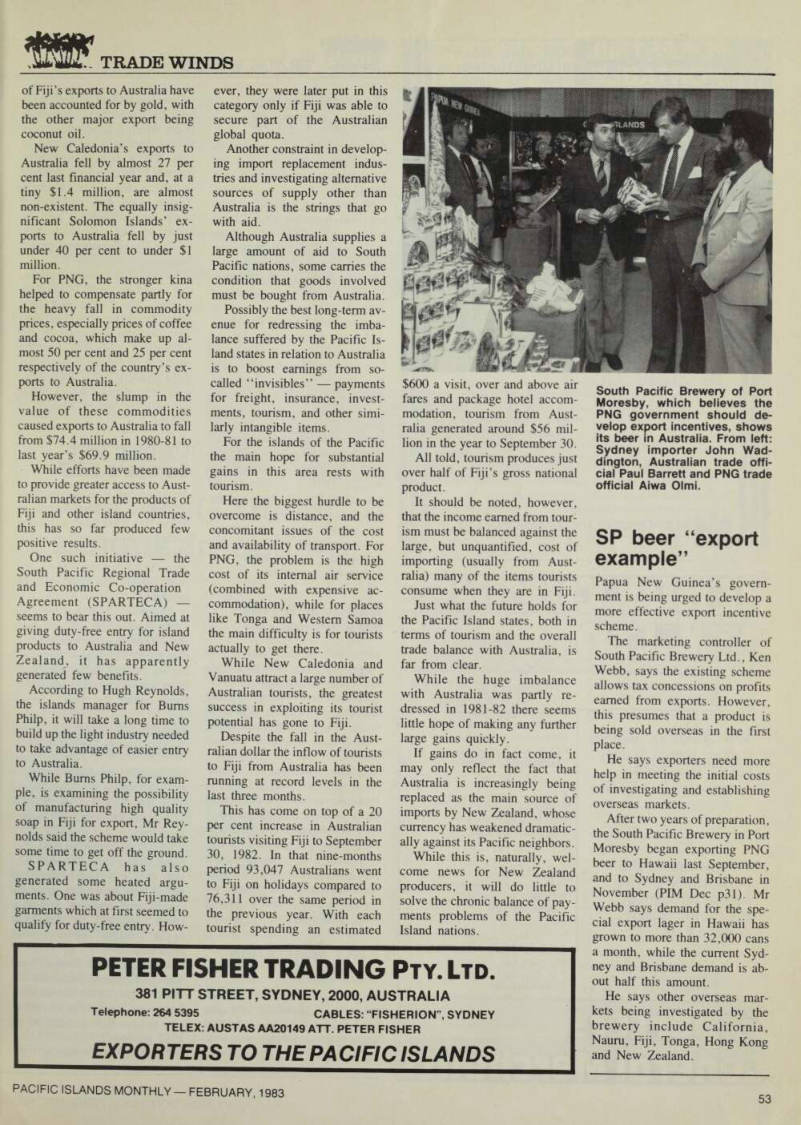
South Pacific Brewery of Port Moresby, which believes the PNG government should de velop export incentives, shows its beer in Australia. From left: Sydney importer John Wad dington, Australian trade offi cial Paul Barrett and PNG trade official Aiwa Olmi.
Remembering
Jfk Of Ptio9
Solomon Islands is hoping to attract tourists from the USA to a new museum containing relics of World War 11.
The museum, at Rendova Har bor, has been set up by local communities on the site of a base used during the war by American patrol-torpedo boats. One of the PT commanders stationed at Re ndova Harbor was Lieutenant John F. Kennedy later to become United States President.
Among guests at the official opening in December of the two bamboo buildings which house the exhibits was John Karo, who was a scout leader in the area at the time of the war and who helped to organise the rescue of Kennedy and his crew after their PTIO9 had been rammed and sunk by a Japanese destroyer in August, 1943. The museum was opened by Bara Buchanan of the Solomon Islands Tourist Author ity who promised help in promoting the attraction, but warned that it might not be pro fitable for some time.
Language rule
hits trade
The Cook Islands and Papua New Guinea say their trade with the French territories of New Caledonia and Tahiti is being disrupted by a French Govern ment ruling on trade documents.
A French directive that all documents accompanying goods should be prepared in French came into force last October. A Radio Australia correspondent in Suva says the complaints have been investigated by the South Pacific Bureau for Economic Co- Operation. He says the com plaints arose because English speaking trading countries in the Pacific have difficulty finding local translators.
PNG welcomes
Italpesca
An Italian consortium is to invest more than $3O million in Papua New Guinea over the next five years, creating a PNG-owned tu na industry. The country’s
cabinet has ratified an agreement with the consortium, Italpesca, under which a purse-seiner tuna fishing fleet will be formed to fish PNG’s rich tuna fishing grounds. The country’s Primary Industry Minister, Dennis Young, said that within five years the fleet, which will be owned by PNG, should be har vesting 40,000 tonnes of tuna a year.
He said that at today’s prices, this would be worth $4O million a year. Mr Young said final details would be worked out next year, but the first stage of the agreement provided for the purchase of two or three purse seine trawlers, and a 2000-tonne cold storage plant which might be built in either Manus or Rabaul.
Oz help with
Samoa’s EEZ
An Australian army survey team is assisting Western Samoa to define the 200-mile exclusive economic zone around its coast.
The team will accurately deter mine the reference points on land from which the zone will be measured.
Australia’s Minister for De fence, lan Sinclair, said that once the 200-mile zone was mapped out it would allow Western Samoa to plan the development of its marine resources and effec tively control the area.
Record sugar
output in Fiji
Fiji in 1982 produced a record 485.000 tonnes of sugar, worth more than $l5O million. This is 12.000 tonnes more than the pre vious record, set in 1979.
Chief executive of the Fiji Sugar Corporation, Rasheed Ali, said that this year’s crushing period was short because of in creased mill capacity, and as a result cane had its maximum sugar content when it was
processed.
Mr Rasheed Ali forecast con
tinuing depressed prices on the
world sugar market for the next few years. He said Fiji was fortu nate to have firm markets for its
1982 production.
Meanwhile, a senior govern-
ment minister has tipped that tourism could overtake sugar as
Fiji’s biggest foreign exchange
earner in 1983. Fiji’s Tourism Minister, Mr Qionibaravi, told parliament that a predicted seven per cent growth in the number of visitors would mean Fiji stood to earn in excess of $l6O million from tourism in 1983.