Missionary in Papua, 1934
pp. 45-50 · Read in the full issue
Yesterday
“Clothes do not make the man”: Missionary in Papua, 1934
That day in June, 1934, was very good to us a bright sunny Sydney winter morning, a good start to a new adventure. The MV Macdhui, today a bombed out shell in Port Moresby’s har bor, wafted us out and up the Australian coast, ere long to be escorted by a school of whales, each spouting in turn beside us.
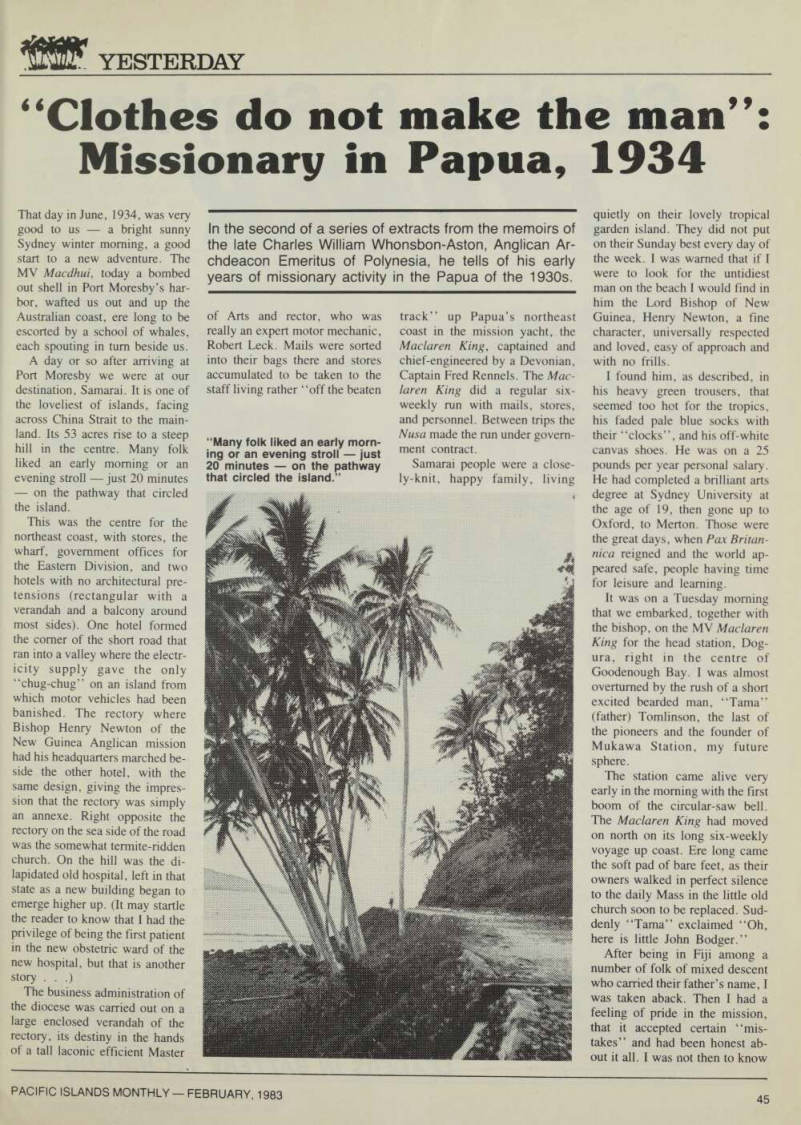
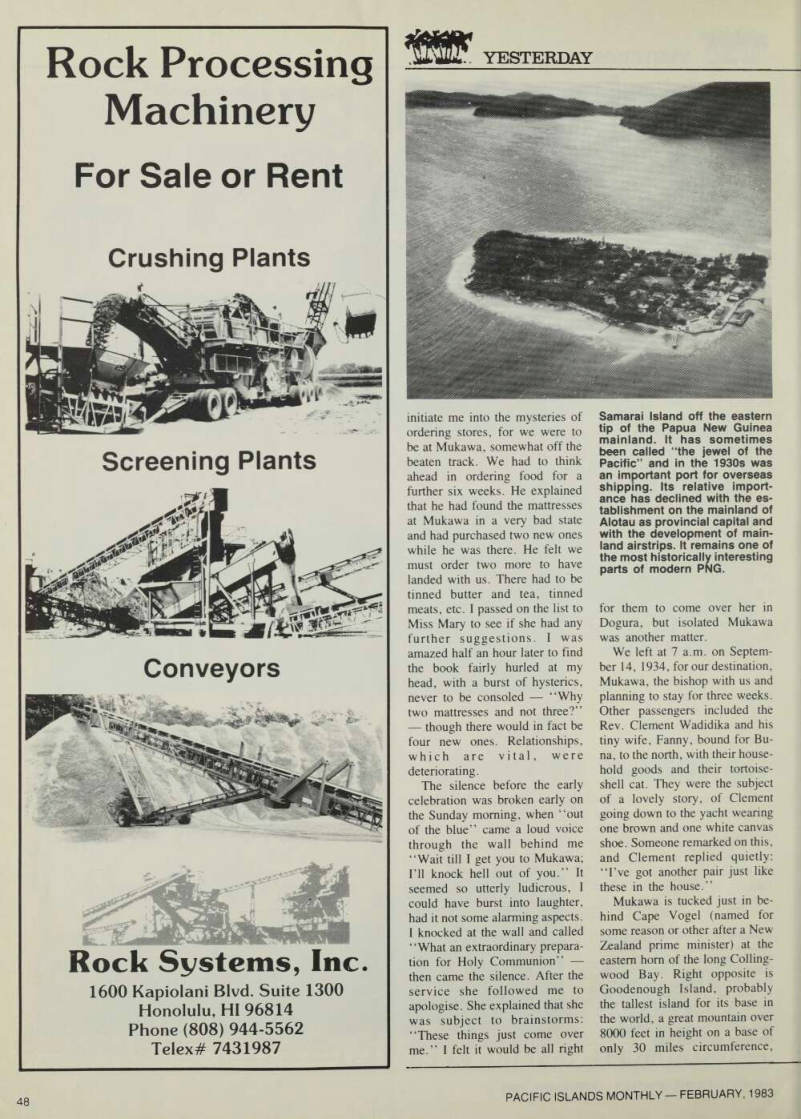
A day or so after arriving at Port Moresby we were at our destination, Samarai. It is one of the loveliest of islands, facing across China Strait to the main land. Its 53 acres rise to a steep hill in the centre. Many folk liked an early morning or an evening stroll just 20 minutes on the pathway that circled the island.
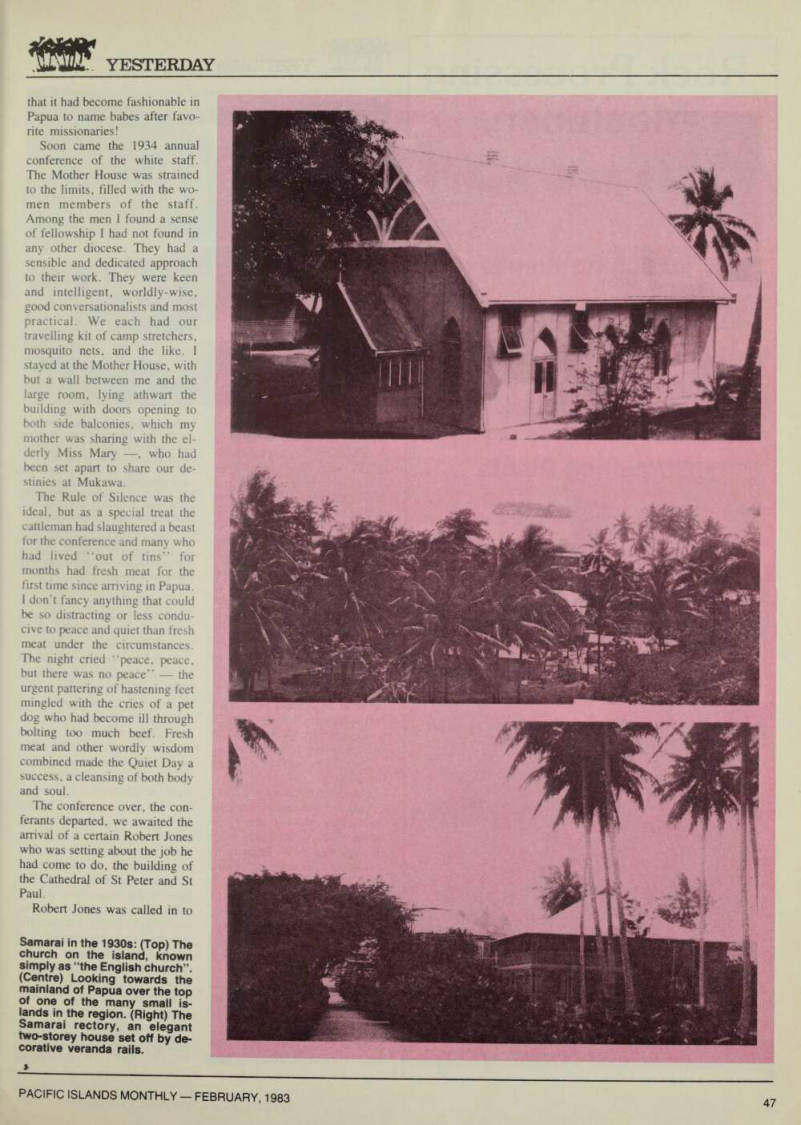
This was the centre for the northeast coast, with stores, the wharf, government offices for the Eastern Division, and two hotels with no architectural pre tensions (rectangular with a verandah and a balcony around most sides). One hotel formed the comer of the short road that ran into a valley where the electr icity supply gave the only “chug-chug” on an island from which motor vehicles had been banished. The rectory where Bishop Henry Newton of the New Guinea Anglican mission had his headquarters marched be side the other hotel, with the same design, giving the impres sion that the rectory was simply an annexe. Right opposite the rectory on the sea side of the road was the somewhat termite-ridden church. On the hill was the di lapidated old hospital, left in that state as a new building began to emerge higher up. (It may startle the reader to know that I had the privilege of being the first patient in the new obstetric ward of the new hospital, but that is another story . . .) The business administration of the diocese was carried out on a large enclosed verandah of the rectory, its destiny in the hands of a tall laconic efficient Master
In the second of a series of extracts from the memoirs of the late Charles William Whonsbon-Aston, Anglican Ar chdeacon Emeritus of Polynesia, he tells of his early years of missionary activity in the Papua of the 19305.
of Arts and rector, who was really an expert motor mechanic, Robert Leek. Mails were sorted into their bags there and stores accumulated to be taken to the staff living rather “off the beaten
track” up Papua’s northeast coast in the mission yacht, the Maclaren King, captained and chief-engineered by a Devonian, Captain Fred Rennels. The Mac laren King did a regular six weekly run with mails, stores, and personnel. Between trips the Nusa made the run under govern ment contract.
Samarai people were a close ly-knit, happy family, living
quietly on their lovely tropical garden island. They did not put on their Sunday best every day of the week. I was warned that if I were to look for the untidiest man on the beach I would find in him the Lord Bishop of New Guinea, Henry Newton, a fine character, universally respected and loved, easy of approach and with no frills.
I found him, as described, in his heavy green trousers, that seemed too hot for the tropics, his faded pale blue socks with their “clocks”, and his off-white canvas shoes. He was on a 25 pounds per year personal salary.
He had completed a brilliant arts degree at Sydney University at the age of 19, then gone up to Oxford, to Merton. Those were the great days, when Pax Britan nica reigned and the world ap peared safe, people having time for leisure and learning.
It was on a Tuesday morning that we embarked, together with the bishop, on the MV Maclaren King for the head station, Dog ura, right in the centre of Goodenough Bay. I was almost overturned by the rush of a short excited bearded man, “Tama” (father) Tomlinson, the last of the pioneers and the founder of Mukawa Station, my future sphere.
The station came alive very early in the morning with the first boom of the circular-saw bell.
The Maclaren King had moved on north on its long six-weekly voyage up coast. Ere long came the soft pad of bare feet, as their owners walked in perfect silence to the daily Mass in the little old church soon to be replaced. Sud denly “Tama” exclaimed “Oh, here is little John Bodger.”
After being in Fiji among a number of folk of mixed descent who carried their father’s name, I was taken aback. Then I had a feeling of pride in the mission, that it accepted certain “mis takes” and had been honest ab out it all. I was not then to know
“Many folk liked an early morn ing or an evening stroll just 20 minutes on the pathway that circled the island."
that it had become fashionable in Papua to name babes after favo rite missionaries!
Soon came the 1934 annual conference of the white staff.
The Mother House was strained to the limits, filled with the wo men members of the staff.
Among the men I found a sense of fellowship I had not found in any other diocese. They had a sensible and dedicated approach to their work. They were keen and intelligent, worldly-wise, good conversationalists and most practical. We each had our travelling kit of camp stretchers, mosquito nets, and the like. I stayed at the Mother House, with but a wall between me and the large room, lying athwart the building with doors opening to both side balconies, which my mother was sharing with the el derly Miss Mary —, who had been set apart to share our de stinies at Mukawa.
The Rule of Silence was the ideal, but as a special treat the cattleman had slaughtered a beast for the conference and many who had lived “out of tins” for months had fresh meat for the first lime since arriving in Papua.
I don’t fancy anything that could be so distracting or less condu cive to peace and quiet than fresh meat under the circumstances.
The night cried “peace, peace, but there was no peace’’ the urgent pattering of hastening feet mingled with the cries of a pet dog who had become ill through bolting too much beef. Fresh meat and other wordly wisdom combined made the Quiet Day a success, a cleansing of both body and soul.
The conference over, the con ferants departed, we awaited the arrival of a certain Robert Jones who was setting about the job he had come to do, the building of the Cathedral of St Peter and St Paul.
Robert Jones was called in to
Samarai in the 19305: (Top) The church on the island, known simply as “the English church”. (Centre) Looking towards the mainland of Papua over the top of one of the many small is lands in the region. (Right) The Samarai rectory, an elegant two-storey house set off by de corative veranda rails.
initiate me into the mysteries of ordering stores, for we were to be at Mukawa, somewhat off the beaten track. We had to think ahead in ordering food for a further six weeks. He explained that he had found the mattresses at Mukawa in a very bad state and had purchased two new ones while he was there. He felt we must order two more to have landed with us. There had to be tinned butter and tea, tinned meats, etc. I passed on the list to Miss Mary to see if she had any further suggestions. I was amazed half an hour later to find the book fairly hurled at my head, with a burst of hysterics, never to be consoled “Why two mattresses and not three?” though there would in fact be four new ones. Relationships, which are vital, were
deteriorating.
The silence before the early celebration was broken early on the Sunday morning, when “out of the blue” came a loud voice through the wall behind me “Wait till I get you to Mukawa; I’ll knock hell out of you.” It seemed so utterly ludicrous, I could have burst into laughter, had it not some alarming aspects.
I knocked at the wall and called “What an extraordinary prepara tion for Holy Communion” then came the silence. After the service she followed me to apologise. She explained that she was subject to brainstorms: “These things just come over me.” I felt it would be all right
for them to come over her in Dogura, but isolated Mukawa was another matter.
We left at 7 a.m. on Septem ber 14, 1934, for our destination, Mukawa, the bishop with us and planning to stay for three weeks.
Other passengers included the Rev. Clement Wadidika and his tiny wife, Fanny, bound for Bu na, to the north, with their house hold goods and their tortoise shell cat. They were the subject of a lovely story, of Clement going down to the yacht wearing one brown and one white canvas shoe. Someone remarked on this, and Clement replied quietly: “I’ve got another pair just like these in the house.”
Mukawa is tucked just in be hind Cape Vogel (named for some reason or other after a New Zealand prime minister) at the eastern horn of the long Colling wood Bay. Right opposite is Goodenough Island, probably the tallest island for its base in the world, a great mountain over 8000 feet in height on a base of only 30 miles circumference,
Samara! Island off the eastern tip of the Papua New Guinea mainland. It has sometimes been called ‘the jewel of the Pacific” and in the 1930s was an important port for overseas shipping. Its relative import ance has declined with the es tablishment on the mainland of Alotau as provincial capital and with the development of main land airstrips. It remains one of
the most historically interesting
parts of modern PNG.
with a narrow coastal plain.
Once, after nearly four days of heavy north-westerly seasonal rain and heavy seas, the sun burst across it late in the afternoon with a perfect rainbow, seen through the high spray of the surf running on our small beach, with a waterfall pouring down the steep jungle-clad slopes for about 7000 feet.
Christopher Osembo, a big, well set-up Mambare man, the school headmaster, was on the beach to meet us. He had been generally in charge during the absence of any other authority.
His wife was Maggie, who, be ing wife of the teacher and there fore higher in the social struc ture, wore a Mother Hubbard arrangement above her grass skirts.
The attractive thatch church was full for Solemn Evensong, sung in the Mukawan dialect.
The building held about 450, the men on one side down to the boys in front who were practical ly unclothed, save for the “ka ra” of tapa cloth, which left little to the imagination. One got ac customed to this uniform as time went by, but I am afraid my mother, at 77 and somewhat Vic torian in background, hardly be came used to it, though after a time her sense of humor pre vailed. However at first she was horrified to see a 13-year-old part-time houseboy waving a bedroom utensil as he greeted his friends passing on the beach.
Bishop Newton remained with us, first, to see us settled in, and, second, to prepare a large class of adults and children brought in from far and wide for baptism or confirmation. The Maclaren King left very early in the morn ing and we unpacked our person
al belongings. The ice chest (quite the thing in those days) looked positively silly sitting there in the wilds, the nearest ice blocks miles away. I felt like Robinson Crusoe.
In those days it would have been fantastic to think that New Guinea people, Stone Age and grass-skirted, would ever find the big world moving in on them.
It seemed to me that the main object of schooling at the time was to give them some means of reading and some idea of mea surements and weights and money, in order to save them from exploitation. Very few were encouraged to anything higher, and the government’s es timation of the position seemed to be underlined by the arrival each year of a retired school inspector from Queensland. As he could hardly be expected to know the dialects, all the exams were taken in English, and from the results the mission gathered a subsidy, according to grade, from the lowest at five shillings
for those who satisfied the ex aminer, through seven-and six pence to 10 shillings.
The inspector during my first few years was just over 80 years old, Colonel Hooper, a grand old soul, very kindly in his assess ments. He was one of the school master type who became col onels between the Boer War and World War 1, graduating through the command of school cadet corps and the volunteers, used to command, who did good work in their fields. He would like to talk about his time in Egypt, Gaza, Heliopolis, Mena Camp, even “the Battle of the Wazir” into which he was call ed, then he would retire, a teetotaller, to rest, aglow with revival of old memories, to rise with the birds to give us a good record.
I learnt that clothes or the lack of them do not make the man, and, with the memory of early missionary enthusiasm in the Pacific fpr clothing bringing dis aster to the wearers, the mission
did nothing to encourage the loc al people to dress. Our local priests and teachers, following the example of government clerks and so on, liked their shirts and waistcloth on occa sions, and village men of stand ing wore the waistcloth in public.
But all this came from them selves, as any change of custom should. There was no shame in their accustomed “undress” and one got completely used to it.
The women were very modest in the Cape Vogel area, wearing longish grass skirts.
We were soon settling in, and my amazing old mother had ta ken over the domestic manage ment very efficiently. We had to be quite sure of having sufficient supplies for there was no nearby
Another view of the famous cor al path which skirts the island of Samarai.
Seeing Samarai for the first time in the days before air travel became general. But even to day the island is too small for an airstrip. Visitors land on the mainland and cross by workboat.
store to slip around to, nor was there the baker or the plumber.
Mother’s old skill in bread making (years upon years earlier) came back to her. Every second day yeast was prepared from limes from two trees that stood right against the open back verandah. At one stage of the year, about October I fancy, these trees would harbor for a few evenings thousands of small beetles, like the “ladybird”, at tracted by the lights on the table.
Soon after my arrival I climbed the old road, much neglected and scored by rainstorms, to the plateau above and to its extremi
ty. Dog’s Hill, to the light which had been placed there by the mission in 1899 to help mariners.
The villages had been there for some generations for their pro tection against other tribes, and the mission buildings had been situated there. But now both vil lages and mission were on the coastal strip below.
I found the famous Dog’s Hill (Cape Vogel) light a most primi tive affair, seriously neglected through lack of supervision by the two villagers paid by the government to tend it. A few months later I received charts from the Admiralty asking if I could indicate the position of the light and give any further infor mation to bring the chart up to date. Only a few days before I had been reading through the old 1914 logbooks and had come
across a record of a detachment of warships passing Cape Vogel going north. Then the next day's record stated they were seen re turning. It seemed a mystery to me, which was solved when the mission veteran “Tama” Tom linson told me that they had been a detachment intended to capture Rabaul a few days earlier, but the commanding officer, poorly equipped with correct charts, de cided not to risk his vessels on this quiet backdoor route.
My life was taking on a sort of Swiss Family Robinson aspect, tackling all sorts of jobs I never before suspected I should have to deal with. White ants had managed to get into the storeroom, attacking the door posts and lintels and the dinghy sails. This called for new skills, though I found some men who
had helped with the whaleboat sails some time before.
Freed from the work that had anchored me at the centre I was able to visit up and down the district. Each out-station had a small thatched house, on stilts, for the priest to stay overnight in, near the grass church. Down coast were Bogaboga, Ginada, laseiase really the name of a small island, laseiaseago, just off the coast, where Nicholas the Greek, a well-known character, would often camp with his fish ing boats and crew, almost bring ing doom to the future of the village from their lustful posses sion of the local lasses and Wabubu.
One Saturday afternoon I seemed to have walked far ahead of my carriers. Suddenly from the nearby mangroves shot a small narrow canoe paddled by a practically naked local man. who offered to ferry me over.
Halfway across, with the canoe riding a fair swell coming in from the sea, the man, Jeremiah, stopped to show me some arrows tipped with human bone which he had bought from the Suau people. Bows and ar rows were not used in the district we were in, and I wondered. The tossing boat half a mile from shore was giving me a little anxiety and I decided we should hurry on. I found, when I arrived on the other side, that Jeremiah had been discharged from the armed constabularly as a mental case and, as they seemed to have no mental institution to take him, they had sent him back to his village. That is another of my allergies, tossing in mid-ocean in a narrow canoe with a madman. . .
A week later Fr. Frere Lane, my “next-door’’ (many crocodiley miles away) neigh bor, told me of sleeping in the bone-dry thatch and bamboo rest house at Kirikirikona, the limit of his district towards mine, and being awakened in the night by the same Jeremiah crawling over the floor towards his campbed holding aloft a flaming torch of coconut fronds, sparks flying in all directions. . . • Next month: A wandering drunk, the “Queen of Naniu" . and mission paternalism.
Early pictures of Samarai re flect a stark frontier-like atmos phere (top) but later the island gained a reputation for its gar dens and tree-lined walks (above).