Australia and the French Pacific:
pp. 13-14 · Read in the full issue
Pacific Diplomacy
Australia and the French Pacific: “Good relations are essential ..."
Dr Malcolm Leader, who has been Australian consul-general based in Noumea for the past three years, has completed his mission and will be returning to Canberra in a fortnight.
Dr Leader’s responsibilities covered the three French Pacific territories of New Caledonia, Wallis and Futuna, and French Polynesia.
We were able to meet him in the course of his “farewell visit’’ to Tahiti, the fifth time he has come to our island. ‘ 7 now have many friends here,’’ he said in his impeccable French. Then we talked about Australia and its relations with the countries and territories surrounding that island-continent.
M.L. Australia certainly be lieves it has a role to play within its geographical region. But that does not mean interference, and it is essential that we have good relations with neighboring coun tries or territories. So we must have regular contacts. This is why immediately after the end of hostilities in World War II one of the very first consular posts set up by Australia anywhere in the
The Tahiti daily Les Nouvelles of November 27, 1982, carried the following interview with Dr MALCOLM LEAD ER, who was then about to complete a three-year mission as Australian consul-general in Noumea, New Caledonia, with responsibility for all French Pacific territories. The interview, in which Dr Leader discusses Australian policies on a number of issues related to France’s Pacific territories, was conducted by Les Nouvelles journalist ANDRE NOUET. The translation is by PIM.
world was in Noumea. We now have about a dozen people work ing there. Apart from myself, there are three Australian consuls regularly visiting the French Pacific territories from Noumea.
L. English-speaking and French-speaking people live side by side in the Pacific, but their relations have for a long time been superficial, even marked by a certain mistrust. Do you think we’ve been moving towards a more open dialogue over recent times?
M. I am accustomed to a certain ambiguity in the attitude of New Caledonians towards Australia. New Caledonia is a very large island whose people appreciate the advantages of hav
ing Australia close handy for holidays, making purchases, and so on. But they seem to fear that in the relatioship there’s another side to the coin. I hasten to add that these fears are absolutely groundless.
L. Are there any develop ments in Australian policy on the matter of New Caledonian independence?
M. Australia supports the decision of the recent South Pacific Forum which expressed a very favorable attitude to the reforms begun by the French Government. The desire was ex pressed to see this program car ried through, and a timetable established leading up to a peace ful and orderly accession to inde
pendence. But I add that at the beginning of the resolution adopted by the Forum there is a reaffirmation of the principles of self-determination and independence.
L. Principles are all very fine, but couldn’t there be a contradiction between self determination and independence?
Who, in your opinion, should be allowed to express their views in any referendum or other elec toral process?
M. Australia has a policy of non-interference in the affairs of others, and if problems of this nature were to arise later on it would be up to the New Caledo nians to sort them out. I am aware that the Independence Front takes the view that the Kanak people have been col onised, and that they alone have the right to determine what the
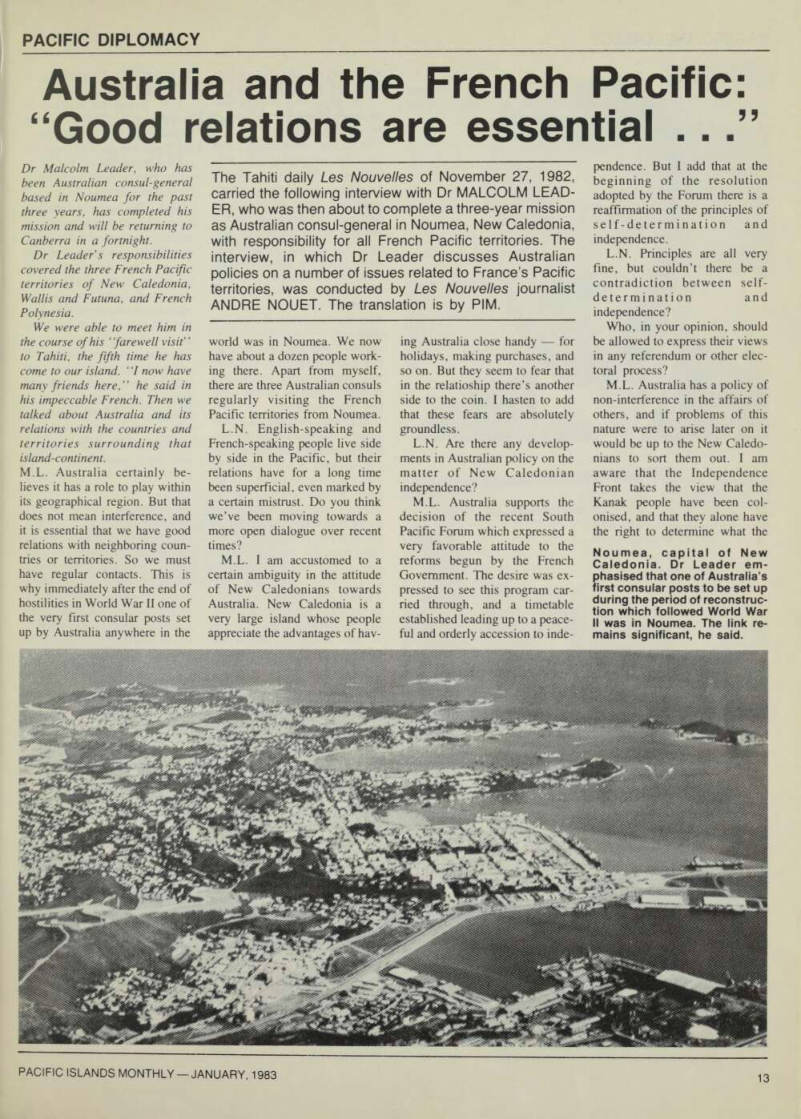
Noumea, capital of New Caledonia. Dr Leader em phasised that one of Australia’s first consular posts to be set up during the period of reconstruc tion which followed World War II was in Noumea. The link re mains significant, he said.
outcome of this colonisation is to be.
L. Does your country take the same position on the future of French Polynesia?
M. For Australians, Tahiti can’t be compared with New Caledonia. First of all, there’s the matter of distance. What’s more, we have democracy in Australia, and we are particularly attached to the democratic pro cess. On several occasions in recent times the French Govern ment has reaffirmed its concern that the wishes of the populations concerned are respected. So there are no problems on that score.
L. Tahiti and its islands are in the tourist business, but there still aren’t many Australians coming to visit us. Is the situa
tion hopeless?
M. No, definitely not. I’m actually delighted with the pre sent growth of tourism between our countries. It’s been going on ever since the resumption of the
three weekly Qantas flights.
There’s increased passenger traffic both ways, and I think it’s fine that Polynesians are discov ering Australia. During my time here on this visit I’ve issued 80 visas. While it’s true that Vanuatu and Fiji have a particu lar attraction for Australian tour ists, the French Pacific territories New Caledonia, Wallis and Futuna, and Polynesia offer
the traveller the bonus of a little breath of France.
L. Before the numbers of
people travelling for pleasure can
be built up to any great extent, the world will have to come out of the present long period of crisis. How is Australia faring in these touchy times?
M. The crisis is affecting Australia too. We have an un employment rate of 7.5 percent.
But Australians believe in their country, and the future looks promising. We have many sources of wealth that we don’t even know about yet. We look forward to a great development of the Australian continent, which at present is home to 15 million citizens. They are hard working people, who still have a sense of adventure. They’ll get through the difficult times.
In the course of the interview, Dr Leader asked several times that more emphasis should be given to his purely consular duties.
But politics kept on coming back in.
After all, politics determine the very way we live. The Aust ralian consul-general under stands this very well, and this is probably why he agreed to en lighten our readers about Aust ralian attitudes. We wish him all the very best as he takes up his
new post.
Andre Nouet.
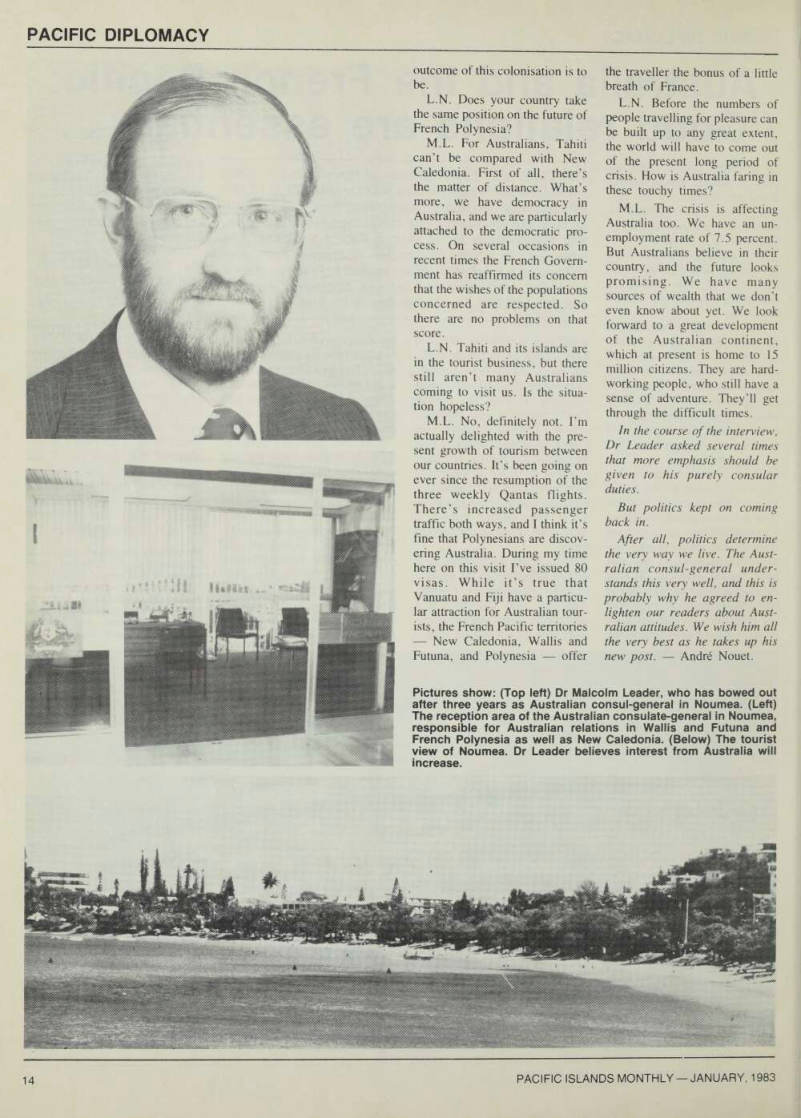
Pictures show: (Top left) Dr Malcolm Leader, who has bowed out after three years as Australian consul-general in Noumea. (Left) The reception area of the Australian consulate-general in Noumea, responsible for Australian relations in Wallis and Futuna and French Polynesia as well as New Caledonia. (Below) The tourist view of Noumea. Dr Leader believes interest from Australia will increase.