Tonga and
pp. 7-12 · Read in the full issue

Letters
Tonga and the Games
Most people believed that the Commonwealth Games in Bris bane last October were staged not only for the benefit of the competitors, but also for the pur pose of enabling the various peo ples from Commonwealth coun tries to meet together in a com mon bond through their interest in sport.
Reflecting this notion was the pre-games conference known as the Commonwealth and Interna tional Conference on Sport, Phy sical Education, Recreation and Dance. The conference, under the direction of Dr lan Jobling of the University of Queensland, produced a most impressive list of keynote and supporting speak ers from all parts of the world.
A group of sporting en thusiasts in Tonga realised the importance the conference could have for their small island king dom where sport, recreation and dance play such important roles in the lifestyle. They gathered the names of those who were both able to pay for their airfares and accommodation, and suit able to represent their kingdom at the conference. The list of coaches, administrators and en thusiasts numbered over 200.
Travel arrangements were finally completed by the charter of a Boeing 707 aircraft which would take the first paid-up and ap proved contingent. The Immigra tion Department in Canberra was advised, and it requested the Australian High Commission in Tonga to issue the necessary visas, subject to the normal requirements.
And so ends the enthusiasm.
The conditions of approval for the visas placed by the High Commission upon the intending participants included production of a bank draft payable in Aust ralia of $7OO to cover 10 days’ expenses (that was after accom modation and return air fares had been paid). Efforts to meet the conditions were hampered by the fact that the organisers were ad vised of the requirements only four days before the charter flight was due to leave.
Notwithstanding all this, the organisers tried to arrange for those able to meet the conditions
to travel independently. Twenty
one applications for visas were lodged with the commission within the next 48 hours. Applic ants included two nobles of the realm and the superintendent of the Tonga Police Force.
Final cancellation of all effort
came the following morning
when all applications were re turned to the organisers without approval. They still don’t know who would have been permitted to attend. One of the nobles in question was the son-in-law of the Prime Minister of Tonga.
However, the Tonga Police Band, of which the Kingdom is justly proud, had an official role at the games.
It is quite a shame that more of their countrymen, who are also members of the Commonwealth, could not share the experience.
Robert W. Moin
Nukualofa Tonga Two readers offer contrasting opinions on the visit to Tuvalu last October by Queen Elizabeth II and her husband Prince Philip, Duke of Edinburgh. Both letters have been cut for length.
The Queen in
Tuvalu (1)
“Superb”, “Fantastic”, “We’ve never seen anything like it”. Those were some of the
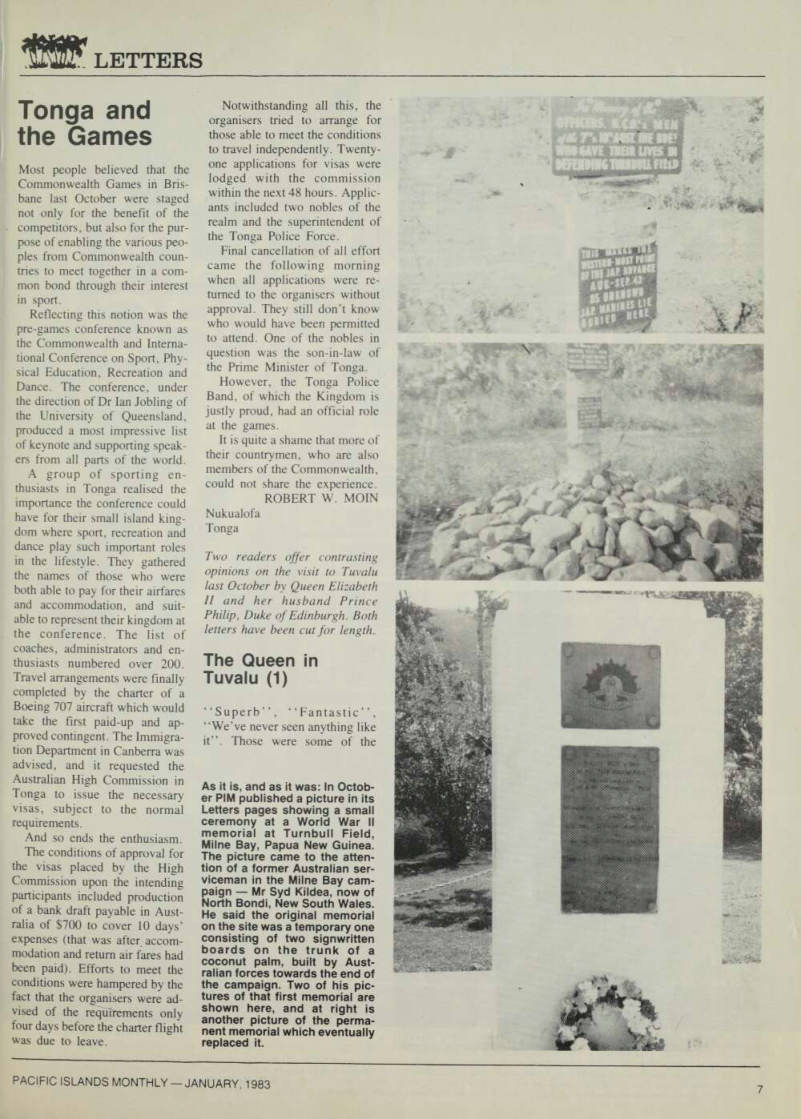
As it is, and as it was: In Octob er PIM published a picture in its Letters pages showing a small ceremony at a World War II memorial at Turnbull Field, Milne Bay, Papua New Guinea.
The picture came to the atten tion of a former Australian ser viceman in the Milne Bay cam paign Mr Syd Kildea, now of North Bondi, New South Wales.
He said the original memorial on the site was a temporary one consisting of two signwritten boards on the trunk of a coconut palm, built by Aust ralian forces towards the end of the campaign. Two of his pic tures of that first memorial are shown here, and at right is another picture of the perma nent memorial which eventually replaced it.
comments made by the 11 mem bers of the international media, who actually made it to Tuvalu to be present for the Royal visit which took place on October 26- 27, 1982. As anyone who has ever tried to get to Tuvalu knows, it is a difficult enough place to reach at the best of times. In theory, 18 members of the press corps were supposed to get here, but several fell by the wayside and those that did not make it will be kicking them selves when they see from the reports of those who did just what they missed.
Where else in the whole Com monwealth would the ordinary citizen be able to get within a few feet of Her Majesty or His Royal Highness, Prince Philip, Duke of Edinburgh, not on one occasion, but umpteen occasions during the two days which the Royal couple spent visiting this, one of the smallest and remotest, yet at the same time most loyal, outposts of the Commonwealth of Nations?
That the Royal couple
thoroughly enjoyed the visit was made abundantly clear on numer ous occasions during the two days, but in no more striking form than on the final departure, when Her Majesty and Prince Philip allowed themselves to be carried shoulder high on canoes, in the pouring rain. They must have been soaked to the skin by the time they reached the com parative haven of the Royal barge, which was to take them back out to H.M. Yacht Britan nia. They would never have al lowed that to happen had they themselves not been thoroughly enchanted with the welcome which they had received.
And who could fail to be charmed by these open-hearted people, who are intensely loyal to the British Crown, in spite of the fact that this has not always been appreciated by the other side?
That the visit was an over whelming success there can be no doubt. The people of Tuvalu had been preparing for months for the great event, and, when it arrived, they gave of their best. It is true that there were some internal disputes within the tight ly-knit group of eight main is lands, but to an outsider that was
not immediately apparent. The local people were delighted at the way things went, the expatriate population, who are there to serve the Tuvaluan people, were delighted, and the representa tives of the media, who can be a very hard-bitten bunch of indi viduals, were also delighted. In deed, had you been able to see these people on the night Her Majesty departed, dressed in loc al costumes, living it up in the country’s only hotel which can only accommodate 14 people you would see how entirely the visiting 11 had been cap tivated by this remote island of Funafuti, only about a square mile in size, set in the middle of 500,000 square miles of ocean.
There had been previous royal visits to the islands in 1959 H.R.H. Prince Philip had visited Vaitupu, in 1978 H.R.H.
Princess Margaret had visited Funafuti for the independence celebrations and in 1979 H.R.H.
Princess Anne had called briefly at the time of the independence celebrations at Tarawa. This, however, was the first occasion
in the 90 years, in which the country has been associated with the British Crown that a reigning British monarch had actually made it to Tuvalu.
What a welcome they gave her. Over 20 large canoes, mann ed by four people, and decorated red, white and blue assembled about a quarter of a mile offshore to greet the Royal couple on their arrival. In the centre of the fleet were two specially made canoes, which were to transport the Roy al couple ashore. On each of them an armchair had been lashed.
The chairs used had not been
specially imported, they were
merely new ones of the kind to be found in the houses of senior government officials and expat riate officers working on con tract. Her Majesty’s canoe was painted in Tuvalu’s colors of turquoise and yellow, while that of Prince Philip was red, white and blue.
As the canoes reached the beach Tuvaluan men, dressed in local costume of skirts of pan danus leaves, with decorations of ferns around their necks, arms and legs, entered the water and bodily carried the two canoes up the beach, through a triumphal
archway and on to the roadway on which mats had been laid.
Lining the shore and the roadway were more than 1000 people, anxious not to miss this historic occasion. The route to the maneapa, where the first official functions were to be held, had been provided with a fence around which garlands of ferns had been wreathed. In front of it stood the schoolchildren, clutch ing their little flags the Tuvalu flag or the British one - looking most attractive in their turquoise uniforms. All around were Tuva luan men and women, mostly in traditional costumes.
On a given signal the two royal canoes, which had not touched the ground, were each lifted up on to the shoulders of 26 stalwart men. In front of the Queen's canoe were a group of dancers, behind it and in front of the Duke’s canoe came some singers and behind the Duke came more singers indeed all the spectators once the canoes had passed. The triumphal pro cession proceeded slowly the 300 yards or so to the tennis court the only hard one in Tuvalu outside the maneapa. There the canoes were slowly lowered and the Queen and Prince Philip de scended a short flight of steps to the ground.
Her Majesty’s official repre sentative in Tuvalu, the Gover nor-General, Sir Fiatau Penitala Teo, was the first to greet her, introducing her to Lady Teo and the Prime Minister, the Rt. Hon.
Dr Tomasi Puapua and his wife, followed by senior Tuvaluan and expatriate officials. The party then moved into the maneapa for the official speeches of welcome and a short dancing display.
This spectacular welcome set the tone for the whole visit.
The maneapa at Vaiaku, where the main government buildings are located on Funafuti, had been almost doubl ed in size in a pleasing mixture of local and traditional materials.
Alongside it was a new building in local materials, where the food for the feast on the first evening was assembled. In the same area a new and attractive building in permanent materials, had been erected to house stalls of handic rafts from each of the islands.
Elsewhere buildings had been
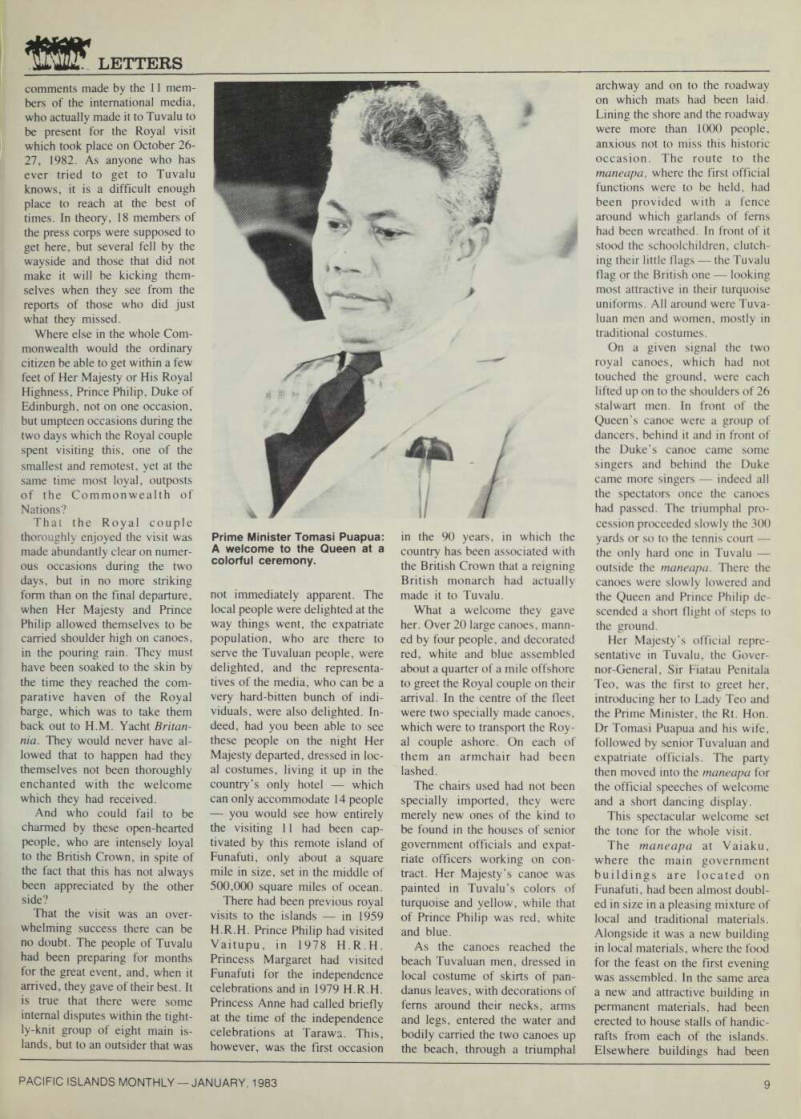
Prime Minister Tomasi Puapua: A welcome to the Queen at a colorful ceremony.
painted and the place generally smartened up even the main rubbish dump, past which Her Majesty drove on several occa sions, had been given a facelift or covering! Perhaps the most striking aspect was the large amount of planting of flowers, trees and shrubs which had taken place. Labor for this was pro vided by the inhabitants of Funafuti prison. Under the able direction of a long-time resident of Funafuti, Sam Rawlins, they worked from dawn to well after dark to make the capital as attrac tive as possible.
The feast and dancing that first
evening were something every
one who witnessed the occasion will never forget. To ensure that there were representatives from each island present the Govern ment had provided free transport for people from each in fact hundreds of others made their own way to Funafuti as well. Food was brought in both
by boat and by the amphibian
plane, which provides a lifeline to most of the outer islands. Even flowers were flown in, as the numerous garlands which were made took a heavy toll of the local bushes. The repast laid be fore the Royal couple and the other official guests would have fed 20 or 30 people. On the Queen’s “mat” were coconut crabs, crayfish, a roast pig, fish, bananas, germinating nuts, pula ka, breadfruit, fekei and other local delicacies, including roast noddy birds, highly prized in the islands. They did not, however, appeal to the Queen, who ap peared to have sampled some breadfruit, a little of the pig and some coconut crab meat, fol lowed by a banana. Neither she nor the Duke had touched the bottle of Perrier water thought fully provided for them.
After the feast came the danc ing, with each island group seek ing to out-dance and out-sing the others. They all wore variations of traditional dress the men and women in their dancing skirts of pandanus leaves, de corated with strips of yellow, black, red, white and brownish red. The noise was deafening, the enthusiasm infectious, and on many occasions the Duke joined in clapping in time with the dancers. It was nearly 11 p.m.
almost an hour behind schedule when the Royal party left to return to their yacht.
The second day’s activities consisted of a tour of places of note around Funafuti, including the local hospital outside which the Queen and Prince Philip watched a demonstration of how to cut toddy, which they then tasted and the local prim ary school. The children were all lined up outside, garlanded on top of their uniforms. One group caused considerable amusement by giving an animated recitation of some English nursery rhymes.
Then it was on to see the coconut tree planted in 1970 by Prince Charles, to lay the foundation stone for the new parliament building, a visit to the Bank of Tuvalu and a call at the country’s main revenue-earner, the Philatelic Bureau.
After the rainy farewell, all concerned were satisfied that the Tuvaluans had provided their Queen with a welcome she will never forget, and that she and her husband had delighted them with their obvious appreciation of what had been prepared.
Guy Slatter
Funafuti Tuvalu
The Queen in
Tuvalu (2)
Almost all routine and develop mental activities in Tuvalu were replaced by preparations for the Royal visit on October 26, 1982.
Preparations began many months before and were intensified as D- Day drew close. Funafuti, the capital, could hardly bear the weight of extra people who swarmed in to dance for and to get a glimpse of the Royal Family.
The capital badly lacks health facilities both in private homes and public places even for per manent residents of Funafuti.
Add on an extra few and the problems become acute. Perhaps the official reasoning behind all this was that this was a reason able sacrifice for a once-in-a lifetime experience of entertain ing and viewing the Royal Fami ly in person.
Poor old Nivanga, the only inter-island vessel, which has be
come more of a liability than an asset, was employed shipping in entertainers from the outer is lands. Building materals for the new co-operative store at Nui Island were missed on the ship’s two previous trips. (God knows what else got missed, particular ly in the way of essential goods for the outer islands).
Roads began to enjoy smooth
surfaces, public buildings cropp
ed up, the jetty underwent neces sary repairs, and the general sur roundings became as pure as crystal. The public buildings will be put to good use after the Royal visit, but the roads should be smooth all the time and the same goes for cleanliness. It is a pity that standards will fall back again to pre-Royal visit conditions.
All police officers stationed on outer islands were called to the capital to take part in the guard of honor mounted for the Royal Family. Apart from this, they could be put on the beat to
tighten security. Administration
of law and order on outer islands for the meantime was allocated to inexperienced special constables.
A sizeable number of civil servants were released from their routine duties to join rehearsals of programs set for the visit.
Whether their daily work was carried out by their colleagues back in the office nobody can tell. If not this would mean a general setback to the public ser vice rendered to the country.
Originally government had said that due to lack of funds entertainment for the Royal visit would be confined to perform ances by people residing in the capital. Later, the government gave the green light for one dancing group from each island outside the capital. But each group had to find its own accom modation and means of survival while at headquarters. They also had to meet their fares both ways. Later still, government had a change of heart and al lowed the dancing teams to travel “free” on the Nivanga. Then the seven dancing teams received $lOOO each in cash. As each team consists of 25 performers the allowance per head was $4O.
Some of the groups were in the capital for more than a month and in view of the consumption
“basket” $4O a head was far
from adequate. Fortunately, the
dancers generally brought with
them their own provisions from their islands. But when you are employed to do a job you do it at the expense of the employer not at your own expense. Some people may argue that, because of the present situation in Tuvalu, people ought to be pre pared to make sacrifices. That may be true. But national leaders must be expected to take a lead in this respect before they start
agitating uneducated villagers in
to doing so.
In the early days of prepara tion a circular letter from the Secretary to the Ministry of Commerce and Natural Re sources went out to all islands through Island Councils request ing production of handicraft from which a set would be selected for presentation to the Royal Family as presents. The rest was to go on display in the newly finished handicraft store and no doubt will be put on sale. God knows where the proceeds will go. As usual the letter declared that there was no money to pay the producers. “No money” has be come a popular slogan of the present government. Reactions from other islands are not known, but Nukulaelae reacted violently against the request be cause there was a general feeling the government was cheating the ill-informed villagers. In this day and age no one should be expect ed to work for no reward.
Subsistence living in an island environment requires hard cash to pay for lighting, fuel, soap, matches, a set of fishing gear, a set of hand tools, ropes, paints and sail cloth for canoes, hand carts and bicycles for transport.
Unfortunately, some imported foodstuffs have become staples.
Now, with the help of Save The Children, villagers have ventured into the field of capital intensive projects such as water tanks and roofing iron for water catchment.
We don’t need to be told how expensive it is to purchase these items at current prices let alone future prices due to inflation at countries of supply. As prices of commodities go up steadily, in comes of villagers keep shrink ing. Their only major income in their own right has been the sale
of copra. The price of copra has been down from 10c a lb. first grade to 6c first grade for some time now.
Occasions such as the Queen’s visit provide a golden opportuni ty for the authorities to supple ment village incomes not to rob the villagers of their time and effort. To take advantage of the age-old tradition of blind obedi ence to authority does not serve
the country’s long-term objec
tives, and could sooner or later prove to be a heated political issue.
The other important matter of principle has been the willing ness of the administration to agi tate the poor to make sacrifices for the rich. The British monarch is among the richest people on earth. Do we regard ourselves as responsible representatives of the people by taking from the poor to give to the already rich? Karl Marx, Lenin and Mao Tse-tung would turn in their graves if they knew the kind of thing that has been going on.
The “no money’’ slogan is beginning to give a nauseating taste to many people. Even civil servants are openly joking about it. The government says “no money’’, but money is readily available to pay salaries and per sonal allowances, including an nual incremental credits as they become due. One pride of the present government has been their ability to beg for money more effectively than the pre vious one. But when the time comes for money to be used effectively, government says there isn’t any.
Everyone here agrees that the Queen, as Tuvalu’s Head of State, represented locally by the Governor-General, should be ac corded the best traditional wel come. But it should be a wel come that does not disrupt na tional services, one that the economy can afford, and above all one that does not jeopardise
long-term national objectives.
Isakala Paeniu
Nukulaelae Tuvalu
Tonga tourism
needs shake-up
I have no wish to question the accuracy of the survey carried
out by the Tonga Visitors Bureau (PIM Oct ’B2 p7l) and I found the officers there most helpful within their limitations. For ex
ample, although they provide the
addresses of people that offer accommodation, they are not al lowed to comment on the quality of it, or so I was told. When one adds this lack of information to the fact that no Tongan authority inspects the said accommodation to ensure that it complies with even minimum acceptable stan dards of hygiene, the visitor is
rather handicapped.
The Pacific Islands are our favorite playground and we re turned to Tonga early in 1982.
We were most disappointed. The quality of the things it has to offer seems to decline as the years go by. This is a sad reflec tion on a kingdom inhabited by such fine people. I feel that un less Tongatapu upgrades its facilities, Vavau will become the tourist spot of the country.
To give some examples let me
cite the main streets of Nukualo fa. What excuse is there after all these years for the lack of effec tive sealing? A stroll to the bank or post office is likely to produce a sprained ankle. Then there is the nonsense of the airline ar rangements where people are re gularly over-booked, off-loaded, have confirmed tickets uncon firmed, and generally suffer frus trating delays if one dares to change one’s itinerary. The or ganisation or whatever it is at the so-called international airport is an unmitigated disgrace.
Need one mention the seedy decline of the capital’s interna tional hotel. It would no longer rate in the Michelin guide. Years ago it was superb. The meals were first-rate, the service im peccable and the toilets beyond reproach. Look today! The air conditioners in the dining room cease to function, cleanliness is no longer a top priority, the toilets near the lounge bar stink, and the smell often creeps into the lounge. As for meals, there is better value at Joe’s fish and chip shop (when he has any chips, that is). In some of the rooms, the carpets are stained badly where the worn-out air
conditioners leak. The pool is not cleaned as often as it should be and the attractive garden setting near it is often littered with beer cans and other debris. This mess stays there for days. After the rain, the dance floor can remain flooded until someone decides it
ought to be mopped up, especial
ly if it’s time to put on the
weekly entertainment.
My view is that the Tongan authorities have become far too complacent. “Visitors will turn up whether any effort is made or not”, seems to be the belief. It is a pity, but people with money to spend want the best value for their dollars. Tonga does not provide this today. It could do so again without spoiling it. Until it casts off its lethargy, my Pacific choices will remain Rarotonga and Port-Vila.
P. Harrison-Mattley
Guildford, NSW Australia
Remembering
Illyria
My article (PIM Jan ’B2 p 57) on the subject of cruising yachts in the Pacific mentioned a large brigantine Illyria, which visited
Tonga: A fascinating country
with much to interest visitors.
But a reader suggests here that high tourism standards are be ing allowed to slip.
Lae, New Guinea, in 1928 while on an extended Pacific cruise under the command of its young owner, Cornelius Crane.
In spite of inquiries made to various American yachting magazines as to the vital statist ics of the vessel’s construction none could give me an answer, although all seemed to be ac quainted with her.
Yesterday I received a letter from one of the staff of the New York Metropolitan Museum of Art enclosing a plan of the vessel and its general layout, and also a photostat copy of one page of a book Jungle Islands which appa rently was a write-up of the cruise. I wish he had sent copies of more pages.
Illyria was 45 metres long, as long as the average suburban building allotment, and with ex tremely tall masts, accommoda tion for about 30 personnel, and gross tonnage of 356.
What a comparison to the 30 and 40 footers with crews rang ing from six down to one only which now prowl around the oceans.
I pass this information on to you as a matter of yachting inter est and for your records.
Bert Weston
Wollstonecraft, NSW Australia
In quest of united
Samoa
I am writing to report my recent conversation with John M. Hay don, Governor of American Samoa for the years 1969-1974, which I feel is indicative of the lack of co-operation and sensitiv ity demonstrated by former U.S. officials. He was appointed by former President Richard Nixon.
This conversation took place in Seattle, Washington, and it was regarding uniting the two Samoas. The conversation went as follows; Peters; Mr Haydon, my name is Falani Peters, and I am calling you since you happen to be a former Governor of the govern ment of American Samoa, and a writer in Marine Digest.
Haydon: What are you inter ested in?
Peters; I’m interested in writ ing about uniting the two Samoas.
Haydon: Why do you want to do that?
Peters; Personally I believe that Samoan means Samoan; and because of the fact that there are too many restrictions between our islands, our people are not free to travel and visit even their own families.
Haydon; I’m sorry I’m not going to support you on this issue because you are not on the right track. Furthermore, Western Samoa does not want to be with American Samoa.
Peters: I don’t believe this is true. My information is based on a meeting between American Samoa and Western Samoa last November. The meeting was re ported in Pacific Islands Month ly, and it was about the easing and the improvement of relations between our islands, and the pos sibility of uniting the Samoas.
Haydon: Your information is incorrect. The meeting was about
immigration restrictions between the two islands.
Peters: No, my information is certainly correct and you are wel come to double-check if you wish. Moreover, I believe im migration restrictions were perhaps only a part of the
meeting.
Haydon: Where are you from, Western Samoa or American Samoa?
Peters: It doesn’t matter, Mr Haydon, I’m a Samoan citizen.
If you wanted me to be more specific then I would have to say Western Samoa.
Haydon: Why is my tax money spent on American Samoa? American Samoa is re
ceiving $45 million annually
from the U.S., and if the two Samoas were combined, that $45 million would be doubled.
Peters: If you think that the U.S. Government has spent too much money on the government of American Samoa then I think it would be advantageous for the Samoan governments to be com bined. Then a decision could be made for either self determination or continuing mutual relations with the U.S.
Haydon; Why do that? I have some very good friends in
American Samoa from the five years I was there.
Peters: Mr Haydon, if I understand you correctly, you stated that you are reluctant to spend your tax dollar on the U.S.
protectorate?
Haydon; I’m sorry I don’t support you on this issue. (End of conversation).
Not surprisingly, and not un like many, if not all, former governors of the protectorate, Mr Haydon has no sympathy for the hardships that our people have endured because of this perpetual and colonial separation. For ex ample, both Samoas have no freedom to cross to the other side to see their families without a few days permit. These historical relations have led us not only into mutual hatred, and antagon ism, but a continuation of more
rules and regulations deterring
good relations. It may still be hoped that Mr Haydon, and other seemingly indifferent former U.S. officials, will eventually be able to see the importance of combining the two Samoas, and help to win recognition of this unity by the U.S. Government.
Falani A. Peters
Seattle, Washington
Usa
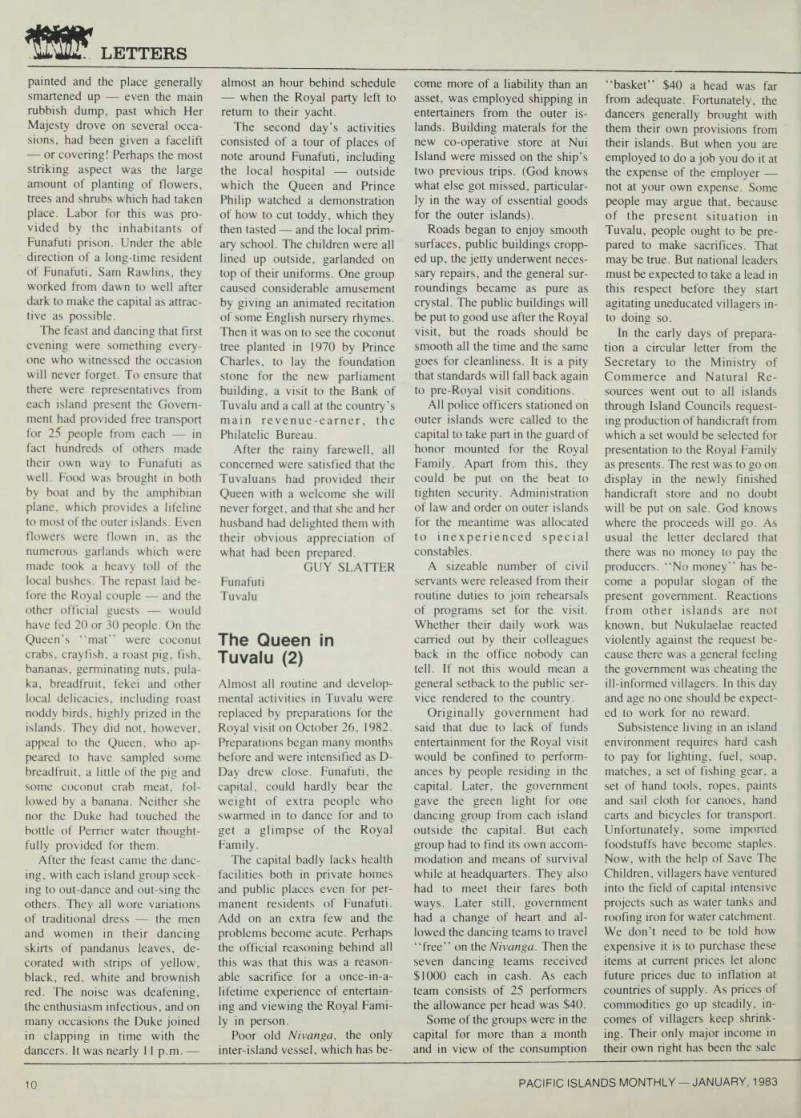
A sectional view of the auxiliary brigantine lllyria, referred to in Bert Weston’s letter on this page. The illustration is from Jungle Islands, a book publish ed about 50 years ago about the voyage.